A long-dormant Bitcoin stash moved into an exchange this week, renewing worries about old coins re-entering the market and the effect that could have on prices.
Related Reading
Mt. Gox Origins And Staggering Returns
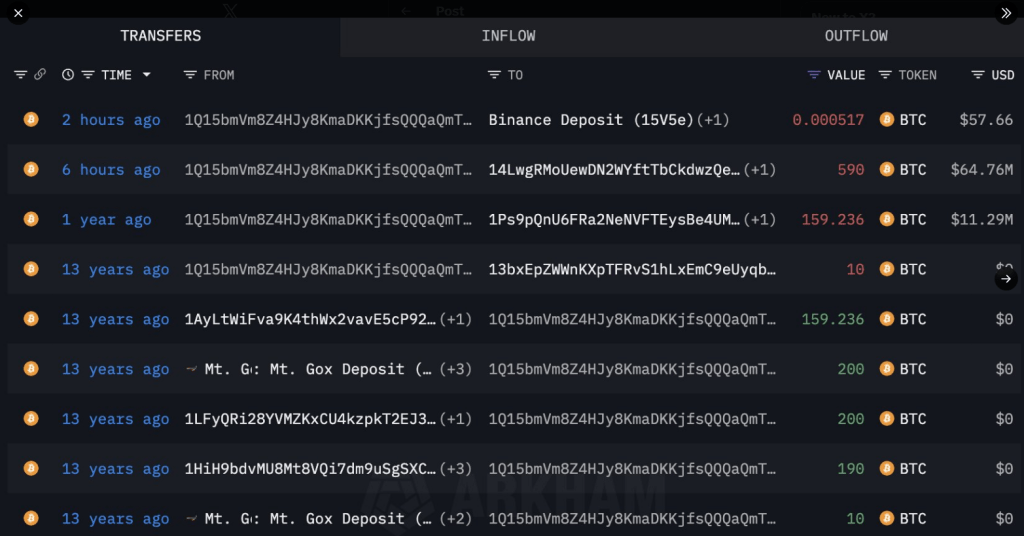
According to blockchain tracker Lookonchain, a cluster of addresses tied to coins pulled from Mt. Gox more than 13 years ago sent 300 BTC to Binance in a single transaction.
Those coins were reportedly bought at about $11 each, meaning the original outlay was roughly $8,151. The transfer is now worth about $33.47 million, a mark-up of roughly 410,624%. Reports have disclosed that about 590 BTC still remain in the same group of addresses.
The market crash just woke up a sleeping Bitcoin OG, who deposited 300 #BTC($33.47M) to #Binance 2 hours ago.
He originally withdrew 749 $BTC($8,151 at the time) from #MtGox 13 years ago, when $BTC was just $11.
He moved 159 $BTC to a new wallet a year ago but didn’t sell —… pic.twitter.com/tSxgO0Mw5E
— Lookonchain (@lookonchain) October 12, 2025
Wallet Activity And What Changed
Last year, the same owner moved 159 BTC into a new wallet and then left it untouched. This recent move is different because the coins arrived in an exchange hot wallet, where they can be sold quickly.
Traders and market watchers noted the difference: one action kept coins on the chain, the other put them within reach of an order book. Whether the owner chooses to sell some or all of the 300 BTC is not known, but the presence of those funds on Binance makes rapid selling possible.
Market Moves And Flows
Bitcoin’s price recovered to about $115,000 on Monday, after dipping to $102,000 on Friday. That drop triggered billions in liquidations and left traders on edge.
Based on figures, ETFs recorded $2.7 billion in inflows over the last week, and institutional demand showed resilience despite the volatility. Still, the market’s calm is fragile; a large sell order from an old holder could change short-term supply dynamics quickly.
The move was flagged by on-chain analysts and then amplified across social platforms. Exchange inflows from wallets tied to early-era miners or Mt. Gox addresses tend to draw attention because they signal supply that was previously dormant coming back into circulation. In this case, the numbers are large enough to get traders’ attention.
Possible Scenarios And Risks
If some of the 300 BTC is sold, price pressure may increase, particularly during thin trading windows. Alternatively, the transfer could be part of estate consolidation or a decision to move funds to cold storage, in which case selling may not follow.
Related Reading
Market participants will watch wallet behavior closely: rapid withdrawals to multiple exchange addresses, for example, would likely be interpreted as a selling sign.
Featured image from Gemini, chart from TradingView
Despite Bitcoin’s inception over a decade ago with Satoshi Nakamoto’s vision of facilitating peer-to-peer electronic cash transactions, its current usage mirrors its early days. The Bitcoin (BTC) transactions are circulating at a pace reminiscent of 13 years ago. This revelation comes from CryptoQuant CEO Ki Young Ju, who highlighted the stagnation in Bitcoin’s velocity.
Bitcoin Velocity Stagnates
Ju noted that the trend indicates a shift towards the digital gold narrative rather than widespread adoption for daily transactions. The concept of Bitcoin as “Digital Gold” has gained traction. Hence, institutions are increasingly holding onto the cryptocurrency as a store of value rather than utilizing it for frequent transactions.

The velocity of Bitcoin transactions, depicted in a chart shared by Ki Young Ju, stands at a level similar to that of 2011. This reflects a long-standing trend of sluggish movement in the Bitcoin ecosystem. Though the Bitcoin velocity spiked several times in these 13 years, it’s now back to the 2011 levels, according to CryptoQuant.
Nick Tomaino, a former Coinbase executive, recalled the early days of Bitcoin adoption. He noted that Coinbase initially raised significant funding under the premise that Bitcoin would revolutionize payments and spur the creation of new applications. However, the reality differed as the platform onboarded merchants like Overstock to accept Bitcoin, but the long-term viability of Bitcoin payments proved elusive.
Tomaino’s insights shed light on the challenges faced by Bitcoin as a payment method. It also emphasizes the lack of a compelling business case for Bitcoin payments in the face of emerging alternatives like Ethereum and decentralized applications. Moreover, he highlighted how Ethereum’s inception changed the entire crypto payments game.
Also Read: Bitcoin Notes $2B Inflows But Ethereum Steals The Spotlight, Here’s Why
Limitations Of BTC Payments
Zach Rynes, a Chainlink community liaison, delved deeper into the technical limitations of Bitcoin for payments. He particularly highlighted Bitcoin’s lack of programmability compared to Ethereum and other blockchain platforms. Rynes highlighted two crucial issues: volatility risk and payment accuracy, both of which are critical for merchants considering cryptocurrency payments.
Rynes explained that smart contract capabilities of Ethereum allow for seamless conversion of crypto assets into stablecoins. Hence, it mitigates volatility concerns for merchants. Additionally, Ethereum’s programmability enables automatic validation of payment amounts. This reduces the burden of manual reconciliation for incorrect payments.
In contrast, Bitcoin’s UTXO-based architecture presents hurdles for implementing similar functionalities directly on its blockchain. While Lightning Network offers potential solutions for validation issues, challenges persist in managing liquidity and scalability. This limits its effectiveness in addressing Bitcoin’s payment shortcomings.
Furthermore, Rynes’ analysis underscores the complexity of Bitcoin payments. It also emphasizes the necessity for pragmatic solutions to accommodate merchant requirements while maintaining decentralization and non-custodial principles.
Despite the backlash from Bitcoin maximalists, Rynes maintains that acknowledging Bitcoin’s limitations in payment processing is essential for driving innovation. However, Bitcoin maximalists also see a hope in the rise of BTC payments as the Layer 2 network is making great progress toward the target. Nonetheless, Layer 1 BTC payments might not go mainstream anytime soon.
Also Read: How Bitcoin Will Benefit From End Of US-Saudi Petrodollar Deal

The presented content may include the personal opinion of the author and is subject to market condition. Do your market research before investing in cryptocurrencies. The author or the publication does not hold any responsibility for your personal financial loss.
✓ Share: