Cardano Price Prediction 2026: ADA and AVAX Signal Cycle Gains, But a $16k DeepSnitch Investment Targets $5.2M at $15 The Wire India
Source link ]]>
Cardano Price Prediction 2026: ADA and AVAX Signal Cycle Gains, But a $16k DeepSnitch Investment Targets $5.2M at $15 Tribune India
Source link ]]>
Crypto Price Today: BTC Sinks 2.24%, Cardano Takes 5.28% Hit, ETH Below $1.6K Analytics Insight
Source link ]]>
Dogecoin Price Analysis Shows Gains, HBAR to Breakout & BlockDAG Miners in Huge Demand — Nearly 16K Units Sold! Analytics Insight
Source link ]]>
Rollblock Nears Rapid Sell Out of Stage 6 with Over 16k Registrants, Shiba Inu Coin Faces Slowdown, BNB Price Prediction Crypto News Flash
Source link ]]>
Bitcoin price recent plunge below $67,000 has sparked discussions among investors, with fears of further declines looming. Notably, renowned analyst and veteran trader Peter Brandt, who accurately forecasted Bitcoin’s drop to $16,000 in 2022, now cautions that the cryptocurrency could plummet to $48,000.
However, he cited the dip could happen if it fails to sustain critical support levels. Meanwhile, amid the bold forecast and significant options expiry, all eyes are on Bitcoin’s next move.
Analyst Predicts Bitcoin Price Dip To $48K
The recent Bitcoin drop has sent ripples through the crypto community. The flagship crypto’s failure to hold above the $67,000 mark has sparked intense speculation about its future trajectory.
Amid this, crypto market expert Peter Brandt, who is also a seasoned trader with a history of accurate predictions, has issued a stark warning. In a recent post on the X platform, he outlined a potential path for Bitcoin’s decline.
In a recent X post, Peter Brandt shared a price chart of Bitcoin, while noting $65,000 and $60,000 as crucial levels for Bitcoin’s near future. According to Brandt, a drop below $65,000 could pull the price towards $60,000. Conversely, a plunge below the $60,000 level might see Bitcoin fall to $48,000.
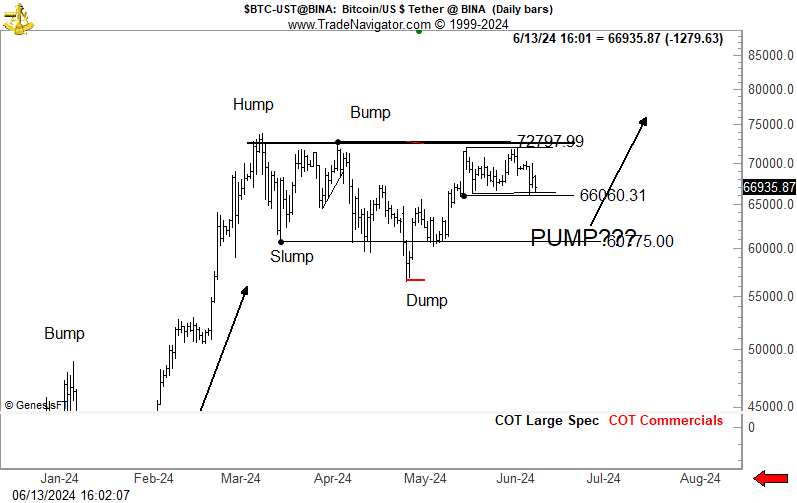
However, Brandt says that while these are the most straightforward interpretations, the market can be unpredictable. In this context, he stated:
Sometimes the most obvious interpretations of a chart work out, most of the time the charts morph.
Also Read: Bitcoin ETF Outflows Hit $228 Million Amid BTC Price Dip, What’s Happening?
Macroeconomic Factors & Options Expiry In Focus
The latest inflation data from the U.S. Labor Department has shown signs of cooling. For context, May’s Consumer Price Index (CPI) and Producer Price Index (PPI) reports suggest cooling inflationary pressures in the nation.
Notably, this development could influence the U.S. Federal Reserve’s approach to interest rates. Having said that, if the Fed adopts a more dovish stance, it might offer some relief to the crypto market. A potential policy shift could mitigate further declines in Bitcoin’s price, providing a possible lifeline for investors.
Meanwhile, another critical factor affecting Bitcoin’s price is the recent expiry of 20,000 Bitcoin options on June 14, 2024. Options expiry events often introduce significant volatility as traders adjust their positions. Notably, the maximum pain point for this expiry was set at $68,500, indicating the price level at which most options would expire.
As of writing, Bitcoin price stayed in the red while crossing the brief $67,000 mark. Over the last 24 hours, its price saw a high of $68,337.23 and a low of $66,304.57, reflecting the volatile scenario in the market.
Furthermore, its trading volume also fell 24.55% to $27.17 billion. However, despite a drop in its price, Bitcoin Futures Open Interest rose 0.98% in the last 4 hours to 522.67K BTC or $35.14 billion.
Also Read:

The presented content may include the personal opinion of the author and is subject to market condition. Do your market research before investing in cryptocurrencies. The author or the publication does not hold any responsibility for your personal financial loss.
U.S. financial regulators SEC and NYDFS’ regulatory action against Paxos for Binance’s dollar-pegged stablecoin BUSD has caused a massive outflow from crypto exchange Binance.
According to CryptoQuant data, Binance recorded over 16K Bitcoin outflow and 11K Bitcoin inflow on February 13. Meanwhile, the BUSD outflow and inflow on Binance were 428 million and 350 million, respectively.
Therefore, it indicates an increase in Bitcoin buying in the last 24 hours as exchange outflow is comparatively higher. On the BUSD front, outflow from Binance is comparatively higher than inflow. In total, users withdrew about $2.8 billion of crypto assets in the last 24 hours, with $2 billion of deposits during the same period. It is the largest daily net outflow from Binance since November.
Binance CEO Changpeng “CZ” Zhao tweeted that users have started migrating to other stablecoins. Binance plans to make product adjustments accordingly, including moving away from using BUSD as the main pair for trading. However, Binance will continue to support BUSD for the foreseeable future.
Just minutes after Binance CEO’s tweet, investors started taking action. Binance recorded nearly 3.5K Bitcoin outflows and large deposits of over 200 million BUSD in all CEX.

Binance USD (BUSD) depegged to Tether (USDT). The market cap of BUSD fell amid uncertainty, while the USDT market cap has increased to $68.58 billion today, February 13. Binance’s BNB price was also impacted by the news, with the price falling to below $280.
Also Read: Cardano Whale Transactions Jump In February, Will It Help ADA Rally?
Bitcoin Price Records Buying Pressure Amid Binance’s BUSD FUD
The increase in Bitcoin outflow from Binance has caused a rise in Bitcoin prices. BTC price is currently trading at $21,737, up 2% after making a low of $21.4K.
Traders are awaiting the U.S. CPI data for January to decide their next move. The inflation rate in the U.S. is expected to fall to 6.2% in January from 6.5% in December.
Also Read: US SEC Could Stop Hedge Funds From Working With Crypto Custodians

The presented content may include the personal opinion of the author and is subject to market condition. Do your market research before investing in cryptocurrencies. The author or the publication does not hold any responsibility for your personal financial loss.
The Bitcoin price has seen a slow start in 2023 as the cryptocurrency remains stalled and moving sideways around its current levels. Many experts believe BTC has seen the worst of the recent bearish cycle and could be gearing up for some profits.
As of this writing, the Bitcoin price trades at $16,700 with sideways movement in the last 24 hours and the previous seven days. The low trading volume and low activity because of the holiday contributed to the current price action.

The Bitcoin Price Near A Bottom, But Profits Remain Elusive
According to analyst Caleb Franzen, the Bitcoin price registered another indication of a bottom. Franzen and others have been tracking down the clues that could support a bullish thesis for BTC, and the Heikin Ashi printed a positive signal.
The Heikin Ashi is a technique to visualize price action and create candlestick charts to measure trends in a market. Franzen claims the Bitcoin price printed its 13th consecutive monthly Heikin Ashi on December 22.
The last time BTC saw a similar trend was at the end of the 2018 and 2015 bear markets. This data supports a positive outlook for the Bitcoin price and hints at a bullish potential in the coming months. The analyst stated:
Each red streak has been longer than the last & we’re currently building #14 for January ’23. Historically, a green monthly candle after 5+ red monthly candles has marked the end of each bear market.

As mentioned, Franzen and other metrics point to Bitcoin forming a bottom at its current levels. Crypto exchange Coinbase claims that 50% of BTC investors present losses.
In previous bear cycles, this metric reaching 50% coincided with a “sold base for a macro market bottom,” the report from Coinbase claims:
These represent major inflection points for BTC performance, preceding subsequent periods of price appreciation, we believe this metric provides important insights into current cycle positioning.
The Bitcoin price must clear a $14 million sell wall at $17,000 to take a first step in this direction. Additional data from Material Indicators claims that this level is a significant short-term hurdle for the cryptocurrency.
#FireCharts shows roughly $14M in ask liquidity, blocking #Bitcoin from a green Weekly candle close. pic.twitter.com/f5kfVtOd0R
— Material Indicators (@MI_Algos) January 1, 2023
What Could Fuel A Fresh Bitcoin Rally
As NewsBTC reported, history is on the side of the bears. For the past two years and since 2015, the Bitcoin price had traded downside during January when it recorded double-digit losses.
The start of a new year, low liquidity, and trading activity contribute to this historical pattern. The elements for another red January are there, but the cryptocurrency might surprise if macro conditions take a turn for the better.
The U.S. Federal Reserve (Fed) is likely to continue with its interest rate hike program, but financial institution representatives have hinted at a shift in the monetary policy. According to the trading desk QCP Capital, if the Fed rushes in and changes its approach, the Bitcoin price will benefit.

- Bitcoin was changing hands near $16,600 on Wednesday, about 1% down in the past 24 hours.
- The cryptocurrency is heading for its worst yearly returns since 2018.
- Stocks have also hit a brutal patch in 2022, with major US indexes headed for their worst annual returns since 2008.
Bitcoin remained uncharacteristically uneventful on Wednesday, trading around $16,600 as investors weighed an end to a brutal 2022.
The benchmark cryptocurrency was just in the red during early afternoon trading (2:10 pm ET) as Wall Street also turned negative amid fading optimism over China’s reopening.
Markets to end 2022 lower
In crypto, Bitcoin volatility has been at its 2022 low this week, with the surge towards $17,000 cooling off to leave the cryptocurrency 67% down in the past year.
In fact, 2022 is shaping as the year with the second-worst returns for BTC since 2010. The digital gold’s performance during this markedly bear year has the asset on track for a worst return since the 73% drawdown in 2018.
In the 2014 bear market, Bitcoin price fell 58%, with other years with lower returns being +35% in 2015 and +66% in 2021 – indeed Bitcoin is more than 75% down since its all-time high in 2021.
As Bitcoin struggles to hold onto gains above $16k, the picture across the stock market is similar for the major US indexes. The S&P 500 is down 4.1% this month and over 20% year-to-date, while the Dow and the Nasdaq are -2.5% and -7.1% over the past 30 days respectively.
The historically bullish season for equities has been largely negative, with ongoing investor jitters around inflation and rate hikes, and the overall outlook for the global economy, adding to the downward pressure that has persisted for most of the year.
As such, while Bitcoin is set to see its worst yearly performance since 2018, US stocks are poised for their worst annual returns since 2008.
Bitcoin price failed to clear $18,000 and corrected lower. BTC is signaling bearish signs and might even start a fresh decline in the coming sessions.
- Bitcoin started a downward move and traded below the $17,600 support.
- The price is trading below $17,500 and the 100 hourly simple moving average.
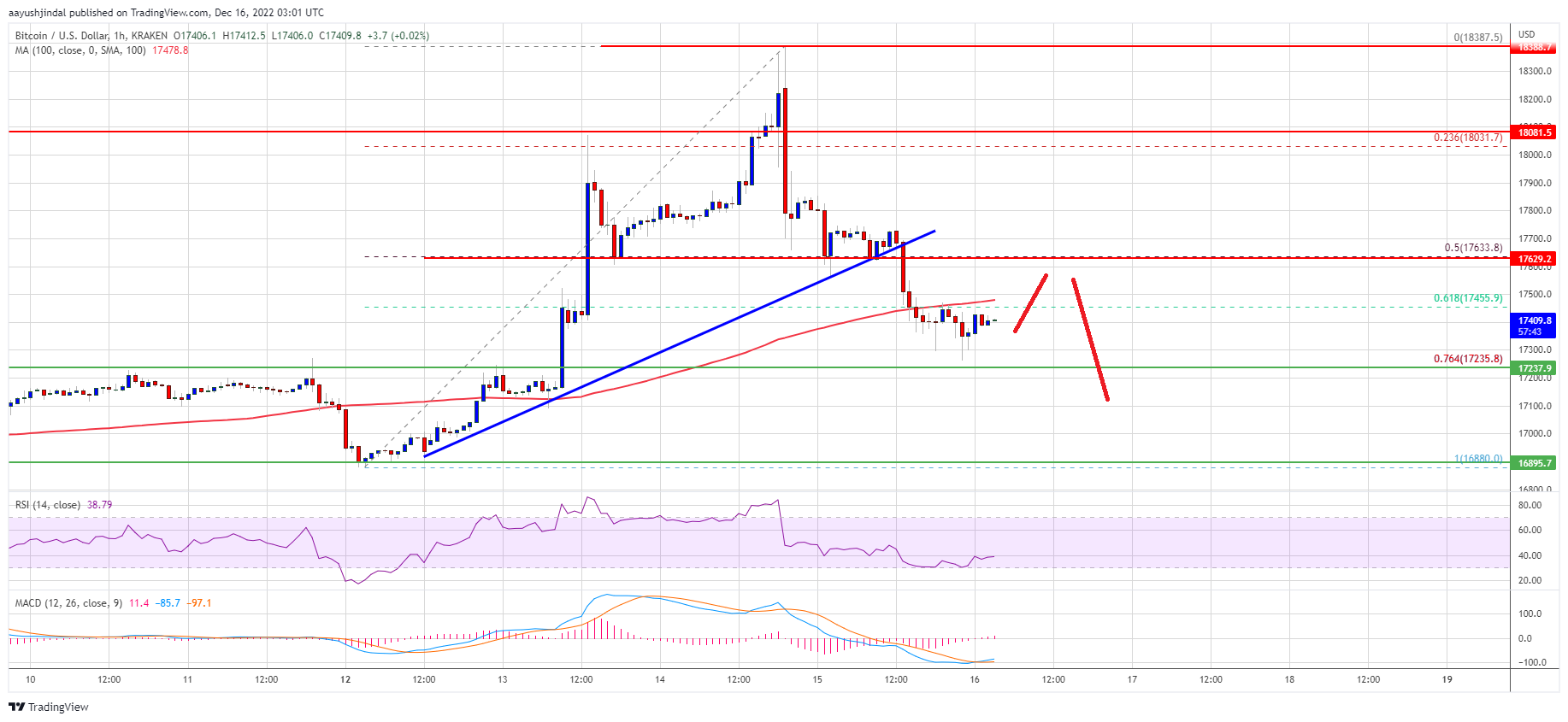
- There was a break below a major bullish trend line with support near $17,620 on the hourly chart of the BTC/USD pair (data feed from Kraken).
- The pair could continue to move lower unless it reclaims the 100 hourly SMA.
Bitcoin Price Restarts Decline
Bitcoin price attempted an upside break above the $18,400 zone resistance zone. BTC failed to stay above the $18,000 pivot level and reacted the downside.
A high was formed near $18,387 before the price started a fresh decline. There was a clear move below the $18,200 and $18,000 levels. The price declined below the 50% Fib retracement level of the key wave from the $16,881 low to $18,387 high.
Besides, there was a break below a major bullish trend line with support near $17,620 on the hourly chart of the BTC/USD pair. Bitcoin price is now below $17,500 and the 100 hourly simple moving average.
Source: BTCUSD on TradingView.com
On the upside, an immediate resistance is near the $17,500 level and the 100 hourly simple moving average. The first major resistance is near the $17,650 zone, above which the price may perhaps revisit the $18,000 zone. The next major resistance is near $18,380, above which the price might gain pace and rise towards the $19,000 level.
More Losses in BTC?
If bitcoin fails to clear the $17,650 resistance, there could be more downsides. An immediate support on the downside is near the $17,240 level. It is near the 76.4% Fib retracement level of the key wave from the $16,881 low to $18,387 high.
The next major support is near the $17,000 zone. A downside break below the $17,000 support might call more losses. In the stated case, the price could decline towards the $16,500 support in the near term. Any more losses might stage a larger decline below the $16,000 level in the coming days.
Technical indicators:
Hourly MACD – The MACD is now gaining pace in the bearish zone.
Hourly RSI (Relative Strength Index) – The RSI for BTC/USD is now below the 50 level.
Major Support Levels – $17,250, followed by $17,000.
Major Resistance Levels – $17,650, $18,000 and $18,380.
✓ Share: