APEMARS Presale Soars With Shiba Inu’s $3.6B & Peanut the Squirrel’s $46M Market Cap – The Best Crypto to Watch Now Before Listing! Digital Journal
Source link ]]>
Forget Shiba Inu Price: Why SHIB’s Market Cap $3.6B Valuation Matters More in 2026 TradingView
Source link ]]>

- Bitcoin ETFs saw $2.7 billion in weekly inflows, pushing BTC to an all-time high near $119,000.
- Ethereum ETFs added $908 million, helping ETH climb 17% to a multi-month peak above $3,000.
- BlackRock’s IBIT and ETHA dominated fund inflows, reflecting strong institutional demand for crypto exposure.
Investor appetite for cryptocurrency exposure through exchange-traded funds (ETFs) reached a new high last week, with Bitcoin ETFs alone drawing in more than $2.7 billion in net inflows over five trading days.
The surge in capital marked one of the strongest weekly performances for these financial vehicles, reflecting growing institutional demand on Wall Street.
According to data from FarSide Investors, the standout activity occurred on Thursday and Friday.
Thursday saw the second-largest daily inflow in the 18-month history of US-listed Bitcoin ETFs, totaling $1.18 billion.
The inflows were spread across major funds: BlackRock’s IBIT received $448.5 million, Fidelity’s FBTC took in $324.3 million, and ARK Invest’s ARKB attracted $268.7 million.
On Friday, the momentum continued with another $1.03 billion in inflows.
BlackRock’s IBIT led decisively, drawing $953.5 million—far ahead of ARKB, which was second with just $23.5 million.
Earlier in the week, inflows remained positive each day: $216.5 million on Monday, $80.1 million on Tuesday, and $215.7 million on Wednesday.
The total net inflow for the week amounted to $2.72 billion, further highlighting the accelerating pace of institutional crypto adoption.
Notably, the funds have seen only one day of net outflows (July 1) since June 9.
Ethereum ETFs see record weekly gains
Ethereum-based ETFs also recorded significant inflows last week, benefiting from increasing investor confidence ahead of their one-year anniversary.
The funds brought in $908.1 million in net inflows for the week, according to FarSide data.
Thursday was a standout day, setting a record for Ethereum ETFs with $383.1 million in inflows.
BlackRock’s ETHA led the way, accounting for over $300 million of that figure.
On Friday, ETHA continued to dominate, capturing $137.1 million of the total $204.9 million inflow.
Wednesday added $211.3 million, while Monday and Tuesday contributed $62.1 million and $46.7 million, respectively.
This sustained inflow into Ethereum funds helped propel ETH’s price higher.
Starting the week around $2,500, Ethereum climbed past $3,000 on Friday. Although it has since pulled back slightly below $3,000, the asset remains up more than 17% for the week.
Crypto prices react to institutional momentum
The robust ETF inflows had a direct impact on the underlying asset prices.
Bitcoin surged by more than $10,000 during the week, reaching an all-time high of nearly $119,000 on Friday.
Ethereum similarly saw its best performance in months, fueled by increased capital inflows and renewed optimism among investors.
In total, both Bitcoin and Ethereum ETFs drew more than $3.6 billion in capital last week, underscoring the expanding role of crypto assets in mainstream investment portfolios.
With consistent inflows and new highs in asset prices, institutional interest in cryptocurrencies appears far from waning.

Wormhole Integrates $36B Dogecoin to Solana: Details The Crypto Basic
Source link ]]>
Bitcoin has seen modest upward momentum in the past 24 hours, climbing back above $83,000 following a recent correction period. The move comes shortly after US President Donald Trump announced a temporary 90-day pause on tariffs, offering a degree of relief to global financial markets.
Though the asset remains down approximately 24% from its all-time high of over $109,000 set in January, its recent decline has now been trimmed to single digits on a weekly scale. This recovery coincides with increased interest from large-scale Bitcoin holders.
$3.6 Billion Inflows Suggest Renewed Institutional Activity
On April 9, accumulation addresses—wallets associated with long-term investors that rarely distribute funds—received a notable 48,575 BTC, according to on-chain data shared by CryptoQuant analyst Burak Kesmeci.

This inflow, the largest since February 2022, totaled approximately $3.6 billion in value. The timing, according to Kesmeci, is significant: it mirrors a similar event from the past, both in scale and macroeconomic backdrop.
Kesmeci emphasized that these accumulation wallets typically increase holdings during market pullbacks. The April 9 transaction occurred when Bitcoin traded around $76,000, a level tested during last week’s sell-off triggered by concerns over renewed trade tensions.
The volume and pattern of inflows suggest a recurring strategy among institutional or long-term market participants whereby they capitalize on corrections and accumulate during uncertainty.
Interestingly, the total value of the inflows—$3.6 billion—matches that of February 1, 2022, another period marked by broader macroeconomic instability.
While this could be coincidental, Kesmeci noted that the repetition of such behavior in response to macro-driven price declines may indicate a deeper behavioral trend among accumulation address holders.
Massive $3.6 Billion Bitcoin Inflow to Accumulation Addresses!
“Bitcoin accumulation addresses received 48,575 BTC — the largest single-day inflow since February 1, 2022. When accumulation addresses move this aggressively, it’s worth paying attention.” – By @burak_kesmeci pic.twitter.com/MVIFUcXKWz
— CryptoQuant.com (@cryptoquant_com) April 10, 2025
Bitcoin Whales Increase Reserves Despite Weak Network Activity
Adding to the accumulation narrative, another CryptoQuant analyst known as caueconomy noted that whale wallets—addresses holding large BTC balances—have resumed consistent buying since March.
According to caueconomy, more than 100,000 BTC has been added to whale reserves in that timeframe. This comes despite the subdued on-chain activity and a visible pullback in retail participation.

The distinction between investor profiles has become clearer in recent months. While smaller investors appear to be withdrawing amid heightened market uncertainty, large holders are taking advantage of lower prices to strengthen their positions.
The strategy, according to caueconomy, aims to reduce average acquisition costs and position for long-term gains. This divergence in behavior may not translate to immediate price shifts but could set the stage for a more pronounced upward move once broader sentiment recovers.
Featured image created with DALL-E, Chart from TradingView
]]>JPMorgan expects maximum outflows from GBTC into spot Bitcoin ETFs due to the very high fees of the former product.
In the US, the debut of spot bitcoin exchange-traded funds (ETFs) is not likely to attract a significant influx of new capital. According to JPMorgan analysts, there might be a shift of up to $36 billion in inflows into ETFs from existing crypto instruments.
This breakdown includes an estimated $3 billion from bitcoin futures-based ETFs, and $3-$13 billion from Grayscale Bitcoin Trust. It also expects $15-$20 billion from retail investors transitioning from digital wallets at crypto exchanges/retail brokers to spot bitcoin ETFs.
The analysts, led by Nikolaos Panigirtzoglou, expressed skepticism about the widespread optimism regarding the approval of spot bitcoin ETFs leading to a substantial increase in fresh capital within the crypto space. Besides, the banking giant noted:
“We instead believe that the amount of fresh capital entering the crypto space will likely be more of a function of regulations and in particular a function of how much room regulators will allow for the crypto ecosystem to encroach into the traditional financial system over time.”
The US Securities and Exchange Commission (SEC) made history by granting approval to 11 spot bitcoin ETFs, marking a significant shift after more than a decade of resistance. On the inaugural trading day, spot bitcoin ETFs have swiftly surpassed $4 billion in trading volume, as reported by Yahoo Finance data.
Speaking about the newly approved ETFs, the JPMorgan analysts said:
“We believe fees and liquidity are likely to play a key role in terms of how much money will enter the newly created ETFs.”
JPMorgan: GBTC Can See the Maximum Outflows after ETF Introduction
In the latest analysis, industry experts emphasize the anticipation of substantial outflows from the Grayscale Bitcoin Trust (GBTC), primarily attributed to its comparatively high 1.5% fees in contrast to newly introduced spot bitcoin ETFs. The analysts predict that speculative investors, who had previously acquired GBTC shares at a discount in the secondary market, might capitalize on profits amid expectations of the discount narrowing upon conversion to Bitcoin ETF.
The forecast suggests an approximate $3 billion exodus from GBTC, with investors reallocating funds to the recently launched ETFs, driven by profit-taking motives. Moreover, there is a potential for an additional $5-$10 billion in outflows if GBTC fails to adjust its fees to the 0.25% benchmark set by major issuers such as BlackRock.
“If over time GBTC loses its crown as the biggest bitcoin fund in the world, then the liquidity advantage that it currently enjoys due to its size would also be lost, thus inducing even more outflows,” the analysts stated.
In summary, the analysts suggest that retail investors have a preference for spot bitcoin ETFs, whereas institutional investors currently holding crypto in fund structures might transition away from futures-based ETFs and the Grayscale Bitcoin Trust (GBTC). This shift is expected to be particularly pronounced if GBTC lags in reducing its fees, with market participants opting for the newly established, more cost-effective spot bitcoin ETFs.
BofA Securities head of cryptocurrency and digital assets Alkesh Shah said he has “no idea” why Dogecoin (CRYPTO: DOGE) has a market value of $36 billion.
What Happened: In a webinar hosted by Columbia Business School on March 16, Shah was talking about the bank’s digital asset research evaluation of the top 10 crypto tokens.
“I look at Dogecoin that has no use case, and I have no idea why it’s $36 billion. I have no explanation,” he said.
“Doesn’t mean it [DOGE] can’t be. If people want to own it, they can.”
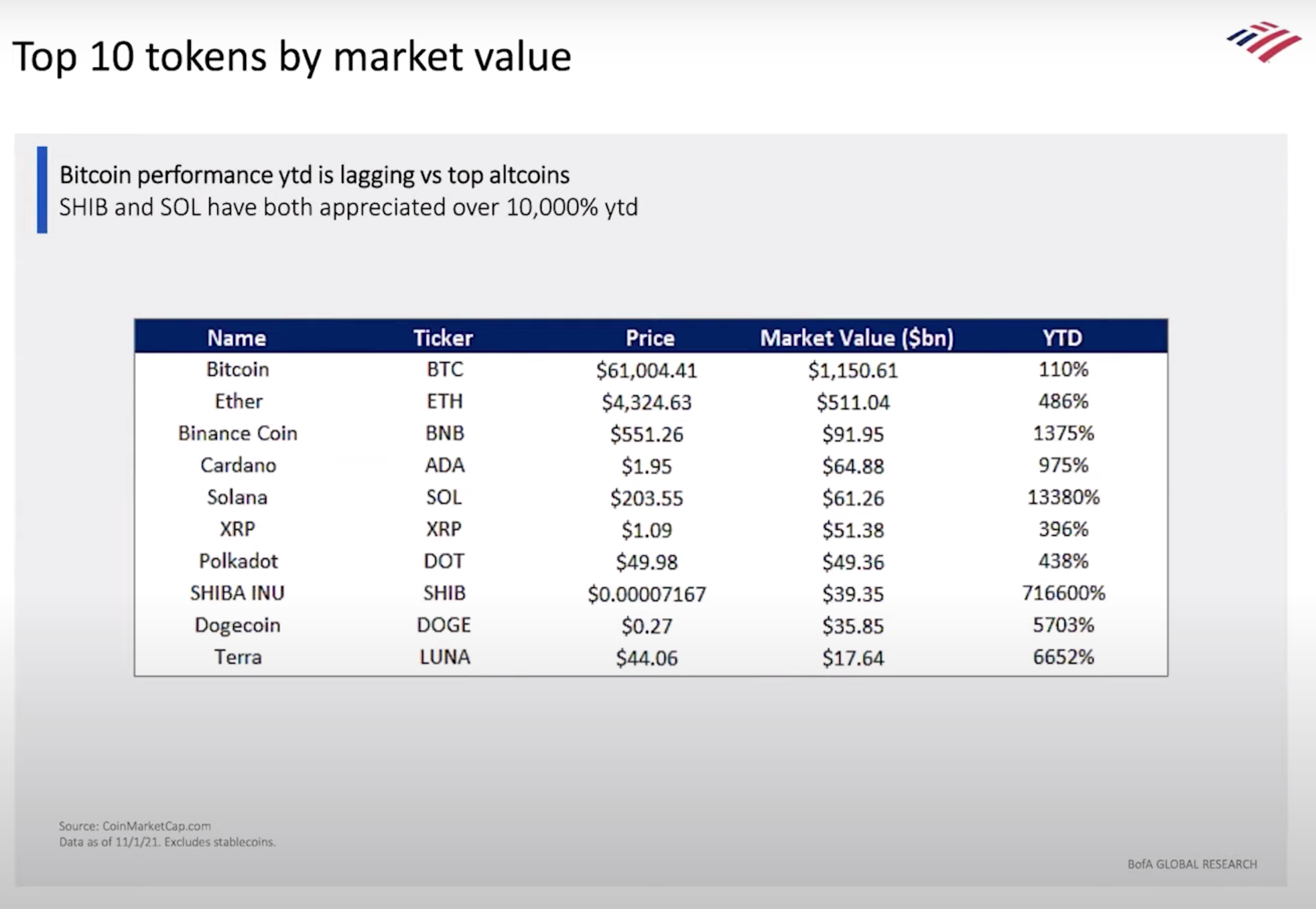
Shah’s comments came as part of a broader discussion around the growing interest in altcoins, or coins besides Bitcoin (CRYPTO: BTC), and their potential to capture more market share.
According to Shah, more people are looking at Ethereum (CRYPTO: ETH), Solana (CRYPTO: SOL), and Polkadot (CRYPTO: DOT) as their use cases expand.
Other Insights: Bank of America also gauged retail interest by analyzing the number of mentions of crypto assets on social media platforms like Twitter Inc (NYSE: TWTR) and Reddit.
Its analysts found that Shiba Inu (CRYPTO: SHIB) saw the largest amount of interest with a monthly increase of 392% month over month, followed by DOGE which saw a 42% increase over the same period.
“Shiba Inu, which you know really took off, again has no operating system real capabilities, which is smart contract capabilities, had the most mentions and the most market value,” he said.
Why It Matters: Despite some industry watchers’ perceived lack of utility, meme coins like DOGE and SHIB have often been some of the first crypto tokens to be accepted as a payment method from major retailers and companies.
Tesla Inc (NASDAQ: TSLA) accepts DOGE as payment for its online merchandise while major theatre chain AMC Entertainment Holdings Inc (NYSE: AMC) began accepting SHIB and DOGE earlier this month.
Price Action: It is worth noting that Dogecoin had a market cap of $16.1 billion, as per data from CoinMarketCap. The meme-based cryptocurrency was trading at $0.122 at the time of writing, down 0.13% in the last 24 hours.
Read Next: Robinhood’s New Cash Card Will Invest Your ‘Spare Change’ In Bitcoin, Ethereum And Dogecoin
© 2022 Benzinga.com. Benzinga does not provide investment advice. All rights reserved.
]]>