Presale Countdown: Arctic Pablo Coin Surges $3.70M as Shiba Inu and Snek Rally, Best Crypto to Buy Today Crypto Economy
Source link ]]>
BlockDAG Presale Hits $370M as Stellar Rises 12.3% and Cardano Gains 30% in 30 Days AInvest
Source link ]]>
Bitcoin evangelist Michael Saylor has made $370 million from the sale of MicroStrategy shares this year. MicroStrategy’s founder entered into a stock-sale agreement with the company last year to sell his shares in the company until April 2024 this year.
Michael Saylor Made $370 Million From Share Sale
MicroStrategy founder and executive chairman Michael Saylor pocketed $370 million from MicroStrategy stock sale, reported CNBC on April 19. On Wednesday, he also sold shares worth $3,023,309 with sales prices for these shares between $1,189.12 and $1,258.05.
Saylor made a stock-sale agreement with the company last year to sell up to 400,000 shares in the first four months of 2024. With 90% of the plan completed, Saylor has made substantial profits from stock sales. The increase in Bitcoin price and MicroStrategy stock price.
MicroStrategy currently owns 214,246 BTC, holding 1% of all Bitcoin in the world after the latest buy of 9,245 BTC for $623 million. Saylor is the largest shareholder of MicroStrategy, with Class B holdings worth about $2.3 billion. Moreover, Class A holdings of MicroStrategy shares are down to 30,000 shares after the latest sale disclosed on Thursday.
Michael Saylor remains bullish on MicroStrategy and Bitcoin to rally over $100,000. However, he expects BTC price to hit $350,000 in 2024 bull run.
Also Read: Tether Expands USDT Support On TON Blockchain, Toncoin Price Soars 15%
MicroStrategy Stock Price Drops 37%
MSTR price saw a 37% pullback from its March high, with a 15% drop coming this week as Bitcoin price saw a significant downfall. However, MicroStrategy shares are still up 81% YTD and 346% in 2023, becoming one of the top performers in bear market.
MicroStrategy price is trading up nearly 3% in the opening hours, with the price currently trading at 1,242 as Bitcoin price also rebounded after hitting a low of $59,600 in the last 24 hours.
Also, Bitcoin price currently trades 5% up at $65,000, with a 24-hour low and high of $59,600 and $65,481, respectively.
Also Read:

The presented content may include the personal opinion of the author and is subject to market condition. Do your market research before investing in cryptocurrencies. The author or the publication does not hold any responsibility for your personal financial loss.
Not only has Ethereum (ETH) seen an impressive rise of nearly 100% in the first quarter of 2024 in terms of price action, but the Ethereum blockchain has also generated substantial profits of up to $369 million during this period. This unexpected profitability has raised questions about how a blockchain like Ethereum can be profitable.
Ethereum Revenue Potential
As noted in a recent analysis by the on-chain data platform Token Termina, the collection of transaction fees is a critical aspect of Ethereum’s business model.
All network users are required to pay fees in ETH when interacting with applications on the blockchain, which serves as an important source of revenue for Ethereum.
Once transaction fees are paid, a portion of the ETH is burned and permanently removed from circulation. This process, commonly referred to as “ETH buyback,” benefits existing ETH holders, as the reduction in supply increases the scarcity and value of the remaining ETH tokens. Thus, the daily burning of ETH contributes to the economic benefit of those holding Ethereum.
In contrast to the burning of ETH, Ethereum also issues new ETH tokens as rewards to the network’s validators for each new block added to the blockchain.
These rewards are similar to traditional stock-based compensation and are designed to incentivize validators to secure and maintain the network’s integrity.
Nonetheless, it’s important to note that the issuance of new ETH tokens dilutes the holdings of existing ETH holders.
According to Token Terminal, the difference between the daily USD value of the burned ETH (revenue) and the newly issued ETH (expenses) represents the daily earnings for existing ETH holders, essentially the Ethereum blockchain owners. This calculation allows for the determination of Ethereum’s profitability on a day-to-day basis.
Reduced Transaction Costs Drive $3.3 Billion Growth
In addition to the overhauled revenue model implemented by the Ethereum blockchain, the launch of the much-anticipated Dencun upgrade to the Ethereum ecosystem at the end of the first quarter of 2024 brought significant changes, including the introduction of a revolutionary data storage system called blobs.
This upgrade has reduced congestion on the Ethereum network and significantly reduced transaction costs on Layer 2 networks such as Arbitrum (ABR), Polygon (MATIC), and Coinbase’s Base.
Implementing the Dencun upgrade, alongside the adoption of blobs and Layer 2 networks, has significantly impacted Ethereum’s revenue.
According to Token Terminal data, the blockchain’s revenue has witnessed an 18% annualized increase, amounting to an impressive $3.3 billion. These revenue gains can be attributed to reduced transaction costs, making Ethereum a more attractive platform for users and developers.
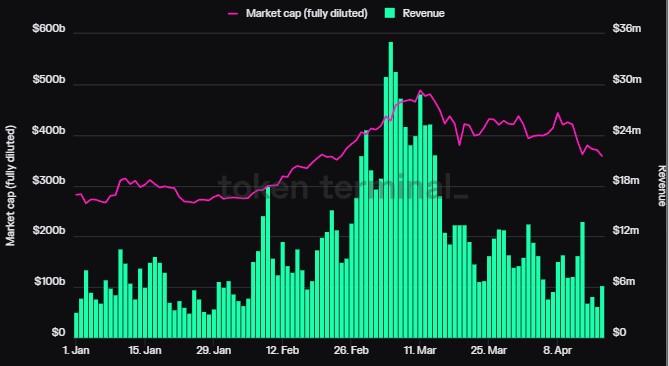
Despite the positive revenue growth, it is essential to acknowledge the impact of market corrections and dampened investor interest in the second quarter of 2024.
Over the past 30 days, Ethereum’s revenue has declined by over 52%. This downturn can be attributed to the broader market dynamics and the temporary decrease in investor enthusiasm.
Examining the data over the past 30 days, Ethereum’s market cap (fully diluted) has decreased by 15.2% to $358.47 billion. Similarly, the circulating market cap has declined by 15.2% to reach the same value.
Additionally, the token trading volume over the past 30 days has declined 18.6%, totaling $586.14 billion.
ETH is trading at $3,042, up 0.4% in the last 24 hours. It remains to be seen whether these changes and the reduction in fees will have the same effect in the second quarter of the year, and how this, coupled with a potential increase in trading volume, can push the ETH price to higher levels.
Featured image from Shutterstock, chart from TradingView.com
]]>
✓ Share: