Cardano loses top-10 spot as price hits 3-year low – What should traders do next? AMBCrypto
Source link ]]>
Shiba Inu Price Prediction: SHIB Just Crashed to a 3-Year Low – Is SHIB Going to $0? Cryptonews
Source link ]]>
Ethereum is undergoing its first notable pullback after an explosive rally that took the price from $2,500 to $3,800 in less than three weeks. Despite this cooldown, bulls remain in control, with ETH holding firm above the $3,600 level—a key support zone now acting as the base for potential consolidation. The market appears to be digesting recent gains, with signs that Ethereum’s strength could be far from over.
Related Reading
On-chain data from Sentora adds to the bullish outlook. Last week, Ethereum saw the highest weekly volume of large transactions since 2021. This surge in big-money activity signals rising interest from institutional players and large investors, even amid short-term volatility.
With legal clarity in the US improving and Ethereum fundamentals strengthening, the current pause may be setting the stage for another leg higher. Whether this consolidation lasts days or weeks, the elevated on-chain activity suggests Ethereum’s ecosystem is heating up again, with major players positioning for the next move.
Institutions Rotate From BTC Into Ethereum
Sentora data confirms a major shift underway: big-money Ethereum is back. Last week, on-chain transfers over $100,000 totaled more than $100 billion—the highest weekly volume since 2021. This spike in high-value transfers reflects renewed institutional interest, reinforcing Ethereum’s role as the leading altcoin amid evolving market dynamics.
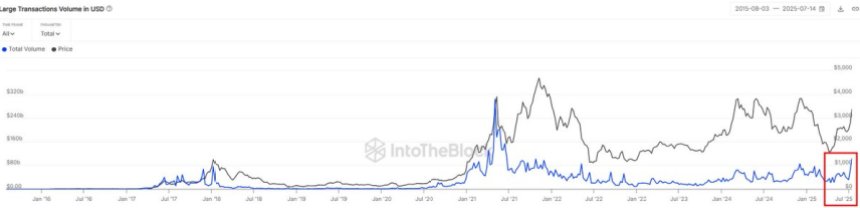
The timing of this surge is critical. Ethereum’s price has rallied aggressively from $2,500 to $3,800 in a matter of weeks, and institutional capital appears to be rotating from Bitcoin into ETH. While Bitcoin remains in a tight consolidation range just below its all-time high, Ethereum’s upside momentum and on-chain strength suggest it may now be leading the charge. This rotation has sparked discussions about the beginning of “Ethereum season,” a pattern seen in previous market cycles when ETH outperforms BTC and capital begins to flow into the broader altcoin market.
Some analysts believe this could mark the early stages of a long-awaited altseason. Historically, Ethereum leads such phases, acting as the gateway for investors to explore high-beta assets across the crypto ecosystem. If ETH maintains current strength and breaks above the $4,000 level, it could trigger a broader market expansion.
Related Reading
ETH Price Holds Above Key Support After Parabolic Rally
Ethereum is undergoing its first meaningful pullback since beginning a powerful surge from the $2,500 region in early July. After reaching a local high of $3,801, ETH is now trading around $3,662, down approximately 2.7% on the day. Despite the minor correction, the overall structure remains bullish. The current price sits above the $3,600 zone, a level that now acts as key short-term support.
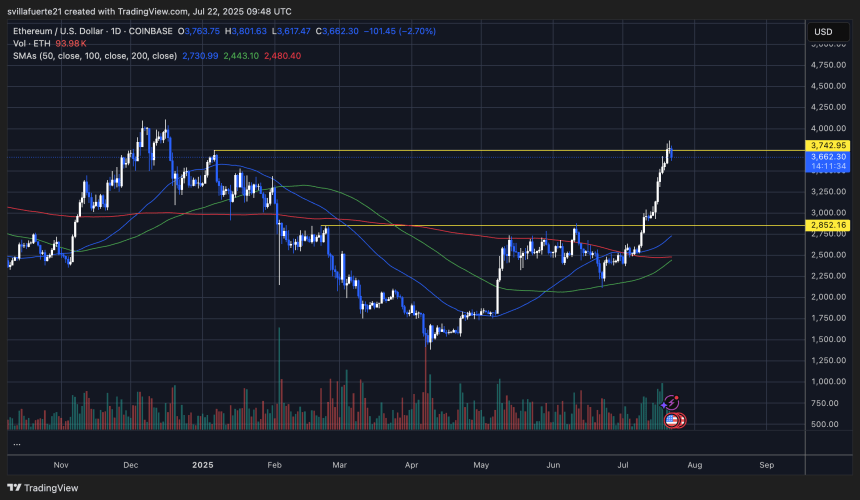
Volume has slightly decreased during this pullback, suggesting that selling pressure remains relatively controlled. ETH is still trading well above its 50-day, 100-day, and 200-day moving averages, reinforcing the strength of the uptrend. The next major resistance lies around $3,800–$3,850, which aligns with previous peaks seen in early 2024.
Related Reading
A successful consolidation above $3,600 could provide the foundation for a new leg higher toward the $4,000 mark. However, failure to hold this support level might trigger a retest of the $3,450–$3,500 area, followed by stronger support around $3,000 and the $2,850 breakout zone.
Featured image from Dall-E, chart from TradingView

- The project’s stablecoin supply has crossed $2.76 billion.
- The metric has hovered beneath this level since 2021.
- A falling wedge pattern suggests POL rallies to $0.50.
Digital tokens remained elevated on Monday as most assets exhibited bullish structures after the latest rallies.
Polygon, which has displayed stability since its Heimdall v2 upgrade on 10 July, is in the spotlight again.
The Polygon PoS saw its stablecoin supply recovering past $2.76 billion over the weekend, touching levels not seen since the 2021 bull run (according to CEO Sandeep Nailwal).
We just surpassed all time stablecoin supply on @0xPolygon POS, crossed $2.76B first time since 2021
The acceleration is just beginning
We consistently
– Top 3 in bridged inflows
– Top 2 in NFT trading volume
– Top 3 in daily transactions
– 150b+ in stablecoin volumes
– Top 2… pic.twitter.com/i0Zy9bt5wv— Sandeep | CEO, Polygon Foundation (※,※) (@sandeepnailwal) July 19, 2025
The prevailing bull run and the latest crypto bills’ approval in the United States fuel this stablecoin growth.
Stablecoins gain traction after Donald Trump signed the GENIUS Act into law.
These assets are vital for the markets’ stability as they peg real-world assets like fiat.
Increased stablecoins entering the Polygon network indicate growing trust in the project, with users betting on potential upticks in ecosystem growth, NFT trading, and DeFi activity.
Such developments have renewed interest in native POL, the new coin replacing MATIC.
The alt has formed a bullish reversal pattern after extended dips since March.
Overcoming the $0.42 – $0.45 resistance could propel POL toward the obstacle at $0.50.
That would translate to a 95.38% increase from the digital currency’s market price of $0.2559.
Network activity confirms trend shifts
Stronger fundamentals support Polygon’s bullish trajectory.
It has topped charts in the last few months, consistently ranked as:
- The top three in bridged inflows
- The top two in NFT trading volume
- The top three in daily transactions
- 150b+ in stablecoin volumes
- The top two in daily active users on several days.
These stats reflect Polygon’s competitiveness in the hot Ethereum-scaling and L2 landscape.
The impressive growth suggests that Polygon remains a perfect choice for traders, institutions, and developers.
With many sectors, including NFTs, DeFi, gaming projects, and real-world assets (RWA) heating up amid the materialising bull run, Polygon might see further stablecoin surges.
POL price outlook: Is $1 next?
The alt trades at $0.2559 after gaining over 5% in the past 24 hours (CoinMarketCap).

It has rallied from June lows of $0.1666, and the 60% surge in daily trading volume suggests further gains for POL.
Technical indicators back the bullish case. A textbook falling wedge is emerging on the weekly charts.
This classic formation often welcomes massive breakouts once confirmed.
Falling wedge patterns trap sidelined cautious buyers and short-sellers before robust gains.
With the prevailing broad market optimism, Polygon bulls will target the key resistance at $0.50, a 95% upswing from POL’s market price of $0.2559.
The soaring stablecoin supply hints at stable gains for the digital currency.
Overcoming $0.50 could catalyse surges to $0.90 before exploding toward the psychological mark at $1.
Cryptocurrencies appear ripe for extended gains as bulls dominate amid shifting trends and increased institutional appetite.

3-Year Symmetrical Triangle Signals Shiba Inu Heading Toward $0.0001 The Crypto Basic
Source link ]]>
Cardano Price Strikes a 3-Year Barrier For 82% Breakout Rally CryptoNewsZ
Source link ]]>
Big Cardano Price Predictions as ADA Shoots Up 17% to 3-Year High CryptoPotato
Source link ]]>
MicroStrategy stock has surged this month, propelling the U.S. convertible bond market to its highest returns in three years. The company’s February 2027 convertible bonds climbed 60 cents on the dollar in November, marking their best monthly performance since issuance in 2021.
This growth is driven by Bitcoin’s recent rally, with the cryptocurrency reaching a historic high of over $93,000 on Wednesday.
MicroStrategy Stock Fuels 3-Year Convertible Bond Peak
MicroStrategy’s stock is leading the charge in the U.S. convertible bond market, which has reached a total of $310 billion. A Bloomberg index tracking 500 US convertible bonds is set for its best month this year, with MicroStrategy contributing to almost 25% of the increase. The company’s bond market has also been under focus due to its February 2027 notes which rose in value in November.
MicroStrategy’s tactical emphasis on Bitcoin has added value to its convertible bonds. The company has more than $24 billion worth of Bitcoin and its bondholders have been enjoying the increasing value of the cryptocurrency.
Convertible bonds, which let investors get a constant yield while having the possibility to exchange the bonds for shares, have also been attractive to MicroStrategy given the growth of its stock in tandem with Bitcoin.
MicroStrategy Expands Bitcoin Holdings Amid Price Surge
Some of the recent actions undertaken by the company are acquiring about 27,200 Bitcoins at an approximate value of $2.03 billion. This acquisition, which was made between October 31 and November 10, is the company’s biggest in the past two years.
As of now, with more invested in Bitcoin and the asset valuing more than ever, MicroStrategy’s holdings are now worth nearly $24 billion.
MicroStrategy’s co-founder and chairman Michael Saylor began the company’s Bitcoin acquisition back in 2020 with the aim of protecting against inflation. At first, the firm bought Bitcoin using cash but has since funded its purchases through selling stock and issuing convertible debt. This has enabled MicroStrategy to get the most out of its Bitcoin buys, strengthens the company’s status as one of the biggest corporate owners of the cryptocurrency.
Bitcoin Price Rally Boosts Market Standing
Bitcoin’s recent surge has had a direct impact on MicroStrategy stock, which is up 46% this month alone. The software company’s stock has risen over 2,500% since August 2020, far outpacing traditional tech stocks. Bitcoin’s latest peak, driven by increasing U.S. investor interest and expectations of a crypto-friendly administration under President-elect Donald Trump, pushed the BTC price above $93,434 on Wednesday.
This rally has helped MSTR stock hit a record high of $335 on Monday, surpassing its previous peak from the dot-com boom in 2000. MicroStrategy’s market performance now exceeds that of major U.S. tech players, including Nvidia, underscoring the impact of its cryptocurrency-driven strategy.
As MicroStrategy and other crypto-related firms like Coinbase and Core Scientific gain traction in the convertible bond market, industry experts are cautioning about sector concentration. Dorian Carrell, a portfolio manager at Schroder Investment Management, noted that the rise in convertible issuance tied to cryptocurrency could lead to increased volatility in the asset class.
Similarly, Pierre-Henri de Monts de Savasse of RBC BlueBay Asset Management highlighted the challenges for portfolio managers who must now consider crypto volatility. The convertible bond market, still recovering from the tech stock downturn in 2022, faces new risks as it becomes more intertwined with the cryptocurrency sector.

Kelvin Munene Murithi
Kelvin is a distinguished writer with expertise in crypto and finance, holding a Bachelor’s degree in Actuarial Science. Known for his incisive analysis and insightful content, he possesses a strong command of English and excels in conducting thorough research and delivering timely cryptocurrency market updates.
Disclaimer: The presented content may include the personal opinion of the author and is subject to market condition. Do your market research before investing in cryptocurrencies. The author or the publication does not hold any responsibility for your personal financial loss.
Will Dogecoin Price Soar To $1.8 After Clearing A 3-Year Resistance? CoinGape
Source link ]]>
Dogecoin price hits 3-year peak as Tesla’s $1T Rally drives Elon Musk’s Wealth to $300B FX Empire
Source link ]]>
✓ Share: