Is Cardano in Trouble? Why Whales Are Abandoning Binance CryptoPotato
Source link ]]>
Shiba Inu Team Accused of Abandoning $3M Hack Victims—Here’s Why Coinpaper
Source link ]]>
Dogecoin Price Prediction: Is Elon Musk Abandoning DOGE Promises? Onchain Data Shows Major Rotation | Bitcoinist
Source link ]]>
Investors Abandoning Shiba Inu (SHIB) and Dogecoin (DOGE) for This New Altcoin—Here’s Why CryptoDaily
Source link ]]>
Shiba Inu Whales Abandoning SHIB for PlayDoge: Next Big Crypto? Techpoint Africa
Source link ]]>
Cardano’s Hoskinson Denies Abandoning Scaling Solution DailyCoin
Source link ]]>
Crypto News: According to on-chain data, the Bitcoin exchange reserve ratio for US vs offshore platforms has been declining recently. This comes in the midst of a rampant regulatory crackdown on businesses offering crypto services in the United States — which seems to have shaken investors’ confidence in the market.
Bitcoin Exchange Reserve Ratio Drops
As noted by an analyst in a CryptoQuant report, the BTC reserve of the US-based exchanges has been decreasing. The “exchange reserve ratio” is the relevant indicator in this case rather than the actual exchange reserve. This indicator provides information about the ratio between the exchange reserves of two specified sets of platforms, as its name suggests. According to the on-chain data shared, the American and international crypto exchanges are the two sets of exchanges being compared.
Read More: LUNC Developer Teases AI App Chain “Block Entropy”, LUNC Price Eyeing $0.1?
When the value of this ratio rises, it indicates that there are more coins available on US-based platforms than there are on offshore exchanges. This logically implies that American platforms are receiving more deposits or in other words, lesser withdrawals than those from other countries. However, the metric’s declining value indicates that global platforms are currently experiencing a greater increase in their reserves than US-based exchanges.

The Bitcoin exchange reserve ratio for these two groups of sites has been declining since the first half of 2022, as shown in the graph above. This suggests that in comparison to overseas platforms, the supply on US-based exchanges has been steadily falling. At the time of writing, Bitcoin’s price is currently exchanging hands at $27,984.12 with a market cap of $541 billion.
Fear Brews As Crackdowns Widen
While U.S. investors are limited to using crypto platforms outside of their jurisdiction, it’s assumed that most are switching to decentralized exchange protocols or storing their crypto in self-custody crypto wallets in order to safeguard from unseen failures or collapses. Multiple reports have indicated that, the use of DEXs such as Uniswap, Quickswap & Pancake Swap has grown in recent times along with the use of hardware wallets.
The downfall in user trust has been especially severe after large collapses, which have led to the bankruptcy of some key platforms and the spread of FUD throughout the crypto market — thereby causing investors to withdraw their coins from centralized exchanges. The February proposal to bar financial advisors from dealing in cryptocurrencies and the possibility of legal action against certain Coinbase products are recent instances of the SEC’s enforcement actions.
Moreover, in the latest crypto news, SPAC King Chamath Palihapitiya famously stated “Crypto is dead in America”. This comes after the SEC Chair Gary Gensler blamed the entire banking crisis solely on crypto. “The United States authorities have firmly pointed their guns at crypto”, he further added.
Also Read: Experts Predict More Bank Runs, Will FED Hike Interest Rates?

The presented content may include the personal opinion of the author and is subject to market condition. Do your market research before investing in cryptocurrencies. The author or the publication does not hold any responsibility for your personal financial loss.

The biggest news in the cryptosphere for Sept. 26 includes Interpol’s red warrant requesting law enforcement worldwide to locate and arrest Do Kwon, news of the upcoming ATOM 2.0 update, and crypto miners leaving PoW tokens after the Ethereum Merge.
CryptoSlate Top Stories
Interpol issues worldwide arrest warrant for Do Kwon
After releasing an arrest warrant for Terraform Labs founder Do Kwon, South Korea asked for Interpol’s aid in looking for Kwon on Sept. 19.
Responding to Korea’s request, Interpol released a red notice for Kwon on Sept. 26, mandating law enforcement worldwide to locate and arrest him.
Terra founder Do Kwon claims he is ‘making zero efforts to hide’
Following the news of Interpol issuing a red warrant, Do Kwon tweeted that he is making “zero efforts to hide” and that he “go(es) on walks and malls, no way none of CT hasn’t run into me the past couple weeks.”
Miners flee PoW tokens as token prices tank, GPU value flounders
Crypto miners who initially flocked to GPU-compatible PoW tokens after the Ethereum Merge are leaving those networks after the value of their tokens fell and as the value of GPUs dropped by up to 40% in China since the merge.
Ethereum community split over reversible transactions proposal
The Ethereum community has voiced widely divergent opinions on whether implementing reversible transactions is a step forward.
A significant aspect of cryptocurrency is transaction irreversibility. While proponents of reversible transactions point to improved safety, detractors argue that, under this proposal, Ethereum reflects the banking system it claims to oppose.
ATOM 2.0 whitepaper to be revealed during Cosmoverse, token up 25% in September
Cosmos’s native token ATOM’s upgrade details will be launched on Sept. 26, during the first day of the Cosmoverse in Medellin. The details will be revealed in Cosmos co-founder Sommelier Zaki Manian’s keynote speech titled “$1K ATOM LFG” and a panel discussion on ATOM 2.0.
Komodo’s AtomicDEX bridge will now connect Cosmos to hundreds of blockchains
Komodo’s (KMD) integration with Cosmos on AtomicDEX was completed on Sept. 26. The integration leverages AtomicDEX’s cross-chain protocol, non-custodial wallet, and DEX to connect the Cosmos ecosystem to other blockchains.
China arrests 93 people suspected of laundering 40B RMB via crypto
Chinese authorities detained 93 people for allegedly being involved in a money laundering operation. According to local news sources, a group of criminals attempted to launder 40 billion RMB using cryptocurrencies. Authorities were able to seize 300 million RMB and 100 mobile phones from the captured subjects.Wrapped
Australian central bank issues whitepaper for the pilot of permissioned CBDC, eAUD
The Reserve Bank of Australia (RBA) published a whitepaper announcing the pilot program for its Central Bank Digital Currency (CBDC) eAUD on Sept. 26. The whitepaper was co-published with the Digital Finance Cooperative Research Centre (DFCRC).
The eAUD will work on a private, permissioned version of the Ethereum (ETH) blockchain both during its pilot period and after it launches.
Ethereum developers, and Cardano founder Charles Hoskinson get into a Twitter feud
Cardano (ADA) founder Charles Hoskinson got into a quarrel on Twitter with the Ethereum developers.
The feud started after Hoskinson criticized the Ethereum developers for ignoring Ouroboros for the last five years. He claimed that the developers were stuck on technology from 2014. In response, Ethereum developer Hudson Jameson spoke for the Ethereum developers community and said they wouldn’t look at Cardano because of Hoskinson’s attitude.
Former IMF official believes CBDCs need to function offline to gain mass adoption
A former IMF official John Kiff published a blog post explaining why he thinks Central Bank Digital Currencies (CBDC) can promote global financial inclusion.
Kiff was responsible for fintech and digital currencies during his position at the IMF. He likens the CBDCs to Avant cards of the 90s and debit cards of the 2000s in terms of utility and expansion potential. Adding that both initiatives both became widely popular and increased financial inclusion in the past, he says that CBDCs carry the potential to be the next big thing in the finance sector.
Osmosis co-founder reveals cross staking through mesh security in chainmail armor at Cosmoverse
Osmosis founder Sunny Aggarwal took to the Comosverse stage to speak about mesh security systems and opened his talk in a 40lb suit of chainmail armor.
Research Highlight
Research: How low can Bitcoin price go?
ı analysts tried to answer one of the most critical questions of today’s market: how low can Bitcoin (BTC) go? To find an answer, analysts looked at the MVRV Z-Score, which is a combination of Market Value (MV), Realized Value (RV), and Z-score.
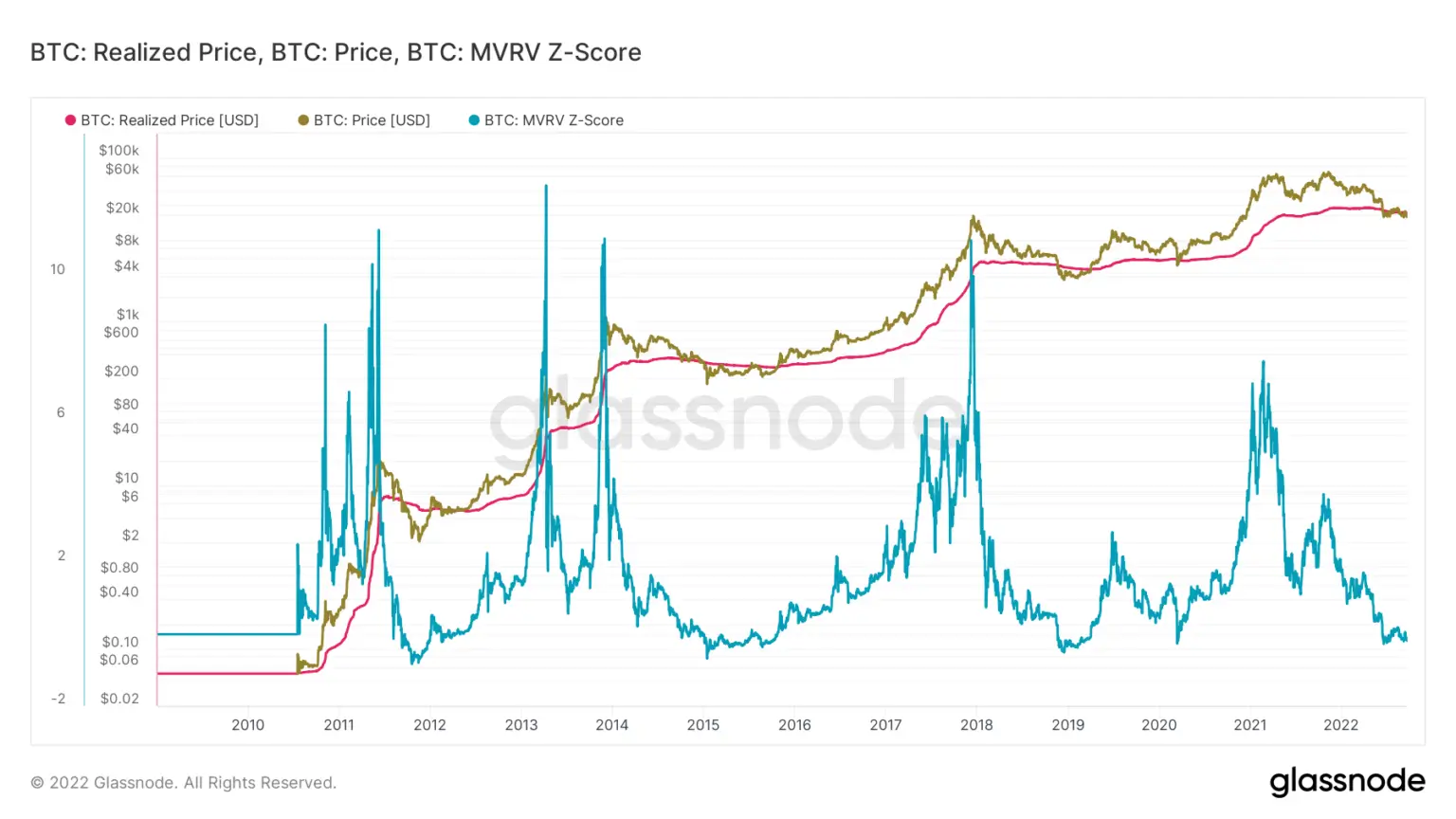
The MVRV Z-Score is currently in the green zone, suggesting a market bottom. However, this has been the case since the beginning of the bear market. In previous bear markets in 2020, 2019, 2014, and 2011, the MVRV Z-Score remained in today’s range between 20 and 300 days, suggesting that Bitcoin’s price can stay the same for six more months.
With that being said, Bitcoin can still drop lower in the future. The closest support level is $17,500, and falling below that would indicate that this bear market is none like the previous ones.
Crypto Market
Bitcoin (BTC)increased by 1.2% in the last 24 hours to be traded at $19,172. Ethereum also increased by 2.61%, reaching $1,331.
Biggest Gainers (24h)
Biggest Losers (24h)

Institutional investors have been increasing their bets in Bitcoin for a while now. Even big banks such as Morgan Stanley have introduced funds through which they provide their clients with exposure to the crypto market. Bitcoin has long been the digital asset of choice for institutional investors given its track record of outperformance. However, the tides look to be changing as big money turns its attention to altcoins.
Bitcoin Losing Steam
A new report from CryptoCompare shows that institutional interest in Bitcoin had dropped significantly in the month of November. Bitcoin assets under management (AUM) took a hit as the digital asset recorded losses not seen since July. This makes it one of the largest pullback months for the year 2021. Total BTC AUM fell 9.5% to $48 billion this month.
Related Reading | Market Analysts Explain Why This Correction Is Good For Bitcoin
This pullback showed a lack of interest from institutional investors who have mostly taken a bullish stance on the digital asset this year. For Bitcoin, November came with terrible turns as the price had crumbled along with interest. After hitting an all-time high of $69K, the asset had taken major hits that saw its price beaten down below $55,000.
BTC trading at $56,000 | Source: BTCUSDon TradingView.com
Bitcoin’s lack of interest from big money had also adversely affected total crypto AUM. Across the market, total digital asset AUM had also dropped 5.5% to $70 billion this month, according to the report.
Trading figures for Bitcoin had also plummeted for the month of November. Bitcoin funds across the space saw declining figures to varying degrees with Grayscale Bitcoin Trust recording the largest decline in the market. The trust had taken a beating that saw its daily volumes drop 25% to $289 million, alongside the share of trust product volume which dropped from 63% the previous month to 51% for the month of November.
Altcoins Pick Up The Slack
While BTC suffered from low interest, institutional investors seemed to have found a new favorite in the market; altcoins. Cryptocurrencies that are not Bitcoin are referred to as altcoins and big money has turned its attention to this blossoming market.
Related Reading | JPMorgan Lists Ethereum As A Better Investment Than Bitcoin
Trading volumes had plummeted across the market given how shaky the market had been. Along with Bitcoin, trading volumes for all digital assets had dropped 13% to an average of $732 million per day. However, despite trading volumes for all crypto assets investments taking a hit, altcoins had maintained momentum and secured the most gains for investors.
Etheruem’s AUM grew 5.4% for the month of November to a total of $16.6 billion. Other altcoins were not left behind as Litecoin and Solana also recorded great gains for the month. Grayscale’s LTCN, which is a Litecoin-based product, had returned 14.9%, while 21Shares ASOL, a Solana-based product, saw 22% gains in the same time period.
Featured image from RJP LLP, chart from TradingView.com