13.7 Trillion Shiba Inu (SHIB) on Verge of Activation: What to Expect U.Today
Source link ]]>
Cardano’s Chang hard fork – Where does ADA stand on the eve of activation? AMBCrypto News
Source link ]]>
Cardano 9.0: On-Chain Governance Set for Activation Bitcoinist
Source link ]]>
Dogecoin Rallies Following X Payments Activation; Rebel Satoshi Fresh Memecoin Appeals to Investors Cryptonews
Source link ]]>
News: Dogecoin Rallies Following X Payments Activation; Rebel Satoshi Fresh Memecoin Appeals to Investors Bitfinex
Source link ]]>
Ethereum’s journey towards a more scalable and efficient blockchain encountered a significant roadblock when the highly anticipated Dencun upgrade failed to achieve finalization on the Goerli testnet today. Activated at 6:32 UTC, the upgrade’s inability to reach consensus has injected uncertainty into the timeline for its deployment on the mainnet, prompting a detailed examination of the factors at play.
Ethereum Dencun Fails To Finalize – Here’s Why
EthStaker, a prominent voice in the Ethereum staking community, shed light on the complexities underpinning the non-finalization issue. “The low participation on Goerli suggests a mix of potential client issues and a lack of updated validators. While not overly concerning in the short term, this does necessitate a deep dive into whether these issues stem from validators not upgrading their systems or more systemic client-side problems,” EthStaker explained.
And it seems like we have a chain split! Client teams are looking into it, but it’s likely to a while to pin down + fix the issues. Keep an eye out for updates!
— timbeiko.eth
(@TimBeiko) January 17, 2024
Terence Tsao from Offchain Labs elaborated on the multifactorial aspects contributing to the testnet’s challenges. “With a participation rate hovering around 80%, the key to losing finality often lies in approximately 10% of validators being offline,” he stated.
This may be due to several factors, including failure to update software components or the presence of bugs. “Given Goerli‘s diverse validator composition, it’s premature to conclusively determine the root cause of the issue at hand,” Tsao remarked.
He advocated for a comprehensive and time-intensive analysis before making any definitive judgments about the Dencun upgrade’s success or potential delays. Proto Lambda, an Ethereum scaling and R&D expert, pinpointed a specific technical mishap that exacerbated the situation. “The accidental removal of ‘historical roots’ from the beacon state by Prysm led to a network split. This highlights the intricate challenges in managing the beacon state, a pivotal component of Ethereum’s consensus mechanism,” Proto Lambda highlighted.
Ethereum Goerli upgraded to Dencun / EIP-4844

And historicalRoots accidentally dropped from the beacon state by Prysm & a resulting network split
pic.twitter.com/5jHU6pq2vX
— proto.eth (@protolambda) January 17, 2024
The beacon state’s evolution, especially with the implementation of SSZ tree hashing, was meant to streamline state management, including the handling of the HistoricalSummary container. This container plays a crucial role for light clients and in creating Merkle proofs against past states.
Ethereum Improvement Proposal 4844 (EIP-4844)
The Dencun upgrade, deeply intertwined with EIP-4844, represents a cornerstone in Ethereum’s strategy for scaling and enhancing network efficiency. EIP-4844’s introduction of blob-carrying transactions is a groundbreaking step towards reducing gas costs by facilitating temporary data storage in beacon nodes. This move is expected to significantly enhance transaction throughput and lower fees, providing immediate relief and setting a foundation for future scalability solutions.
Proto-danksharding, a term coined from the contributions of researchers Protolambda and Dankrad Feist, underpins this process. It represents a simplified yet potent version of danksharding, aiming to radically cut down gas fees and improve transactional efficiency. This development is a crucial part of Ethereum’s scaling roadmap, ensuring compatibility and future readiness with the network’s long-term strategic vision.
Implications And Future Steps
The Ethereum community and developers are now racing against time to resolve these unforeseen challenges.
Tsao stated:
Prysm encountered a bug right at Goerli’s hard fork. The bug has been identified, and a fix is currently being merged. A hot patch image will be released within the next few hours. Sorry for the inconvenience, and thank you for your patience!
The transition from Goerli to Sepolia, and eventually to the Holesky testnet, signifies a cautious but strategic approach in Ethereum’s upgrade rollout.
“If all goes well with the testnets, my own personal estimate for Dencun on mainnet is mid-late March,” Sassal.eth, founder of The Daily Gwei, noted prior to the Dencun testnet upgrade. Following the faulty start, it is uncertain whether this schedule is still tenable.
At press time, ETH traded at $2,546.
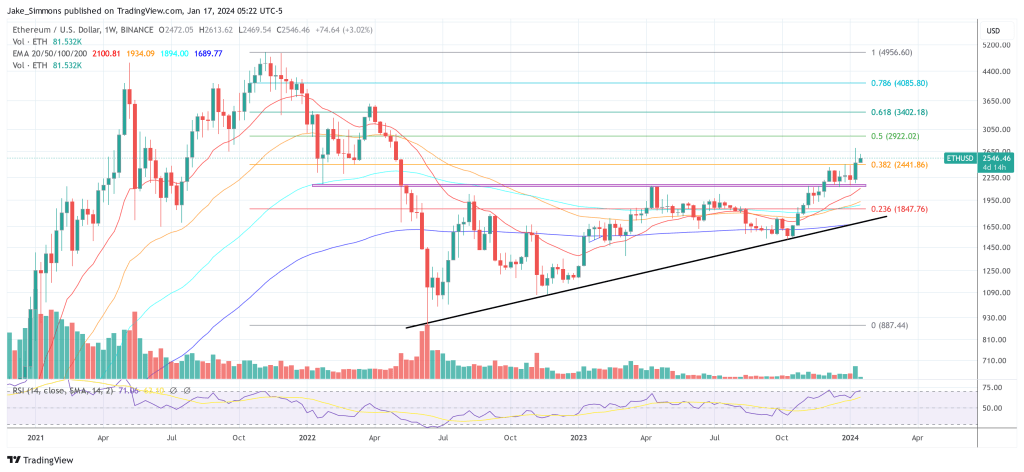
Featured image from Shutterstock, chart from TradingView.com
The cryptocurrency market continues its poor performance this week, with most of the coins in the top 100 currently trading in the red zone.
The cryptocurrency market has been underperforming since the start of the week. The market has lost more than 4% of its value in the last 24 hours and the total market cap could drop below the $900 billion mark if the trend continues.
Bitcoin has lost its position above $21k and looks likely to drop below $20k for the first time this week. Ether is forced to defend its position above $1,200 after losing more than 7% of its value in the last 24 hours.
AXS, the native token of the Axie Infinity ecosystem, is also underperforming. AXS is down by more than 7% in the last 24 hours despite Axie Infinity announcing that its Ronin Bridge is now open.
This comes months after the Ronin Bridge suffered a loss of over $600 million. The team said user funds are fully backed 1:1 by the new bridge and it had undergone an internal audit and two external audits.
However, this positive development wasn’t enough to stop AXS from underperforming.
Key levels to watch
The AXS/USD 4-hour chart is bearish as Axie Infinity has lost more than 7% of its value in the last 24 hours. The technical indicators also show that AXS is performing negatively at the moment.
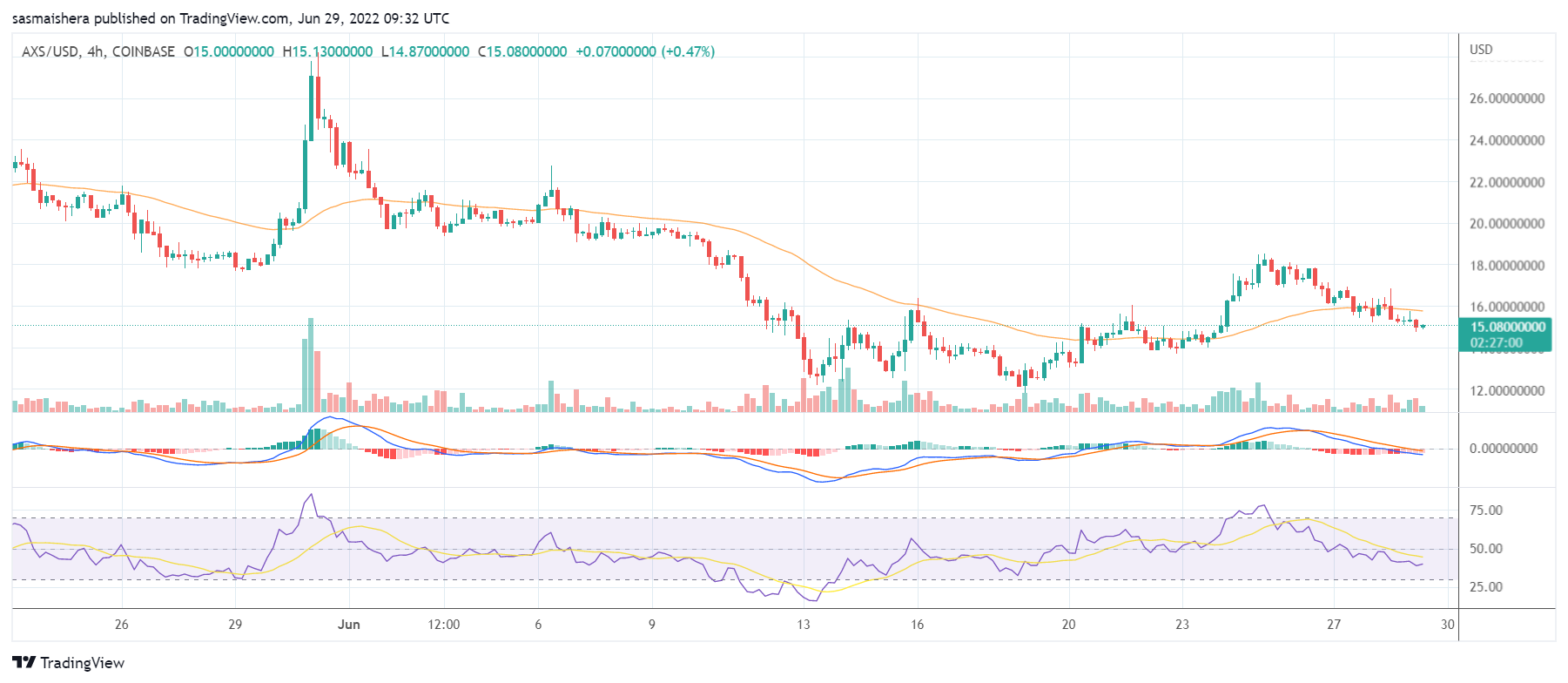
The MACD line dropped below the neutral zone a few hours ago as AXS sustained huge losses. The 14-day RSI of 40 shows that AXS could enter the oversold region if the bearish sentiment continues.
At press time, AXS is trading at $15.05. If the bearish trend continues, AXS could drop below the $14.01 support level over the next few hours or days. Unless there is an extended bearish period, AXS should stay above the $12.28 support level in the near term.