
Vitalik Buterin is pushing back against the dominant narrative shaping today’s artificial intelligence industry. As major AI labs frame progress as a competitive sprint toward artificial general intelligence (AGI), the Ethereum co-founder argues that the premise itself is flawed.
In a series of recent posts and comments, Buterin outlined a different approach, one that prioritizes decentralization, privacy, and verification over scale and speed, with Ethereum positioned as a key piece of enabling infrastructure rather than a vehicle for AGI acceleration.
Buterin likens the phrase “working on AGI” to describing Ethereum as simply “working in finance” or “working on computing.” In his view, such framing obscures questions about direction, values, and risk.
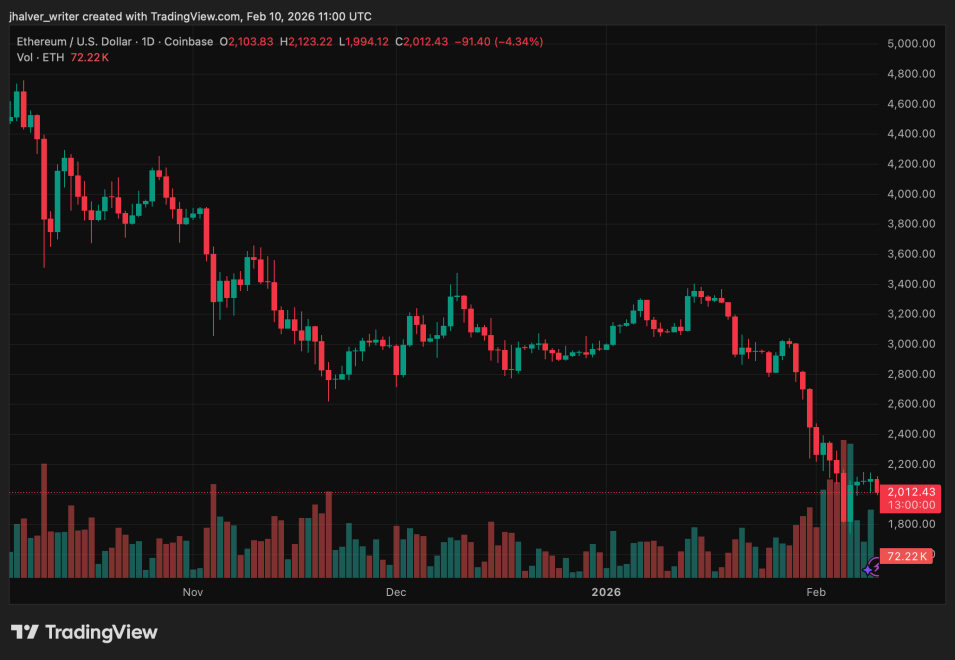
ETH's price trends to the downside on the daily chart. Source: ETHUSD on Tradingview
Ethereum as Infrastructure for Private and Verifiable AI
A central theme in Buterin’s vision is privacy-preserving interaction with AI systems. He points to growing concerns around data leakage and identity exposure from large language models, especially as AI tools become more embedded in daily decision-making.
To address this, Buterin proposes local LLM tooling that allows AI models to run on user devices, alongside zero-knowledge payment systems that enable anonymous API calls. These tools would make it possible to use remote AI services without linking requests to persistent identities.
He also highlights the importance of client-side verification, cryptographic proofs, and Trusted Execution Environment (TEE) attestations to ensure AI outputs can be checked rather than blindly trusted.
This approach reflects a broader “don’t trust, verify” ethos, with AI systems assisting users in auditing smart contracts, interpreting formal proofs, and validating onchain activity.
An Economic Layer for AI-to-AI Coordination
Beyond privacy, Buterin sees Ethereum playing a role as an economic coordination layer for autonomous AI agents. In this model, AI systems could pay each other for services, post security deposits, and resolve disputes using smart contracts rather than centralized platforms.
Use cases include bot-to-bot hiring, API payments, and reputation systems backed by proposed ERC standards such as ERC-8004. Supporters argue that these mechanisms could enable decentralized agent markets where coordination emerges from programmable incentives instead of institutional control.
Buterin has stressed that this economic layer would likely operate on rollups and application-specific layer-2 networks, rather than Ethereum’s base layer.
AI-Assisted Governance and Market Design
The final pillar of Buterin’s framework focuses on governance and market mechanisms that have historically struggled due to human attention limits.
Prediction markets, quadratic voting, and decentralized governance systems often falter at scale. Buterin believes LLMs could help process complexity, aggregate information, and support decision-making without removing human oversight.
Rather than racing toward AGI, Buterin’s vision frames Ethereum as a tool for shaping how AI integrates with society. The emphasis is on coordination, safeguards, and practical infrastructure, an alternative path that challenges the prevailing acceleration-first mindset.
Cover image from ChatGPT, ETHUSD chart on Tradingview
Editorial Process for bitcoinist is centered on delivering thoroughly researched, accurate, and unbiased content. We uphold strict sourcing standards, and each page undergoes diligent review by our team of top technology experts and seasoned editors. This process ensures the integrity, relevance, and value of our content for our readers.
Cardano founder Charles Hoskinson believes Artificial General Intelligence (AGI) could emerge within three to five years, marking a transformative moment in AI evolution.
In a Feb. 19 post on X, Hoskinson said:
“I’d say we are 3-5 years away from AGI.”
AGI represents a significant leap in AI evolution. Unlike current models, AGI would possess human-like intelligence, allowing it to learn and perform tasks without specific programming. This breakthrough could redefine industries and everyday life.
Hoskinson’s statement comes as tech companies race to build stronger AI models. Over the past years, industry leaders have poured billions into research and development of more powerful AI systems that could reshape industries.
Considering this, Hoskinson believes this rapid progress is a sign that AGI is approaching. He pointed to upcoming advancements in AI, such as Grok 3, Llama 4, Claude’s next version, and OpenAI’s GPT-4.5 and GPT-5, as evidence of this accelerating trend.
He emphasized that these releases would significantly expand AI’s capabilities and real-world applications.
Hoskinson said:
“Grok 3 is coming out tonight. Soon Llama 4, Claude’s next release, and Open AI GPT-4.5 and 5. All of these are massive leaps forward in AI and will dramatically improve the use and utility of AI for practical applications.”
Is AGI near?
The Cardano founder is not alone in his views on AGI. Several industry experts have pointed out that AI development is accelerating thanks to breakthroughs like DeepSeek, a Chinese AI model.
Venture capitalist Nic Carter recently suggested that DeepSeek has advanced AGI’s arrival by five years.
Moreover, OpenAI’s CEO Sam Altman has also expressed confidence in AGI’s imminent arrival. Earlier this year, he stated that his team understands the path to achieving it and predicted that AGI-driven agents could start appearing in workplaces by late 2025.
More recently, Altman hinted that GPT-4.5 could offer a “feel the AGI” experience, suggesting a significant leap in AI capabilities.
Mentioned in this article


- Bangkok will host the Open AGI Summit on November 13 alongside DevCon 2024.
- The summit focuses on ethical AI development through decentralized governance models.
- Prominent speakers include Pramod Viswanath and Sandeep Nailwal from leading firms.
Bangkok is set to be the epicenter of innovation as it hosts the Open AGI Summit on November 13, 2024, in conjunction with DevCon, a major blockchain developer conference.
These unique events aim to explore the intersection of Artificial General Intelligence (AGI) and decentralized technologies, fostering dialogue about the ethical implications of AI in a rapidly evolving digital landscape.
Supported by flagship partners including Google Cloud, Sentient, Polygon Labs, and SCB 10X|SCBX, the Open AGI Summit promises to engage both AI and blockchain communities.
All eyes on the Open AGI Summit
As the world advances toward AGI, concerns about centralized control and potential societal risks are becoming increasingly prominent. The Open AGI Summit seeks to address these anxieties by examining how decentralized, blockchain-based governance models can lead to safer and more transparent AI development.
By emphasizing collaboration and ethical dimensions, the summit aspires to ensure that AGI serves as a tool for universal benefit and prosperity.
The summit will feature prominent voices from the fields of AI, blockchain, and web3, including Pramod Viswanath, a professor of engineering at Princeton University, and Sandeep Nailwal, co-founder of Polygon.
Nailwal highlights the critical decision society faces: to allow a handful of corporations to dominate AI technology or to embrace a future where AI is open, transparent, and accessible to all. He asserts that blockchain technology can ensure the equitable distribution of AI benefits, guided by collective values.
Discussions at the summit will cover essential topics, including advancements in AI safety research, decentralized governance structures, and ethical considerations in AI development.
Attendees can expect a deep dive into the innovative synergy between AI and blockchain, emphasizing emerging applications that could redefine industries.
Ultimately, the Open AGI Summit aims to bridge the gap between academia, industry, and the decentralized AI community, fostering collaboration towards responsible AGI development.
This convergence is essential for ensuring that AI technologies are built with a commitment to ethical principles and societal benefit, marking a significant step toward a safe and beneficial future for AGI.