Algorithmic Trading Platform Leads Market Gains With 1200% Upside Potential, Dogecoin and TON Recovery … NullTX
Source link ]]>
Bitcoin investors in Asia have been experiencing major volatility due to the fallout of the automated trading protocols that react to flows taking place in the US Bitcoin ETFs. Every day, updates on the demand for spot Bitcoin ETFs ripple through the cryptocurrency market during Asian trading hours, following the conclusion of US share trading.
On Tuesday, Bitcoin and the broader crypto market experienced their most significant decline in a month during the Asian morning session, driven by data indicating investors were withdrawing funds. Shiliang Tang, president of principal trading firm Arbelos Markets said:
“From an algorithmic trading perspective, bots can basically auto-scrape this data and buy and sell based on this. It seems that’s basically what is happening.”
Bitcoin ETF Inflows Cool down
On the other hand, the Bitcoin ETF market also experienced some volatility recently. Inflows reached their peak in the initial two weeks of March, coinciding with BTC’s rally to its all-time high of $73,798. Since that pinnacle, the sector has experienced intermittent periods of outflows, leading to a decline of approximately 11% from the token’s historic peak.
Charlie Morris, Chief Investment Officer at ByteTree Asset Management, highlighted that approximately 5.5% of Bitcoin is held within the broader ETF sector, contrasting with gold’s 1% allocation. According to Morris, this makes ETF flows more impactful for Bitcoin than for gold.
Tang further noted that this flow pattern elucidates the varying market returns during Asian trading hours. There was a notable strength visible in February and early March, followed by a decline in later March.

Additionally, the liquidation of bullish crypto wagers, totaling about $354 million on Tuesday according to Coinglass data, is due to algorithmic protocols offloading BTC. This activity can trigger ripple effects in the derivatives market.
The Bitcoin price tanked over 6% on Tuesday moving all the way lower to $65,400. The industry is closely awaiting the upcoming Bitcoin halving which could induce a major supply shock in the market while driving the prices higher.

The presented content may include the personal opinion of the author and is subject to market condition. Do your market research before investing in cryptocurrencies. The author or the publication does not hold any responsibility for your personal financial loss.
Cardano ($ADA) Powered Algorithmic Stablecoin $DJED Loses Peg … CryptoGlobe
Source link ]]>
Shiba Inu Traders are buying the Avorak AI ICO to reap benefits of Algorithmic Bot Analytics Insight
Source link ]]>
Cardano-Powered Algorithmic Stablecoin $DJED Achieves Major … CryptoGlobe
Source link ]]>
Cardano Founder Supports Algorithmic Stablecoin for BTC’s Vision BeInCrypto
Source link ]]>
Cardano Founder Says Algorithmic Stablecoins Are Essential for Bitcoin (BTC) to Achieve Its Vision U.Today
Source link ]]>
Cardano-Powered Algorithmic Stablecoin $DJED Now Backed by Over 31.5 Million $ADA CryptoGlobe
Source link ]]>
The much anticipated algorithmic stablecoin on Cardano, Djed, has gone live. But the scammers didn’t miss this opportunity.
The collapse of UST, the algorithmic stablecoin on the Terra ecosystem, drove negative sentiment for this category of stablecoins. This collapse last year drove the crypto industry deeper into a bear market, and investors lost billions.
The COTI team, with the help of Input Output Global (the creators of Cardano), worked for a year to re-establish trust in algorithmic stablecoins. Finally, they announced “a new era of stablecoins” with the launch of Djed.
Djed Goes Live on the Cardano Mainnet
The Djed ecosystem has joined with over 40 partnerships to bring the adoption of the new stablecoin. It is listed on decentralized exchanges such as MinSwap, Wingriders, and MuesliSwap.
Centralized exchanges have not listed Djed yet. But Bitrue announced that it would be the first centralized exchange to list the token.
To tackle the negative sentiments of algorithmic stablecoins, the team has built Djed to be overcollateralized by 400%-800% by Cardano’s native coin ADA and reserve coin Shen. The on-chain proof of reserves will be available for investors to check the reserve ratio.
The team also mentioned the plan to add other assets like Wrapped Bitcoin (WBTC) and Wrapped Ethereum (WETH) as reserves along with ADA.
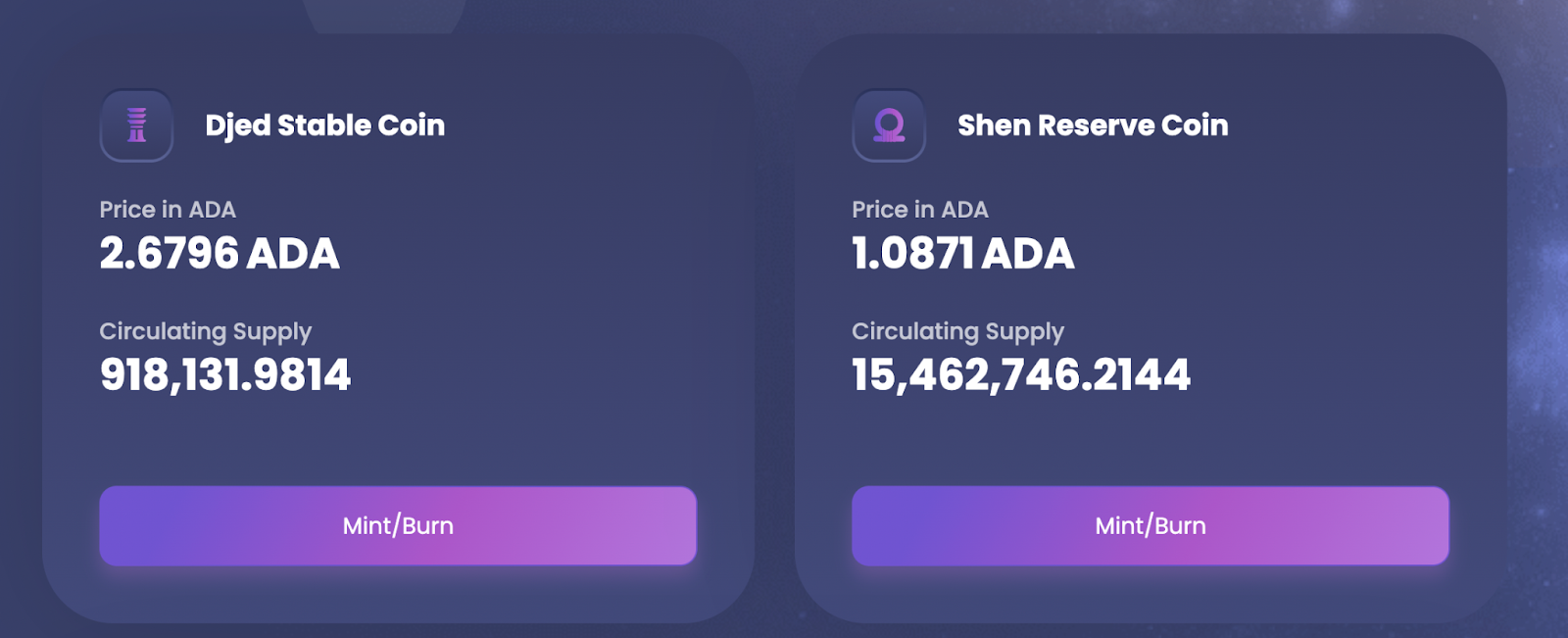
According to the official website, the price of Djed is 2.67 ADA, and the price of Shen is 1.08 ADA. Presently it has a 783% reserve ratio supported by around 20 million ADA tokens.
Scammers Making the Most out of the Stablecoin Launch?
The Djed launch suffered a few hitches, as community members lost ADA to scammers. As the website does not display the policy ID of Shen and Djed, scammers took advantage and stole over 20,400 ADA from unaware investors within 15 minutes of launch. The Discord community criticized the team for not displaying the Policy ID.
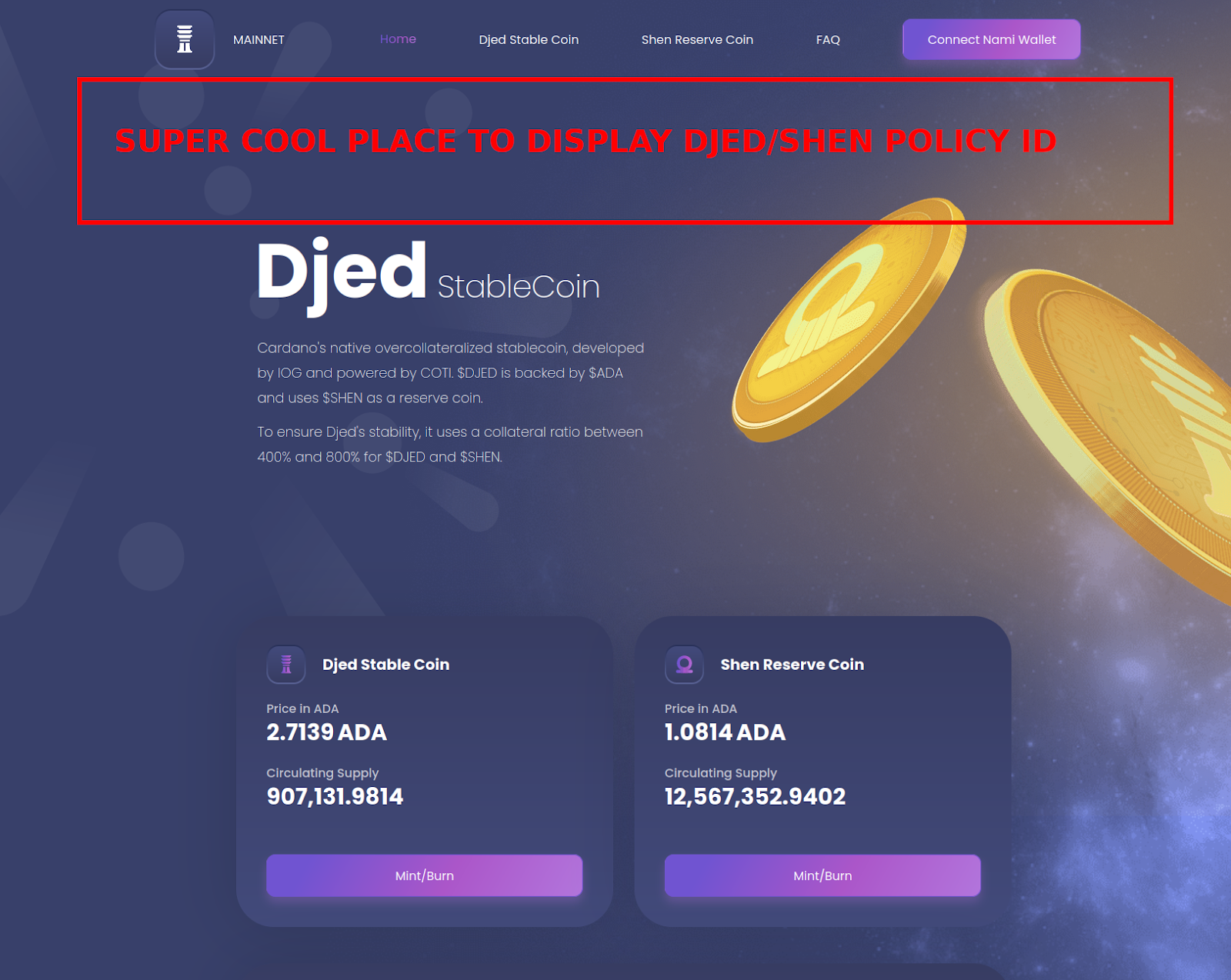
Some users also experienced an error with the Djed website, saying, “Service is currently unavailable.” However, the Discord moderator informed the community that the team was working on the error.
Presently, there is not much impact on ADA price. But, our analysis suggests that a short-term correction is on the horizon.
Got something to say about this article or anything else? Write to us or join the discussion on our Telegram channel. You can also catch us on TikTok, Facebook, or Twitter.
For BeInCrypto’s latest Bitcoin (BTC) analysis, click here.
Disclaimer
BeInCrypto has reached out to company or individual involved in the story to get an official statement about the recent developments, but it has yet to hear back.
Since the crash of the TerraUSD (UST) algorithmic stablecoin in May 2022, many users in the crypto ecosystem have acquired a weariness against that specific asset class. The market for algorithmic stablecoins has plummeted 10x from its all-time high before the Terra crash.
However, this has not prevented Cardano network engineers from going through with the introduction of the ecosystem’s overcollateralized stablecoin on Jan.31. The new algorithmic stablecoin, Djed (DJED), released on the Cardano mainnet and is tied to the United States dollar and backed by Cardano’s native cryptocurrency, ADA. It employs the Shen (SHEN) token as its reserve currency.
The release states that the new token has only just passed a security assessment and that it has been in development for more than a year. As a method for the creation of new decentralised finance (DeFi) and payment possibilities, DJED is a product that was developed by Coti, a developer of DeFi solutions that runs on the Cardano blockchain.
The concept of bringing into existence yet another algorithmic stablecoin produced tremors among members of the online cryptocurrency community prior to the debut of the brand new Cardano stablecoin.
This is one of the most recent updates in a series of recent updates that have come out of the Cardano network. These updates include an announcement made on January 12 by co-founder Charles Hoskinson that the ecosystem will expand via custom-built sidechains. This is one of the most recent updates in this series.
On January 23, an anomaly caused fifty percent of Cardano nodes to become disconnected and need a restart; this resulted in an interruption of network service. This was only one week before to the introduction of the brand new algorithmic stablecoin.
According to a report by Bloomberg from the beginning of the year 2023, the risk assessment company Moody’s Corporation is in the process of building a score system for stablecoins. This system will include an initial examination for up to 20 digital assets.
✓ Share: