Bitcoin is heading into the final stretch of 2025 with an unusual setup. Despite printing a new all-time high in October, the price has since pulled back enough to put the annual performance at risk of closing negative. That difference puts into context how the current cycle should be interpreted and what it means for Bitcoin’s price outlook. According to one analyst, the answer is less dramatic than it may appear at first glance, and Bitcoin might be about to enter into a bear market.
A Red Close Would Identify A Bear Market, Not A Broken Cycle
Bitcoin’s long-term price action has often followed a familiar rhythm, with three consecutive green yearly candles eventually giving way to a red close. This sequence has appeared multiple times since 2011, leading many traders to expect the same structure to repeat in the current cycle. This time, however, the pattern has shifted. Although both 2023 and 2024 closed in the green, 2025 is on track to finish negative, interrupting the usual progression.
Related Reading
Crypto analyst CryptoBullet noted that a red close for Bitcoin in 2025 would simply confirm that the cycle has transitioned into a bear phase, not that the four-year cycle is broken. In his view, the color of the yearly candle is often misunderstood. What matters most is where Bitcoin forms its cycle highs and lows, not whether a specific post-halving year finishes green or red.
He explains that if 2025 closes in the red, the yearly candle is likely to form a doji candlestick. In technical analysis, doji candles reflect indecision after strong upside expansion and often lead to trend reversals.
In this context, such a close would correspond with Bitcoin having already completed its cycle top earlier in October, when it reached a new peak of $126,080. In previous cycles, once a new high is set in the post-halving year, Bitcoin’s price action transitions into a prolonged corrective phase regardless of how that year ultimately closes.
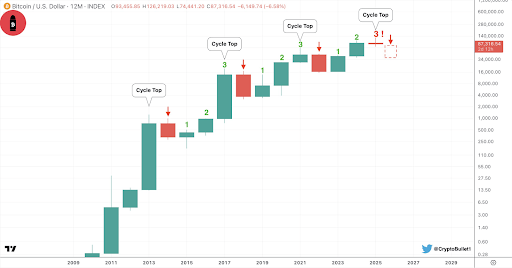
Bitcoin Chart Image From X. Source: @CryptoBullet1
What To Expect For Bitcoin In 2026
Responding to comments on his technical analysis on X, Crypto analyst CryptoBullet reiterated that he is sticking with an analysis he first shared on December 2, which also proposes that Bitcoin’s cycle top is already in. Bitcoin opened 2025 around $93,396 and has since fallen well below its October peak, a structure he says closely resembles the post-top consolidation seen in 2019.
Related Reading
In that earlier cycle, Bitcoin spent months trading roughly 30% below its high while altcoins, measured through the OTHERS/BTC chart, formed a cycle bottom and began to recover. CryptoBullet believes the same dynamic is unfolding now, but on a larger scale, with altcoins having underperformed Bitcoin for nearly four years.
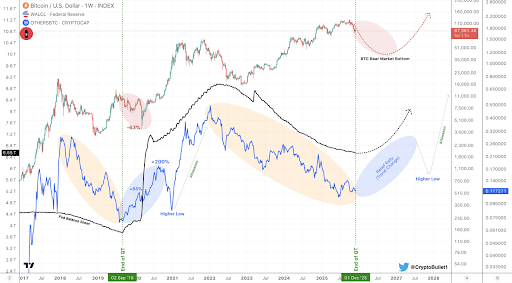
Bitcoin Bear Market Setup. Source: @CryptoBullet1 on X
Based on that setup, he expects a dead cat bounce in early 2026, accompanied by a short-lived rotation into altcoins, before a much deeper correction takes hold across Bitcoin as the bear market progresses.
Featured image created with Dall.E, chart from Tradingview.com
Will Shiba Inu Still Survive in 2026? On-Chain Data Answers Pintu
Source link ]]>
What Will be Cardano’s (ADA) Most Likely Price on Christmas? 4 AIs Give Shocking Answers CryptoPotato
Source link ]]>
Will The Shiba Inu Price Hit A New All-Time High In 2025? Machine Learning Algorithm Answers TradingView
Source link ]]>
XRP’s decline in recent weeks has led to questions among holders who worry that Ripple may be pushed into selling more of its XRP reserves to maintain operations. This concern resurfaced as discussions around Ripple’s shifting business model gained traction, especially with the company’s RLUSD stablecoin.
The conversation was held on the social media platform X, where Ripple’s Chief Technology Officer, David Schwartz, stepped in to address whether a lower XRP price could force Ripple into additional token sales.
Ripple CTO Says Falling Prices Do Not Increase Selling Pressure
Schwartz’s comment came as a response after a user argued that Ripple might gradually shift its priorities away from XRP because RLUSD is tied directly to fiat reserves, unlike the cryptocurrency. The user’s argument is that this difference could leave Ripple less exposed to XRP’s price movements and more inclined to depend on the stablecoin during uncertain market periods.
Related Reading
This could create a scenario in which Ripple becomes insulated from XRP’s market swings, potentially making it less motivated to support the token if its price declines.
Schwartz pushed back strongly against that line of reasoning. He made it clear that the assumption that falling prices increase the company’s need to offload XRP is misguided. He pointed out that Ripple’s broader revenue structure now allows the company to operate without relying on market conditions to stay afloat.
In his view, new income channels lessen the chances that Ripple would ever face a situation where it must sell XRP to sustain operations.
Ripple Needs To Diversify
Part of the tension around potential XRP sales comes from Ripple’s business model. The company has always earned a sizable portion of its income from controlled XRP sales, even though it also offered enterprise products such as cross-border payment solutions through RippleNet.
However, public reports from previous years showed that these software licensing fees and enterprise offerings brought in smaller revenue compared to the revenue gained through XRP sales. This is why there have been concerns that heavy selling during market dips could weigh on XRP’s price.
Related Reading
An important part of Ripple’s token management is the escrow program, which unlocks 1 billion XRP tokens in scheduled monthly releases. This mechanism was originally designed to bring predictability to XRP’s circulating supply and prevent sudden large inflows into the market.
Ripple typically returns most of the unlocked XRP (70% to 80%) back into escrow each month, releasing only a small amount for operational purposes. This structure limits the potential impact Ripple can have on market liquidity at any given time.
However, the company currently depends much on XRP sales, and there is a pressing need to look for more sources of income. Schwartz’s comments show that Ripple is not positioned in a way that requires dumping XRP, even as the token trades near recent lows.
Featured image created with Pxfuel, chart from Tradingview.com
In a recent post on X, crypto analyst Pumpius argued that the recent drop in XRP’s price is not natural but the result of deliberate actions by Binance. According to him, the exchange wants to protect its position because the digital currency poses a threat to the system it has built over the years. He says the exchange is doing more than just selling tokens; it is working to hold XRP back.
Binance Accused Of Coordinating XRP Price Suppression
Pumpius says Binance is not only selling XRP but is also actively manipulating the market around it. He points to sudden drops in liquidity, heavy waves of sell pressure, and red flashes on charts that appear whenever there’s an announcement of positive Ripple news. He claims this is not a coincidence but evidence of coordination and a strategy to keep XRP from breaking out.
Related Reading
The analyst stresses that the real reason Binance targets XRP is that it is different. XRP is not a meme or speculative bet but a payment infrastructure. Pumpius argues it could replace the liquidity pools that Binance has used for years, and if that happens, the exchange’s market-making business could crumble.
He also warns that it is not only Binance that is involved. According to him, powerful investors, legacy financial players, and offshore networks all see XRP as a threat. He says that because XRP runs on transparent rails, it could expose money flows they prefer to keep hidden. Therefore, price suppression becomes their primary tool to slow down the process.
Why Suppression Could Backfire As XRP Price Fundamentals Strengthen
Despite these heavy claims, Pumpius argues that the pressure on XRP may backfire. The crypto expert points to Ripple and its ecosystem, noting that the fundamentals are strengthening every day. New payment corridors are opening in Japan and the UAE. Projects such as DNA Protocol are using the XRP Ledger to anchor IDs and even genetic data.
Related Reading
Pumpius believes this shows the suppression is artificial. The fundamentals are exploding, he says, while the adverse price action comes from deliberate dumping. He adds that every time Binance sells, more XRP moves into self-custody wallets. Instead of weakening the community, this decentralizes the asset even more. Holders are preparing for the day when real utility drives demand at a scale far beyond speculation.
In his view, when that switch flips, Binance’s paper games will be meaningless compared to trillion-dollar settlement flows. He warns that the exchange may think it is winning now, but it’s only exposing the truth about the digital currency. XRP, he says, is not just a trader’s coin. It is the backbone of a new financial order. And according to him, no amount of dumping can stop already living rails.
Featured image from Dall.E, chart from TradingView.com
XRP has just dropped below $3, but the market may not be as bearish as it looks. The price fell into the 0.382 Fibonacci retracement level at $2.96, a significant support zone. The wick to $2.94, which matched the 0.618 subwave target, quickly reversed and reclaimed $2.96. This fast recovery is classic behavior often seen when a market finds its bottom.
According to market analyst Casi Trades, the current setup could open the door for XRP to stabilize and possibly aim for higher targets, with levels like $4.80 already on the radar.
XRP Holds Strong At $2.96 Support
XRP’s latest price action delivered exactly what technical analysts were waiting for. Adding even more weight to the case for a bottom is the Relative Strength Index (RSI). The RSI printed bullish divergence on both the 15-minute and the 1-hour charts.
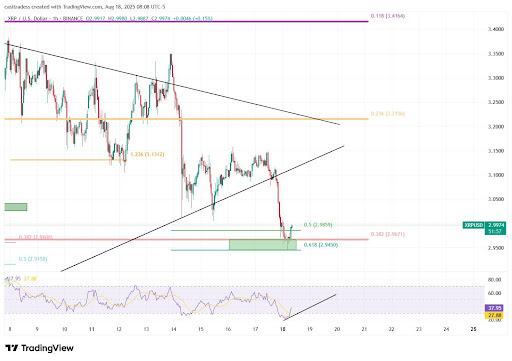
While prices were falling, the RSI showed higher lows, signaling momentum was shifting in favor of buyers. Combined with the clear 5-wave downward move on the chart, Casi Trades believes this confirms that XRP has completed its correction phase.
Related Reading: Dogecoin Eyes 1,000% Increase To Reach $2.55 ATH This Cycle
The analyst explained that the drop into $2.96, followed by an immediate bounce, shows that the market “was hunting for a bottom, and XRP delivered.” The combination of Fibonacci levels, divergence signals, and clean wave structure makes this support zone one of the most important in the current cycle.
Bullish Outlook And Upside Targets
Now that XRP has hit and held the $2.96 support, traders focus on the next phase. Casi Trades noted that XRP may linger around this level or retest it again, but its holding is already a positive sign.
The market analyst expects large-cap cryptocurrencies, including XRP, to lead the next wave of gains. With support confirmed, attention is now shifting to upside targets. The most critical one mentioned is $4.80, but the analyst believes the momentum could carry XRP even higher if conditions remain favorable.
Related Reading
This bullish outlook is fueled not just by XRP’s chart but also by broader market conditions. Large caps tend to move together when sentiment improves, and XRP holding its ground at $2.96 is a signal of strength. “From these support lows across the market, I expect things to turn exciting and bullish,” Casi Trades commented.
If the impulsive upside resumes, XRP’s recovery from this support zone could mark the beginning of a strong upward leg.
For now, all eyes remain on the $2.96 level. As long as XRP holds above it, the case for a bullish rally stays strong. The market setup points to higher prices, whether it takes off immediately or after a brief consolidation. With the potential for a run toward $4.80 and beyond, XRP’s sharp drop may have just set the stage for its next big move.
Featured image from Dall.E, chart from TradingView.com
Digital Assets Director Bo Hines confirmed that the Strategic Bitcoin Reserve is still on track, despite its absence from the latest crypto report. The government, according to him, is working on establishing a Bitcoin reserve, a process that requires significant time and effort to ensure its longevity and success. US Bitcoin Reserve Plan Remains Active,
The post Will Strategic Bitcoin Reserve Make a Comeback? Digital Assets Director Bo Hines Answers appeared first on CoinGape.
]]>Will Elon Musk Pick XRP Over Dogecoin For X Payments? Market Expert Answers | Bitcoinist.com Bitcoinist.com
Source link ]]>
Will The Dogecoin Price Resume Its Rally Toward $1? Inverse Head And Shoulders Pattern Has Answers | Bitcoinist.com
Source link ]]>