
- CCA runs fully on-chain auctions that clear bids block by block for gradual price discovery.
- After auctions end, liquidity is automatically added to a Uniswap v4 pool at the final cleared price.
- The model aims to reduce sniping, front-running, and bundled transactions during token launches.
Uniswap has rolled out its Continuous Clearing Auctions (CCA) feature on Base, giving developers a new way to launch tokens fully on-chain with built-in price discovery and automatic liquidity setup.
The decentralised exchange confirmed the rollout on Jan. 22, with the CCA framework now available to builders using Uniswap v4 on the Base network.
The update expands Uniswap’s structured token launch tools to one of the busiest Ethereum layer-2 ecosystems, offering teams a single workflow for auctions, pricing, and liquidity.
With CCA now live for Base developers, projects can run token sales that settle gradually over time rather than relying on one-time listings or fixed-price launches that can trigger sharp price swings.
What CCA does on Base
CCA allows teams to run fully on-chain token auctions where tokens are sold gradually instead of all at once.
The mechanism clears bids block by block, which helps prices form naturally before open trading begins.
Once the auction ends, liquidity is added automatically to a Uniswap v4 pool at the final cleared price.
This reduces the need for teams to manually create a pool after launch and aims to avoid common listing issues linked to sudden volatility at the start of trading.
Developers can also adjust auction settings to fit their launch requirements while keeping the entire process on-chain and transparent.
How auctions reduce launch risks
The model is designed to create a fairer starting point for new tokens by spreading distribution over time.
Rather than concentrating activity into a single launch moment, CCA introduces a phased selling process that can lower the impact of sniping, front-running, and bundled transactions.
By clearing bids over multiple blocks, the auction format supports more gradual price discovery.
This can help reduce sharp dislocations that often happen when tokens go live with limited liquidity or when early trading activity is dominated by automated strategies.
For teams, this approach bundles the early steps of a token launch into one on-chain flow, covering auction mechanics, pricing formation, and liquidity provisioning without requiring separate manual actions.
Open access for all Base developers
Uniswap’s deployment on Base is open to all developers building on the network. The feature does not require approvals or special access, meaning any team can integrate CCA into its token launch process.
This open availability may appeal to projects looking for alternatives to private sales or unstable fair-launch formats.
It also supports teams that want a more standardised on-chain approach to distributing tokens while setting up liquidity in a predictable way once the auction completes.
With CCA, teams can rely on the auction’s final cleared price to determine the pool setup, rather than selecting an initial listing price independently.
Uniswap’s wider v4 expansion
The Base rollout follows Uniswap’s broader expansion of v4 tools across multiple chains in recent months.
CCA was rolled out in late 2025 and has already been used by projects such as Aztec Network for early price discovery and liquidity setup.
Uniswap has also been integrating with partners such as Revolut for fiat access and Ledger for safe swaps via its trading API.
Separately, the protocol has gone live on networks including Monad and X Layer.
By bringing CCA to Base, Uniswap is extending structured launch infrastructure into a major Ethereum layer-2 environment, while continuing to expand its product suite and chain support across decentralised finance.
With Cardano and XRP Interest Rising, Zero Knowledge Proof’s Presale Auctions Promise a Fresh Direction for Privacy Analytics Insight
Source link ]]>
Silk Road founder Ross Ulbricht has raked in $1.8 million in Bitcoin from the sale of personal items linked to his incarceration. His prison ID card pulled in 11 BTC while an oil painting earned 1.2 BTC from the auction. Ross Ulbricht Earns Nearly $2 Million In Bitcoin From Prison Mementos As Ross Ulbricht savors the taste of freedom after over a decade behind bars, the Silk Road founder is parting ways with his items from prison. According to a listing description on Bitcoin-based marketplace Scare City, Ulbricht opted to auction the personal effects from his time in prison. “I’ve decided to auction some personal items from before my arrest and during my time in prison,” said Ulbricht. “I don’t need the reminders and I’m sure some of you will love to havee them.” Right off the bat, bids for the items began trickling in with Ulbricht’s prison ID card… Read More at Coingape.com
The post Ross Ulbricht Auctions Prison Memorabilia, ID Card Sells For 11 Bitcoin appeared first on CoinGape.
]]>Bitcoin accelerator ViaBTC has auctioned off the “epic” satoshi it mined for 33.3 Bitcoin which is approximately $2.13 million based on the current market value of the flagship cryptocurrency.
The Historic ViaBTC Auction
Upon the conclusion of fourth Bitcoin halving on April 20, ViaBTC mining pool won the competition to mine the first satoshi. It immediately decided to auction the ‘prize’ to interested bidders who are willing to pay enough. The auction for the epic “sat”, as crypto exchange CoinEx called the smallest denomination of Bitcoin, had a face value of $0.0006.
Notably, the auction was conducted on the CoinEx crypto exchange.
The completed auction seen the sat sold for a whopping $2.13 million. As expected, the auction recorded participation from several bidders who made the competition tough. Noteworthy, this epic sat is the first one produced by the Bitcoin launch before the reset of the Block count that will start the countdown to the next halving.
Therefore, it was expected that the offering would pique the interest of many crypto enthusiasts. Certain commentators even speculated that it could be worth millions of dollars. On X, CoinEx stated the auction is more than a bidding event, while adding that it signifies recognition, media attention and widespread embrace for the Bitcoin community.
Bitcoin 4th Halving Surpass Expectations
In past Bitcoin halving events, there wasn’t much at stake besides the prestige of mining the first block after the halving. The coming of Ordinals protocol brought a new view to how the sat is perceived. Satoshi, which is equivalent to 0.00000001 BTC, can now be identified and traded on blockchains like they were unique tokens, more like Non-fungible Tokens (NFTs) on other networks.
In a rarity categorization explained by Casey Rodarmor, the creator of Ordinals, these sat could be “uncommon,” that is, the first sat of each block; “rare,” the first one after Bitcoin’s fortnightly difficulty adjustment; or “epic,” the first after a quadrennial halving.
It is not yet certain what ViaBTC will do with with proceed from the auction. Current speculation suggests it have plans of redistributing the auction profits entirely to miners. At the time of writing, Bitcoin was trading for $64,745.97, up 1.11% in 24 hours.

The presented content may include the personal opinion of the author and is subject to market condition. Do your market research before investing in cryptocurrencies. The author or the publication does not hold any responsibility for your personal financial loss.

- IOG has collaborated with MLabs10 for the creation of a reference implementation of an auction using Hydra protocols.
- As a layer 2 scaling solution, Hydra offers a variety of benefits for digital assets auctions.
The engineering company known as Input and Output Global (IOG), popular for creating the Cardano blockchain, is partnering with Blockchain and fintech consultancy firm MLabs10, to create a reference implementation of an auction, by using the Hydra head protocol to facilitate the development.
In a recent blog post from one of Cardano’s medium pages, the announcement notes that the partnership will kick off with the introduction of a paper that lays out the steps required for the implementation stage, along with pros, cons, and hindrances of running auctions on Hydra.
ICYMI: IOG collaborates with @MLabs10 to propose a way for handling auctions using Hydra. This will allow #Cardano developers to start using Hydra for scalability in common practice.
Find out more
https://t.co/IdKoCeOZZ9
— Input Output (@InputOutputHK) January 22, 2023
Decentralized auctions, also known as blockchain auctions, are a more sustainable alternative to physical auctions for a myriad of reasons. Some benefits include stronger data security, along with the exclusion of a centralized body in charge of the auctions.
There are also no third parties needed to facilitate transactions, and data stored from each auction is made transparent and immutable. Blockchain auctions are enabled by smart contracts, which help buyers and sellers seamlessly carry out transactions.
This collaboration aims to demonstrate the feasibility of the current implementation of the Hydra Head protocol to develop auction applications. The proposed reference implementation also constructively determines and aligns the Hydra Head protocol design with the concrete use cases in the Cardano ecosystem.
How Hydra can help facilitate blockchain auctions
Hydra is a scalability solution that runs on Cardano. It functions as an open-source framework that aids the creation of edgers that are built off-chain, while also helping developers utilize blockchains more efficiently.
Hydra is especially useful for digital asset auctions, because of its layer 2 scalability solutions, which outperform the layer 1 scaling solutions.
When compared to the Cardano main chain (layer 1), the hydra head channels (2), provide benefits that include cheaper transaction fees or no transaction fees at all. With cheaper fees, bidders, auction houses, and sellers pay a significantly lower price than they would on the Cardano layer 1 chain.
The hydra head channel also allows for increased transaction speed, which then results in an increased high bidding frequency during auctions.
Explaining Hydra’s potential effect on the auction process, the blog post explained that ;
Cardano can run different auction types using the Hydra Head protocol. Auction designs on a single Head can cover basic single-head auctions, single-head secret auctions, delegated custodial auctions, voucher auctions, or delegated voucher auctions. Auction designs on networks of Hydra Heads can cover such cases as star-shaped auctions or constellation schema auctions.
No spam, no lies, only insights. You can unsubscribe at any time.
Team members behind the project have chosen to use a delegated voucher auction design and core English-style auction features for the reference implementation.
The auction’s design will present both sellers, bidders, and buyers with many notable features using Hydra, throughout the auction process.
Crypto News Flash does not endorse and is not responsible for or liable for any content, accuracy, quality, advertising, products, or other materials on this page. Readers should do their own research before taking any actions related to cryptocurrencies. Crypto News Flash is not responsible, directly or indirectly, for any damage or loss caused or alleged to be caused by or in connection with the use of or reliance on any content, goods, or services mentioned.

The Cardano price continues to suffer a downtrend throughout the month of November. Over the last 24 hours, ADA registered a 0.6% depreciation. ADA’s next upcoming trading sessions remain crucial as the market is expected to move out of lateral trading.
Depending on how quickly it breaks through its current resistance. The bears continue to pull down the price level. Bears will continue to succeed if ADA doesn’t claim the $0.36 price.
A buying resurgence could help ADA move upwards, marking the start of bullish price action. Continued demand for the coin can also potentially form a rally. The overhead hurdle of $0.32 remains crucial for the altcoin. Today’s global cryptocurrency market cap is $879 billion, with a 0.0% change in the last 24 hours.
Cardano Price Analysis: One-Day Chart
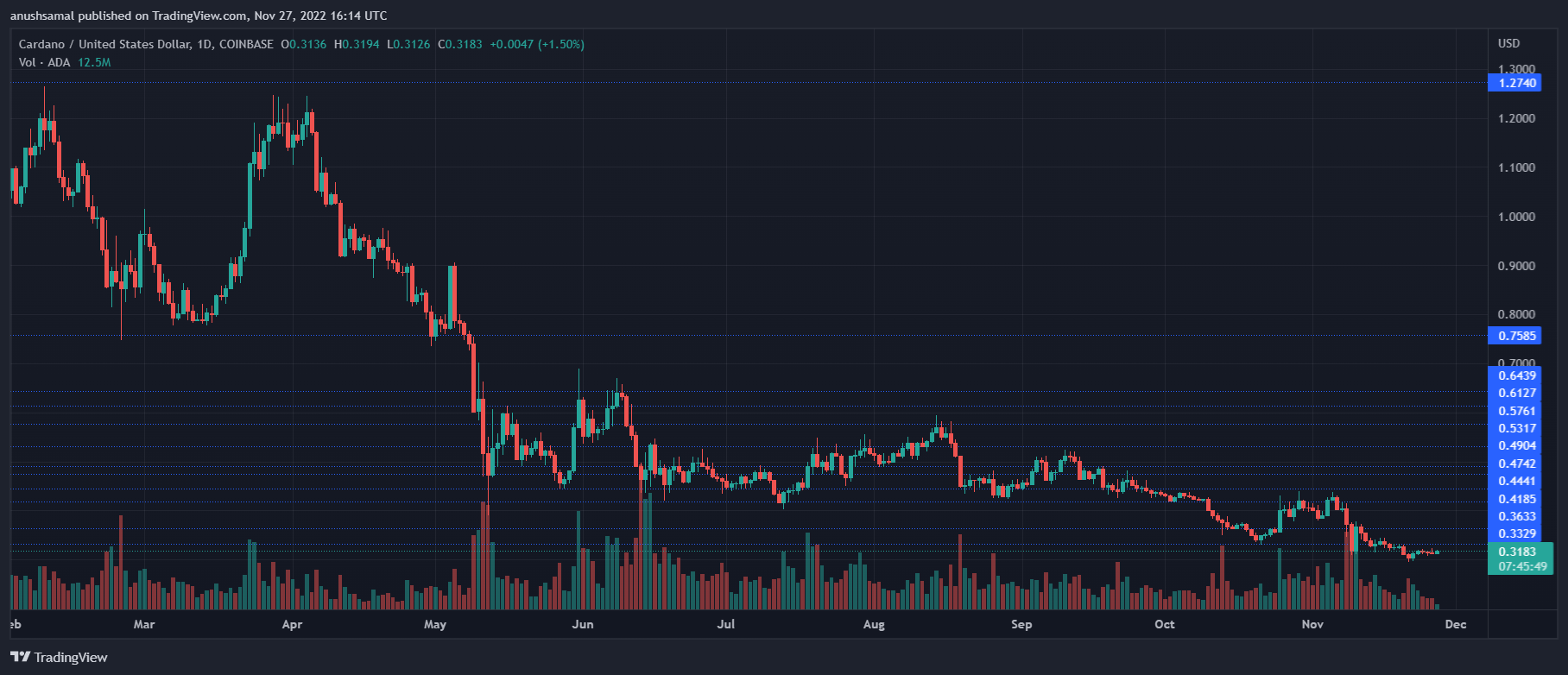
ADA was exchanging hands at $0.31 at press time. Over the last 24 hours, Cardano’s price witnessed an increase in buying pressure. Immediate resistance for ADA is awaited at $0.32. After overtaking the aforementioned price mark and flipping it into a support floor, there are chances of ADA appreciating by 18%.
Moving above the $0.32 price mark will propel the asset price to $0.36 first and then to $0.38. On the flip side, if ADA cannot break past the $0.31 level, it will cause the coin to fall to $0.29. The amount of Cardano exchanged in the past session was in green, indicating that demand grew for the altcoin.
Technical Analysis
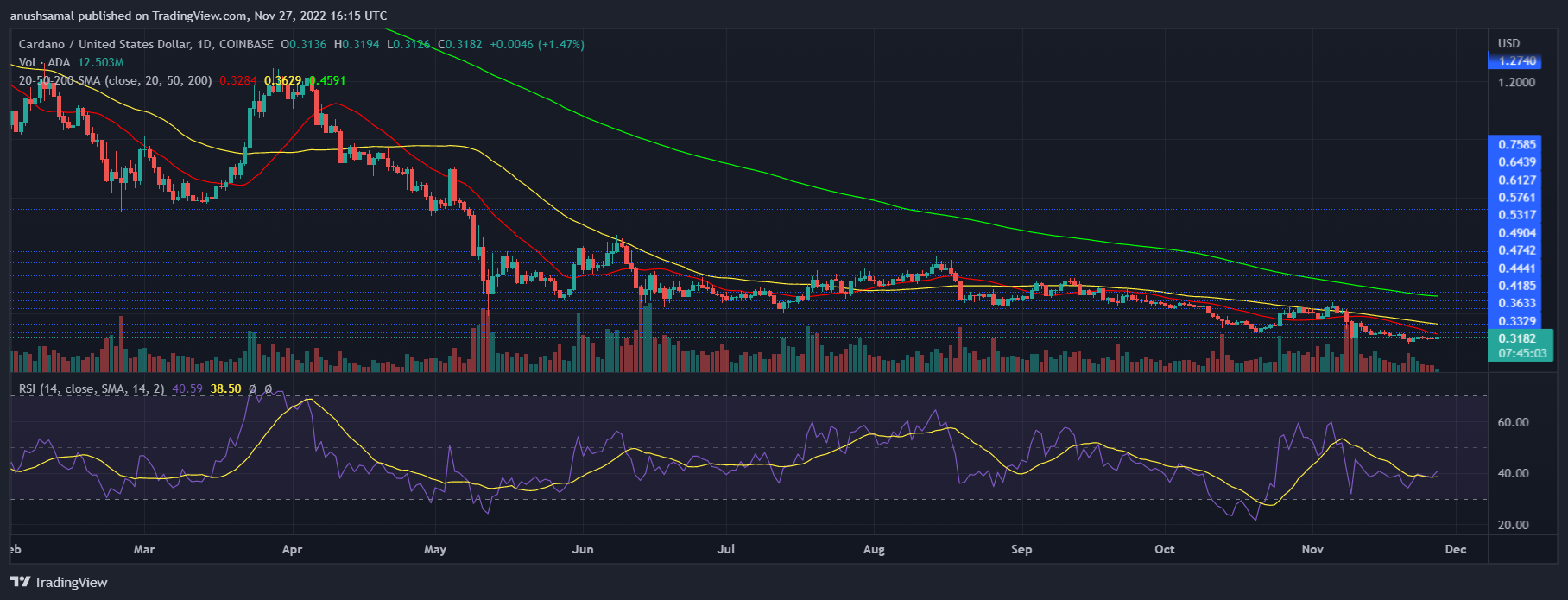
Since November 26, the coin has registered a slight growth in buyers. The Relative Strength Index shot slightly past the 40-mark, noting a slight increase in demand.
The buying strength, however, continues to be neutral. The price of the altcoin was below the 20-Simple Moving Average. This reading indicated that the selling pressure continues to dominate as sellers drive the market’s price momentum.
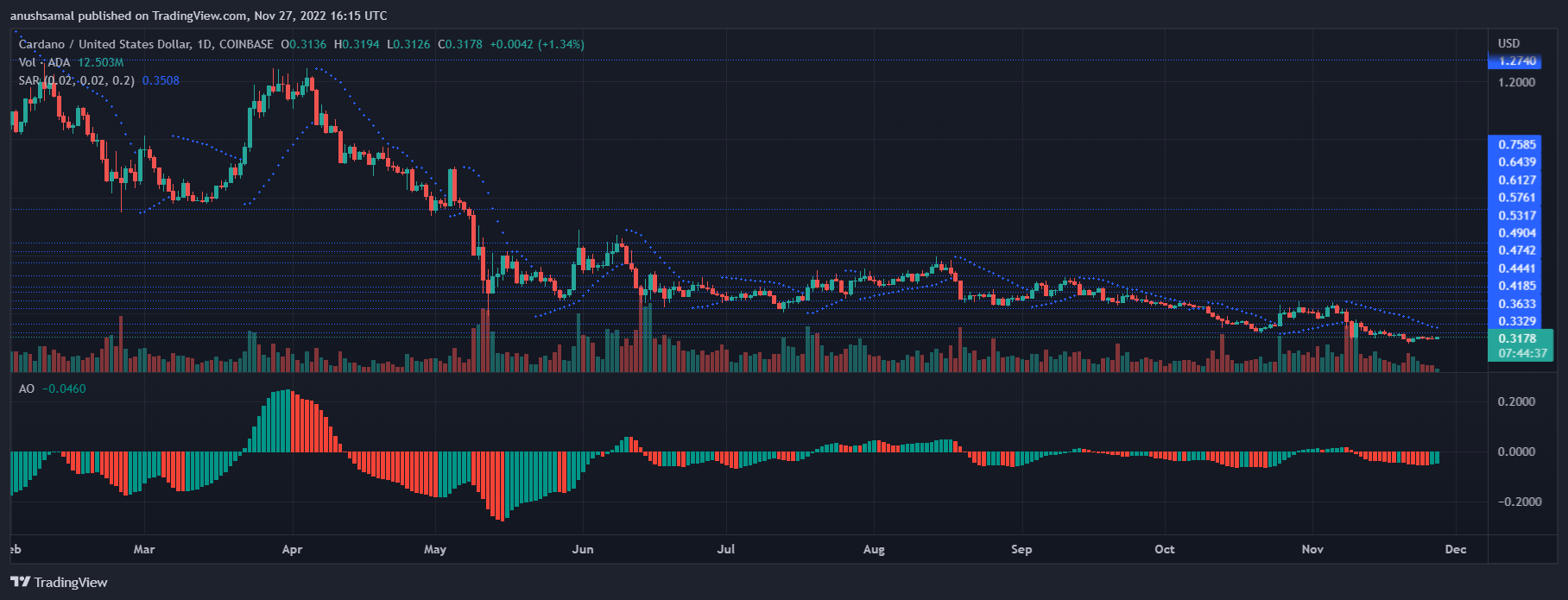
ADA has also witnessed mixed signals on the one-day chart. Per the buying strength, the Awesome Oscillator also started to depict positive price action. The green signal bars on AO were the buy signal for the coin.
On the other hand, the Parabolic SAR signaled that downward price movement. The dotted lines were above the price candlestick, indicating that the bears continue to drive the price action in the market. ADA must cross the $0.32 threshold for bullish forces to take over.
Oscar Mayer Auctions Off Single Pack of ‘Hot Doge Wieners’ Worth 10,000 Dogecoins – CoinDesk CoinDesk
Source link ]]>
Oscar Mayer Auctions Off Single Pack of ‘Hot Doge Wieners’ Worth 10,000 Dogecoins Yahoo Finance
Source link ]]>
 Insider Info in my Socials
  https://guy.coinbureau.com/socials/
 20% Binance Discount https://guy.coinbureau.com/binance/
 “Crypto Bae” Shirt https://store.coinbureau.com
 TOP Crypto TIPS In My Newsletter https://guy.coinbureau.com/signup/
~~~~~
 Essential Videos
Previous Polkadot Parachains Video https://youtu.be/KzqLf7Kteuk
First Kusama Video https://youtu.be/mNSuvYaJ2Vg
Parachain Slot Auction Process In Detail https://youtu.be/sxju74QqYuA
Cryptocurrency Tokenomics Tutorial https://youtu.be/ftCaqG7wckg
How To Research Cryptocurrencies https://youtu.be/HCLWDGYnAzk
~~~~~
– TIMESTAMPS –
0:00 Intro
1:55 Kusama Update
3:39 Parachain Slot Auctions Recap
6:13 Parathreads, Common Good Parachains, Parachains Roadmap
8:38 Parachain Slot Auction Timeline
14:06 How To Participate In Parachain Slot Auctions
15:31 KSM Price Analysis
17:07 Possible Parachain Problems
20:13 Conclusion
~~~~~

 Useful Links
► Polkadot.js Browser Wallet Extension: https://polkadot.js.org/extension/
► Polkadot.js Web App: https://polkadot.js.org/apps/?rpc=wss%3A%2F%2Frpc.polkadot.io#/explorer
► Polkadot Projects Waiting For Slot Auctions (Not All): https://polkaproject.com/#/slot
► Parachain Slot Auction Timeline: https://medium.com/polkadot-network/the-launch-of-parachains-78188fcf024f
► Common Good Parachains Explained: https://polkadot.network/common-good-parachains-an-introduction-to-governance-allocated-parachain-slots/
► Kusama Twitter To Keep Up With Parachain Updates: https://twitter.com/kusamanetwork
~~~~~
 Kusama Recap
Kusama was created by Dr. Gavin Wood as a way of testing Polkadot under real economic conditions. Unlike a regular testnet, Kusama exists as its own independent cryptocurrency
In terms of tech, Kusama and Polkadot are basically identical. The two primary differences are that Kusama’s code is not audited, and all non-transaction related processes are 4 times faster on Kusama

 Parachain Slot Auctions Recap
Regular parachains are acquired through the parachain slot auction process. Like regular auctions, parachain slot auctions involve bidding on a slot using money, in this case KSM or DOT tokens
In contrast to regular auctions, the winner of a parachain slot auction is determined based on a snapshot that is taken at a random time shortly before the auction ends
The difference between ICOs and parachain slot auctions is you never actually give your money or crypto. It just gets locked in the smart contract that connects that project’s parachain to the relay chain
Prathreads, Common Good Parachains, And Parachains Roadmap
The primary difference between parathreads and regular parachains is that parathreads can be shared by multiple projects which take turns producing blocks as needed
Once Kusama’s first common good parachain has been up and running for a day or two with no major issues, Kusama will announce the start of its parachain slot auctions on its website and on Twitter
 Parachain Slot Auction Process
As far as I understand, Kusama will be announcing its parachain slot auctions just over a week before the first one begins
This is to give enough time for everyone staking KSM to unstake so they can participate in the first parachain slot auction. The KSM unstaking period is 7 days in case you’re wondering
 How To Pick A Polkadot/Kusama Project For PLO
An easy way to keep track of which projects will be launching on Kusama is to use the Slot tab of the Polkaproject website. Just note that there are other Kusama projects that are not mentioned here
Once you’ve identified a few Kusama projects that you think have potential, the next step is check what the terms and conditions are for their parachain loan offerings
 How To Participate In Parachain Slot Auctions
To actually participate in Kusama’s parachain loan auctions, you need to have the polkadot.js browser extension wallet and use it with the Polkadot.js web app
 KSM Price Analysis
It’s possible that the demand that will be created by parachain slot auctions on Kusama has already been priced in to KSM. Late adopters could still push up the price like mad when they begin however
 Possible Parachain Problems
There are only two things that could take the wind out of Kusama’s wings and these are network issues and Polkadot’s own upcoming parachain slot auctions
~~~~~
 Disclaimer
The information contained herein is for informational purposes only. Nothing herein shall be construed to be financial legal or tax advice. The content of this video is solely the opinions of the speaker who is not a licensed financial advisor or registered investment advisor. Trading cryptocurrencies poses considerable risk of loss. The speaker does not guarantee any particular outcome.
#Kusama #KSM #polkadot #parachains #DOT
source
✓ Share: