ChatGPT Shiba Inu Price Prediction Points to $0.000085 While Pepeto Presale Targets Bigger Multiples Before Listing FinanceFeeds
Source link ]]>
Dogecoin Breakout Mirrors Past Trend — Bigger Move Coming? Cryptonews.net
Source link ]]>
Aayush Jindal, a luminary in the world of financial markets, whose expertise spans over 15 illustrious years in the realms of Forex and cryptocurrency trading. Renowned for his unparalleled proficiency in providing technical analysis, Aayush is a trusted advisor and senior market expert to investors worldwide, guiding them through the intricate landscapes of modern finance with his keen insights and astute chart analysis.
From a young age, Aayush exhibited a natural aptitude for deciphering complex systems and unraveling patterns. Fueled by an insatiable curiosity for understanding market dynamics, he embarked on a journey that would lead him to become one of the foremost authorities in the fields of Forex and crypto trading. With a meticulous eye for detail and an unwavering commitment to excellence, Aayush honed his craft over the years, mastering the art of technical analysis and chart interpretation.
As a software engineer, Aayush harnesses the power of technology to optimize trading strategies and develop innovative solutions for navigating the volatile waters of financial markets. His background in software engineering has equipped him with a unique skill set, enabling him to leverage cutting-edge tools and algorithms to gain a competitive edge in an ever-evolving landscape.
In addition to his roles in finance and technology, Aayush serves as the director of a prestigious IT company, where he spearheads initiatives aimed at driving digital innovation and transformation. Under his visionary leadership, the company has flourished, cementing its position as a leader in the tech industry and paving the way for groundbreaking advancements in software development and IT solutions.
Despite his demanding professional commitments, Aayush is a firm believer in the importance of work-life balance. An avid traveler and adventurer, he finds solace in exploring new destinations, immersing himself in different cultures, and forging lasting memories along the way. Whether he’s trekking through the Himalayas, diving in the azure waters of the Maldives, or experiencing the vibrant energy of bustling metropolises, Aayush embraces every opportunity to broaden his horizons and create unforgettable experiences.
Aayush’s journey to success is marked by a relentless pursuit of excellence and a steadfast commitment to continuous learning and growth. His academic achievements are a testament to his dedication and passion for excellence, having completed his software engineering with honors and excelling in every department.
At his core, Aayush is driven by a profound passion for analyzing markets and uncovering profitable opportunities amidst volatility. Whether he’s poring over price charts, identifying key support and resistance levels, or providing insightful analysis to his clients and followers, Aayush’s unwavering dedication to his craft sets him apart as a true industry leader and a beacon of inspiration to aspiring traders around the globe.
In a world where uncertainty reigns supreme, Aayush Jindal stands as a guiding light, illuminating the path to financial success with his unparalleled expertise, unwavering integrity, and boundless enthusiasm for the markets.

Ethereum is trading above $2,300. The 8-9% move in 24 hours has it outperforming Bitcoin. And an XWIN Research Japan analysis has identified something that separates the current rally from every short-term bounce Ethereum has produced in the past several months: the catalysts this time are not the same kind.
The analysis documents a simultaneous convergence of three independent developments arriving within days of each other. On April 13, the SEC issued a staff statement clarifying that certain DeFi user interfaces — front-ends and wallet-based applications — may operate without broker-dealer registration provided they meet specific conditions.
In practical terms, the regulator that has cast the longest shadow over DeFi’s institutional adoption just signaled that DeFi can be treated as a neutral technology layer rather than a securities distribution mechanism. That is not a minor clarification. It is a structural reduction in regulatory risk for the entire Ethereum ecosystem.
The on-chain data confirms the shift is being felt in real behavior. Active addresses on Ethereum are trending upward — network usage is expanding, not just price. Simultaneously, the Coinbase Premium Gap is improving, suggesting that US-driven demand — the institutional demand that has been conspicuously absent during previous recovery attempts — is beginning to return.

Three catalysts. One week. None of them is leverage.
Institutions Have Arrived
The XWIN Research Japan analysis adds the capital layer that transforms the regulatory and on-chain signals into a complete structural picture. ETF inflows have recorded three consecutive days of net inflows, reaching the highest weekly levels of 2026. These are not traders responding to a price move — they are portfolio allocators making sustained, deliberate decisions to increase Ethereum exposure at the institutional level. Three consecutive positive days at a 2026 weekly high describe conviction, not momentum.
At the corporate level, the signal is even more specific. Bitmine now holds approximately 4.8 million ETH — more than 4% of Ethereum’s total supply — having added over 70,000 ETH in the past week alone. The parallel to MicroStrategy’s Bitcoin accumulation strategy is not incidental. It is the point.
When a publicly listed company begins treating an asset as a treasury reserve rather than a speculative position, it removes supply from the liquid market permanently and signals a conviction about long-term value that short-term price action cannot produce.
The analysis names the combined picture with precision: this is not a leverage-driven bounce. It is a structural shift. Regulatory clarity, institutional inflows, and rising network activity have arrived simultaneously — and when those three forces align in the same asset at the same time, the question stops being why the price rose and starts being what the asset is becoming.

Ethereum is transitioning toward something the analysis calls a DeFi infrastructure asset — a category distinct from speculative token and distinct from store of value, one where the network’s utility as a settlement and execution layer for global finance becomes the primary driver of institutional demand. The price has started to reflect that transition. The structure beneath it suggests the transition is not finished.
Ethereum is attempting a recovery after a sharp structural breakdown in February that drove the price from the $3,000 region to sub-$2,000 levels in a high-volume capitulation move. That event remains the dominant feature of the chart, marking a clear shift from a distribution phase into a reset of positioning.
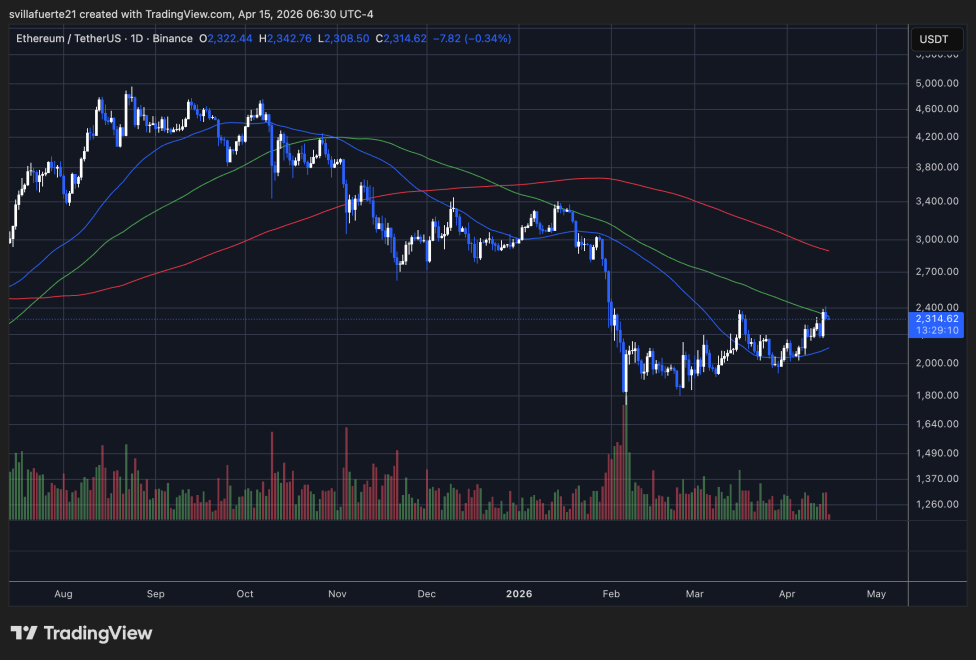
Since then, ETH has established a base between roughly $1,900 and $2,200, with repeated higher lows suggesting gradual absorption of sell pressure. The recent push toward $2,300–$2,400 places price back into a critical supply zone, previously acting as support before the breakdown and now functioning as resistance.
Technically, ETH is still trading below the 200-day moving average (red) and the 100-day (green), both trending downward, confirming that the broader trend remains bearish despite short-term strength. However, the 50-day moving average (blue) is flattening and beginning to turn upward, indicating improving short-term momentum.
Volume has declined significantly compared to the February spike, suggesting that the recovery is controlled rather than impulsive. This typically reflects repositioning rather than aggressive speculation.
The key question is whether ETH can reclaim and hold above $2,400. Failure here likely extends the range. Acceptance above it would shift the structure toward a sustained recovery phase.
Featured image from ChatGPT, chart from TradingView.com
Editorial Process for bitcoinist is centered on delivering thoroughly researched, accurate, and unbiased content. We uphold strict sourcing standards, and each page undergoes diligent review by our team of top technology experts and seasoned editors. This process ensures the integrity, relevance, and value of our content for our readers.
The Cardano Foundation is becoming less dependent on ADA. Its latest report shows Bitcoin and cash now account for a much larger share of reserves after a year of sharp price divergence.
That shift changes how closely the Foundation’s balance sheet tracks the performance of Cardano’s native token.
In its 2025 Activity and Financial Insights Report shared with CryptoSlate, the Foundation said its total assets stood at 287.5 million Swiss francs, or about $361 million. This represents a 45% decline from the $659.1 million assets it held as of the end of 2024.
The drop in headline value reflected a difficult year for Cardano’s native token, ADA, but the more notable shift came in the composition of the Foundation’s holdings.
Why this matters: The Foundation has historically been one of the largest long-term holders of ADA, so changes to its treasury structure affect the degree of internal alignment between Cardano’s ecosystem and its core institution. A lower ADA concentration reduces direct exposure to the token’s price but also weakens the feedback loop linking the Foundation’s balance sheet to ADA’s performance.
A year earlier, the Foundation said 76.7% of its assets were held in ADA, 14.9% in Bitcoin, and 8.3% in cash, cash equivalents, and financial assets.
However, by the end of 2025, ADA’s share had fallen to about 51.6%, while BTC rose to 25.5%, and cash, cash equivalents, and financial assets climbed to 22.9%.
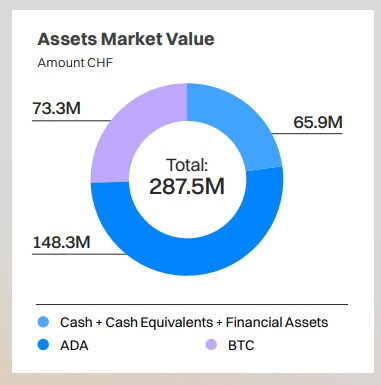
On that basis, the Foundation’s holdings worked out to roughly $186 million in ADA, $92 million in Bitcoin, and $83 million in cash and financial assets.
This essentially means that the Cardano-focused organization’s asset was no longer as concentrated in ADA as it had been a year earlier. Now, nearly half of the balance sheet was tied to Bitcoin, cash, and other financial assets.
How Bitcoin gained a foothold in Cardano’s Foundation assets
Bitcoin’s greater role in the portfolio did not stem from an increase in the Foundation’s BTC holdings.
In fact, the report showed that the Foundation significantly reduced its BTC holdings last year, down 37% to 656 BTC from 1,054 BTC a year earlier.
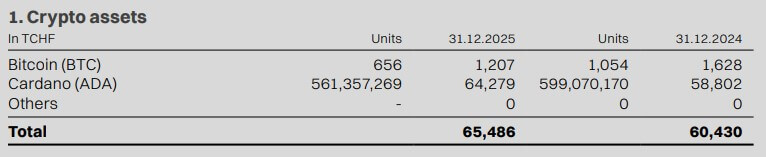
That means BTC’s increased share of the treasury was driven by relative performance and a broader reshaping of reserves, rather than by an outright accumulation of more BTC.
Market moves help explain the change. Data from CryptoSlate showed that ADA has fallen by roughly 63% over the past year, while Bitcoin has shown more resilience, declining by around 25%.
That divergence meant BTC did not need to rise in absolute terms to claim a larger place in the Foundation’s holdings. Instead, the top crypto’s greater resilience during the bear market helped it gain a stronger footing.
Meanwhile, the report also suggests the treasury was becoming more layered, with the Foundation finding more use cases for BTC and also expanding its cash holdings.
The Foundation said part of its Bitcoin allocation was invested in loans and collective investment schemes during 2025.
At the same time, its financial assets, including loans to third parties, investments, and shares, rose to 43.9 million Swiss francs (around $54.9 million) from 14.3 million Swiss francs (equivalent to $17.8 million) a year earlier.
Additionally, the organization’s cash and cash equivalents stood at 20.1 million Swiss francs, or $25.1 million.
Taken together, those figures show a reserve base moving beyond a straightforward ADA-and-bitcoin treasury into something more diversified and more actively managed.
Spending priorities shift
The change in portfolio mix was matched by a clearer reset in how the Foundation spent money in 2025.
The report said 23.6 million Swiss francs (equivalent to $29.5 million) was allocated across three strategic pillars, including technology, adoption, and governance.
Technology accounted for the largest share at 40.3%, or 9.5 million francs. Adoption followed at 39.6%, or 9.3 million francs, while governance spending represented 20.1%, or 4.8 million francs.
That marked a change from 2024, when the foundation grouped its work under adoption, operational resilience, and education. The new structure gives a sharper picture of where resources are now being directed and how the Foundation sees Cardano’s next phase.
Technology spending centered on protocol enablement, developer tooling, node diversity, interoperability frameworks, oracle infrastructure, and operational resilience.
The Foundation said it also increased its focus on community initiatives to improve liquidity and adoption in decentralized finance. At the same time, it expanded its Web3 adoption team with an emphasis on integrations, listings, and real-world asset efforts.
A significant part of the technology and adoption story was tied to digital identity. In 2025, the foundation launched Veridian, a privacy-preserving identity platform designed to let organizations issue and verify digital credentials anchored on Cardano.
Meanwhile, adoption spending covered enterprise solutions, identity and traceability systems, regulatory collaboration, education, and ecosystem partnerships.
The report said the foundation made Originate available as an open-source traceability solution, advanced the Reeve platform through internal use and its first enterprise proof of concept, and pushed Veridian into wider deployment, including a white-label rollout for the United Nations Development Program and the launch of the Veridian Wallet.
The Cardano Academy also expanded through new courses, distribution partnerships, and multilingual deployment. The Foundation said course material was extended to Binance Academy, which it said reaches more than 44 million learners, while collaborations also included the Blockchain Research Institute and Coursera.
Lastly, governance took a smaller share of the budget than technology and adoption, but it remained central to the Foundation’s 2025 agenda as Cardano deepened its commitment to decentralized decision-making.
The report highlighted support for the largest on-chain budget submitted so far on Cardano, resulting in 38 separate treasury withdrawal governance actions. It also pointed to the Foundation’s enterprise membership in Intersect and its work across committees tied to civics, budget, technical matters, product, open-source enablement, marketing, and oversight.
That participation fed into a series of initiatives, including work on the constitutional process, the Cardano 2030 vision and strategy, the Cardano Summit 2025 proposal, and the Cardano 2026 budget process.
The Foundation also said it supported tools aimed at widening participation in governance, including the open-source Cardano Voting Tool, a Proposal Examiner built with Griffin AI, updated governance documentation, and dedicated sessions at Cardano Summit 2025.
The foundation’s DRep Delegation Program distributed 140 million ADA to seven builder DReps, with a further 220 million ADA allocation to adoption and operational DReps announced. It also published the Constitutional Committee’s cold keys and expanded internal frameworks for delegation and elections as the governance transition continued.
2026 will test whether the reset works
The next question is whether the Foundation’s repositioning can translate into a stronger operating story for Cardano itself.
Frederik Gregaard, the Foundation’s chief executive, said the organization’s focus in 2026 would remain on technology, governance, and enterprise and institutional adoption.
He said the group would continue working to strengthen Cardano’s role in real-world asset infrastructure, support the expansion of stablecoin markets and DeFi liquidity, and build the open-source tooling needed for broader adoption.
Notably, this aligns with the blockchain network’s recent efforts to integrate the Pyth network, LayerZero, and Circle’s USDCx stablecoin. All of these efforts are geared towards expanding Cardano’s DeFi ecosystem and stablecoin supply to attract institutional support.
That leaves Cardano facing a clearer test in 2026 to determine if a more diversified balance sheet, combined with heavier spending on infrastructure, governance, and adoption, can help stabilize the economics around ADA itself.

- Bitcoin price tests $65,000 support amid oversold conditions and weak momentum.
- Rising US real yields and oil prices weigh on short-term buying pressure.
- Traders should watch the $68,400 resistance and $65,100 support for the next moves.
Bitcoin (BTC) is showing signs of short-term fatigue as it navigates a tricky market environment.
After failing to break above resistance near $68,400, BTC has retreated toward critical support between $65,600 and $65,100.
The cryptocurrency is now hovering in a delicate range, where technical oversold signals clash with potent macroeconomic pressures.
Technical analysis
The seven-day RSI currently sits at 32.37, suggesting that Bitcoin is nearly oversold.

This level often indicates a potential bounce, but the market has yet to show sustained buying strength. Short-term momentum is fragile, with price action struggling to maintain levels above $66,000.
Even though buyers have defended the $65,600 band so far, a break below $65,100 could signal a deeper correction.
Resistance remains firmly in place at $68,400, and attempts to push past it have been met with immediate selling. Traders should closely watch the $68,000–$68,500 zone, as it represents the ceiling for any short-term recovery attempts.
In this range-bound setup, the market is consolidating rather than trending decisively.
The macro headwinds shaping Bitcoin price movements
Bitcoin’s short-term struggles are compounded by external pressures.
Rising real yields, especially on 10-year TIPS in the United States, have increased the appeal of government bonds over risk assets like BTC.
As a result, investors seeking yield are diverting capital toward these safer instruments, leaving Bitcoin with weaker demand.
At the same time, WTI crude oil prices have surged past $103 per barrel and Brent crude oil prices have hit $114, adding another layer of market uncertainty.
Energy-driven inflationary concerns make the broader financial environment more cautious, further dampening appetite for speculative assets.
Adding to the pressure, a $2.2 billion payout by the FTX Recovery Trust to FTX creditors is scheduled for March 31, 2026.
Recipients may choose to liquidate portions of their holdings, which could add temporary selling pressure and keep BTC range-bound.
Even large buyers, often referred to as whales, are active but appear to be accumulating cautiously below $70,000.
This cautious accumulation suggests that institutional players are positioning for the long term but are unwilling to push aggressively at current levels.
What traders should expect this week?
Short-term momentum is still weak, so any bounce is likely to be contained unless macro conditions improve.
Overall, Bitcoin is at a crossroads, balancing oversold technical conditions against persistent bear pressures from rates, oil prices, and potential selling catalysts.
Traders should monitor the $65,100 level closely, as a decisive hold here would support consolidation between $65,100 and $68,000.
A break below this band could open the door to a further decline toward $63,000 or lower.
On the upside, sustained moves above $68,400–$68,500 would be required to challenge resistance near $70,000.
Next Shiba Inu: Crypto Winter Nears End as Pepeto Builds Momentum for a Bigger Breakout mexc.co
Source link ]]>
Bitcoin is hovering near the $71,000 mark, consolidating after recent swings as the market digests key liquidity zones. While price remains contained, underlying technical signals suggest a larger move may be brewing, with both upside breakouts and downside sweeps on the horizon.
A Bounce Back To $71,000 After Channel Support Holds
Crypto analyst Columbus highlighted Bitcoin’s resilience following a successful bounce from its channel boundary support. This technical reaction has allowed the price to grind steadily higher, reclaiming the $71,000 level. While the explosive momentum has begun to decelerate after that first reaction, the overall market structure remains decidedly constructive for the bulls as long as this newly reclaimed territory is defended as support.
According to the MMT Heatmap, the path toward further upside is clearly defined by a significant stack of liquidity resting just above the current price. A sustained push through the immediate overhead supply would effectively clear the way for a continuation move toward higher liquidity clusters concentrated around the $75,000 to $76,000 region.
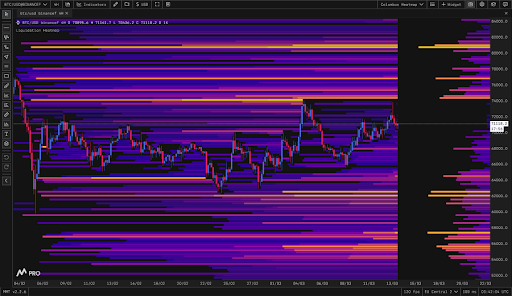
However, the analysis also cautions that the current level is a precarious battleground for the asset. Should Bitcoin fail to maintain its footing above this support region, the market would likely undergo another sweep into lower liquidity pockets to find sufficient buying interest before any meaningful attempt at higher expansion.
Ultimately, the short-term outlook hinges on whether the current support holds or if the slowing momentum leads to a structural failure. For now, this area is key to determining if the market is preparing for a breakout toward the mid-70s or a temporary retreat.
Bitcoin Consolidates Mid-Range After Recent Range Breakout
BTC is consolidating in the mid-range, according to Lennaert Snyder’s post on X. The market recently experienced a range breakout, which effectively acted as a push-to-fill on Bitcoin, moving the price toward key liquidity zones.
Snyder is already positioned short, but he is prepared to add to his position on the next weekly candle if the price pushes into the fair value gap (FVG) around $72,400. This level represents a potential trigger zone for further downside, aligning with his bearish strategy.
He plans to short the bearish market structure break (MSB) when the conditions above are met, targeting the liquidity around the $65,580 low. While lower prices are possible, he intends to manage risk carefully and will be roughly 80% positioned at that level.
For long positions, Snyder cautions that BTC is trading mid-range and is currently exhausted from the recent drop. Thus, he is waiting for significant liquidity to be mitigated at the range low or for higher time frame (HTF) levels to be gained before considering any new long entries.
]]>Cardano Price Prediction Rises as 137 Swiss Stores Accept ADA and Crypto Adoption Accelerates, but Pepeto’s Exchange Math Makes It the Bigger Play CoinCentral
Source link ]]>
Shiba Inu Price Prediction: Weak Bounce Signals Trouble — Is a Bigger Drop Coming? Yahoo Finance
Source link ]]>