The US Federal Reserve is expected to hold interest rates steady today despite President Donald Trump continuing to pressure Fed Chair Jerome Powell to lower rates. However, rising oil prices due to the Iran war have put a Fed rate hike back on the table. Meanwhile, China plans to release its massive oil reserves to
The post 10x Research Warns Fed Rate Hike, US CPI Rising to 3.4% While China Taps 1.4 Bln Oil Reserves appeared first on CoinGape.
]]>Cardano News: Charles Hoskinson Reveals Losing Over $3 Bln During The Recent Crash The Coin Republic
Source link ]]>

The BlackRock Bitcoin ETF has recently secured a landmark feat by recording nearly $1 billion worth of inflows amid broader bullish crypto market trends. ETP metrics revealed by the tracker Sosovalue indicated that while IBIT recorded massive inflows, other U.S.-based spot BTC ETFs witnessed outflows intraday. Meanwhile, the flagship crypto’s price continues to climb, now nearing $95K after pumping 7.5% weekly.
BlackRock Bitcoin ETF Takes Charge With Nearly $1B Inflows; Details
SosoValue data on April 29 revealed that the BlackRock Bitcoin ETF recorded inflows worth $970.93 million over the past day. This statistic has underscored rising traditional market interest in the flagship crypto amid a broader bullish landscape.
However, U.S. spot BTC ETFs as a whole saw only $591.29 million worth of inflows on April 28. Apart from IBIT, other products such as Fidelity, GrayScale, and VanEck witnessed outflows or no flows at all. The relatively poor performance of other products, compared to that of IBIT, has underlined the asset manager’s prominent stance in the institutional landscape.
Fidelity’s FBTC recorded outflows worth $86.87 million in the interim. Further, Grayscale’s GBTC recorded outflows worth $42.66 million. However, Valkyrie’s BRRR and Invesco’s BTCO recorded net flows worth $0. Franklin Templeton’s EZBC also reported nil net flows as of April 28, remaining undermined by BlackRock’s Bitcoin ETF.
BTC Price Holds Above $94K
BTC price today extended weekly gains to over 7%, closing in at $94,974. Primarily, the flagship coin mirrors a bullish action amid rising institutional interest. CoinGape recently reported that U.S. spot Bitcoin ETF products even recorded a staggering $3.4 billion worth of inflows in the last week.
Meanwhile, crypto-backed traditional financial products appear to be securing a prominent spot on traders’ and investors’ radars amid speculations of a bull market. Amid this optimistic buzz, BlackRock’s IBIT recorded nearly $1 billion worth of inflows in just a day. The Bitcoin market continues to leverage such bullish feats.
CoinGlass data indicated that the flagship coin’s future OI remained above the $60 billion mark as of reporting. Whereas, the derivatives volume shot up by 50% to $96.56 billion.
The post BlackRock Bitcoin ETF IBIT Records $1 Bln Inflows appeared first on CoinGape.
]]>Bitcoin (BTC) ended February on a bearish note, dropping over 17% last month, with US Bitcoin ETFs seeing $3.5 billion of outflows last month. This marks the biggest monthly withdrawal since launch as macro uncertainties, the Trump trade war have escalated crypto market panic over the past week. Investors are curious whether March will be better or are we heading for another month of correction.
Bitcoin ETF Inflows Resume After February Bloodbath
During the last month of February 2025, spot Bitcoin ETFs recorded net outflows of $3.546 billion, or 40,000 BTC, from the market. This marked the first month where every BTC ETF reported negative inflows, coinciding with an 18% drop in Bitcoin’s price from $102,400 to $84,300.
Top funds like BlackRock’s iShares Bitcoin Trust (IBIT) saw its first ever monthly outflows, shedding off 9,470 BTC worth a $721 million outflow. Now, the fund holds a total of 573,136 BTC. Similarly, the Fidelity Bitcoin ETF (FBTC) experienced a $1.202 billion outflow while Grayscale’s two Bitcoin funds – GBTC and BTC – clocked a cumulative outflow of $585 million.

After eight consecutive days of outflows, Bitcoin ETFs finally recorded net inflows on Friday. As per the data from Farside Investors, yesterday’s inflows stood at a total of $94.9 million amid the broader crypto market recovery.
While BlackRock’s IBIT continued with net outflows of over $243 million, Ark Invest’s ARKB and Fidelity’s FBTC made up for it with $193.70 million and $176.03 million worth of inflows respectively. It seems that the crypto market is finally taking a sigh of relief after key corrections in February.
Will March Be Better for Bitcoin and Altcoins?
February 2025 proved to be the toughest on record for the crypto market. Bitcoin price crashed more than 17.39% all the way to $82,000, making it the worst February performance for BTC over the past decade. However, altcoins like Ethereum (ETH) faced even steeper fall correcting 31.95%, making it its worst February since inception.
Blockchain analytics platform SpotonChain showed that historically, negative trends in February have often carried over into March, raising concerns about whether the market will rebound or if the downturn will continue. Analysts are closely watching for signs of recovery as March unfolds.

The latest Matrixport report suggested that hedge funds, and not traditional investors, have been behind the current Bitcoin sell-off. Furthermore, the report shows that the current Bitcoin price correction can continue even further until March or April, before the upward journey resumes again. Thus, it’s a wait and watch to see whether institutional inflows return to Bitcoin ETF moving ahead.

Bhushan Akolkar
Bhushan is a FinTech enthusiast with a keen understanding of financial markets. His interest in economics and finance has led him to focus on emerging Blockchain technology and cryptocurrency markets. He is committed to continuous learning and stays motivated by sharing the knowledge he acquires. In his free time, Bhushan enjoys reading thriller fiction novels and occasionally explores his culinary skills.
Disclaimer: The presented content may include the personal opinion of the author and is subject to market condition. Do your market research before investing in cryptocurrencies. The author or the publication does not hold any responsibility for your personal financial loss.
A staggering $5.78 billion in Bitcoin and Ethereum options are expiring today as the crypto market sees heightened volatility and selling pressure today. BTC short-term volatility recently peaked at 90%, while ETH’s short-term volatility surged past 100% as panic grips the market amid Trump tariff wars.
59,000 Bitcoin Options Expire As BTC Tanks Under $80,000
Bitcoin price crashed another 6% in the last 24 hours, diving $80,000 earlier today amid the broader crypto market correction. A total of 59,000 Bitcoin option contracts are expiring today with a notional value of $4.68 billion and a put-call ratio of 0.71. The data indicates that the maximum pain point for the expiring options is set at $96,000.

The market faced near-collapse this week, driven by the U.S. stock market crash and a series of security breaches such as the Bybit hack. Under the pressure of these events, mainstream cryptocurrencies led a sharp downturn, with implied volatility (IV) surging significantly. Notably, Bitcoin’s short-term volatility spiked to 90%, reflecting heightened market instability, as per Deribit data.
Hedge Funds Behind the BTC Unwinding
The latest report from Matrixport suggests that hedge funds, instead of traditional Wall Street investors have been the primary drivers behind the Bitcoin price unwinding.
“A stronger US dollar causes liquidity measures to decline, suggesting downward pressure on Bitcoin prices,” the report states. The analysis points to global liquidity peaking in late December 2024—driven by a surging US dollar—as a “clear explanation for Bitcoin’s ongoing correction.”
As per the Matrixport research report, there are two types of institutional Bitcoin investors. The first group consists of wealth and asset managers who view Bitcoin as “digital gold” and a long-term investment, typically holding between 100-1,000 BTC.
In contrast, the second group—hedge funds—focuses on arbitrage strategies rather than long-term price appreciation. These funds basically exploit the market inefficiencies by shorting Bitcoin futures and simultaneously purchasing spot Bitcoin or Bitcoin ETFs to capture the funding rate spread. Notably, a recent report on the US Spot Bitcoin ETF highlights how it impacts the broader market sentiment.
529,000 Ethereum Options Expire Today As ETH Price Drops to $2,100
Ethereum (ETH) is bracing for a significant options expiry event, with 529,000 contracts set to expire shortly. The data reveals a Put-Call Ratio of 0.52, suggesting a slightly bullish sentiment among traders. The maximum pain point for these options stands at $3,000, with a total notional value of $1.12 billion.

Notably, ETH’s short-term volatility has surged, exceeding 100%, reflecting heightened uncertainty in the market. Amid the current Ethereum price crash, the altcoin technical chart forms a death cross.

Bhushan Akolkar
Bhushan is a FinTech enthusiast with a keen understanding of financial markets. His interest in economics and finance has led him to focus on emerging Blockchain technology and cryptocurrency markets. He is committed to continuous learning and stays motivated by sharing the knowledge he acquires. In his free time, Bhushan enjoys reading thriller fiction novels and occasionally explores his culinary skills.
Disclaimer: The presented content may include the personal opinion of the author and is subject to market condition. Do your market research before investing in cryptocurrencies. The author or the publication does not hold any responsibility for your personal financial loss.
The crypto market is in turmoil, with its total market cap plunging by $325 billion since last Friday. Bitcoin’s price took a sharp 8% hit, dropping to the $87,000 mark. Leading altcoins like Ethereum, XRP, and Solana saw losses exceeding 12%.
So, here we take a quick look at the potential reasons that may have dampened the investors’ sentiment.
Why Is Crypto Market Falling?
A flurry of factors might have contributed to the recent crypto market collapse. A combination of liquidity issues, macroeconomic trends, and technical sell-offs appears to be behind the latest downturn.
According to The Kobeissi Letter, a leading global capital markets commentary platform, crypto markets erased $100 billion in just one hour today without any major headlines. The platform pointed out that around $150 billion in liquidations occurred in 24 hours, dragging almost all cryptocurrencies down.
Even the meme coin sector, which had been booming, saw a steep decline. Notably, CoinGlass data showed that $1.49 billion has been liquidated in the last 24 hours amid the broader digital assets market crash. As of writing, the global crypto market cap stood at $2.9 trillion.

Solana’s Downfall Triggered Selling Pressure
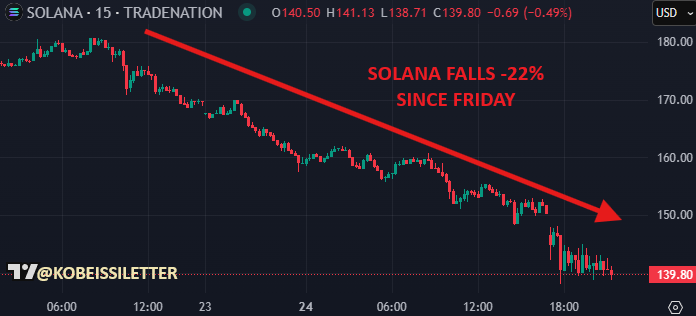
Solana was one of the key players in the recent crypto frenzy, especially with meme coins driving its rapid surge. However, as memecoin hype started fading, Solana price suffered a drop of around 20% in a week. Initially, this decline remained isolated from Bitcoin, but it later spread across the market.
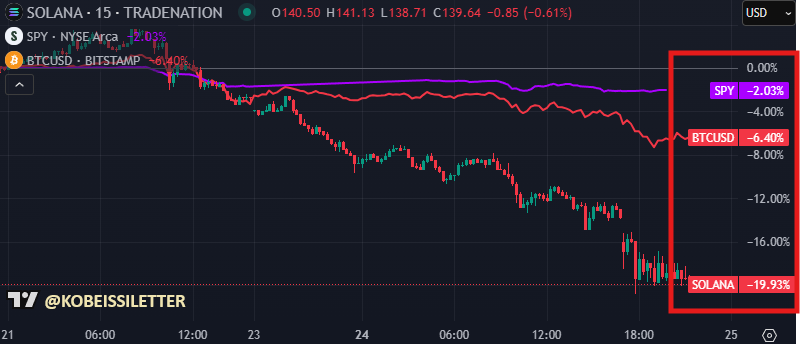
Adding to the market-wide sell-off, the S&P 500 also began losing ground on Friday. Bitcoin, often correlated with broader financial markets, followed suit. Once Bitcoin broke below the $98,000 support level, panic selling intensified. As of writing, BTC price was down about 8% and hovered near the $87K mark.
Citadel’s Crypto Pivot and the Bybit Hack Impact
Interestingly, the sharp decline came just hours after a report that the $65 billion financial giant Citadel Securities is exploring the crypto space as a liquidity provider. However, instead of boosting market sentiment, the news triggered a “sell-the-news” reaction.
Another major blow came from the Bybit hack, which cybersecurity firm Arkham Intelligence described as the “largest financial heist in history.” The hack exceeded $1 billion in stolen assets, more than doubling the infamous $611 million PolyNetwork breach in 2021. Such security incidents erode investor confidence, leading to more panic-driven exits from the market.
Crypto Market Pullback: Normal Correction or Bull Run End?
Ethereum’s weakness has added more strain to the broader crypto market. The recent wave of selling appears to be a mix of technical pullbacks and declining liquidity. However, analysts suggest that such corrections are part of a healthy market cycle.
For context, in a recent X post, popular market expert “il Capo Of Crypto” hints at a “strong bounce” in the market. These comments indicate that despite the short-term selloff, the crypto market is likely to witness a strong comeback in the coming days.

Rupam Roy
Rupam is a seasoned professional with three years of experience in the financial market, where he has developed a reputation as a meticulous research analyst and insightful journalist. He thrives on exploring the dynamic nuances of the financial landscape. Currently serving as a sub-editor at Coingape, Rupam’s expertise extends beyond conventional boundaries. His role involves breaking stories, analyzing AI-related developments, providing real-time updates on the crypto market, and presenting insightful economic news.
Rupam’s career is characterized by a deep passion for unraveling the complexities of finance and delivering impactful stories that resonate with a diverse audience.
Disclaimer: The presented content may include the personal opinion of the author and is subject to market condition. Do your market research before investing in cryptocurrencies. The author or the publication does not hold any responsibility for your personal financial loss.
Michael Saylor, the co-founder and Chairman of American business intelligence and software firm MicroStrategy has revealed his Bitcoin (BTC) holdings. Saylor made this revelation earlier today, confirming previous speculations regarding his personal BTC bets.
Michael Saylor and Bitcoin
While it is not surprising that Michael Saylor has Bitcoin holdings, the size of the investments comes as a shock. For context, Saylor allegedly revealed that he owns more than $1 billion in Bitcoin. To many in the industry, the majority of his focus is hinged on MicroStrategy which has continued to accumulate Bitcoin.
However, it turns out that he also has his interest at heart as much as he has that of his business intelligence software company.
For many years, the focus rested on MicroStrategy’s Bitcoin accumulation spree. Under Michael Saylor’s leadership, the firm began to acquire BTC in 2020 just after the global Covid-19 pandemic hit. Four years down the line, the firm has successfully acquired a total of 226,500 Bitcoin units as of July 30. Based on today’s price, this entire stash is worth around $12.7 billion. Therefore, Saylor’s personal Bitcoin holding corresponds with about 10% of MicroStrategy’s stash.
This Michael Saylor update is coming at a time when the broader digital currency ecosystem is recording intense BTC adoption. From spot Bitcoin ETF products to US political landscape, the focus on BTC is growing at a very fast pace.
Japan Exercise Caution in Approving Bitcoin ETFs
Considering how much Bitcoin has improved since the United States Securities and Exchange Commission (SEC) approved the offering, many other regions are vying for such cryptocurrency products. Shortly after the SEC gave its greenlight in January, Hong Kong and Australia have gone ahead to launch similar product in their region.
Currently, investors in Japan are pushing for the same crypto products but their regulator has some concerns. Japan’s Financial Services Agency highlighted the need to tread with caution win reference to the approval of spot crypto ETF products in the Asian country.
Earlier today, Commissioner of the Financial Services Agency Hideki Ito emphasized the need to reconsider before following in the footsteps of nations like the United States, Hong Kong, Australia, and the United Kingdom, which have recently given the green light to such investment products.
Read More: Japan’s Top Finance Regulator Turns Cautious On Bitcoin ETF Approvals

Godfrey Benjamin
Benjamin Godfrey is a blockchain enthusiast and journalists who relish writing about the real life applications of blockchain technology and innovations to drive general acceptance and worldwide integration of the emerging technology. His desires to educate people about cryptocurrencies inspires his contributions to renowned blockchain based media and sites. Benjamin Godfrey is a lover of sports and agriculture. Follow him on Twitter, Linkedin
Disclaimer: The presented content may include the personal opinion of the author and is subject to market condition. Do your market research before investing in cryptocurrencies. The author or the publication does not hold any responsibility for your personal financial loss.
In the background of Bitcoin’s highly turbulent price action in recent days, BTC accumulations have considerably risen. In a post shared by a renowned crypto market analyst today, May 31, it was brought to attention that nearly $2.5 billion worth of BTC has been withdrawn from exchanges in the past 72 hours, causing a bustle across the global crypto realm.
The data on BTC accumulations has set the stage for a significant upward price action for Bitcoin, a development eagerly anticipated by crypto market participants post-halving. Here’s a closer look at the reasons behind this expectation:
BTC Accumulations Ignite Market Optimism
According to Ali Martinez’s post on X, the Bitcoin exchange reserve has seen a notable fall as BTC’s price gained upside momentum towards its ATH in recent days. This potentially hints at increased confidence among crypto investors surrounding the flagship crypto’s future price movements.
Meanwhile, this optimism comes in tandem with another bullish event unfolding in the crypto-trading landscape. Data by Farside investors illustrated that Bitcoin ETFs have recorded inflows for the 13th consecutive day as of May 30. Fidelity Wise Origin Bitcoin Fund (FBTC) recorded the most inflows, worth $119.1 million, whereas ARK 21Shares Bitcoin ETF (ARKB) saw outflows worth $99.9 million.
Nonetheless, market data collectively paints a bullish portrait of BTC in its re-accumulation period post-halving. It’s also worth mentioning that BTC briefly topped the $70K mark this week on May 27, whereas as soon as the token tumbled, 37K BTC has been accumulated to date, as mentioned above. This hints that further pumps might be in the pipeline.

Also Read: Bitcoin Price Sees Recovery After US PCE Inflation Data
Bitcoin Price Today
Whereas, while writing, Bitcoin’s price illustrated a 1.03% upswing in the past 24 hours, reaching $68,748.37. The token’s 24-hour lows and highs are $67,869.22 and $69,500.54, respectively.
BTC’s futures OI saw a 0.18% jump to $34.61 billion, further accompanied by a 3.75% derivatives volume upsurge to $51.09 billion. This data flagged a market uptrend for BTC at press time, falling in line with today’s rising price action.
Besides, even the RSI hovered at 56, indicating the presence of some upside momentum despite broader neutrality. Moreover, the technical indicators signal a strong buying sentiment prevailing in the market.
Collectively, the market data has added a bullish splash to BTC’s current price movements and future price actions. Also, this year’s pivotal juncture, BTC halving, is yet to cause a potential parabolic uptrend in the token. Crypto market participants expect a snowball effect to kick in the BTC price soon.
Also Read: Shiba Inu Coin: Over 4 Tln SHIB Transferred To Exchanges, Price At Risk?

The presented content may include the personal opinion of the author and is subject to market condition. Do your market research before investing in cryptocurrencies. The author or the publication does not hold any responsibility for your personal financial loss.
SHIB News: Shiba Inu Community Burns 1.69 Bln Coins In April, What’s Next? CoinGape
Source link ]]>
Amid a topsy-turvy scenario, the recent crypto market selloff has sparked discussions in the digital asset market while resulting in the liquidation of a massive $70 billion within the last 24 hours. Meanwhile, this significant downturn follows a period of heightened volatility in recent days, raising concerns among investors and analysts alike.
Although some have warned about short-term volatility following the recent Bitcoin Halving event, there could be several other reasons weighing on the sentiment. So, let’s take a look at the potential events that might have fuelled the recent crypto market selloff.
Economic Data Sparks Fears
The recent crypto market selloff can be attributed to a confluence of factors, with economic data from the United States serving as a primary catalyst for the downturn. The Bureau of Economic Analysis released GDP figures on Thursday, April 25, that fell short of market expectations, indicating a sluggish growth rate of 1.6% compared to the anticipated 2.5%.
In addition, the Core PCE Price Index surged to 3.7% in the first quarter, while PCE inflation rose to 3.4%, surpassing forecasts. Notably, the GDP data has painted a gloomy picture in the crypto market as well as in the broader financial sector, while intensifying worries about a potentially hawkish stance from the Federal Reserve.
Meanwhile, amid these developments, the U.S. Personal Consumption Expenditures (PCE) inflation data from Friday, April 26, has further fueled apprehensions among crypto investors. While March saw a modest 0.3% increase in PCE inflation in line with estimates, the year-on-year surge to 2.7% exceeded market forecasts.
Simultaneously, the Core PCE Inflation, excluding food and energy prices, surged to 2.8% in March, amplifying concerns about rising inflationary pressures.
These gloomy data have dampened the crypto investors’ sentiment while raising concerns over a further delay in the U.S. Federal Reserve’s rate cut plans. For context, the market is expecting the Federal Reserve to maintain a hawkish stance, as the inflation still stayed above their 2% target.
Also Read: Bitcoin ‘Sell’ Calls on the Rise Amid Trader FUD and Impatience, What’s Next?
Spot Bitcoin ETF Outflows Triggers Crypto Market Selloff
Compounding the market downturn, outflows from the U.S. Spot Bitcoin ETF over three consecutive days signaled a cooling sentiment among institutional investors. Notably, significant withdrawals from major players in the cryptocurrency arena, including Grayscale’s GBTC, Fidelity’s FBTC, and Bitwise’s BITB, contributed to the downward pressure on prices.
Meanwhile, Farside UK showed that on April 26 alone, outflows from the U.S. Spot Bitcoin ETF amounted to $83.6 million, exacerbating the crypto market selloff.
As a result of these developments, the global cryptocurrency market cap experienced a substantial decline, shedding nearly $70 billion within a 24-hour period. Notably, the crypto market cap has touched a high of $2.38 trillion and a low of $2.31 trillion over the last 24 hours, suggesting a loss of $70 billion.
However, amid the turbulence, some investors have seized the opportunity to accumulate digital assets at discounted prices, hinting at underlying resilience in the market. As of writing, the crypto market capitalization stood at $2.33 trillion.
Meanwhile, the Bitcoin price lost 2.13% over the last 24 hours and traded at $62,950.61, while its trading volume fell 24.32% to $24.17 trillion. Simultaneously, the Solana price retreated over 5% and exchanged hands at $136.36 amid a slump in the broader crypto market.
On the other hand, the XRP price fell 2.25% to $0.5156 as of writing, with its trading volume dropping 22.59% to $1.02 billion. In addition, the leading meme coin, Shiba Inu price plunged 3.12% to $0.00002463, and its trading volume dropped 27% to $537.25 million.
Also Read: XRP, ADA, BCH, LTC, STX Declared Zombie Among 20 Crypto By Forbes
The presented content may include the personal opinion of the author and is subject to market condition. Do your market research before investing in cryptocurrencies. The author or the publication does not hold any responsibility for your personal financial loss.
✓ Share: