Can Shiba Inu Reach $1 in 2026? The Math Behind This Bold Prediction. The Motley Fool
Source link ]]>
Ripple CTO Comes Out Guns Blazing Following Cardano Founder’s Bold Accusation CryptoRank
Source link ]]>
The Ethereum Foundation is taking a decisive step to strengthen decentralized finance (DeFi) on ETH and launching a new initiative. This move signals a renewed strategic focus on scaling DeFi adoption, improving protocol security, and fostering sustainable growth across lending, trading, and on-chain financial services.
Why Boosting Developer Support And Ecosystem Funding
In a key development, the Ethereum Foundation is launching a renewed and more ambitious protocol to strengthen DeFi within the ETH ecosystem. Ethereum Daily has revealed on X that the initiative is being framed as a Defipunk approach, which is centered on building financial infrastructure that is truly permissionless, private, secure, and fully open-source. The goal is to enable anyone, anywhere, to save, borrow, hedge risk, or make payments without relying on big companies like banks or large corporations.
Related Reading
Rather than focusing solely on incremental upgrades to existing applications, like improved stablecoins, the Foundation’s vision reportedly targets deeper structural innovation. The key areas include developing more secure price oracles, enhancing privacy loans to reduce unfair liquidations, and integrating artificial intelligence (AI) to strengthen system security.
With a newly formed DeFi team leading the effort, the foundation is inviting developers who share its vision to help build a financial system that will give users full control and expand accessibility, not just speculators.
How Inflow And Outflow Trends Reveal Strategic Positioning
Even as ETH price action has been brutally down from $4,900 to below $2,000, Ethereum spot ETF flows are quietly signaling a shift behind the surface. The head of research at Lisk, analyst Leon Waidmann, stated that the ETF flow dynamics have shown that after a period of heavy outflow around mid-2025, the intensity of selling pressure has been gradually fading.
Related Reading
Meanwhile, the massive inflow waves that were seen in late 2024 and early 2025 have subsided, and the peak panic selling that followed has largely dissipated. The recent ETF flow bars are significantly smaller in both directions compared to the prior volatile period, and sellers are running out of steam.
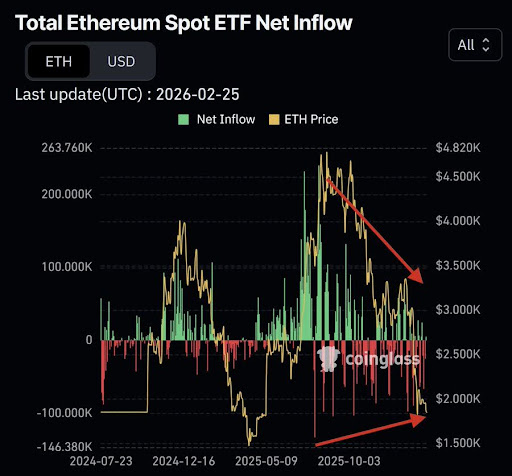
Waidmann noted that this shift is significant because, despite one of the sharpest ETH drawdowns in recent memory, the institutional exodus appears to be exhausting. While the weak hand that wanted out has largely exited, this means there’s no bottom.
However, there’s still a slight outflow bias in recent weeks, indicating that there’s no confirmed accumulation signal yet. Waidmann emphasized that the intensity of the selling pressure is clearly fading, which is the first step that must happen before any trend reversal. In his view, participants should pay attention to when the selling dries up before sentiment recovers, because that’s usually where the next move will start to build.
Featured image from iStock, chart from Tradingview.com
Pressure Builds on ADA Despite Cardano’s Bold Behind-the-Scenes Push ZyCrypto
Source link ]]>
Markets are quiet and uneasy. Bitcoin prices have pulled back, and big holders are keeping a cool face while the charts wobble. Reports note that one outspoken investor frames the market in stark terms: it either fails completely or becomes far more valuable than people now imagine.
Related Reading
Saylor’s Binary Bet
According to Michael Saylor, Bitcoin has only two plausible final outcomes: worthless, or worth $1 million per coin. That is not a quick trading idea. It’s a long-running view about scarcity and demand.
Saylor argues that a fixed supply paired with growing institutional buying and broader custody tools makes a future of massive price gains possible. He points to more banks, more spot ETFs and bigger corporate allocations as proof that demand has matured.
If it’s not going to zero, it’s going to a million. $BTC
— Michael Saylor (@saylor) February 20, 2026
A Warning From The Other Side
Reports note that not everyone agrees. Mike McGlone of Bloomberg has sketched a darker path, one where price pressure and macro shocks could push values much lower — even toward $10,000.
That view is rooted in history: markets can fall a long way before confidence returns. Short-term moves can be savage. Longer swings can be slower to recover. Both views are true on their own terms, because they answer different questions about time and risk.
Balance Sheet And Funding
Based on reports, the firm backing Saylor’s posture holds a very large stake: 717,131 BTC bought at an average cost of $76,027 a coin. That position is underwater for now. Still, financing choices matter. Strategy relies on equity, convertible notes, and preferred shares to meet cash needs.
Arkham Intelligence has mapped out that preferred dividends are optional and redemptions are not automatic, which lowers the chance of forced sales right away. That setup buys time, though it does not erase exposure if prices stay low for a long stretch.
SAYLOR IS UNDERWATER. BUT WILL HE SELL BTC?
Saylor is over 10% underwater from his average purchase price. But what could actually force him to sell Bitcoin?
Here’s an explainer of how, when and why Strategy might be forced to sell BTC. pic.twitter.com/uKbJ3ivO54
— Arkham (@arkham) February 20, 2026

Supply, Demand And The Big Numbers
Saylor’s $1 million projection is driven by a supply argument: there are only 21 million coins. If enough institutions and treasuries keep buying, the math pushes the price up.
He has said that with a particular share of total coins held by his firm, values could move into the millions, and he has sketched an even higher, $10 million possibility under stronger concentration scenarios.
Related Reading
Those are not forecasts you can treat like short-term targets. They are conditional models — possible only if adoption, regulation and market behavior all line up for years.
The path forward is not easy. Bitcoin could crawl higher, stumble and trade in narrow ranges for years, or shoot up as new buyers enter. Politics, regulation and global liquidity will shape which route unfolds. Institutional entry has changed the market structure, but it has not removed the risk of big drawdowns.
Featured image from Pixabay, chart from TradingView
Bitcoin sits on edge again, trading below the critical $68,000 level after a volatile stretch that erased around 28% from its price in about a month. Prices are swinging hard, and that swing has pushed smart-money talk and wild bets into the same room.
Related Reading
Experts Offer Starkly Different Paths
According to some investors, a deep bargain is forming. Andrew Parish, a serial entrepreneur and outspoken Bitcoin proponent, argues that mood matters — when retail traders turn gloomy, big buyers can step in and lift markets fast.
He put a bold target on the table: $500,000 within a few years if flows and sentiment flip. Ric Edelman, a veteran investor, has a similar headline number but with a slower clock; his math rests on broad wealth moving a tiny slice into crypto over time. Both views hinge on steady inflows and more investors taking small positions in crypto.
GM.
Bitcoin sub $70K is a gift. Buy more.
In three years $BTC will trade above $500K.
— Andrew (@AP_Abacus) February 16, 2026
A Bear Case That Cuts Deep
On the other side, the warning is loud and clear. Bloomberg macro strategist Mike McGlone has painted a much darker path, saying an 85% drop could be possible and that $10,000 should not be dismissed.
Legendary Investor Ric Edelman: “I believe #bitcoin can reach $500,000 by 2030.”
pic.twitter.com/XNQFTbuA69
— Altcoin Daily (@AltcoinDaily) February 16, 2026
He points to stronger stock markets, lower market swings, and fading political tailwinds tied to US President Donald Trump as reasons capital might stay away from risky bets. Markets can be moved by big shifts in where money chooses to sit, and moments like this can put a damper on optimism quickly.
Collapsing Bitcoin/Cryptos May Guide the Next Recession –
“Healthy Correction” is what we should hear soon from stock market analysts (who risk unemployment if not onboard), following collapsing cryptos. The buy the dips mantra since 2008 may be over, here’s why:
– US stock… pic.twitter.com/fPPc2fV3EU
— Mike McGlone (@mikemcglone11) February 15, 2026
Flows And Sentiment Matter
Reports note that exchange-traded funds saw heavy withdrawals recently. On-chain readings flagged hundreds of millions in outflows in a short window. A separate fear-and-greed meter cratered to very low readings, signaling panic among small traders.
Those two facts together help explain why price fell so sharply; when many try to leave, price can slip faster than logic expects. That said, outflows can also clear the way for a different type of buyer to move in later.
Related Reading
On Institutional Behavior & Lofty Price Targets
Meanwhile, institutional behavior will be the key variable. Large managers could buy when retail is jittery, and some market watchers point to companies that have built crypto desks as potential demand anchors.
Despite the uncertainty, the $500,000 mark remains the headline grabber for bullish investors. Parish’s call captures attention because it ties sentiment swings to potential market moves, while Edelman’s projections underline how even modest allocations from global wealth could push Bitcoin higher over time.
Featured image from Unsplash, chart from TradingView
Cardano And Ethereum Leaders Launch Bold Privacy Initiatives Evrim Ağacı
Source link ]]>
The era of the crypto industry being seen as a two-asset town is officially over at the world’s largest derivatives marketplace.
On Jan. 15, CME Group announced plans to launch futures contracts for Cardano (ADA), Chainlink (LINK), and Stellar (XLM) on Feb. 9, pending regulatory review.
This move represents a calculated signal from the Chicago-based exchange giant that the digital asset market has matured beyond the gravitational pull of Bitcoin and Ethereum into a diversified, risk-managed asset class.
The expansion introduces a deliberate two-tier structure designed to capture both institutional heavyweights and active retail traders.
The contracts will feature standard and micro sizes: 100,000 ADA and 10,000 ADA, 5,000 LINK and 250 LINK, and 250,000 XLM and 12,500 XLM.
By widening its “blue-chip” rails to include these three distinct assets, CME is effectively declaring that the infrastructure for crypto risk transfer is ready to handle a broader spectrum of blockchain utilities, from smart contract platforms to middleware and payments.
CME’s volume argument
The primary driver behind this expansion is visible in the exchange’s own scoreboard as its new listings come on the heels of a blowout year for CME’s crypto desk.

In 2025, the exchange reported record crypto futures and options activity, clocking an average daily volume (ADV) of 278,300 contracts. That figure represents approximately $12 billion in notional value changing hands every single day.
Perhaps more importantly for institutional adoption, average open interest (OI) stood at 313,900 contracts, representing about $26.4 billion in notional value.
These metrics suggest the market has crossed a threshold. Crypto at CME is no longer a niche experiment but a robust input into global portfolio construction.
The 2025 data reveal that scale is increasingly driven by accessibility rather than by large block trades alone. In its annual recap, CME noted that crypto ADV rose 139% year over year to a record 278,000 contracts.
Notably, the engine room of this growth has been the “micro” suite. Micro ETH futures averaged 144,000 contracts per day, while Micro Bitcoin futures averaged 75,000 per day.
This distribution model allows for granular hedging and speculative positioning, a feature that was on full display during the market’s volatility spikes.
On Nov. 21, 2025, the complex hit an all-time daily volume record of 794,903 contracts. The micro suite alone accounted for 676,088 of those, with Micro Bitcoin futures and options reaching 210,347 that day.
For CME, the lesson was clear: if you build accessible, regulated rails, the volume will follow.
The graduation playbook
Meanwhile, CME is not entering this expansion blind as it has developed a proven playbook for “graduating” assets into the regulated sphere, validated by the performance of Solana and XRP.
When the exchange rolled out futures for those assets in 2025, they quickly became some of the fastest-adopted contracts in its history.

For context, more than 540,000 Solana futures had traded by mid-September 2025, since their March 17 launch, representing about $22.3 billion in notional value.
XRP showed similar traction, with more than 370,000 futures traded since its May 19 launch, totaling roughly $16.2 billion in notional value.
CME also flagged record monthly average daily volume and open interest metrics for both assets in August 2025, proving that liquidity can pool around specific altcoins if the venue is trusted.
This precedent is crucial for understanding the ADA, LINK, and XLM listings.
CME is likely betting that these assets, like SOL and XRP, have sufficient “graduated” status to support an institutional derivatives market.
The move reinforces the narrative that regulated futures can accumulate real traction for select assets, effectively pulling volume away from offshore perpetual swap markets and into a cleared, US-regulated environment.

Why CME is betting on ADA, LINK, and XLM
CME’s selection of these three specific tokens offers insight into how institutional investors are beginning to categorize crypto assets.
Industry observers noted that this represents diversification of “beta,” or market exposure.
Cardano functions as a classic Layer 1 instrument, allowing traders to hedge or take exposure to a smart contract ecosystem distinct from Ethereum.
Meanwhile, Chainlink represents “infrastructure beta,” serving as a proxy for the middleware oracle networks that connect on-chain applications to off-chain data.

Stellar is associated with payments and cross-border value transfer, a narrative that frequently resurfaces during discussions of tokenized cash and compliance-friendly settlement.
Crucially, the plumbing for these contracts has been in place longer than many realize. CME’s contracts are cash-settled based on CME CF reference rates, which are designed to be transparent and replicable.
Stellar, for instance, has been part of this benchmark universe for years. CME Globex notices from as far back as April 2022 listed the CME CF Stellar Lumens–Dollar Reference Rate (XLMUSD_RR) alongside other benchmark additions.
This benchmark maturity acts as a quiet prerequisite for institutional adoption, giving clearing members the assurance that settlement mechanisms will behave like traditional derivatives infrastructure.
The broader macro context further justifies the timing. CME has announced plans to make crypto futures and options available 24/7 (with a brief weekly maintenance window) beginning in early 2026, pending regulatory review.
The ETF catalyst
The strategic weight of CME’s move was confirmed almost immediately by a wave of new product filings.
Ahead of the Feb. 9 futures debut, ProShares filed for six new ETFs tied to these specific assets, aiming to capitalize on the regulated infrastructure CME is building.
The filings cover both standard and leveraged exposure: the ProShares Chainlink ETF, ProShares Cardano ETF, and ProShares Stellar ETF.
This is alongside their 2x leveraged counterparts, which include the ProShares Ultra Cardano ETF, ProShares Ultra Chainlink ETF, and ProShares Ultra Stellar ETF.
While tickers and fees remain to be announced, the filings list an effective date of March 31.
This timeline is instructive, as it suggests an orchestrated sequence in which CME futures establish the necessary liquidity, hedging capabilities, and reference pricing in February. This would then clear the path for structured retail products to launch roughly 7 weeks later.
Notably, the inclusion of “Ultra” versions is particularly significant, as leveraged ETFs typically rely heavily on regulated futures markets to deliver their magnified returns. Thus, the CME listing is a functional prerequisite for their existence.

Measuring success
The market will quickly determine if ADA, LINK, and XLM are ready for the big stage.
The true test will be whether these contracts become genuine “tradable markets” with persistent open interest and tight spreads, or if they remain occasional hedging tools.
Using CME’s 2025 average daily notional of $12 billion as a baseline, a simple scenario analysis offers a framework for what success looks like over the first 90 days.
A “soft adoption” scenario, capturing just 0.1% of the share, would result in approximately $12 million in combined daily notional. This would be enough to sustain the listings but would indicate limited institutional integration.
Meanwhile, a “base case” of 0.5% share would yield roughly $60 million per day, consistent with steady hedging and meaningful market-making participation.
However, a “breakout” scenario with a 1.5% share would translate into about $180 million per day. Such a figure would signal that the onshore complex has become a genuine venue for altcoin risk transfer, likely paving the way for deeper options liquidity.
Cardano’s Bold Price Surge: ADA Sets Sights on the $10 Milestone Bitget
Source link ]]>
Cardano’s Bold Price Surge: ADA Sets Sights on the $10 Milestone MEXC
Source link ]]>