Cardano is one of the largest cryptocurrency projects by means of total market capitalization but also in terms of developers working on it.
In essence, it’s a proof-of-stake blockchain network that’s being developed into a decentralized application development platform with a multi-asset ledger, as well as verifiable smart contracts.
One of the main talking points of Cardano has always been the team’s peer-reviewed academic research and public approach, where all the technical specifications that underpin the network are published publicly, making all of the team’s development activity visible.
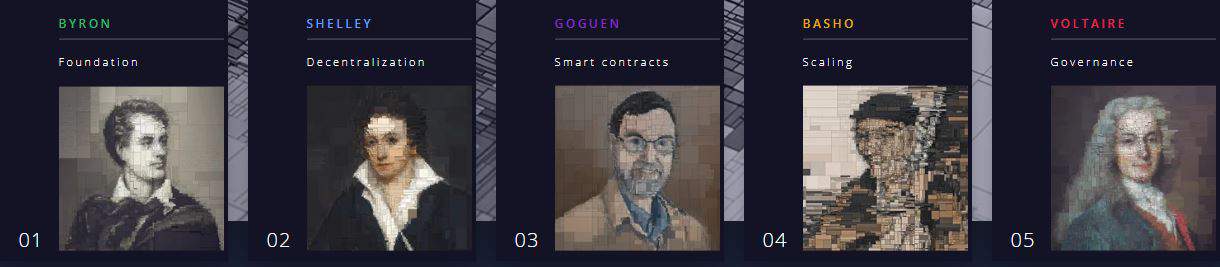
With that in mind, a commonly asked question is how close is Cardano to being fully developed. To answer this, we need to take a closer look at its roadmap – which is divided in five eras – Byron, Shelley, Goguen, Basho, and Voltaire.
Let’s take a closer look at each one of them.
The Byron Era
As mentioned, Cardano makes use of a peer-review and research model of formal development.
It all started back in 2015, but it wasn’t for another two years that the project saw the light of day and, thus, in September 2017, the Byron era started.
This is the foundation period for Cardano, and not many people know that its first iteration allowed users to buy and sell ADA tokens on a federated network that was running on the Ouroboros consensus protocol.
Quick fact: ADA is named after the revolutionary programmer Ada Lovelace.
Cardano’s team takes pride in what they claim to be the first proof-of-stake protocol “created on the basis of academic research, with a mathematically-proven level of security.”
Some of the papers published during this particular era include:
Meanwhile, the scope of work for the Byron era included the development of:
- ADA Cryptocurrency
- Cardano’s block explorer
- Daedalus wallet
- Ouroboros consensus protocol
- Paper Wallets and so forth.
The Shelley Era
The transition to Cardano’s second epoch was designed to achieve low-risk progress without any interruptions of service.
This is when more nodes switched towards being run by the community in a bid to achieve further decentralization, greater security, and robustness. During this period, some of the developments for Cardano included:
- Consensus incentives and fees
- Stake pools
- Delegation certificates
- Ouroboros Praos, Genesis, and BFT
- Delegation in Daedalus
- Shorter Addresses and so forth.
Meanwhile, some of the papers published during the Shelley era include:
In essence, the Shelley era represented the natural maturation of the network, and that’s when it became more useful and rewarding for its users. That’s why it’s also mainly focused on decentralization.
The Goguen Era
The Goguen era is the one where we saw smart contracts going live on Cardano for the very first time. It represents a massive step in the network’s history and a huge achievement for the team behind it.
On September 13th, 2021, the team deployed the Alonzo upgrade – a historic feat in the project’s roadmap, allowing users to build decentralized applications on the mainnet for the first time since the network was live.
Besides adding this functionality, however, the Goguen era is also designed to improve the core of Cardano’s offerings. Most significantly, this is the addition of the multi-currency ledger that’s expected to extend the network’s usefulness, allowing users to create new tokens that are supported natively.
This would allow the creation of both fungible and non-fungible tokens, as well as the creation of new cryptocurrencies and the overall tokenization of many other assets.
Some of the papers published during the Goguen era include:
Meanwhile, some of the major developments are:
- Plutus and Plutus Core
- Smart Contracts Integration
- Multi-Currency Ledger
This is the era Cardano is at the time of writing this guide.
The Basho Era
The next era for Cardano will be all about scaling and optimization. If the previous eras were focused on functionality and decentralization, this one would be about improving the underpinning performance of the network in a bid to better support its growth and adoption.
Perhaps the main development of Basho will be the integration of sidechains. These will be new blockchains that will be fully interoperable with the mainnet of Cardano and would bring serious potential to extend the capabilities of the underlying network.
Sidechains can also be used as a mechanism to shard and offload work from the main chain to increase its broader capacity. They can also be used to introduce certain experimental features without having to affect the security of the main network.
The Voltaire Era
This is the last in line for Cardano’s roadmap, and it’s designed to provide the final pieces necessary for the network to become a self-sustaining one. The focus is on governance and:
“… it will require not only the distributed infrastructure introduced during the Shelley era but also the capacity to be maintained and improved over time in a decentralized way.”
This is the time when community members will be able to present network improvement protocols, vote on them, and leverage existing staking and delegation processes.
During the Voltaire era, the project will also see the addition of a treasury system whereby a fraction of transaction fees will be pooled to make sure there are enough funds necessary for the development activities undertaken after the voting process.
Binance Free $100 (Exclusive): Use this link to register and receive $100 free and 10% off fees on Binance Futures first month (terms).
PrimeXBT Special Offer: Use this link to register & enter POTATO50 code to receive up to $7,000 on your deposits.
Byron Network, an ecosystem offering decentralized apps (DApps) for the Cardano blockchain, will launch its token on OccamRazer in March 2022.
Byron Network is building an ecosystem of top-notch blockchain-based products, including ByronDex, Byron Wallet and the Launchpad Toolset. Its goal is to provide users with the necessary trading tools to guarantee risk control, ease of use and user satisfaction.
The Byron team consists of experienced developers and knowledgeable crypto experts passionate about crypto trading. Byron Network is derived from the BinarApps software company, which has supported projects such as Everest, Brave Browser, Dash, Asdra Protocol and Minerva.
In April 2021, Byron Network joined the Plutus Partnership program and started building on Cardano. Since then, the team has been working on the oracle blockchain platform-based ByronDex and a self-sovereign mobile wallet, marking the beginning of an ecosystem.
Maciej Krasowski, CEO of Byron Network, said, “Accessibility and ease-of-use are some of the main aspects emphasized in our DApps and what we wish to provide for all blockchain enthusiasts. We are an ambitious team with a strong roadmap to delivering trading solutions, part of which will be powered by the Byron [native] token, BYNET. We look forward to launching BYNET through the initial decentralized exchange (DEX) offering (IDO) on OccamRazer and introducing the token to the Occam community.”
BYNET will grant tokenholders access to advanced trading mechanisms on ByronDex. The token will power the interactions on the DEX and give the option for staking BYNET and liquidity mining. Tokenholders will also be granted voting rights to decide on tokens to be listed on ByronDex and staking pools to be available on Byron Wallet.
The Byron Wallet, currently in the testing stage, is expected to debut in first-quarter 2022, followed by ByronDex in second-quarter 2022.
Follow Byron Network’s social media channels for the latest news:
About Byron Network
Byron Network aims to bring the cutting-edge solution to traders, tokenholders and blockchain lovers. The mobile wallet and DEX on the Cardano blockchain are only the first steps in developing the Byron ecosystem. Its goal is to deliver investment tools and a cryptocurrency gateway for multi-chain investing for any blockchain enthusiast.
About Occam.fi
The Occam.fi ecosystem is managed and maintained by the Occam Association, a Switzerland-based entity operating from the crypto-friendly Canton of Zug. When the Occam.fi ecosystem grows sufficiently, Occam.fi will be governed and steered by a carefully designed decentralized autonomous organization. Occam.fi is the first decentralized launchpad designed for the Cardano ecosystem, built with expertise and care from a veteran team of blockchain entrepreneurs and professionals. Learn more at www.occam.fi.
This is a paid press release. Cointelegraph does not endorse and is not responsible for or liable for any content, accuracy, quality, advertising, products, or other materials on this page. Readers should do their own research before taking any actions related to the company. Cointelegraph is not responsible, directly or indirectly, for any damage or loss caused or alleged to be caused by or in connection with the use of or reliance on any content, goods, or services mentioned in the press release.

Last year in April Byron Network had the opportunity to join the Plutus Partnership Program and start building on Cardano. Since that time, our team has been building OBP-based ByronDex and a self-sovereign mobile HD wallet. We want to deliver an ecosystem that combines these two and guarantees the best possible experience for the users. We plan to provide traders-oriented products, enabling complete control over traders’ investments.
Cardano’s most significant advantage is the potential behind its solutions and approach. Our team sees a wide range of possibilities, especially in open banking. Fizen.com, a start-up that integrates banks with open banking, is a perfect example of where Cardano seems to be the best choice to build the backend. Having banks in the middle of transaction processes results in extremely high fees. With Cardano, we could create a registry without a centralized entity. Therefore, we see great potential in delivering the possibility for the “unbanked to be banked finally”.
We focused on the DEX with traders-approach and advanced order types known from centralized exchanges. We would love to see our Mobile Wallet be the first choice wallet for Cardano, which we are pursuing. We have many valuable features planned in our Roadmap, which we hope will make our app even stronger. At the moment, we still were internally testing our mobile DApp to release a beta testing version for the community. We appreciate all of the community members who joined us and helped us find bugs or suggestions for our DApp.
To say even more, in the bigger picture, we want to connect traders from different platforms, first UTxO-based such as Dash.org and take advantage of multichain possibilities. That could lead to excellent applications built upon our model. We would love to see both communities grow together.
Cardano holds a powerful position with many talented developers building on this blockchain. Many teams are bringing up a lot of exciting ideas to the table. The community is looking at ways that UTxOs and Cardano can revolutionize DeFi. Our team is no exception — we also believe there is a place for blockchain among regular FinTechs.
Our vision for Byron Network is to enable new projects to use our open source ecosystem. What we are working on is already on our GitHub, with more to come. A growing number of DApps could enable a greater Cardano adoption and a stronger community. With upcoming solutions, such as Hydra, new ideas will keep appearing, and we want to contribute to their success.