
- The action was detected by Whale Alert and ranks among the largest single-day USDT freezes.
- Tether has frozen over $3 billion in assets from more than 7,000 addresses since 2023.
- Stablecoins now account for the majority of illicit crypto activity tracked by Chainalysis.
Tether, the issuer of the world’s largest stablecoin, froze more than $180 million worth of USDT within 24 hours, underscoring the growing role of centralized control and law-enforcement coordination in the stablecoin market.
The event stands out not only for its size but also for what it reveals about issuer-level control in the crypto economy.
As regulators scrutinise digital dollars more closely, the mechanics behind this freeze offer insight into how compliance now shapes on-chain liquidity.
Large-scale freeze on Tron
On Jan. 11, Tether froze roughly $182 million worth of USDT held across five Tron-based wallets in a single day.
The action was flagged by on-chain tracker Whale Alert, which showed individual wallet balances ranging from about $12 million to nearly $50 million.
The timing and concentration of the freezes marked it as one of the largest single-day USDT enforcement events recorded on the Tron network.
The wallets were not drained or moved.
Instead, the tokens were locked at the contract level, making them unusable while remaining visible on-chain.
This approach is consistent with how fiat-backed stablecoins are restricted when issuers respond to external requests.
Enforcement-linked coordination
While Tether did not publish a detailed explanation, the freezes appear linked to cooperation with US authorities, including the Department of Justice and the Federal Bureau of Investigation.
Historically, similar actions have followed investigations tied to scams, hacking incidents, sanctions breaches, or other forms of illegal crypto usage.
Tether maintains administrative control through special keys embedded in the USDT smart contracts it issues.
These keys allow the company to halt or freeze tokens at the issuer level.
Such functionality is central to how stablecoin operators comply with anti-money-laundering rules and legal enforcement demands, particularly when funds are suspected of being linked to criminal activity.
Scale of past USDT freezes
Data from analytics firm AMLBot places the Jan. 11 action in a broader context.
Between 2023 and 2025, Tether froze more than $3 billion in assets spread across over 7,000 addresses.
That cumulative figure far exceeds comparable actions by other stablecoin issuers, underlining USDT’s dominant role in enforcement-led interventions.
Tron has become one of the largest settlement layers for USDT, with more than $80 billion in circulation on the network.
Its low fees and fast settlement times have driven adoption, particularly in emerging markets and high-frequency trading environments.
At the same time, this scale makes Tron-based USDT a focal point for monitoring illicit flows.
Centralisation and market implications
The episode has renewed debate around centralised control in stablecoins.
Unlike decentralised assets such as Bitcoin, USDT can be paused or frozen by its issuer when legal pressure is applied.
This structural difference has practical consequences for users who rely on stablecoins as cash equivalents.
According to Chainalysis, stablecoins accounted for around 84 % of illicit crypto activity by the end of 2025.
The data reflects how dollar-pegged tokens have become a primary medium in fraud cases and sanctions-related transfers.
As enforcement actions grow in size and frequency, issuer-controlled stablecoins continue to sit at the intersection of regulatory compliance and decentralised finance.

The price of Ethereum showed a significant level of volatility over the past week, oscillating between about $4,260 and $4,490. This price movement is not merely a result of market volatility but also a host of intriguing underlying factors. Recent on-chain analysis delves into some factors behind Ethereum’s price action.
Ethereum Holdings Across Exchanges Drop In 3 Months
In a Quicktake post on the CryptoQuant platform, pseudonymous analyst CryptoOnchain revealed that the Ethereum holdings across different centralized exchanges have witnessed a significant drop over the past few months.
Most notably, Binance and Coinbase, two of the world’s largest exchanges by trading volume, are the major culprits behind this persistent ETH outflow trend.
According to the analyst, Binance’s holdings have dropped by about 700,000 ETH in less than two weeks (from August 23 to September 5). Within this same period, US-based Coinbase also recorded a token outflow of approximately 900,000 ETH.
Going higher on the timeframe, CryptoOnchain cited the outflow of ETH over the span of roughly two months to be over 2.6 million Ether tokens across centralized exchanges. Interestingly, the analyst noted an apparent inverse correlation between ETH exchange holdings and the market price of Ethereum.
Implications For Ethereum Price
The general increase in outflows from exchanges, specifically Coinbase and Binance, suggests an ongoing accumulation of Ethereum tokens. Typically, exchange outflows indicate that investors are moving their assets from exchange addresses to non-custodial wallets.

Source: CryptoQuant
Essentially, this trend signals that investors are no longer looking to sell their Ethereum tokens but rather hold them in the long term. The earlier-mentioned inverse correlation between Ethereum exchange holdings and ETH price supports this conjecture.
When there is a significant withdrawal of digital assets from exchange addresses to holder wallets, a phenomenon known as a supply shock may ensue. For context, a supply shock or supply crunch refers to a drop in the amount of an asset available in the open market, leading to a jump in prices.
Related Reading: Stablecoin Exchange Liquidity Hits Record $68 Billion, Binance Alone Holds 67%
In light of this, CryptoOnchain reiterated this basic economic principle, stating that this sustained decrease in ETH supply on exchanges could lead to a rise in price, especially if investor demand remains or increases.
As of this writing, the Ethereum price stands at around $4,276, reflecting an almost 1% decline in the past 24 hours. According to CoinGecko data, the second-largest cryptocurrency is down by more than 2% in the last seven days.
The price of ETH on the daily timeframe | Source: ETHUSDT chart on TradingView
Featured image from iStock, chart from TradingView
Editorial Process for bitcoinist is centered on delivering thoroughly researched, accurate, and unbiased content. We uphold strict sourcing standards, and each page undergoes diligent review by our team of top technology experts and seasoned editors. This process ensures the integrity, relevance, and value of our content for our readers.
Shiba Inu Supply Most Centralized Among Top Coins—62% Held By Just 10 Whales Vocal
Source link ]]>
Shiba Inu Supply Most Centralized Among Top Coins—62% Held By Just 10 Whales TradingView
Source link ]]>
Max Keiser Dismisses Ether, Cardano, Solana, And XRP As “Centralized Garbage” Heading To Zero ZyCrypto
Source link ]]>
Investor confidence appears to be on the rise in the crypto market lately, and Bitcoin has been a major beneficiary of this positive trend. Consequently, there has been a continuous accumulation of BTC amongst large-scale investors despite its somewhat frustrating price action.
The premier cryptocurrency’s price may have ended May beneath the psychological $70,000 mark, despite having touched the level a couple of times in the last two weeks of the month. The latest on-chain data suggests that the faith in Bitcoin has only continued to grow strong.
Is BTC Primed For A Price Rally?
Prominent crypto analyst Ali Martinez shared via a post on the X platform that substantial amounts of Bitcoin have been making their way out of centralized exchanges. This on-chain observation is based on the CryptoQuant Exchange Reserve metric, which tracks the amount of a particular cryptocurrency in the wallets of all centralized exchanges.
Related Reading
An increase in the metric’s value indicates that investors are making more deposits than withdrawals of a crypto asset (Bitcoin, in this scenario) into centralized exchanges. Meanwhile, when the metric declines in value, it implies that more coins are moving out than into the trading platforms.
According to Martinez’s post, more than 37,000 BTC (worth roughly $2.53 billion) have been transferred out of crypto exchanges in the past three days. This significant exodus of funds indicates a change in sentiment and the long-term holding strategy of Bitcoin investors.
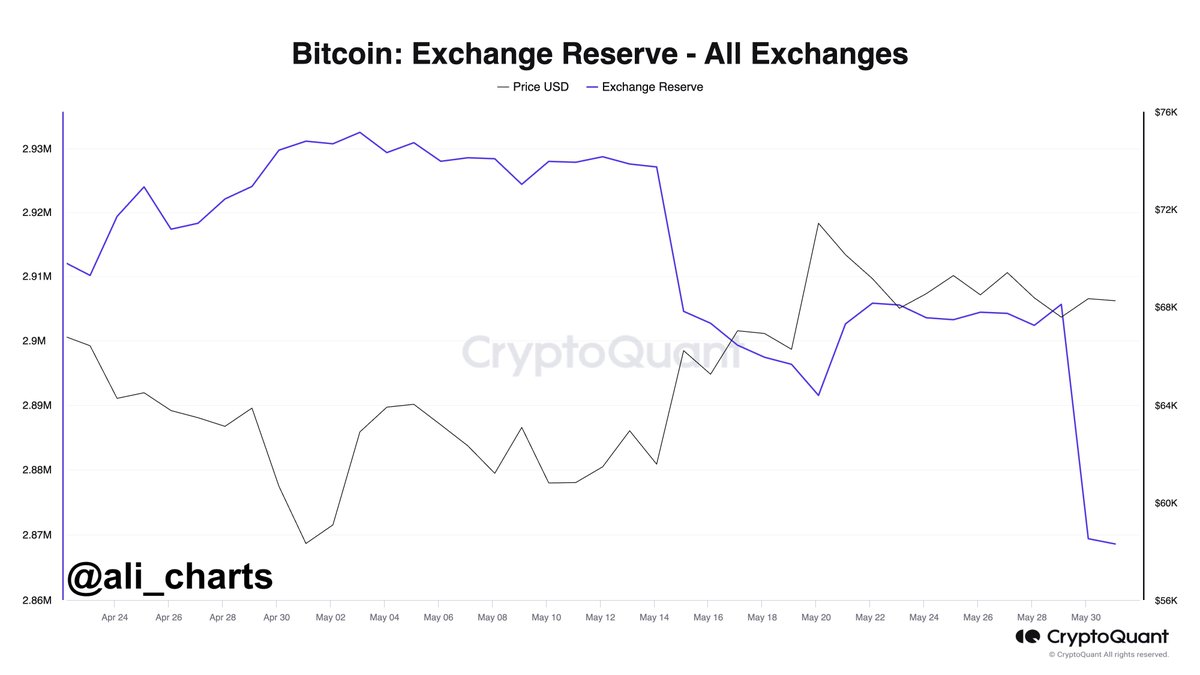
While it is difficult to tell the exact rationale behind the massive outflow from exchanges, the movement of funds from trading platforms suggests an increase in investor confidence. This indicates that many investors might be convinced by the future promise of Bitcoin, thereby opting to store their assets in self-custodial wallets in the long term.
What’s more, the downward spiral of Bitcoin’s supply on centralized exchanges could trigger a bullish rally for the premier cryptocurrency’s price. The sustained decline in BTC’s balance on exchanges could result in a supply crunch.
For context, the supply crunch refers to a scenario or period during which the supply of a particular asset is lower than the demand for it, resulting in a surge in the asset’s value.
Bitcoin Price At A Glance
As of this writing, the price of Bitcoin stands around $67,489, reflecting a 1.5% decline in the past 24 hours. This sluggish performance in the past day underscores the premier cryptocurrency’s struggles in the past week. According to CoinGecko’s data, the BTC price is down by nearly 2% in the last seven days.
Related Reading
Featured image from iStock, chart from TradingView
Is Cardano Centralized? KangaMoon Announces New Listing On Coingecko 10X On The Cards? CryptoDaily
Source link ]]>
Cardano Community Fires Back At Claim That ADA Is ‘Extremely Centralized’ ZyCrypto
Source link ]]>
How Centralized Is Cardano? Crypto Founder Has Answers And ADA Holders Will Not Like It | Bitcoinist.com Bitcoinist
Source link ]]>
Cardano (ADA) Is Centralized, Cyber Capital Founder Says CoinGape
Source link ]]>