

What Is Going Live on Cardano After Alonzo Launches?
Cardano’s Alonzo hardfork, which brings smart contract functionality to the network, is going live on Sep. 12. However, it could be several months before DeFi comes to mainnet due to…
updraftplus domain was triggered too early. This is usually an indicator for some code in the plugin or theme running too early. Translations should be loaded at the init action or later. Please see Debugging in WordPress for more information. (This message was added in version 6.7.0.) in /home/aonyeani76/cryptocurrencypanther/wp-includes/functions.php on line 6131hustle domain was triggered too early. This is usually an indicator for some code in the plugin or theme running too early. Translations should be loaded at the init action or later. Please see Debugging in WordPress for more information. (This message was added in version 6.7.0.) in /home/aonyeani76/cryptocurrencypanther/wp-includes/functions.php on line 6131wpforms-lite domain was triggered too early. This is usually an indicator for some code in the plugin or theme running too early. Translations should be loaded at the init action or later. Please see Debugging in WordPress for more information. (This message was added in version 6.7.0.) in /home/aonyeani76/cryptocurrencypanther/wp-includes/functions.php on line 6131 
Strict editorial policy that focuses on accuracy, relevance, and impartiality
Created by industry experts and meticulously reviewed
The highest standards in reporting and publishing
Strict editorial policy that focuses on accuracy, relevance, and impartiality
Morbi pretium leo et nisl aliquam mollis. Quisque arcu lorem, ultricies quis pellentesque nec, ullamcorper eu odio.
Bitcoin’s current price action is marked by a consolidation around the $105,500 price level. Although it reached an intraday high of $106,807, it has since returned to $105,500, and its dominance also witnessed a minor fall. Notably, Bitcoin’s dominance metric, the BTC.D, which measures its share of the total crypto market capitalization, has stalled around the 64% level in recent weeks.
This stalling behavior drew attention from a certified market analyst, especially in light of many altcoins struggling to gain momentum in an environment dominated by Bitcoin’s inflow.
According to certified Level III CMT analyst Tony “The Bull” Severino, the 64% region on the Bitcoin Dominance (BTC.D) chart could mark a meaningful reversal point. Sharing his insights alongside a technical chart of Bitcoin’s market cap dominance on the monthly timeframe, Severino pointed out that the latest monthly candlestick formed a Doji right at the bottom of a previous Falling Window.
In Japanese candlestick theory, such “windows” are not just gaps to be filled but serve as critical zones of support or resistance. The fact that BTC.D formed a Doji candle precisely at this window, according to Severino, is a textbook reaction suggesting the dominance rally may be losing strength.
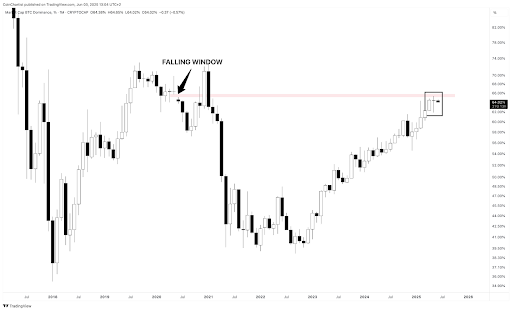
This candlestick structure brings the focus onto how the current monthly candlestick plays out. If the current monthly candle becomes an Evening Star candlestick and closes below 62%, the odds of Bitcoin dominance rolling over increase significantly.
As noted by Tony, if Bitcoin’s dominance candlestick this month forms an Evening Star pattern and closes below 62%, it has a high possibility of marking the end of the cryptocurrency’s current dominance. However, the analyst added a key caveat: the BTC.D Relative Strength Index (RSI) closed the previous month above 70, still suggesting strong momentum and keeping the larger trend in flux.
Despite these early signals, Severino warned against jumping the gun. Although the technical evidence points to a possible short-term reversal in dominance, he clarified that it does not necessarily guarantee a full-fledged altcoin season. In his words, “I am still not of the mindset that we will get a typical altcoin season, but I am seeing some of the first signs that BTC.D might reverse here.”
For now, Bitcoin continues to hold steady above $105,000, and until BTC.D breaks convincingly below 62%, the cryptocurrency is in dominance. Nonetheless, the altcoin market could soon be looking at its first real window of opportunity in months.
At the time of writing, Bitcoin is trading at $105,500, down by 0.1% in the past 24 hours. Bitcoin dominance is currently at 63.1%, down by 0.57% in the past 24 hours. Ethereum, on the other hand, increased its market share by 2.13% to 9.6%.
Featured image from Adobe Stock, chart from Tradingview.com
Strict editorial policy that focuses on accuracy, relevance, and impartiality
Created by industry experts and meticulously reviewed
The highest standards in reporting and publishing
Strict editorial policy that focuses on accuracy, relevance, and impartiality
Morbi pretium leo et nisl aliquam mollis. Quisque arcu lorem, ultricies quis pellentesque nec, ullamcorper eu odio.
Bitcoin’s bullish momentum has somewhat faded after reaching an all-time high of $111,000 on May 22, casting doubt on the sustainability of the rally. Bitcoin has pulled back slightly after its record-setting push, and analysts are split on what this means for its price action going forward.
Interestingly, not everyone is convinced the recent all-time high reflects genuine strength. One of the most notable voices challenging this is certified crypto expert Tony “The Bull” Severino, who warned that Bitcoin’s move may not be as solid as it looks on the surface.
In his assessment, Tony Severino argues that the breakout to $111,814 lacks the technical confirmation usually associated with a true bullish breakout. He noted that while BTCUSD did print a new high, other major trading pairs did not follow suit.
Particularly, Bitcoin failed to reach a new all-time high against currencies such as the Euro, British Pound, Japanese Yen, and the Swiss Franc. The same applies to BTC/XAU, Bitcoin’s price measured against gold, which currently lags far behind its former peak of 41 ounces per Bitcoin. At the time of writing, that pair is still hovering at 32 ounces, a significant difference that suggests the upward momentum is isolated to the US Dollar.
This divergence leads Severino to argue that the move could be a byproduct of the USD’s weakness rather than Bitcoin’s strength. A true bullish breakout, he says, would have been evident across multiple currency pairs and asset benchmarks. His skepticism is further reinforced by the structure of the charts, as seen in the six comparative panels he shared on the social media platform X. Most of them show Bitcoin forming lower highs or simply failing to match the previous all-time level.
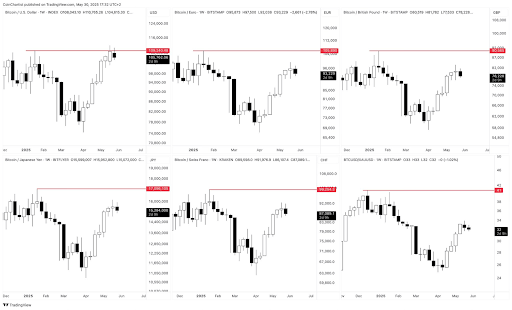
For instance, Bitcoin priced in euros is still well below its peak of €105,890, currently trading around €93,229. Similarly, Bitcoin has failed to breach the 17 million mark against the Japanese Yen and now sits at ¥15.28 million. The same trend is repeated in the Swiss Franc and British Pound pairings, with BTC / Swiss Franc failing to cross 99,254 and BTCGBP forming a lower high at $78,228. These price actions make it difficult to argue that Bitcoin is in a universally strong position, particularly when measured in anything other than USD.
In conclusion, Tony Severino warns traders and investors not to be misled by the surface-level optimism that comes with a new all-time high in BTCUSD. A single breakout, especially one lacking confirmation from cross-pair strength and fundamental indicators, does not necessarily signal the start of a new wave five or a sustained bullish trend for the Bitcoin price.
According to him, the May monthly candle close and the June monthly candle open will be important in determining the next direction. If the current indecision tilts bearish, technicals could teeter back bearish towards a larger correction.
At the time of writing, Bitcoin is trading at $104,850 after reaching a 24-hour low of $103,832. This is a brief recovery from its June open of $104,646.
Featured image from Getty Images, chart from Tradingview.com
The development company behind Cardano, Input-Output (IOHK), has unveiled the Plutus dAppStore, a new shop for decentralized applications on the network. Developers will be able to post their Cardano dApps to this shop, making it easier for the community to find them.

Image Source: Cardano Feed
Cardano has announced the creation of a marketplace for verified decentralized applications. In a blog post published on Wednesday, IOHK gave a sneak peek at its new “integrated approach” to the development of the Cardano ecosystem, which will be unveiled at Cardano Summit 2021. The Plutus dAppStore, a shop where developers can publish their decentralized applications running on Cardano and make them simpler to discover, is the centerpiece of the announcement.
The dAppStore, according to Shruti Appiah, Cardano’s head of product and smart contracts, removes two hurdles to entry. The first is that there is no formal discovery procedure for dApps running on the network, and the second is that end-users do not have a consolidated picture of all dApps available in a specific ecosystem.
Cardano users will be able to explore the complete ecosystem of dApps running on the protocol through a single “storefront” or web page with the Plutus dAppStore.
IOHK is also launching a formal certification scheme for third-party decentralized applications on Cardano, in addition to the dAppStore. Through automated logic tests, manual smart contract auditing, and formal verification, the program aims to provide users with assurance about the integrity of the dApps they utilize.
The dAppStore, according to Appiah, will provide a “democratized environment for developers to publish their dApps without facing censorship,” which means that both certified and uncertified apps will be listed on the storefront, as the site does not intend to act as a gatekeeper but rather as a “platform for transparent user assessment.”
The long-awaited Alonzo hard fork for Cardano, which added smart contract capability to the network, went live earlier this month, but not without issues. While the upgrade itself proceeded without a hitch, many members of the community were unhappy to see only a handful of applications launch on the network.
Minswap, the first decentralized exchange to debut on the testnet, quickly ran into scale issues and was forced to cease down. Long Nguyen, the founder and engineering lead of Minswap, told Crypto Briefing that the issue stemmed from the so-called concurrency “issue,” which refers to the capacity for several agents to engage with the same smart contract at the same time.
While account-based blockchains, like Ethereum, allow numerous users to interact with the same smart contracts by default, state-based or EUTXO-based networks, such as Cardano, present certain challenges for developers. The Minswap team published in a post-mortem blog post after the incident: “It’s an issue that every competent team and development lab building DeFi protocols on Cardano must overcome. It’s not a fundamental flaw, but is simply a design challenge that must be addressed.”
The Plutus dAppStore prototype will be previewed by IOHK during the Cardano Summit 2021, which will take place on the 25th and 26th of this month. Sidney Vollmer, Cardano’s head of marketing and communications, predicted that some of the summit’s partnerships may “blow people’s minds.” While the Plutus dAppStore’s official debut date has yet to be announced, it remains to be seen whether and when fully-fledged DeFi applications will be added to the store.
If you find this article informative then do share it with your friends and family!
Also read: Elizabeth Warren warns crypto scams’ increment on exchanges
Input Output (IOHK), the development company behind Cardano, has announced the upcoming store for decentralized applications on the network, called Plutus dAppStore. In this storefront, developers will be able to upload their Cardano dApps, making it easier for the community to discover them.
Cardano has revealed that it’s building a storefront for certified decentralized applications.
In a Wednesday blog post, IOHK published a preview of its new “integrated approach” to the development of the Cardano ecosystem ahead of Cardano Summit 2021. The centerpiece of the announcement is the upcoming launch of the Plutus dAppStore, a storefront where developers can upload their decentralized applications running on Cardano and make them easier for discovery.
According to Shruti Appiah, head of product and smart contracts at Cardano, the dAppStore addresses two barriers to entry. The first is that there is currently no formal discovery process for dApps running on the network, and the second is that there is no consolidated view of all dApps available in a given ecosystem for end-users.
The Plutus dAppStore will allow Cardano users to explore the entire ecosystem of dApps running on the protocol through a single “storefront” or web page.
In addition to the dAppStore, IOHK is also launching a formal certification program for third-party decentralized applications on Cardano. The program’s goal is to give users assurance about the integrity of the dApps they use through automated logic checks, manual smart contract auditing, and formal verification.
According to Appiah, the dAppStore will provide a “democratized environment for developers to publish their dApps without facing censorship,” meaning both certified and uncertified applications will be listed on the storefront, as the site intends not to act as a gatekeeper but rather provide “a platform for transparent user assessment.”
Cardano’s long-awaited Alonzo hardfork, which brought smart contract functionality to the blockchain, went live earlier this month, but not without its problems. While the actual upgrade went smoothly, many in the community were disappointed to see a very small number of applications launching on the network.
Minswap, the first decentralized exchange to launch on the testnet, faced immediate scaling issues and was forced to shut down soon after the launch. In an interview following the incident, Minswap founder and engineering lead Long Nguyen told Crypto Briefing that the problem arose from the so-called concurrency “issue,” which refers to the ability for multiple different agents to interact with the same smart contract at the same time.
While account-based blockchains like Ethereum allow multiple users to interact with the same smart contracts by default, state-based or EUTXO-based networks like Cardano pose certain difficulties for developers in that regard. In a post-mortem blog post following the incident, the Minswap team wrote:
“It’s an issue that every competent team and development lab building DeFi protocols on Cardano must overcome. It’s not a fundamental flaw, but is simply a design challenge that must be addressed.”
The prevailing lack of fully-fledged DeFi applications on Cardano may be explained by the fact that, thus far, nobody seems to have found a practical solution to the concurrency issue. SundaeSwap—another decentralized exchange building on Cardano—published an article following Alonzo’s launch on testnet, downplaying the issue and offering several theoretical solutions to concurrency. however, thus far, they have not yet been able to launch a functioning DEX on the network.
While individual projects are currently working towards solutions, Minswap says that “thus far efforts have been siloed with little exchange of information amongst teams.”
IOHK will showcase a preview of the Plutus dAppStore prototype at the Cardano Summit 2021, taking place on the 25th and 26th of this month. Cardano’s head of brand and communications, Sidney Vollmer, hinted that some of the partnerships announced during the summit will “blow people’s minds.”
While the official launch date of the Plutus dAppStore is yet to be announced, it remains to be seen whether, and how soon, fully-fledged DeFi applications will populate the storefront.
Disclaimer: At the time of writing this feature, the author owned ETH and several other cryptocurrencies.
Cardano’s Alonzo hardfork, which brings smart contract functionality to the network, is going live on Sep. 12. However, it could be several months before DeFi comes to mainnet due to…