Shiba Inu’s shib created a $1 billion AI war chest — and Vitalik regrets it CoinDesk
Source link ]]>
Cardano Lines Up An $80 Million War Chest: DDC Fund Goes Live Bitcoinist.com
Source link ]]>
In a recent report by Capriole Investments’ Charles Edwards explored the Federal Reserve’s ever-expanding war chest and its potential implications for the Bitcoin and crypto market. As Bitcoin gears up for its halving in April 2024, a pivotal event that will make it scarcer than gold, understanding the macroeconomic environment becomes crucial.
Why Macro Matters For Bitcoin And Crypto
Edwards underscores the inherent interconnectedness of global markets, asserting, “Bigger markets drive smaller markets.” This symbiotic relationship is evident in the crypto realm, where altcoins’ performance is closely tethered to Bitcoin’s movements. Drawing a parallel with traditional markets, Edwards elucidates, “Bonds drive equities, equities drive Bitcoin and Bitcoin drives altcoins.”
Contrary to the prevailing sentiment of an impending recession in 2023, the equities market defied expectations with a robust rally. This surge was not arbitrary but was propelled by the groundbreaking integration of usable AI, which has the potential to significantly augment GDP. Edwards directs attention to the NAAIM Exposure Index, a barometer of NAAIM managers’ equities exposure. The current readings of this index are reminiscent of those in June and October 2022, both of which signaled local bottoms for the S&P 500.
Furthermore, the AAII sentiment survey results, which are currently moderate, could provide a more convincing buy signal if they align with the NAAIM Exposure Index. Another metric that Edwards holds in high regard is the Put/Call ratio. This ratio offers insights into the relative bullishness or bearishness of market participants in the options market. A recent spike in this ratio suggests that the traditional finance market might be on the cusp of a near-term upward movement, Bitcoin and crypto could follow.
However, Edwards tempers this optimism with a note of caution. For a more definitive bullish signal, the S&P 500 would need to breach and sustain above the pivotal monthly resistance level at 4600. A consistent performance above this threshold would dispel any notions of a transient “dead-cat-bounce.”
Macro Fundamentals: A Mixed Bag
The broader macroeconomic picture presents a mosaic of varying hues. The aggressive tightening cycle, a hallmark of the Fed’s recent monetary policy, is still being assimilated by the markets. With the reservoir of household savings accumulated during the Corona stimulus years now running dry, a consequential contraction in consumer spending is on the horizon.
Edwards shines a spotlight on a couple of particularly disconcerting metrics: a marked decline in manufacturing, a sector whose downturns have historically been harbingers of recessions and consumer spending, which has not only dipped below its 20-year average growth rate but has done so at an alarming velocity.
Other red flags in the US economic landscape include a relative rise in the cost of living as income growth, at a meager 1% annually, lags behind inflation; an unprecedented credit card debt mountain of $1 trillion; escalating delinquency rates; and a squeeze on net worth as housing prices wane in the face of dwindling demand.
Yet, despite these ominous signs, the robust employment rates render any immediate proclamations of a recession premature. Edwards emphasizes the significance of the “initial claims” metric as a bellwether for unemployment trends.
However, the integration of AI into the workforce is not just a technological marvel but a potential economic game-changer. Edwards, drawing from personal experience, notes a 50% surge in productivity with AI’s aid. He references a statement by Sam Altman, CEO of OpenAI, which projects that in the near future, a single programmer, with tools like ChatGPT and Copilot, could rival the productivity of 20-30 of today’s programmers.
The Fed’s War Chest
Aware of the looming economic uncertainties, the Federal Reserve has been bolstering its defenses. The unprecedented rate hikes, catapulting interest rates from zero to 5% in a mere year, coupled with a contraction in the money supply rate, have engendered the most stringent economic conditions ever recorded that has been weighing heavy on tradfi, Bitcoin and crypto.
The Fed’s dual strategy of high interest rates, which provide leeway to slash rates during crises, and its recent success in paring down its balance sheet by a whopping $1trillion, are central to its defensive posture. Edwards speculates on the timing of the next QE round, suggesting that given the impending election year, the Fed might be compelled to deploy its liquidity arsenal sooner than anticipated.
Given the current macroeconomic tableau and the 90% of rate hikes already factored into the market as per the CME FedWatch, Edwards posits that the Fed might be compelled to infuse liquidity in the imminent future, especially if indicators like rising unemployment or plummeting consumer spending manifest. What will happen then should be clear to everyone: risk assets like Bitcoin and crypto will rally, aligning perfectly with the BTC halving.
At press time, BTC traded at $26,015.
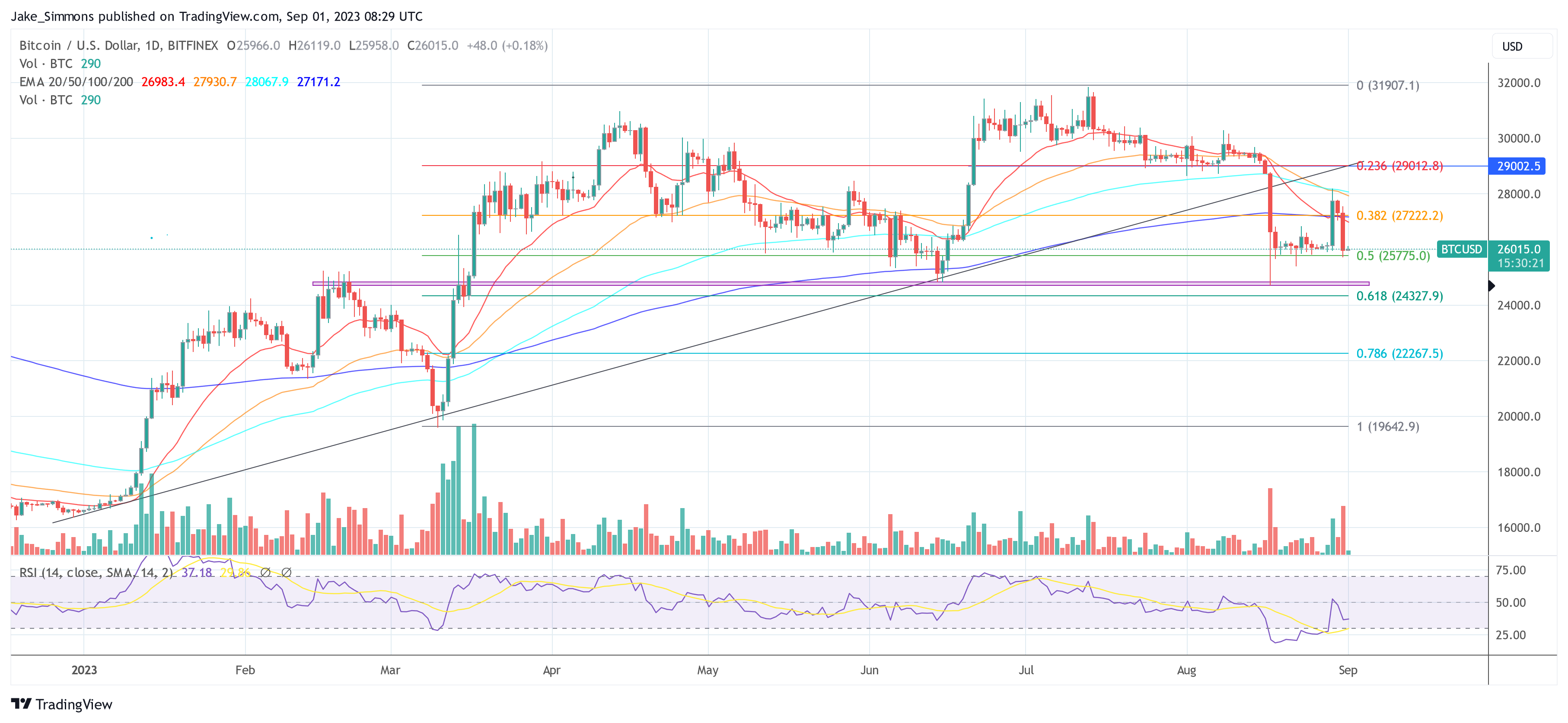
Featured image from iStock, chart from TradingView.com
Dogecoin Lawsuit Plaintiffs Claim Elon Musk Using ‘Bottomless War Chest’ for Harassment in New Court Filing The Daily Hodl
Source link ]]>
Coming every Saturday, Hodler’s Digest will help you track every single important news story that happened this week. The best (and worst) quotes, adoption and regulation highlights, leading coins, predictions and much more — a week on Cointelegraph in one link.
Top Stories This Week
Infrastructure bill passes US Senate — without clarification on crypto
On Tuesday, the controversial infrastructure bill passed in the U.S. senate In a 69-30 vote.
The bipartisan bill proposes roughly $1 trillion of funding into transportation and electricity infrastructure projects. The bill also puts forward more stringent rules for firms handling crypto assets while expanding reporting requirements for brokers, who will be required to report digital asset transactions worth more than $10,000 to the IRS.
Six senators, including Pat Toomey, Cynthia Lummis, Rob Portman, Mark Warner, Kyrsten Sinema and Ron Wyden, proposed an amendment to the buzz-kill bill on Monday that would exempt software developers, transaction validators and node operators as brokers, while proposing that tax reporting requirements “only apply to the intermediaries.”
Their efforts didn’t bear fruit, however, with further clarification on crypto not provided. Senator Toomey flamed the bill in the aftermath, noting that the legislation was “too expensive, too expansive, too unpaid for and too threatening to the innovative cryptocurrency economy.”
Walmart seeks crypto product lead to drive digital currency strategy
On Aug. 16, it was reported that U.S. retail giant Walmart was seeking out an experienced crypto expert who can develop and drive a digital currency strategy and product roadmap for the firm.
According to the job listing, Walmart is looking for someone with a track record of leading and scaling businesses. They also want at least 10 years of experience in product/program management and tech-based product commercialization.
Ideally, the candidate should also know a thing or two about crypto, blockchain tech and why JPEGs of poorly drawn pet rocks are selling for absurd prices on Ethereum.
Walmart’s future digital currency and crypto product lead will be based in the company’s home office in Bentonville, Arkansas. The state has produced talents such as Billy Bob Thornton and Johnny Cash, along with Bill and Hillary Clinton.
Eth2 staking contract ranks as single-largest Ether hodler with $21.5B
There was good news for Doge fanatics this week as the Dogecoin Foundation resurfaced after several years of total media silence.
According to an announcement on Tuesday, the foundation stated it was reestablishing itself in a bid to support the fiery-eyed Dogecoin (DOGE) community. The foundation also said it would be announcing new projects that are centered on encouraging adoption of DOGE and promoting its utility.
The project’s website lists Ethereum co-founder Vitalik Buterin, Dogecoin co-founder Billy Markus and Dogecoin Core developer Max Keller as advisory board members. Furthermore, Tesla CEO and DOGE proponent Elon Musk’s interests may be catered to from the shadows via Neuralink CEO Jared Birchall.
It is yet to be revealed if Musk’s “toddler hodler” son has loaded up on DOGE in light of the announcement.
Former US Treasury official joins Binance to lead AML efforts
Coinbase, the top U.S. crypto exchange, has amassed a cash-based war chest worth $4 billion on the back of two very productive quarters for the firm.
The company reportedly expected to use the cash to cover costs incurred by a variety of factors, including conforming to new regulations handed down by the United States legislature.
Coinbase has also announced its official launch in Japan in partnership with banking giant Mitsubishi UFJ Financial Group, while also revealing plans to add $500 million worth of crypto to its balance sheet and invest 10% of all generated profits into digital assets moving forward.

Winners and Losers

At the end of the week, Bitcoin is at $48,778, Ether at $3,282 and XRP at $1.28. The total market cap is at $2.09 trillion, according to CoinMarketCap.
Among the biggest 100 cryptocurrencies, the top three altcoin gainers of the week are Avalanche (AVAX) at 105.79%, Arweave (AR) at 96.17% and Audius (AUDIO) at 93.78%.
The top three altcoin losers of the week are DigiByte (DGB) at -5.06%, Celsius (CEL) at -4.44% and BitTorrent (BTT) at -3.81%.
For more info on crypto prices, make sure to read Cointelegraph’s market analysis.
Most Memorable Quotations
“Poly Network has no intention of holding Mr. White Hat legally responsible, as we are confident that Mr. White Hat will promptly return full control of the assets to Poly Network and its users. As we have stated in previous announcements and encrypted messages that have been made public, we are grateful for Mr. White Hat’s outstanding contribution to Poly Network’s security enhancements.”
“Lawmakers and regulators must work together to properly balance protecting innovation with any new regulations to ensure the digital asset marketplace flourishes in the United States.”
Glenn Thompson and Patrick McHenry, U.S. representatives
“The most important thing that can be done today is moving away from the idea that coin voting is the only legitimate form of governance decentralization.”
Vitalik Buterin, Ethereum co-founder
“Here at home in America, […] our payments infrastructure is arguably the worst of any developed country in the world, and increasingly falling behind, while China is moving with determination and haste to build an infrastructure that will make the digital yuan a challenger to the dollar as the world’s reserve currency.”
David Marcus, Diem co-creator
“Ethereum is outperforming Bitcoin, and it can be expected to continue this trend for the rest of 2021.”
Nigel Green, CEO of DeVere Group
“This is all about DeFi. […] This is the Treasury Department trying to work out how to get jurisdiction over DeFi […] and also expand its warrantless surveillance over a peer-to-peer financial system.”
Jake Chervinsky, general counsel at Compound
“Frankly, as one of the first pilots, we have on the table the question of paying salaries to employees of the Ministry of Digital Transformation in electronic hryvnia.”
Mykhailo Fedorov, vice prime minister of Ukraine
“It’s important to remember that when we look at the business, the long-term arc of adoption of digital assets in crypto matters far more than the businesses we are building.”
Mike Novogratz, founder and CEO of Galaxy Digital
Prediction of the Week
Ethereum ‘liquidity crisis’ could see new ETH all-time high before Bitcoin — Analyst
Bitcoin, the crypto industry’s largest asset by market cap, and Ethereum (ETH), the second-largest asset, have both posted notable price recoveries over the past several weeks. Although BTC has yet to be surpassed as the crypto industry’s top dog, ETH might tap its own all-time price high near $4,400 sooner than BTC reaches its record level of nearly $65,000, according to thoughts from CryptoQuant CEO Ki Young Ju.
“$ETH might reach its all-time high earlier than $BTC in the long term,” Ju tweeted on Wednesday. “Current $ETH price is closer to ATH compared to $BTC. Higher demand, lower supply. $ETH sell-side liquidity crisis still intensifies, while $BTC exchange reserve stopped its downward trend in May.”
On Friday, BTC fluctuated above the $48,000 mark, and ETH traded above $3,200 — which, however, are both still notably shy of their record highs.
FUD of the Week

JPMorgan Chase reportedly shuts down bank accounts of Bitcoin mining firm
On Aug. 19, U.S. banking behemoth JPMorgan Chase reportedly blocked all account activities of Bitcoin mining firm Compass Mining.
Whit Gibbs, the CEO of Compass Mining, took to Twitter to share the news:
“Shoutout to @Chase for shutting down @compass_mining accounts for doing our part to replace the old guard with self-sovereign, future-focused supporters of hard money. Get behind #Bitcoin or get out of our way.”
It is unclear if the temper tantrum will be enough to sway JPMorgan Chase to change its mind, and it is also unclear how shutting down banking services to one Bitcoin mining firm represents an attack on BTC in any way.
If anything, the banking giant has been upping its exposure to Bitcoin and the crypto sector in 2021.
Liquid exchange hacked to the tune of $80 million
Liquid, a Japanese crypto exchange, was the victim of a $80 million-plus hack this week which made the platform not so… liquid.
Cointelegraph reported on the news quickly after the exchange announced the attack, which compromised digital assets including BTC, Tron (TRX), Ripple (XRP) and Ether.
The exchange explained that only its hot wallets were affected and added that its assets were being moved into cold storage for security purposes.
The platform has since provided an update and revealed the hack totaled $91.35 million. The firm has urged users to not deposit any crypto assets in Liquid wallets until further notice.
T-Mobile looking into potential hack of data on 100 million customers
Speaking of hacks, U.S. telecom giant T-Mobile was looking into an alleged massive data breach at the start of this week that may have compromised the information of more than 100 million users.
According to Vice’s Motherboard, T-Mobile is looking into a potential data breach claimed by an author who posted details on an underground forum. A Sunday report said the hacker claims to have obtained data on more than 100 million customers from T-Mobile servers.
Unlike the Poly Network hacker, who syphoned $600 million worth of digital assets because “cross-chain hacking is hot,” the T-Mobile hacker seems to be displaying entrepreneurial instincts, as they were asking for 6 BTC — worth around $280,000 at current prices — in exchange for some of the data.
Best Cointelegraph Features

Shanghai Special: Crypto crackdown fallout and what happens next
Owning Bitcoin isn’t banned, but many fear for the future of regulations in China. Here’s a look at where we stand and where we might be headed.
Poly Network hack exposes DeFi flaws, but community comes to the rescue
The DeFi hacker’s initial intentions remain unclear, but they refused to accept a $500,000 bounty after returning all funds.
The perfect storm: DeFi hacks will advance the crypto sector moving forward
There is a silver lining from the DeFi hacks as new tech develops to protect the sector: “DeFi will be much safer in 12 months from now.”