Cardano’s Community Clash: A $12 Million Fund Passes as Its Flagship Summit Fails AD HOC NEWS
Source link ]]>
Dogecoin Price Prediction: DOGE at $0.0914 as Analysts Clash openPR.com
Source link ]]>
Hoskinson Fires Back as Cardano-Midnight Clash Escalates CoinCentral
Source link ]]>
XRP is approaching mid-February caught between technical stress and renewed accumulation. After one of its sharpest sell-offs in months, the token has rebounded from recent lows but remains capped below a key resistance zone near $1.50.
Related Reading
The conflicting signals, extreme oversold indicators, heavy capitulation volume, and steady institutional inflows, are fueling debate over whether XRP is stabilizing or simply pausing before another move lower.
The latest downturn unfolded quickly. XRP fell more than 30% from early January highs, briefly touching the $1.11 level during the February 5 market-wide sell-off. That drop coincided with peak fear across crypto markets, as Bitcoin slid toward $60,000 and broad liquidations erased hundreds of billions in market value.
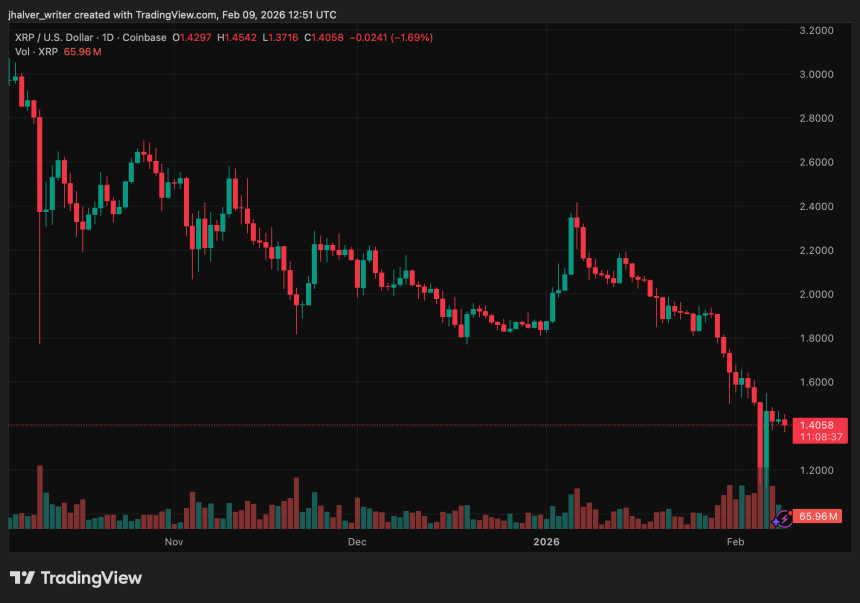
XRP's price trends to the downside on the daily chart. Source: XRPUSD on Tradingview
Oversold Signals and Capitulation Volumes
Technical analysts point to unusual momentum conditions. On the weekly chart, XRP’s Relative Strength Index fell to levels historically associated with market bottoms rather than routine pullbacks.
Analysts such as STEPH IS CRYPTO note that these readings often reflect selling exhaustion, though they do not guarantee an immediate reversal.
Volume data adds weight to that view. During the February 5 crash, XRP recorded its highest single-day trading volume on Coinbase in nearly a year, a pattern some analysts associate with capitulation.
Blockchain Backer, who had warned of a downturn earlier in January, argues that such spikes often mark the later stages of a decline, even if prices still consolidate or retest lows afterward.
XRP Dip Buyers Step In as Institutions Hold Interest
While retail sentiment weakened during the drop, several high-profile investors publicly disclosed dip buying.
Media personality Patrick Bet-David confirmed adding to his XRP position during the sell-off, echoing similar disclosures from market commentator Coach JV. Both framed their purchases as long-term accumulation rather than short-term trades.
Institutional data tells a similar story. XRP was the only major crypto asset to post positive ETF flows last week, attracting roughly $45 million in net inflows while Bitcoin, Ethereum, and Solana products saw outflows.
The bulk of that demand came from Franklin Templeton and Bitwise XRP ETFs, suggesting that some institutions are maintaining exposure despite ongoing price weakness.
The $1.50 Level Remains the Line to Watch
Despite the rebound, technical resistance remains firm. XRP continues to trade below former support zones between $1.50 and $1.65, which now act as supply. Analysts caution that until the price reclaims these levels and begins forming higher lows, recent gains should be viewed as corrective.
Related Reading
For now, XRP sits at a crossroads. Oversold conditions and steady inflows suggest selling pressure may be easing, but the market has yet to confirm a broader trend change. Whether XRP can turn stabilization into a sustained recovery likely hinges on how it behaves around the $1.50 resistance in the days ahead.
Cover image from ChatGPT, XRPUSD chart on Tradingview
Ethereum (ETH) has entered a decisive phase after a sharp sell-off erased much of its recent gains and pushed the price toward the closely watched $2,200 level. The move followed repeated failures to break above the $2,500–$2,550 zone, triggering liquidations.
Related Reading: Crypto Hacks Explode: $370 Million Stolen In January Alone: Researchers
With large holders taking opposing positions and on-chain data flashing caution, ETH is now at a point where both downside risk and rebound potential remain firmly in play.
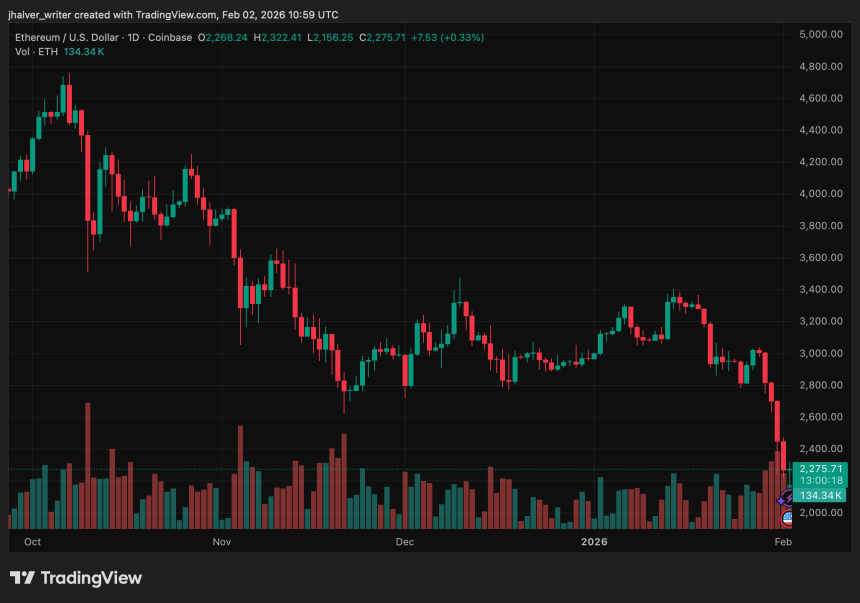
ETH's price records major losses across the board. Source: ETHUSD on Tradingview
Ethereum Price Structure Weakens as $2,200 Comes Into Focus
Ethereum (ETH) has fallen more than 20% from recent highs, briefly trading below $2,220 before stabilizing.
The drop pushed ETH below the $2,300–$2,400 range and under key short-term moving averages, shifting near-term control toward sellers. Technical data shows a developing bearish trend line around $2,400–$2,420, an area that would need to be reclaimed to ease downside pressure.
The $2,200 zone is now acting as the main support. A sustained break below this level could expose deeper downside toward $2,050 or psychological $2,000 mark. Momentum indicators remain cautious, with the hourly RSI below 50 and MACD still aligned with bearish momentum, suggesting buyers have yet to regain control.
Exchange Inflows and Liquidations Signal Distribution Risk
On-chain data has added to concerns. Exchange inflows surged ahead of the breakdown, with roughly 600,000 ETH moving onto major exchanges in a single day, including a sharp spike into Binance. Such inflows are often associated with selling, hedging, or risk reduction rather than accumulation.
At the same time, derivatives markets saw heavy stress. ETH-related liquidations reached about $280 million over 24 hours, surpassing Bitcoin and confirming that long positions were crowded near recent highs.
The unwind’s speed suggests structural weakness, as spot demand failed to absorb forced selling once support levels gave way.
Whale Longs Add a Bullish Counterweight
Despite bearish flow data, whale activity tells a more mixed story. According to on-chain analysts, dormant wallets reactivated after five years and posted over 45,000 ETH as collateral to open a large coin-margined long, borrowing roughly $100 million.
This move highlights growing divergence at current levels, with some institutions deleveraging while certain large holders add exposure.
Related Reading: Is The Bitcoin Bottom In? CMT Reveals What Traders Need To See Now
This clash between whale longs and bearish exchange flows shows the uncertainty around $2,200. A rebound above $2,420 could shift momentum back toward buyers, while failure to hold current support may confirm that distribution pressure remains dominant.
Cover image from ChatGPT, ETHUSD on Tradingview
Dogecoin Price Analysis: Bullish Patterns Clash With Fragile Support CoinCentral
Source link ]]>

The Ethereum (ETH) ecosystem is facing a mix of structural progress and market uncertainty. On one side, developers are pushing forward with a series of scalability upgrades aimed at lowering fees and expanding capacity across the network.
Related Reading: South Korea Explores Crypto Account Freezing Measure To Prevent Market Manipulation
On the other hand, large holders are using recent price strength to reduce exposure, introducing short-term selling pressure. Together, these opposing forces are building Ethereum’s near-term outlook as ETH trades above the $3,200 level.
The contrast is clear, while the protocol is absorbing more capital through staking and infrastructure improvements, parts of the market are testing how much supply and demand can absorb during a renewed rally.
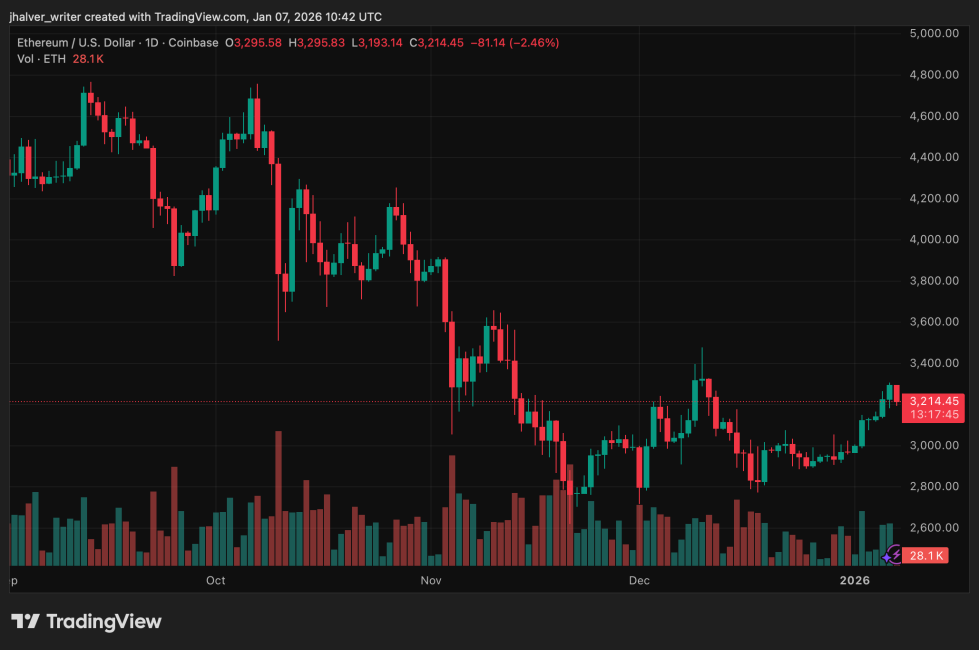
ETH's price moving sideways on the daily chart. Source: ETHUSD on Tradingview
Scalability Roadmap Moves Forward
Ethereum developers activated the second Blob Parameter-Only (BPO) hard fork this week, raising the blob limit from 15 to 21 and increasing the blob target from 10 to 14.
Blobs are temporary data containers used primarily by rollups to batch transactions more efficiently. With each blob holding 128 kilobytes, the network can now process roughly 2.6 megabytes of blob data per block.
The upgrade is part of a broader effort to scale Ethereum through layer-2 networks rather than pushing all activity onto the main chain. Since the first BPO fork in December, transaction fees on Ethereum have shown reduced volatility, reflecting lower congestion as rollups move data off-chain.
Developers are already discussing additional changes, including raising the gas limit from 60 million to 80 million, and later up to 200 million under the planned Glamsterdam hard fork in 2026. That upgrade is expected to introduce parallel transaction processing, further increasing throughput.
Ethereum’s (ETH) Staking Growth Tightens Liquid Supply
At the same time, staking activity is reshaping Ethereum’s supply dynamics. Institutional participation has increased, highlighted by BitMine’s latest deposits, which pushed its total staked ETH close to 780,000 tokens, worth over $2.5 billion.
Network-wide data indicates that more than 1.3 million ETH are waiting to enter staking, while the validator exit queue has dropped to zero. This imbalance suggests that fewer validators are choosing to exit, even amid market volatility.
As more ETH is locked into consensus contracts, circulating supply on exchanges continues to decline, potentially limiting downside pressure over the medium term.
Whale Selling Adds Near-Term Pressure
Despite these fundamentals, large holders have recently turned into net sellers. Whale wallets holding between 100,000 and 1 million ETH sold roughly 300,000 ETH over three days, valued at about $970 million.
This selling coincided with ETH’s breakout from a multi-week descending wedge, indicating that some whales are using the rally to take profits.
Related Reading: Scudo Announced: Tether’s Newest Crypto And Gold Unit – Here’s The Breakdown
While long-term holders remain largely inactive, helping to stabilize the broader structure, continued distribution by whales could slow upside momentum. Ethereum now sits at a crossroads, balancing protocol-level progress against market-driven supply pressure as traders assess whether demand can sustain the next leg higher.
Cover image from ChatGPT, ETHUSD chart from Tradingview
Editorial Process for bitcoinist is centered on delivering thoroughly researched, accurate, and unbiased content. We uphold strict sourcing standards, and each page undergoes diligent review by our team of top technology experts and seasoned editors. This process ensures the integrity, relevance, and value of our content for our readers.
The Clash of Titans: Elon Musk vs. EU Regulations OneSafe
Source link ]]>
Bittensor’s Short-Term Rebound & Dogecoin’s Resistance Clash With BlockDAG’s $435M Presale & Value Era Demand Surge BlockchainReporter
Source link ]]>
Cardano Price Prediction: ADA Risks Breakdown As $25M Outflows Clash With Leios Milestone Coin Edition
Source link ]]>