Featured image from The Pixabay, Chart from TradingView.com
Bitwise Chief Investment Officer Matt Hougan is rejecting a growing claim that Strategy could be compelled to sell Bitcoin. He called the premise just flat wrong. His note argues that neither index changes nor market pressure creates a requirement to liquidate the firm’s BTC holdings. Bitcoin Jitters as MSCI Weighs Strategy A client note carried
The post Bitwise CIO Calls Strategy Bitcoin-Sell Narrative “Flat Wrong” in New Client Memo Note appeared first on CoinGape.
]]>FBI called as Cardano split in two by a single transaction: Lessons for ETH and SOL client diversity CryptoSlate
Source link ]]>

On Nov. 21, Cardano’s mainnet bifurcated into two competing histories after a single malformed staking-delegation transaction exploited a dormant bug in newer node software.
For roughly 14 and a half hours, stake pool operators and infrastructure providers watched as blocks piled up on two separate chains: one “poisoned” branch that accepted the invalid transaction and one “healthy” branch that rejected it.
Exchanges paused ADA flows, wallets showed conflicting balances, and developers raced to ship patched node versions that would reunify the ledger under a single canonical history.
No funds vanished, and the network never fully halted. Still, for half a day, Cardano lived the scenario Ethereum’s client-diversity advocates warn about: a consensus split triggered by software disagreement rather than an intentional fork.
Cardano co-founder Charles Hoskinson said he alerted the FBI and “relevant authorities” after a former stake-pool operator admitted broadcasting the malformed delegation transaction.
Law enforcement’s role here is to investigate possible criminal interference with a protected computer network, under statutes like the U.S. Computer Fraud and Abuse Act, since deliberately (or recklessly) pushing an exploit to a live, interstate financial infrastructure can constitute unauthorized disruption, even if framed as “testing.”
The incident offers a rare natural experiment in how layer-1 blockchains handle validation failures.
Cardano preserved liveness, blocks kept coming, but sacrificed temporary uniqueness, creating two legitimate-looking chains that had to be merged back together.
Solana, by contrast, has repeatedly chosen the opposite trade-off: when its single client hits a fatal bug, the network halts outright and restarts under coordinated human intervention.
Ethereum aims to sit between those extremes by running multiple independent client implementations, betting that no single codebase can drag the entire validator set onto an invalid chain.
Cardano’s split and the speed with which it resolved test whether a monolithic architecture with version skew can approximate the safety properties of genuine multi-client redundancy, or whether it simply got lucky.
The bug and the partition
Intersect, Cardano’s ecosystem governance body, traced the failure to a legacy deserialization bug in hash-handling code for delegation certificates.
The flaw entered the codebase in 2022 but remained dormant until new execution paths exposed it in node versions 10.3.x through 10.5.1.
When a malformed delegation transaction carrying an oversized hash hit the mempool around 08:00 UTC on Nov. 21, newer nodes accepted it as valid and built blocks on top of it.
Older nodes and tooling that had not migrated to the affected code path correctly rejected the transaction as malformed.
That single disagreement over validation split the network. Stake pool operators running buggy versions extended the poisoned chain, while operators on older software extended the healthy one.
Ouroboros, Cardano’s proof-of-stake protocol, instructs each validator to follow the heaviest valid chain it observes, but “valid” had two different definitions depending on which node version processed the transaction.
The result was a live partition: both branches continued producing blocks under normal consensus rules, but they diverged from a common ancestor and could not reconcile without manual intervention.
The pattern had appeared on Cardano’s Preview testnet the day before, triggered by nearly identical delegation logic.
That testnet incident alerted engineers to the bug in a low-stakes environment. Still, the fix had not yet propagated to mainnet when a former stake-pool operator, who later claimed he followed AI-generated instructions, submitted the same malformed transaction to the production network.
Within hours, the chain had split, and infrastructure providers faced the question of which fork to treat as canonical.
Safe failure without a kill switch
Cardano’s partition resolved itself through voluntary upgrades rather than emergency coordination. Intersect and core developers shipped patched versions of node, 10.5.2 and 10.5.3, which correctly rejected the malformed transaction and rejoined the healthy chain.
As stake pool operators and exchanges adopted the patches, the weight of consensus gradually tipped back toward a single ledger.
By the end of Nov. 21, the network had converged, and the poisoned branch was abandoned.
The incident exposed an uncomfortable gap: two canonical ledgers existed simultaneously, but several boundaries prevented it from cascading into a deep reorganization or permanent loss of finality.
First, the bug lived in application-layer validation logic, not in Cardano’s cryptographic primitives or Ouroboros’ chain-selection rules. Signature checks and stake weighting continued to operate normally. The disagreement centered solely on whether the delegation transaction met ledger validity conditions.
Second, the partition was asymmetric. Many critical actors, including older stake pool operators and some exchanges, ran software that rejected the bad transaction, ensuring substantial stake weight remained behind the healthy chain from the start.
Third, Cardano had pre-positioned a disaster-recovery plan under CIP-135, which documented a process for coordinating around a canonical chain in more extreme scenarios.
Intersect is prepared to invoke that plan as a fallback, but voluntary upgrades proved sufficient to restore consensus under normal Ouroboros rules.
The narrow scope of the bug also mattered. The flaw affected a specific hash deserialization routine for delegation transactions, a bounded attack surface that could be patched and closed without requiring broader protocol changes.
Once fixed, the exploit path disappeared, and no generalizable class of malformed transactions remained available to trigger future splits.
| Time (UTC) / Date | Phase | What happened | Detection / signal | Mitigation step |
|---|---|---|---|---|
| Nov 20, 2025 – evening | Testnet precursor | Malformed delegation transaction is submitted on the Preview testnet and exploits a dormant deserialization bug in the hash-handling code, creating a split between a “poisoned” and “healthy” testnet chain. | Engineers and SPOs see anomalous behaviour on Preview; incident is logged and a technical response prepared overnight because the bug is clearly reproducible. | Core teams begin developing and testing a hotfix and updated node binaries so the same malformed pattern can be rejected in future. |
| Nov 21, 2025 – around 08:00 | Malformed tx hits mainnet (T0) | An almost identical malformed delegation transaction is broadcast on Cardano mainnet from a wallet later tied to a former stake-pool operator. Newer node versions accept it; older versions reject it, creating two competing chains. | Block explorers and monitoring dashboards begin to diverge; some SPOs notice inconsistent tip hashes and slowed block production. | Initial containment is procedural: exchanges and infrastructure teams are told to watch for anomalies while engineers confirm that the mainnet behaviour matches the Preview testnet bug. |
| Nov 21, 2025 – minutes after T0 | Formal detection and public flag | Intersect and IOG classify the situation as a “temporary chain partition” between a poisoned and healthy chain. Teams across Intersect, IOG, Cardano Foundation, EMURGO, and major SPOs join a coordinated incident bridge. | Internal alerts fan out to SPO channels; Intersect notes that teams were “alerted within minutes.” Shortly after, the “Mainnet Incident Update” post is published on X to warn the wider ecosystem that a malformed transaction has triggered a partition. | Exchanges are pausing ADA deposits and withdrawals as a precaution; SPOs are advised not to blindly upgrade and to await patched binaries that will converge on the healthy chain. |
| Nov 21, 2025 – late morning to afternoon | Hotfix release and upgrade campaign | Core developers confirm the root cause as a legacy hash-deserialization bug present in specific recent node versions and absent in older ones. | With the cause understood, the risk of repeated malformed transactions is assessed and shared with SPOs, CEXs, and infra providers in coordination channels. | Patched versions 10.5.2 and 10.5.3 of the node are released with the deserialization bug fixed. SPOs, relays, and exchanges are instructed to upgrade so that their stake weight moves to the healthy chain; a CIP-135 disaster-recovery plan is prepared as a fallback if upgrades lag. |
| Nov 21, 2025 – by ~22:17 | Network reconverges | As upgraded nodes reject the poisoned branch and follow the healthy chain, Ouroboros consensus density shifts decisively toward the healthy ledger. The poisoned chain continues only on a shrinking minority of un-upgraded nodes. | Monitoring shows that block production and tip hashes are again consistent across major pools, explorers, and exchanges. Intersect confirms that Cardano “never went offline,” only slowed during the partition. | Intersect reports that all nodes voluntarily joined the main chain at about 22:17 UTC and that the network converged back to a single healthy chain within roughly 14.5 hours of the malformed transaction. A reconciliation working group has been set up to handle any transactions that existed only on the poisoned branch. |
| Nov 22–23, 2025 | Post-incident mitigation and disclosure | Attacker “Homer J” publicly admits to crafting the malformed transaction using AI-generated instructions; FBI and other agencies are notified. Full “facts at a glance” report and ongoing after-action review are published by Intersect. | Community and media receive a precise reconstruction of the event; myths about a “protocol hack” or a “total outage” are explicitly debunked. | Long-term fixes are scoped to expanded test coverage for legacy code, accelerated upgrade cycles, stronger monitoring, and a renewed emphasis on responsible disclosure and bug bounties rather than mainnet experimentation. |
Ethereum’s multi-client insurance policy
Ethereum treats client diversity as a first-order resilience property. Since the Merge, Ethereum has run separate execution and consensus layers, each supported by multiple independent implementations.
On the execution side, Geth, Nethermind, Erigon, and others process transactions and compute state transitions. On the consensus side, Prysm, Lighthouse, Teku, Nimbus, and Lodestar handle validator duties and finality.
The architecture is deliberate: no single codebase should be able to impose an invalid block on the network, and bugs in one client should result in localized penalties rather than chain-wide failure.
The strategy has been tested. In early 2024, a consensus-impacting bug in Nethermind caused validators running that client to fall behind during block processing.
Those validators suffered missed-reward penalties, but Ethereum’s canonical chain persisted on majority client implementations, and no fork occurred.
The incident validated the core thesis: if a minority client fails, the network continues. If a majority of clients fail, there is enough redundancy to prevent a false chain from finalizing.
Cardano’s split offers an unintended comparative case. The bug lived inside a single node codebase, but version skew between patched and unpatched releases effectively created two competing clients that disagreed on validity.
The partition manifested as a live fork rather than a clean rejection of invalid blocks, because both versions had enough stake weight to sustain separate chains.
Ethereum’s multi-client model tries to make that kind of disagreement survivable by default: if Geth misinterprets a transaction but Lighthouse, Teku, and others reject it, the network should follow the majority of independent implementations rather than any single binary.
The model has weaknesses. Geth often accounts for more than half of Ethereum’s execution layer, and Prysm has held an uncomfortable share of the consensus layer at various points.
Ethereum’s client-diversity advocates explicitly frame these concentrations as systemic risks and push for more even distribution precisely to avoid a Cardano-style split at the majority-client level.
But the principle remains: independent implementations with independent bug surfaces reduce the likelihood that a single validation failure cascades into a network-wide event.
Solana’s halt-and-restart trade-off
Solana occupies the opposite end of the design space. The network runs a single validator binary and runtime, and when that implementation fails, consensus typically halts outright rather than splitting.
In September 2021, bot traffic flooding a Grape Protocol token launch pushed Solana past 400,000 transactions per second, exhausted validator memory, and caused vote transactions to stop propagating.
Consensus broke down, and the network remained offline for roughly 17 hours until validators coordinated a restart with a patched binary.
In February 2024, a bug in the Berkeley Packet Filter loader, a core component of on-chain program execution, caused block finalization to halt for about 5 hours.
Engineers identified the faulty upgrade path, released a patched client, and restarted the cluster.
The pattern is consistent: Solana prioritizes chain uniqueness over liveness, accepting periodic complete outages as the cost of a monoclient, high-throughput architecture.
When the client fails, the chain freezes and restarts under human coordination. Cardano’s incident demonstrates the inverse trade-off: liveness persisted, but software divergence created two chains that both kept producing blocks.
Ethereum’s multi-client strategy attempts to avoid both failure modes by ensuring that no single bug can halt the network or split it into competing histories.
Takeaways for protocol designers
Cardano’s split underscores the need for aggressive fuzzing and fault injection around serialization and deserialization code, especially for legacy features or rarely exercised validation paths.
The bug hid in a hash deserializer introduced years earlier and only triggered by a narrow class of delegation transactions, exactly the kind of dormant flaw that standard testing often misses.
Differential testing across client versions, and ideally across entirely separate implementations, is the more fundamental lever.
| Chain | Client diversity | DoS surface | Gossip hardening | Replay protection |
|---|---|---|---|---|
| Ethereum |  (multi-client on both EL/CL, diversity an explicit goal) (multi-client on both EL/CL, diversity an explicit goal) |
 (MEV, mempool spam, blob/DA attack surface growing) (MEV, mempool spam, blob/DA attack surface growing) |
(gossip subnets, scoring, DOS-hardened fork choice) |
(post-DAO, replay mitigations standard; chain IDs) |
| Solana | (effectively one dominant validator client) |
(history of DoS / congestion and runtime bugs) |
(QUIC, localized fixes, but outages show residual fragility) |
(no simple cross-chain replay; restarts coordinated) |
| Cardano | (single main node codebase, multiple versions) |
(recent malformed-tx split shows sensitive paths) |
(gossip solid but version skew + malformed certs still hurt) |
(no obvious cross-chain replay; partitions resolved by consensus) |
Ethereum research now treats client diversity as something to measure and incentivize, not just recommend, precisely to ensure that no single bug can silently redefine validity rules for the entire chain.
Cardano’s use of a pre-written disaster-recovery plan under CIP-135, combined with public incident communication from Intersect, kept the partition from escalating into a coordination failure.
The plan was never fully invoked, but its existence created a clear focal point for stake pool operators and exchanges to align around the same chain.
That process discipline, documented playbooks, fire drills on governance testnets, and transparent post-incident analysis, is arguably the strongest part of the response.
Finally, the incident highlights a cultural gap around bug disclosure. The attacker chose to run a testnet exploit on mainnet rather than submit it through Cardano’s bug bounty program.
Intersect stressed that the same behavior on testnet could have been rewarded instead of criminalized, a reminder that clear, well-compensated disclosure pathways remain the best way to prevent “try it on mainnet and see what happens” from becoming the default researcher posture across all layer-1 blockchains.
Mentioned in this article
Cardano Founder Slams ‘Drama’ Over Client Diversity Debate Bitcoinist.com
Source link ]]>
In a move towards a more diversified Ethereum execution client ecosystem, AllNodes, a staking provider, has announced its complete transition from Geth to Besu. With this shift, AllNodes has eliminated the use of Geth across its entire network of 23,895 nodes, marking a milestone in the ongoing efforts to reduce the current centralization around Geth, a majority client.
AllNodes Migrates To Besu
In a post on X, the non-custodial staking provider said the decision is a testament to the growing recognition of the need for a more robust and decentralized Ethereum ecosystem. Though Geth is the most widely used execution client for Ethereum nodes, analysts are concerned about its dominance and potential security vulnerabilities should it fall prey to a bug.
The transition to Besu aligns with AllNodes’ commitment to providing its clients with the most secure and reliable staking infrastructure. Besu, developed by ConsenSys, is a highly performant and secure execution client offering several advantages over Geth.
This development significantly boosts its decentralization efforts for Rocket Pool, an Ethereum staking protocol that utilizes mini pools. Rocket Pool’s mini pool operators are free to leverage AllNodes’ staking and node hosting services. Even if some of Rocket Pool’s mini-pool operators still use Geth, the decision by AllNodes to switch to Besu further strengthens Ethereum’s resilience against potential client-side failures.
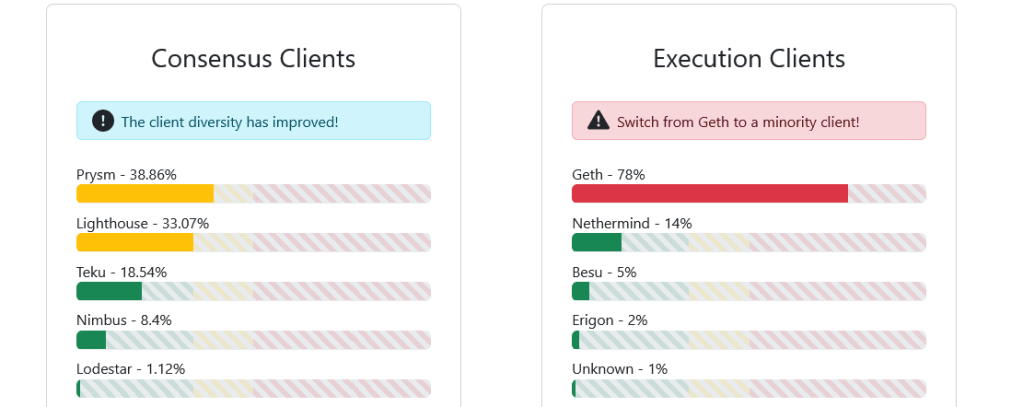
The current landscape of Ethereum validators still heavily favors Geth. Data from Client Diversity shows that over 75% of all validators rely on this client. However, in light of the current realization that client failures can negatively impact the network’s stability, more staking providers will likely diversify their base with others following AllNodes. If more validators are spread across Nethermind, Geth, Besu, and other clients, Ethereum will become more resistant to potential forks and security issues.
No Bailouts For Ethereum Node Operators If Geth Fails
One analyst on X, Marius, explained that anyone can use any client, even gravitating to the first and popular Ethereum execution client, Geth. However, the analyst insists there will be no “bailouts” if the network forks.
A buggy Geth will inevitably expose validators to the risk of catastrophic losses, triggering a network fork since it already controls over 66% of nodes needed for finality. Validators running that client could face slashing penalties of up to 32 ETH, effectively wiping out their stake.
The Ethereum network usually “slashes” the stake of validator nodes should their reliability drop below 100%. The longer they are offline, the higher the slashing penalty.
Feature image from Canva, chart from TradingView
The Spot Bitcoin ETFs started trading on Thursday, January 11, 2024, marking a historic moment for the crypto arena. However, all’s not well with major Wall Street investment firms. Recently, Vanguard, Merrill Lynch, Edward Jones, and Northwestern Mutual have expressed strong criticism against Bitcoin ETFs. These firms noted that investing in these assets is banned for their clients.
Why are Wall Street firms against Bitcoin ETF adoption?
The above-mentioned firms are preventing retail investors from accessing the newly approved Spot BTC ETFs, as reported by FOX Business. These financial institutions have chosen not to provide their clients with exposure to the burgeoning crypto market.
The move contradicts the Securities and Exchange Commission’s (SEC) decision to approve 11 Spot Bitcoin ETFs. The SEC’s decision marked a pivotal moment for the crypto market, which is now nearing $2 trillion.
The inclusion of Bitcoin (BTC) in a regulated investment vehicle like a Spot ETF allows retail investors to access crypto asset investments through broker-dealers. This eliminates the need for reliance on unregulated crypto exchanges. Additionally, it eradicates the requirement for investors to qualify as accredited investors, a criterion for the Bitcoin futures ETF launched in 2021.
The restriction on this new cryptocurrency investment avenue has led some clients to reconsider financial institutions that embrace the opportunity. In a recent post on X, Yuga Cohler, Senior Engineering Manager at Coinbase, revealed plans to transfer his $401,000 savings from Vanguard to Fidelity. According to the FOX report, he rebuked the investment firm’s approach. He said, “Vanguard’s paternalistic blocking of Bitcoin ETFs does not fit in with my investment philosophy.”
Bitcoin ETF issuer BlackRock‘s competitor, Vanguard, defended its stance, stating that the new ETFs don’t align with the institution’s investment ideology. Moreover, the firm emphasized its commitment to aiding investors in generating positive real returns in the long run. Hence, they noted that the crypto space’s speculative and unregulated nature would obstruct them from achieving their goals.
On the other hand, the internal communication records of Merrill Lynch and its clients highlight its current policy prohibits investment in Spot BTC ETFs. However, there is a possibility of a policy change in the future. According to FOX Journalist Eleanor Terrett’s post on X, Merrill Lynch is going to monitor how the ETFs perform to make a final decision.
Also Read: Grayscale Dominates As Spot Bitcoin ETFs Debut With Over $4 Billion Trading
Will Spot BTC ETFs be banned?
Edward Jones and Northwestern Mutual have mirrored Vanguard’s approach. These firms have informed clients of their decision to join the Bitcoin ETF ban. This indicates that Bitcoin ETFs would be banned at an institutional level, especially among the major Wall Street investment firms.
However, eradicating these ETFs from the U.S. would never be possible, considering the SEC’s decision. If it considered a nationwide Bitcoin ETF ban, the regulatory body would never have approved the proposals. The first Bitcoin ETF was proposed in 2013, marking a decade-long effort to achieve the milestone. Hence, if the SEC has decided to approve the proposals now, it is most likely to stick to its decision.
Moreover, CoinRoutes CEO Dave Weisberger expressed his views on the Wall Street firms’ decision to ban Bitcoin ETF investments. He stated that it’s common for firms to conduct due diligence on individual ETFs before offering them to clients. However, he also noted, “Vanguard’s attitude shows it may have more to do with the asset itself, rather than the performance of the ETF.”
Also Read: Spot Bitcoin ETF: Vanguard Backtracks, Vows Not to Join the Train

The presented content may include the personal opinion of the author and is subject to market condition. Do your market research before investing in cryptocurrencies. The author or the publication does not hold any responsibility for your personal financial loss.
Spot Bitcoin ETF applicants have set low fees to attract fund advisors with experts highlighting that custodians will be forced to lower fees to remain competitive in the near future.
The race to attract institutional clients to invest in spot Bitcoin Exchange-Traded Funds (ETFs) has trickled down to the specific sponsor fees. With investors having a wide variety of fund managers to choose from, the back-end detailing of the spot ETF will determine the winner. In addition, advisors to most investors in the United States will be evaluating the spot Bitcoin ETF liquidity to determine the best-fit fund manager. As a result, the dozen spot Bitcoin ETF applicants have been working with traditional financial institutions to ensure ample liquidity access.
Spot Bitcoin ETF Fee Wars
With the decision for the spot Bitcoin ETF applications expected later today, all the involved fund managers – led by Grayscale Investments, Ark Invest, and BlackRock Inc (NYSE: BLK) – have already filed their detailed sponsor fees. According to re-filings with the United States Securities and Exchange Commission (SEC), the Bitwise Bitcoin ETP Trust (NYSE: BITB) has the lowest fee of 0.20 percent and a waiver of 6 months or until the fund hits $1 billion.
The Ark 21Shares Bitcoin ETF (CBOE: ARKB) has the second lowest sponsor fee of 0.25 percent and a six-month waiver until the fund hits $1 billion. Blackrock’s iShares Bitcoin Trust (NASDAQ: IBT) has set its sponsor fee between 0.20 percent and 0.30 percent with a 12-month waiver or until the fund hits $5 billion. The VanEck Bitcoin Trust (CBOE: HODL) has set its sponsor fee at 0.25 percent without any waiver detailing.
Updated Fee war for the #Bitcoin ETF Race. Was missing Wisdomtree’s waiver that was added this morning! Looking for potential approvals tomorrow and potential listings on Thursday pic.twitter.com/7WCTUO95nf
— James Seyffart (@JSeyff) January 9, 2024
Notably, the spot Bitcoin ETF fees are expected to remain unchanged as it would tarnish the reputation of the respective fund managers in case of future alterations. As a result, experts argue that Bitcoin custodians – led by Gemini Custody, BitGo, and Coinbase Global Inc (NASDAQ: COIN) – will be compelled to lower their fees in a bid to remain competitive in an open market. Moreover, every fund manager could develop its infrastructure to facilitate secure Bitcoin custody and further cut fees.
Market Picture
Today’s anticipated approval of spot Bitcoin ETFs in the United States has increased the crypto volatility significantly in the recent past. In the past 24 hours, more than $216 million was liquidated from the crypto market following a false alarm that the US SEC had approved the spot Bitcoin ETFs. Notably, the US SEC Chair Gary Gensler clarified that the agency’s X account was hacked, thus resulting in the false alarm. Meanwhile, Bitcoin price reached a new multi-month high of around $47.9k but has since retracted to trade at about $46k during the early Asian session on Wednesday.
Péter Szilágyi, a software engineer, contends that the widespread adoption of Geth, an Ethereum client he helped develop, is not why the dominant smart contract platform is “slow.” Szilágyi responded to a thread on social media platform X discussing Solana’s high throughput, stating, “Geth does not control all factors affecting processing speed.”
Geth Is The Most Popular Ethereum Client
Geth is the most popular client in Ethereum, controlling over 55% of the total share of all clients in operation, including Nethermind and Erigon. Besides enabling users to interact with the network, it can be used to deploy full nodes.
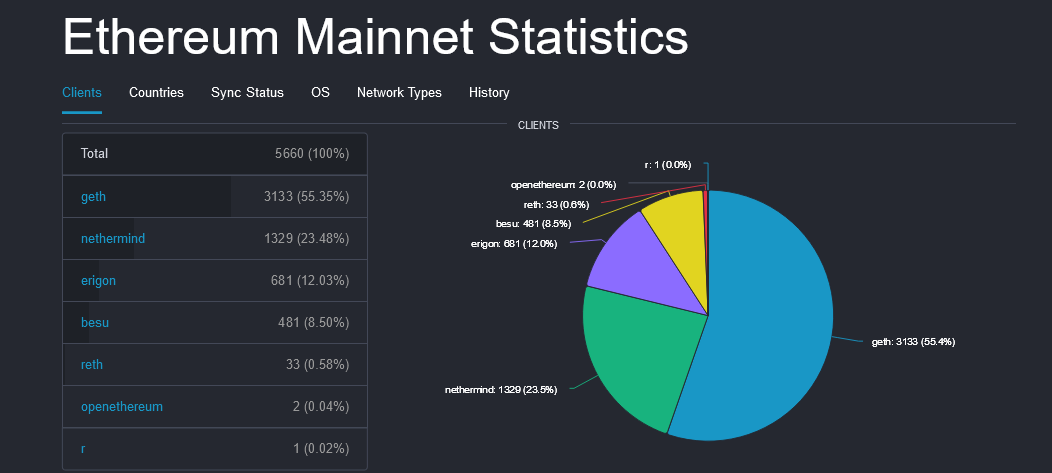
Every synchronized full node in operation has to download and store a complete copy of Ethereum, meaning they can verify transactions and blocks independently, contributing to the network’s decentralization. With a higher degree of decentralization, there is higher reliability.
One analyst had argued that Ethereum is slower because of the dominance of Geth. In the analyst view, the Ethereum throughput can be boosted only if full nodes are distributed across the popular client providers or if any more efficient and fast client anchors most.
Szilágyi shot back, saying processing speed has been impacted because “Ethereum’s state is growing fast.”
Blame The Rapidly Expanding “State” For Slow Processing Speeds?
As the network’s state snowballs, the storage rate must keep up. This implies that irrespective of the client selected; the provider must address the storage speed to match the state of the network.
Full nodes are always in sync with the network, basically holding all the “state” of the blockchain—that is, accounts, balances, and smart contracts—they must be efficient in creating storage to remain connected with others. Moreover, since full nodes provide a service, all of them, regardless of their client selection, can receive block rewards once they validate a transaction.
Accordingly, as part of his argument, Szilágyi also said that even if there is an increment in gas limit by 10X, all full nodes operating on Geth, or any other client, would be “perfectly happy.” In Ethereum, the gas limit is the maximum amount of gas (paid in Ethereum (ETH)) that a user is willing to spend on a transaction. The user can adjust it, and those more complex transactions mean a user has to pay more gas.
Feature image from Canva, chart from TradingView
Cryptocurrency lender BlockFi has filed a proposed court order seeking approval to convert certain client assets into withdrawable funds as part of its ongoing bankruptcy proceedings.
The company applied to bankruptcy court on Aug. 30, requesting authorization to exchange limited cryptocurrency holdings known as “trade only” assets into stablecoins. According to the filing, the trade-only assets comprise less than half a percent of all client funds BlockFi holds, including Algorand, Bitcoin Cash, and Dogecoin.
BlockFi states that technical limitations prevent clients from withdrawing the trade-only assets in their original form. If approved, the proposed order would allow a one-time conversion of the assets into Gemini Dollar or other stablecoins of BlockFi’s choosing. Clients could then withdraw the stablecoin funds through BlockFi’s platform.
The company says the move is necessary to facilitate a comprehensive withdrawal process for all client assets held in custody. Earlier court orders reopened the BlockFi platform to client withdrawals last week.
A hearing date has not been set. The proposed order requires advance notice to affected clients holding trade-only assets.
BlockFi and related entities filed for Chapter 11 bankruptcy protection in late November. The cryptocurrency lender cited exposure to failed hedge fund Three Arrows Capital and volatility in crypto markets as reasons for the filing.
The post Bankrupt BlockFi proposes client asset conversion into stablecoins for trade-only wallets appeared first on CryptoSlate.
]]>Preparations are on the high side as the date for Ethereum Merge draws closer. The Ethereum ecosystem has been putting in an excellent effort for the final launch of its long-awaited upgrade. This upgrade would take the Ethereum mainnet from the Proof-of-Work (PoW) consensus mechanism to Proof-of-Stake (PoS).
The transition plan for the second-largest cryptocurrency has been lagging considerably. However, the move has become necessary due to the high criticisms of energy consumption from PoW blockchains during mining.
Also, most miners use fuels that lead to increased emissions of carbon in the atmosphere, thereby creating high environmental threats in many jurisdictions.
But the Ethereum blockchain has gathered its games as it looks forward to finally scrapping mining activities on the network. It had already rolled out Beacon Chain, the main engine that supports Ethereum 2.0 network. Finally, it is working towards the “Merge” of the Beacon Chain and the Ethereum mainnet in mid-September this year.
Teku Released v22.8.1
As one of its significant moves for the transition to PoS, the Ethereum 2.0 client Teku has recently released a new version called v22.8.1.
According to the announcement from the network, the version is a vital stage that maintains the Bellatrix upgrade running for the activities on September 6. Hence, it would support the processes for the Merge and keep everything working in line for the final launch as a PoS network.
With this newest rollout, all the mainnet nodes are expected to align with the process by upgrading to the Teku version. The version requires a connection to the local execution client’s engine API and will facilitate a seamless transition to PoS. Also, validators of the nodes are expected to set a default fee recipient for the upgrade.
Without the update of the execution client, Teku will be giving the Merge transition configuration error in its report. So, following the execution client update, there would be no reports warning about the client’s unavailability.
Wait Period Between Bellatrix Upgrade And Ethereum Merge
To get the desired activation of the Merge, there’s a need for proper timing. The process demands 14 days as the waiting period between the Bellatrix upgrade and the Merge. This necessary time gap would cause the network to hit its unique total terminal difficulty. (TTD).

According to the speculations from Tim Beiko, an Ethereum core developer, and Terence Tsao, the co-founder of Prysmatic Labs, a TTD of about 58750000000000000000000 could trigger the Merge. They believe getting this TTD value could happen very soon, around September 15.
Recall that the Merge has been set to occur on September 19 after several delays. But some reactions suggest the possibility of getting the transition even before the set date.
✓ Share: