
Key takeaways
- Pi Network’s PI token holds steady at $0.1730, up 4.5% from the previous day.
- The Pi Core Team’s upgrade to enable smart contracts, with a deadline set for April 27, is a potential catalyst.
Pi Network’s PI token has managed to hold steady around $0.1770 as of Friday, adding a 4.5% gain from the previous day.
The Pi Core Team (PCT) is driving momentum with the impending upgrade to the mainnet, which will enable smart contract functionality—expected to be a key catalyst for price movement.
PI rallies ahead of the Protocol 22 upgrade
PI is up 4.5% in the last 24 hours, outperforming the broader cryptocurrency market. The rally comes after the Pi Core Team announced that April 27 is the final deadline for all mainnet nodes to complete necessary steps for remaining connected to the network, as part of the Stellar Protocol version 22 upgrade.
While this upgrade will cause a brief 15-minute downtime during internal data transfer, it lays the groundwork for future improvements. Additionally, the full upgrade to version 26 is slated for June 22, ahead of Pi2Day on June 28.
Will PI rally higher in the near term?
The PI/USD 4-hour chart is bearish and efficient, trading above the $0.1770 level. However, Pi Network remains in a bearish posture, with the token still trading below the 50-, 100-, and 200-day Exponential Moving Averages (EMAs).
The immediate resistance level is marked at $0.1785, corresponding to the 50-day EMA, followed by stronger resistance at $0.1865 (100-day EMA) and $0.2334 (200-day EMA).
However, momentum indicators present mixed signals. The Relative Strength Index (RSI) at 71 is above the neutral 50 line, and is heading into the overbought region.

The Moving Average Convergence Divergence (MACD) crossing above its signal line indicates growing bullish momentum.
On the downside, key support is found at $0.1556, near the February 23 low, with further weakness potentially exposing $0.1310 if the market slips below this level.
Cardano (ADA) Price Prediction: Core Team Drops Parallel Node to Focus on Chain Abstraction Layer openPR.com
Source link ]]>
Best Crypto Presale: Pepeto Project Is The Way To Go This Year as Core Scientific Pivots to AI and Dogecoin Waits on Elon Musk CoinCentral
Source link ]]>
Nasdaq-listed Core Scientific has dumped almost 1,900 BTC as the Bitcoin miner transition to to artificial intelligence (AI). CORZ stock tanks almost 4% during pre-market hours on Tuesday, following a 2.83% fall to $16.49 a day before. Bitcoin Miner Core Scientific Dumps Bitcoin Holdings Core Scientific, a major Bitcoin mining company, recently sold approximately 1,900
The post Core Scientific Sells 1,900 BTC as Bitcoin Miner Pivots to AI, CORZ Stock Dips appeared first on CoinGape.
]]>
- Prenetics halts new Bitcoin purchases after recent crypto market volatility.
- The company is prioritising the growth of its IM8 supplements brand.
- Prenetics currently holds 510 BTC and over $70 million in cash reserves.
Prenetics Global, a consumer health and supplements company backed by football icon David Beckham, has reversed its short-lived plan to build a Bitcoin treasury, opting instead to focus its capital on expanding its flagship nutrition brand, IM8.
In a statement issued on Tuesday, the Nasdaq-listed firm confirmed that it will no longer pursue additional Bitcoin purchases, signalling a shift away from digital assets amid volatile market conditions.
The company’s management stated that the redirection of resources is aimed at accelerating growth in IM8, which the company describes as one of the fastest-scaling supplement brands in the global wellness sector.
Notably, the decision comes less than three months after the company raised $48 million in fresh equity financing that was raised for cryptocurrency accumulation as a strategic objective.
Strategic pivot after crypto market volatility
When Prenetics announced its equity raise in October, Bitcoin was trading near historic highs, hovering above $110,000.
Since then, prices have dropped significantly, reflecting broader instability across digital asset markets driven by tightening financial conditions, regulatory uncertainty, and reduced institutional risk appetite.
As of this week, Bitcoin has fallen to the high-$80,000 range, underscoring the challenges companies face when managing crypto-heavy balance sheets.
Although the fundraising round was intended to support both Bitcoin accumulation and consumer brand expansion, Prenetics’ leadership now views its health and wellness business as a clearer path to long-term value creation.
The Chief Executive Officer and co-founder, Danny Yeung, said the board unanimously agreed that focusing on IM8 represents a rare growth opportunity that outweighs the potential benefits of further crypto exposure.
However, the company plans to hold on to its crypto assets despite halting new purchases.
Prenetics disclosed that it still holds approximately 510 Bitcoin alongside more than $70 million in cash and cash equivalents, providing flexibility while it reassesses capital allocation priorities.
Part of a broader corporate reassessment of crypto treasuries
Prenetics’ move mirrors a growing trend among publicly listed companies that experimented with cryptocurrency treasury strategies during bullish market cycles.
As crypto prices pull back, several firms are scaling back or abandoning aggressive accumulation plans in favour of more predictable uses of capital.
Earlier this month, Ethereum-focused treasury firm ETHZilla, backed by prominent technology investors like Peter Thiel, announced a pivot away from holding ether toward real-world asset tokenisation initiatives.
Other companies across sectors have similarly turned to share buybacks, debt reduction, or reinvestment in core operations as safer ways to support shareholder value during uncertain market conditions.
Investors in Prenetics’ October funding round included major crypto industry names such as Kraken, Exodus, and GPTX, alongside traditional investment firms.
While their participation highlighted confidence in the company’s innovation strategy, Prenetics’ latest announcement reflects a more cautious and pragmatic stance toward digital assets.
Cardano’s Core Network Faces Liquidity Drain Amid Midnight Token Frenzy AD HOC NEWS
Source link ]]>

The leading Ethereum network is witnessing serious engagement even as its price struggles to undergo a major surge. After a massive wave of both new and old investors, the ETH mainnet utilization has increased drastically, reaching levels of adoption not seen since its inception.
Historic Lift-Off For Ethereum Mainnet Utilization
Ethereum is undergoing a shift in network adoption. In a significant landmark that cements its dominance, the Ethereum Maninnet usage has increased to the point where it feels more like a structural awakening than regular growth.
Leon Waidmann, the founder of On-Chain Foundation and market expert, reported that the ETH mainnet’s utilization is currently at an all-time high. This kind of spike in network traffic may indicate the return of activity from the periphery to the center of the chain, new applications, or even a resurgence of trust in the network’s long-term prospects.
Data shared by the market expert shows the network’s usage in the past 30 days rose to 1.97mags/s, marking its highest level in history. The chart reveals that the rise to a new peak represents a more than 57% increase in Year-Over-Year (YoY), indicating that ETH is moving with intent once again.
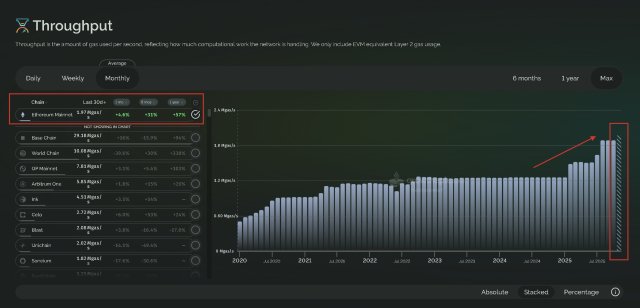
While weak network effects and parasitic Layer 2s are being debated within the community, Waidmann highlighted that the Ethereum Mainnet continues to display strong growth and strength. This robust growth is evidenced by the increase in activity, spiking gas fees, and the surge in the number of ETH being burned.
By combining these key factors about the network, Waidmann claims that ETH could attract more economic load. As a result, the leading altcoin may gradually shed its old skin and take on a more rigid financial function.
Waidmann has declared that ETH could become harder money and a settlement collateral. As a result, ETH is starting to resemble the foundation of a future financial structure rather than just a utility token.
ETH Layer 2s Dominates Network’s Transactions
In the midst of surging network activity and adoption, Ethereum layer 2s are now dominating in terms of transactions at a speed that makes the base layer feel nearly slow in contrast. While the center might still hold, the edges are undeniably where users’ action currently resides.
Last week, Waidmann noted that the total Transaction Per Second (TPS) across the Ethereum network reached over 358.21. Meanwhile, a more significant portion of these transactions was carried out on layer 2 networks. According to the data shared by the on-chain Foundation founder, layer 2s controlled over 95.2% of the overall throughput.
Such a development implies that execution has largely moved to the layer 2 chains. A major reason for this might be that users, liquidity, and developers are looking for quicker and less expensive channels to carry out transactions, transforming ETH’s scaling stack into the ecosystem’s actual heartbeat.
Featured image from Peakpx, chart from Tradingview.com
Editorial Process for bitcoinist is centered on delivering thoroughly researched, accurate, and unbiased content. We uphold strict sourcing standards, and each page undergoes diligent review by our team of top technology experts and seasoned editors. This process ensures the integrity, relevance, and value of our content for our readers.
Cardano seeks 70 million ADA from Treasury for core infrastructure buildout Crypto Briefing
Source link ]]>
Cardano Approves First-Ever Treasury Fund for Core Upgrades CryptoRank
Source link ]]>
Cardano Community Approves First-Ever Treasury Allocation for Core Development Crypto Economy
Source link ]]>