UAE Integrates Cardano Blockchain for Enhanced Criminal Investigation Security Cryptonews
Source link ]]>
Renowned investor and author Robert Kiyosaki has sparked controversy with his recent declaration that the Federal Reserve is a “criminal organization.” Expressing strong criticism, Kiyosaki noted that trusting Bitcoin (BTC), gold, and silver is better than having faith in the Fed.
Robert Kiyosaki Slams The Federal Reserve
Kiyosaki holds the Federal Reserve responsible for economic turmoil. In a bold statement, the ‘Rich Dad Poor Dad’ author criticized the Fed for fostering wealth inequality. Moreover, he emphasized that the Fed is accountable for impoverishing the middle and lower classes and favoring wealthy banking elites through its policies.
Sick and tired of hearing “experts” ask “What is the Fed doing?” The Fed is the problem. The Fed is a criminal organization. The Fed has destroyed the economy, made the poor and middle class poorer, and bailed out their rich banking friends.
Wake up. Pay less attention to…— Robert Kiyosaki (@theRealKiyosaki) February 15, 2024
Furthermore, Kiyosaki urged the public to scrutinize the actions of the Federal Reserve rather than blindly following its directives. In addition, he expressed support for alternative stores of value such as gold, silver, and Bitcoin. He has repeatedly emphasized the reliability of these assets, especially Bitcoin compared to traditional fiat currencies controlled by central banks.
Moreover, while concluding a post on X, Kiyosaki reiterated that he believes the Fed is a “criminal organization.” This strong stance against the Fed has drawn attention from both supporters and critics. Some have been applauding Kiyosaki’s call for financial autonomy, while others question the validity of his claims against the Federal Reserve.
Also Read: Bitcoin ETF’s $4.1 Bln Inflow Sparks Concern Over Gold Price Dip To $1.2K
Rich Dad Author Expresses Resentment Toward Jerome Powell & Janet Yellen
Earlier, Kiyosaki once again took aim at conventional finance, delivering scathing critiques of key figures including Federal Reserve Chairman Jerome Powell, Treasury Secretary Janet Yellen, and Wall Street bankers. Notably, he reaffirmed his allegiance to Bitcoin, positioning it as his weapon of choice in this ongoing financial battle.
Meanwhile, the renowned advocate for the largest crypto repeatedly defends his stance, asserting that Bitcoin stands as the ultimate defense against the erosion of wealth caused by inflation, taxation, and manipulations within the stock market.
In a post on the X platform, Kiyosaki outlined his unwavering support for Bitcoin and emphasized its role as a safeguard against the devaluation of our wealth through currency debasement. He articulated, “Bitcoin serves as a shield against the plundering of our wealth through our monetary system.”
While lauding Bitcoin’s potential as a more secure asset, he slammed Fed Chair Jerome Powell, Janet Yellen, and Wall Street financiers for perpetuating wealth extraction through practices such as inflation, taxation, and manipulation of stock prices. Furthermore, Kiyosaki boldly differentiated his financial approach from traditional investments, stating, “That is precisely why I opt to save and invest in Bitcoin, rather than stocks, bonds, and fiat currencies.”
Also Read: How Bitcoin Price 35% Monthly Surge Will Trickle Capital Down To Large And Low-Cap Altcoins

The presented content may include the personal opinion of the author and is subject to market condition. Do your market research before investing in cryptocurrencies. The author or the publication does not hold any responsibility for your personal financial loss.

- Department of Justice prosecutors split on whether enough evidence to file criminal charges against Binance CEO Changpeng Zhao
- Binance’s position in the industry is so dominant that any story on them is now a big deal
- Regardless on the charges, Binance’s proof of reserves failing to satisfy transparency demands
- Crypto needs to change its entire ethos, as customers currently forced to hope with blind faith that all is OK
Here we go again. According to a Reuters report, Department of Justice prosecutors are split over the next steps to take regarding a Binance investigation.
The exchange has been under investigation since 2018 for allegedly failing to comply with anti-money laundering laws and sanctions.
The report claims that some of the federal prosecutors want to move ahead aggressively against the exchange. They believe they have enough evidence to file criminal charges against individual executives, including CEO Changpeng Zhao (CZ).
Binance fire back
Binance criticised the report, to nobody’s real surprise.
“Reuters has it wrong again. Now they’re attacking our incredible law enforcement team”, it tweeted out.
So, is this the latest storm in cryptoland? Is Binance in trouble?
Well, it’s easy to jump to knee-jerk reactions given the shenanigans in the space from other actors (we don’t need to name any names, I’m sick of talking about certain people). But this isn’t that.
This has been a long-running investigation, commencing in 2018. Binance’s tussles with regulators are no secret. Brian Brooks, the former CEO of the American subsidiary, Binance.US, stepped down only three months into the job as regulators closed in.
CZ said at the time that Binance was “going to pivot to be a fully regulated financial institution going forward” and that he would be “very open” to stepping down if a replacement CEO with more regulatory experience was found.
This is therefore not a wholly unexpected development, with the public well aware this was an ongoing investigation.
More of the same for crypto
However, while this is not an alarm bell situation, it sums up big problems in the crypto industry. Nobody really knows what to make of this investigation, and that is sort of the point – Binance is far from transparent which is not healthy for the industry at large.
Crypto is now also at a point where CZ and Binance are vitally important to the space at large. A misstep from the exchange could be fatal. Its importance has never been more evident than by looking at the $1 billion fund created by CZ to prop up struggling players in the industry (in a move spookily reminiscent of Sam Bankman-Fried’s carryon as the “lender of last resort” in a past life, by the way).
It makes perfect sense that regulators are coming for the former “headquarterless” exchange (which seems to still not have a formal headquarters, by the way), given both this dominance of the market and the lack of transparency.
Coinbase and Binance the last two players, but one is more transparent than the other
Binance, alongside Coinbase, is now probably the most important firm in the entire crypto industry. But they are very different. Coinbase is publicly listed and on a completely different level in terms of transparency. The required disclosures and other hoops that public companies must jump through may be burdensome, but they do provide peace and mind for customers.
Binance, on the other hand, has skirted the law throughout its highly successful few years of existence. Not that this is a criticism of them – the industry literally sprung up from nothing, with regulation entirely non-existent. It was impossible to do anything otherwise in the past.
But the crypto industry has grown, and Binance still presents as a complete mystery when it comes to its financials. This is despite several claims to the contrary.
Their proof of reserves was largely meant to address this transparency issue. However, their process is far from satisfactory. I spent a few hours over the weekend trying to get my head around it, and came out more confused than when I went in.
Jesse Powell, CEO of Kraken, has been noticeably critical of this, and I believe he raises good points.
Another misleading “PoR” AUP (not an audit) released today. Apparently, there is no consistent process used across exchanges. Again, the process strays far from the original spec.
1. “interchangeable” assets
2. negative balances included
3. no signing
4. aggregation by “class” https://t.co/FGQ3Mn9kyo— Jesse Powell (@jespow) December 10, 2022

In fairness, CZ has said that he will improve this, and it is still early days. But the information that has been published thus far reveals next to nothing about the inner workings, or financial health, of Binance.
Crypto at a turning point
CZ is now the most important man in crypto, given Binance’s monstrous dominance of the market.
These continued stories do nothing but drag crypto’s reputation through the mud, which is its biggest problem right now. Institutions, mainstream media and non-crypto natives will see these stories and roll their eyes. Many will be fearful of going anywhere near this industry right now.
In my view, it would be nice to see Binance make a concerted effort to establish true transparency. I think their efforts thus far have been very below-par, and just because they compare favourably to some bad actors in the space does not mean they are doing well in this regard.
Given the chaos in the industry all year, and especially recently with FTX, Binance is obliged to hold itself to a higher standard, whether deserved or not. Happenings like the below – while probably perfectly legitimate – are concerning for the industry, because of what they could mean.
This is part of the Proof-of-Reserve Audit. The auditor require us to send a specific amount to ourselves to show we control the wallet. And the rest goes to a Change Address, which is a new address. In this case, the Input tx is big, and so is the Change. Ignore FUD! https://t.co/36wUPphIZk pic.twitter.com/2NkH5L5J9j
— CZ
Binance (@cz_binance) November 28, 2022
The ethos of crypto is to never trust, but verify. And yet we all depend on the tweets of a collection of CEOS to assure us are funds are OK (and sometimes – just sometimes – certain people have been known to “bend” this truth).
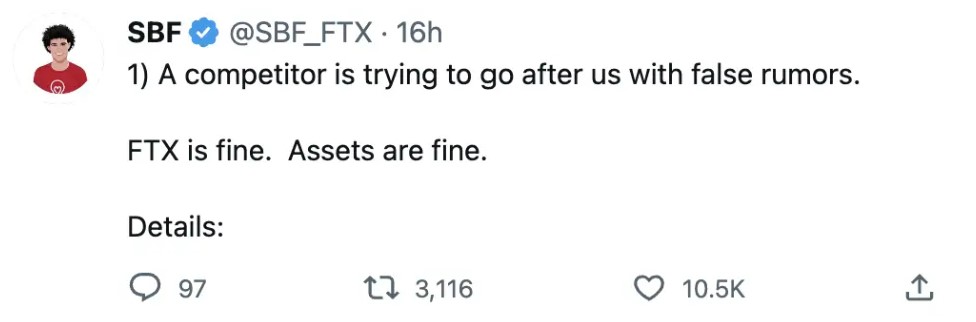
CZ has been very critical and vocal about other players in the space over the last while. Personally, I would rather he separate himself from that mess and focus on getting Binance into a place where it is as transparent as possible.
Because it makes perfect sense that regulators are coming after these centralised crypto players. It is exactly what they should be doing, until we get some more transparency.
But until that day comes, people have to just “hope” that Binance is acting in good faith and have their ducks in a row. Fro avoidance of doubt, there is no evidence to suggest that this hope would be misguided.
I just thought that one of the main perks of crypto was that you didn’t have to just blindly trust centralised financial institutions to do the right thing…
Unpacking FIOD’s crypto response
New info from the Netherlands agency that arrested tornado cash developer Alexey Pertsev
We wanted to get this *troubling* statement from the FOID out there (which raises more questions than it answers) while we’re chasing down more info + assessing next steps
h/t @sccanavos pic.twitter.com/qbJK4F49vR
— DeFi Education Fund (@fund_defi) August 17, 2022
Stay on top of crypto news, get daily updates in your inbox.
Chainalysis recently published a study on criminal enterprises, specifically the so-called criminal whales, that retain vast sums of money in the form of cryptocurrencies.
The study claimed that criminal whales still hold $25 billion in crypto assets despite substantial law enforcement seizures last year.
Cryptocurrency had a solid year in 2021, reaching a value of over $3 trillion in November, while bitcoin, which accounts for around a third of all cryptocurrency, also achieved a high until plummeting by more than 40% last week.
Criminals who stole bitcoin were among the biggest winners from rising prices, as the number of cryptocurrencies linked to illegal operations more than quadrupled since last year.
The Dark Web comes in second, providing $448 million in illegal cryptocurrency. Scams rank third with $192 million, Fraud Shops in fourth with $66 million, and Ransomware is at last row with $30 million.
Criminal Whales Swallow Big
According to the report, last year saw “a huge increase in criminal balances,” with criminal whales holding around $11 billion in 2021 compared to $3 billion in 2020.
Furthermore, the funds represent the lion’s share of crypto held by unscrupulous entities out of stolen funds, Ransomware, fraud and illegal trading.
Throughout the years, stolen funds have accounted for 93% of all criminal balances, according to latest figures. Criminal whales have obtained more than 10% of their funds through illegal addresses. They account for 3.7% of cryptocurrency whales.
Chainalysis is a popular blockchain surveillance company that publishes blockchain analytics research regularly.
Total crypto market cap at $1.711 trillion in the daily chart | Source: TradingView.com
Related Article | Russia Said SWIFT Ban Could Be Tantamount To A Declaration Of War
Illegal Crypto-Related Activities
Whales are the biggest hodlers, with wallets containing over $1 million in cryptocurrency.
Iranian hackers were the most significant contributors to ransomware activity globally through 2021, according to the 2022 Global Threat Report by the cyber security firm CrowdStrike.
Thefts soared by 516%, accounting for $3.2 billion in illegal transactions, with the DeFi sector becoming a new cause of concern.
“Criminal balances also fluctuated throughout the year, from a low of $6.6 billion in July to a high of $14.8 billion in October,” Chainalysis disclosed.
Hodling is a phrase used in the cryptocurrency industry to describe persons who keep vast amounts of cryptocurrency without selling them in the hopes of making a profit in the future.
On the Brighter Side
Meanwhile, in a memo to investors, FSInsight predicted that Bitcoin would reach $200,000 in the second part of 2022.
According to FSInsight, Ethereum might reach a price of $12,000 this year, representing a 385% premium to where it is now trading.
According to the analysis, cryptocurrencies have become increasingly linked to infotech stocks. Sean Farrell, head of digital asset strategy, said this is due to “legacy market money joining the fold.”
Related Article | Russian Politicians’ Crypto Wallets Targeted By Ukraine – Hefty Reward Up For Grabs
Featured image from Nairametrics, chart from TradingView.com
By coming together and setting up a single-purpose trust structure as the entity underwriting the deal, the investment banks can get around allegations that they’re involved in collusion.
This market response, of course, makes it even harder for the ACCC and the CDPP to justify continuing with their case.
But the fiasco surrounding ANZ’s $2.5 billion capital raising highlights an important question about the quality of the information flow to the market.
‘Disturbing’ silence
As Clime Asset Management’s chairman, John Abernethy, pointed out in an article published on the fund manager’s website in August 2015, there was a deafening market silence regarding the large shortfall on the $2.5 billion placement.
At the time, Abernethy penned an article speculating that there had been a shortfall, and the investment banks underwriting the deal had been left “holding some of the can”.
In an article published three years later, Abernethy argued that this silence was disturbing.
“We would suggest that the institutional or sophisticated market for Australian equities knew very quickly after the ANZ placement that there was a shortfall and therefore a possible overhang,” he wrote.
“The market for ANZ shares immediately traded below the placement price.”
But, he added, this raises question of why major banking analysts were silent on the obvious shortfall in the ANZ placement.
“How could any banking analyst who has any understanding of the market not warn their clients and readers that there was a probable overhang of ANZ stock that will affect its market price until cleared?”
Abernethy argued that there was probably a range of buyers for the ANZ shares, including index funds, active long-only funds, active long-short funds, international funds and highly geared and hyperactive hedged funds.
Hedge funds, he noted, are the biggest source of brokerage for stockbrokers, particularly those owned by investment banks. “They are huge generators of broking commissions because they are big traders, and they reward the delivery of good ideas and stock placements,” he wrote. “Hyperactive hedge funds are given access to all deals and are well looked after.”
It appears that younger investors are keen to play in markets where they believe system is less rigged against them.
In the case of the ANZ placement, he argued, it’s possible that hedge funds bid aggressively, which might explain the dearth of commentary on the overhang of ANZ stock.
“It seems to us that the information wasn’t made public because the major market players, commission agents and trading funds needed to protect each other from losses.”
This, of course, resulted in a big asymmetry in the market between the sophisticated professional players and the rest.
As Abernethy noted, “there is a swag of advisers and retail investors who – through lack of knowledge and experience – may have had no idea that an overhang existed in the market.
“Indeed, it was not only the shortfall held by underwriters, but the shares held by wrong-footed traders that would depress the ANZ price for months.”
ACCC focus on the wrong issue
But this raises a serious issue for Australian regulators as to how well-informed the market really is.
As Abernethy wrote: “The stock market has been gamed in so many ways, and the ACCC has chosen to focus on a part that is not the real problem. The most blatant rigging is in information flow.”
It is likely the widespread perception that stock markets are rigged in favour of well-placed Baby Boomers at least partly explains the huge interest that Millennials and Gen Z-ers are showing in alternative assets, particularly the 8800 cryptocurrencies now on offer.
As an asset class, cryptocurrency boasts a staggering market value of almost $US3 trillion ($4 trillion), or roughly the equivalent of a quarter of the world’s mined gold.
It appears that younger investors are keen to play in markets where they believe system is less rigged against them, and where they’re not dependent on analysts or advisers to decipher the market.
Eye-watering returns
Indeed, in these asset classes digital natives have an advantage over traditional investors because they’re able to profit from their ability to pick chat room trends quickly.
They’re able to monitor chat rooms and detect when particular cryptocurrencies – or meme stocks – are generating lots of mentions.
And the returns from these non-traditional assets have been eye-watering.
During the meme stock mania in January –where retail investors targeted stocks with high interest from short sellers, hoping to punish the hedge funds who had laid large bets that the company’s share price would fall – professional investors lost billions of dollars as the share prices of companies such as GameStop, AMC Entertainment and BlackBerry soared.
Rather than relying on analysts, young, newbie investors used platforms such as Reddit, Discord, Facebook and Twitter to exchange information, boast about their gains, and even organise concerted action to intensify the losses suffered by professional traders.
Hedge funds, in turn, complained that social media hordes were conspiring to manipulate markets.
The run-up in cryptocurrency values has been even more dazzling.
Dogecoin, a dog-themed cryptocurrency that started out as a parody less than a decade ago is now valued at $US34.4 billion.
Its market value was briefly eclipsed by the Shiba Inu coin, another dog-themed joke currency that reached $40 billion last week before it tumbled 20 per cent on Thursday. Shiba Inu’s price has since recovered, giving it a market value of $US34.5 billion.
Of course, not all cryptocurrencies are winners. Last week, the value of a Squid coin – a once red-hot cryptocurrency named after the Netflix hit series Squid Game – collapsed from a high of just over $US2860 to effectively zero in an apparent swindle.
Despite the danger and the volatility, however, younger investors prefer to take their chances with these cultish assets, rather than confine themselves to traditional markets, which they believe are rigged against them.
✓ Share: