Damaging Impact: Cardano Founder Reveals How Trump’s Crypto Moves Hurt the Market Bitget
Source link ]]>
Cardano’s Hoskinson denies ADA misappropriation allegations, calls them deeply personal and damaging CryptoSlate
Source link ]]>

Cardano founder Charles Hoskinson expanded his response to allegations that Input Output Global (IOG) misappropriated over 318 million ADA from unredeemed pre-sale wallets, calling the situation deeply personal and damaging.
In a May 18 post on X, Hoskinson reflected on the reputational toll of the allegations, noting that the incident has reshaped his view of his relationship with the Cardano community.
He added:
“For a decade, I’ve been on the front lines. To not be given the benefit of the doubt here without strong evidence to the contrary means I don’t have the connection I thought with some people.”
Hoskinson added that following the release of an external audit, he intends to hand control of his social media account to a media team and scale back his direct engagement.
Legal pushback and audit plans
Hoskinson first responded to the allegations on May 7, saying that IOG may pursue legal action against those accusing him of redirecting unclaimed ADA from Cardano’s 2017 Token Generation Event.
According to a social media thread by X user Masato Alexander, a December 2020 protocol update introduced a function that reassigned ADA from unredeemed UTxOs to Cardano’s reserves.
Alexander alleged that the subsequent Move Instantaneous Rewards (MIR) transaction diverted these funds without transparency or notification to the original voucher holders.
Hoskinson countered that investors redeemed 99.8% of ADA vouchers. The remaining 0.2%, recovered under protocol rules after a seven-year window, was donated to Intersect, the Cardano industry coordination body.
He added that an externally audited report would soon document the redemption history and crowdsale process. Hoskinson also said he would “send letters to the relevant parties demanding retractions and apologies.”
Alexander disputed the claim, citing a public statement by Intersect’s interim executive director that it received only $7 million in 2024, far less than the estimated $600 million value of the disputed ADA. He also criticized the lack of a detailed audit publicly tracing the fund flows.
Foundation and Emurgo address governance process
On May 19, the Cardano Foundation issued a statement distancing itself from the operational aspects of ADA voucher redemption after 2021. The statement added that while it received general updates, it did not provide detailed accounting.
The foundation stated:
“The effort to locate and support remaining voucher holders has been led by the IO team over the past four years.”
The foundation welcomed IOG’s pledge to release a third-party audit and recommended that it include all MIR transactions, balances, and any returns generated during fund administration.
Cardano’s commercial arm, Emurgo, also defended IOG’s efforts in a May 19 post. It said the seven-year redemption process involved multiple campaigns, third-party investigations in Japan, and Know Your Customer (KYC) verification.
Emurgo acknowledged:
“While the vast majority of the pre-sale ADA vouchers have been successfully redeemed, there was a small percentage that had gone unredeemed.”
The company added that the Shelley hard fork would have rendered unredeemed ADA unspendable, necessitating their movement to enable further redemptions.
The firm also expressed concern over “excessive, unwarranted FUD,” saying accusations based on limited facts caused unnecessary harm to the ecosystem. It echoed IOG’s call for an audit and urged the community to remain patient.
Mentioned in this article

FTX token (FTT/USD) slid 1.23% on Monday, marking a 12% decline in the past week. The decline comes amid a dampened sentiment around the token on the latest cryptocurrency news.
As CoinJournal reported, FTX was a victim of accelerated fund withdrawals. Over $451 million in stablecoins have been withdrawn from the crypto exchange in the past one week. That came after reports indicated that billions of dollars of Sam Bankman-Fried’s Alameda Research are tied up in FTT.
Besides, a tweet by Binance CEO Changpeng “CZ” Zhao on November 6 raised further concerns about FTT. CZ said that his company would relinquish its entire position in FTX tokens. The Binance CEO said the liquidation was post-exit risk management. The words of CZ highlighted a crypto exchange that could be in turmoil. “We gave support before, but we won’t pretend to make love after divorce.” CZ said the action was “learning from LUNA.” So, what went wrong?
As many crypto exchanges experienced liquidations earlier this year, FTX showed resilience. Sam Bankman-Fried was alongside Binance, bailing out struggling firms. However, the latest revelations are concerning and could accelerate the FTT sell-off going by the crypto’s price action.
FTT at a make-or-break level as sellers mount
 Source – TradingView
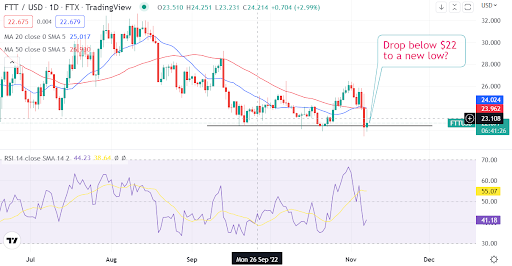
On the technical outlook, FTT trades at a support zone of $22. Following the recent weaknesses, the token broke below the moving averages to the June lows. The RSI remains below the midpoint meaning that the sellers are more at the crucial support.
With weak momentum, FTT could break below to find a new low. Buyers could still try to force a recovery at the current support zone. A muscle up of the buyers and sellers could see the token consolidate at the support.
Should you buy the FTX token?
FTT remains vulnerable to a new yearly low amid weak sentiment and a bear market. Although there is a potential for recovery at the support, sellers are still active, and low prices are more likely.
Investors should wait before buying the token until the negative news is clear or positive developments happen.
Where to buy FTT
Bitstamp
Bitstamp is a leading cryptocurrency exchange which offers trading in fiat currencies or popular cryptocurrencies.
Bitstamp is a fully regulated company which offers users an intuitive interface, a high degree of security for your digital assets, excellent customer support and multiple withdrawal methods.
Binance
Binance is one of the largest cryptocurrency exchanges in the world. It is better suited to more experienced investors and it offers a large number of cryptocurrencies to choose from, at over 600.
Binance is also known for having low trading fees and a multiple of trading options that its users can benefit from, such as; peer-to-peer trading, margin trading and spot trading.
The China bitcoin mining ban that took place mid-last year was no doubt a heavy blow to the space. It saw the hash rate from the region which was once termed the mining capital of the world crumble to almost zero as miners had to shut down their operations. The reason for this from the Chinese government boiled down to concerns about electricity consumption and environmental impact.
As the miners exited China, they had to set up business elsewhere and procure electricity for their mining farms, which can be quite energy-intensive. According to a new report, these new energy sources have been mainly from non-renewable sources compared to what the miners used in China. This means that the energy impact of bitcoin mining has gone up in recent months.
Bitcoin Mining Carbon Footprint Now Worse
It has been less than a year since China placed a ban on bitcoin mining and the effects are already being felt energy-wise. The general school of thought following the ban had been that miners would focus on more renewable energy sources so as to avoid a repeat of the issues in the region. However, a new study has shown that this is not so. Rather, the environmental impact of bitcoin mining has only gotten worse.
Related Reading | TA: Why Bitcoin Must Close Above $40K For Trend Reversal
China is a country known for its wide use of hydropower, a renewable energy source, and the miners in the country had used a significant amount of renewable energy for their operations. Even then, the carbon footprint of mining activities was still enough to cause a stink. The Joule journal has revealed that miners have not necessarily increased their renewable energy consumption.
BTC trading above $38,000 | Source: BTCUSD on TradingView.com
The study shows that the amount of renewable energy used by bitcoin miners has fallen since the ban. At its peak, this number had reached as high as 42% in August. But since then, barely seven months after, renewable energy use in mining has fallen to as low as 25%.
Related Reading | Bitcoin Staggers After Putin’s Nuclear Deterrence Alert Warning
Bitcoin mining continues to produce significant amounts of carbon dioxide yearly. With over 65 megatons of carbon dioxide produced annually, bitcoin mining is less green than ever. For comparison, the entire country of Greece reportedly produced less than 57 megatons of carbon dioxide in 2019. This means that miners are producing more CO2 than entire countries.
A lot of the miners that left China have now moved to countries where energy sources are largely produced by burins “hard coal” which produces more pollution. This new study shows that mining is less favorable to the environment now. Its carbon intensity has already grown by 17%.
Featured image from Bloomberg, chart from TradingView.com