Market Players Say Dogecoin (DOGE) is Doing its “Last Dance” — Here’s What It Means ZyCrypto
Source link ]]>
The Whale Effect: Cardano’s Price Dance and Retail Reactions OneSafe
Source link ]]>
In a charged statement on X, Justin Bons, founder and Chief Investment Officer of Cyber Capital, one of Europe’s oldest cryptocurrency funds, has voiced a critical view of Ethereum’s current trajectory, asserting that “Ethereum is dying while L2’s dance on its grave.” Bons argues that Ethereum (ETH) is struggling to maintain its fee revenue due to inadequate network capacity, while Layer 2 (L2) solutions are capitalizing on this limitation by keeping Ethereum’s capacity constrained.
Bons claims, “ETH cannot sustain high fee revenue because it lacks the capacity. At the same time, L2s are seeing record highs in usage & fees while they lobby to keep ETH’s capacity down!” He characterizes this dynamic as parasitic, where L2s benefit at Ethereum’s expense, particularly post the EIP-4844 (Proto-Danksharding) implementation, which Bons claims has precipitated a collapse in fee revenue for Ethereum. His commentary suggests that the fee burning mechanism, meant to offset inflation by making Ethereum deflationary, can no longer keep pace due to the fee diversion to L2s.
Is Ethereum Dying Because Of L2’s?
Bons argues that this scenario has created a “parasitic relationship” between Ethereum and its L2 counterparts. He believes that L2s, while designed to scale Ethereum’s capacity by handling transactions off the main chain, are now operating almost independently, thereby fragmenting the ecosystem. This fragmentation, according to Bons, is breaking up liquidity and composability, crucial elements that facilitate seamless operations across the Ethereum network.
The shift towards L2 solutions, in Bons’ view, has led to a rise in centralized tendencies within platforms that were originally promoted as decentralized. “This also pushes the users into centralized L2s. As every single L2 in the top 10 (stopped counting after 10) can now steal user funds & censor. This is ironic, considering that the entire ‘L2 scaling’ roadmap was justified in the name of decentralization… A bait & switch,” Bons elaborated.
The critique extends to the governance model of Ethereum, which Bons claims eschews on-chain governance leading to what he perceives as centralized control over its development. “The total rejection of on-chain governance by the ETH community could only have one outcome: Capture, resulting in what is effectively centralized control over ETH development!” he asserted, suggesting that this governance model has enabled L2 entities to exert disproportionate influence over the network.
If Ethereum were to scale at the L1 level with new technological breakthroughs, Bons speculates that it would “crash the token & equity price of all L2s overnight by making them obsolete & unnecessary,” illustrating a conflict of interest where L2 entities may prefer to suppress L1 advancements to maintain their market position.
Contributing to the debate, Pengu Aaron, lead of the ICP Hub Singapore, remarked, “IMO the L2s have to find a way to contribute back to Eth or else we will see a potential collapse in value.” Bons’ response underscored a systemic issue: “L2s only have to contribute back to ETH from ETH’s perspective. From the L2s perspective, it makes far more sense to keep all of that value for themselves. That is the problem as you are setting up a system with opposing & perverse incentives. Making it entirely unfixable & broken.”
In a contrasting view, a user named @bowtied3hbt drew an analogy to the United States, where the federal system allows states considerable autonomy yet remains functional. Bons countered this comparison, highlighting historical conflicts that were necessary to maintain the federation, such as the Civil War, thus illustrating the enforceability challenges in decentralized systems which lack overarching compulsion mechanisms.
“Multiple wars were fought to keep the US federation together! From the Civil War to the Utah War, to name a few. The difference is that in cryptocurrency, nobody can force an L2 to stay on ETH if it goes against the L2s interests. That is where your analogy totally falls apart!, Bons concluded.
At press time, ETH traded at $2,687.
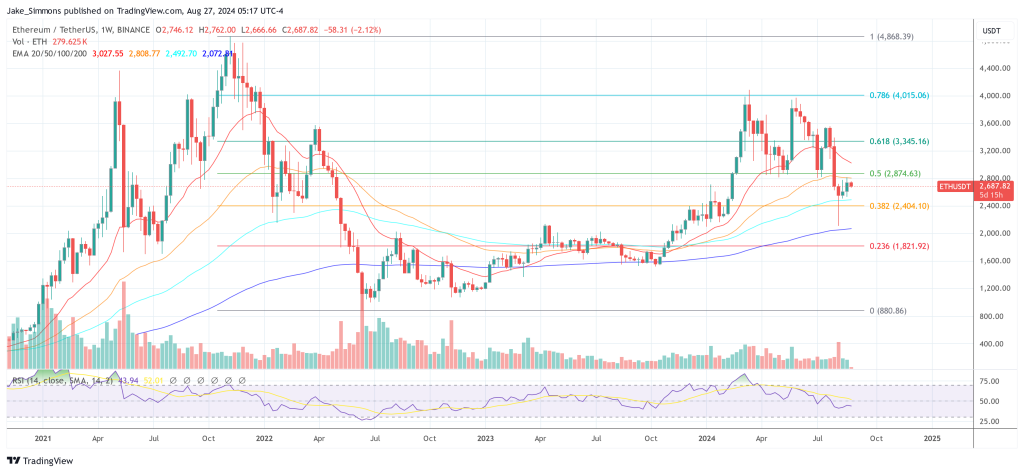
Featured image created with DALL.E, chart from TradingView.com
Million Doge disco is a game. Or a movement. Or cannabis-fueled joke. Or the most tech-blender startup of 2021, with NFTs and blockchain and cryptocurrency and augmented reality mixed together with Pokémon Go-like gameplay and Tamagotchi pet patterns.
ADVERTISEMENT
Plus dancing.
Did I mention the dancing?
“Million Doge Disco is a master plan to get the entire world dancing together,” co-founder and CEO Gary Lachance told me when I interviewed him for the TechFirst podcast. “Is that all the detail you require?”
Nope. Not even close, Gary.
“It’s a great way to unify and liberate humanity,” Lachance added, helpfully.
Still lost.
Dogecoin looks nothing like this. In fact, it doesn’t look like anything at all.
“The idea is we are dropping one million Disco Doge, Dancing Doge NFTs all across the globe with Doge within them, over the next three months leading up to World Peace Day,” Lachance continued. “And these NFTs are also a Tamagotchi-style Dogeagotchi pet. And the idea is that people will receive them and we have proof of partying mechanisms where people will dance, post to social media, and be showered with Dogecoin in return.”
That didn’t fully illuminate Million Doge Disco for me either, but it did at least zero in on about five or sixteen different concepts of what this thing is. Eventually, downloading the game on my phone and playing it filled in the other gaps.
I think.
Million Doge Disco is kind of like Pokémon Go. You go around the world, or at least your neighborhood, and find Dogeagotchis using augmented reality superimposed on plain old boring actual reality. Collect them, and you collect Dogecoin, the favorite joke cryptocurrency of none other than Elon Musk. It’s currently worth about 20 cents, and by some chance Lachance owns about a million dollars worth of them. They are currently stored on a paper crypto wallet, he wants to give them all away, and you acquire them by playing the game.
ADVERTISEMENT
Along the way, you get connected with other people. You dance with those other people.
And then world peace erupts.
Did you get all of that?
Listen to the conversation behind this story:
ADVERTISEMENT
It all comes out of something called the DDP: the Decentralized Dance Party. Twelve years ago Lachance and others started the Decentralized Dance Party in Vancouver, Canada by wearing a portable FM transmitter — he clearly never wants kids — and catalyzing add-water-and-stir dance parties by handing out hundreds of old-school boomboxes: portable radios anyone can take. The DDP kicks off in one part of the city with dozens of strangers, and ends up all over the city with thousands of decentralized dance parties. Everyone’s a node on the network, Lachance says: there’s no central stage or one performer.
Also no tickets and no cost.
Eventually, the concept went all over the world, Lachance says, scaling to tens of thousands of people at a time.
Then he saw Pokémon Go.
“In 2016, when Pokémon Go was first happening, I was looking at it and I was like, wow, this is like, we always wanted to do giant simultaneous global parties,” Lachance says. “I was like, man, if we could combine Pokémon Go with a crazy dance party and some sort of crypto incentivization, like that is how we get the whole world partying together … hopefully with the side effect of world peace.”
ADVERTISEMENT
Add an AR-enabled NFT platform — Million Doge Disco uses BLOCKv — and you’ve got the potential to take a crazy idea to sober reality.
There’s some room to go yet.
I played the game, but not everything worked. (Caveat: it’s entirely possibly that I’m just a complete failure at playing games.) And there are components that remain conceptual. For instance, Lachance wants to add Proof of Partying, as opposed to Proof of Work or Proof of Stake in many cryptocurrencies, and you’ll have to dance with your Dogeagotchi to keep it happy and loyal. (Fail to dance with it regularly and it’ll run off in search of someone with better moves who has more fun.)
That’s not quite ready yet, and I get the sense that the vision may always outstrip reality. (”We never had like billions of dollars of development money,” Lachance notes.)
But World Peace Day 2021 is still a month and a few weeks away. They have time.
ADVERTISEMENT
And, clearly, no lack of imagination.
Get a full transcript, or subscribe to TechFirst.