Dogecoin Price Prediction: Layer Brett Becomes the New Meme Coin Darling Digital Journal
Source link ]]>
Cardano’s Remittance Revolution: Why ADA Could Be the Next Institutional Darling AInvest
Source link ]]>
Dogecoin started a fresh decline from the $0.1880 zone against the US Dollar. DOGE is now consolidating losses and might recover if it clears $0.1780.
- DOGE price started a fresh decline below the $0.1880 and $0.180 levels.
- The price is trading below the $0.180 level and the 100-hourly simple moving average.
- There is a short-term bearish trend line forming with resistance at $0.1760 on the hourly chart of the DOGE/USD pair (data source from Kraken).
- The price could start a fresh decline if it declines below the $0.180 zone.
Dogecoin Price Dips Again
Dogecoin price started a fresh decline after it failed to clear the $0.1880 zone, like Bitcoin and Ethereum. DOGE declined below the $0.1800 and $0.1750 levels.
The bears even pushed the price below the $0.1720 level. A low was formed at $0.1695 and the price is now consolidating losses below the 23.6% Fib retracement level of the downward move from the $0.2064 swing high to the $0.1697 low.
Dogecoin price is now trading below the $0.180 level and the 100-hourly simple moving average. There is also a short-term bearish trend line forming with resistance at $0.1760 on the hourly chart of the DOGE/USD pair.
Immediate resistance on the upside is near the $0.1760 level. The first major resistance for the bulls could be near the $0.1785 level. The next major resistance is near the $0.180 level. A close above the $0.180 resistance might send the price toward the $0.1880 resistance. It is close to the 50% Fib retracement level of the downward move from the $0.2064 swing high to the $0.1697 low.
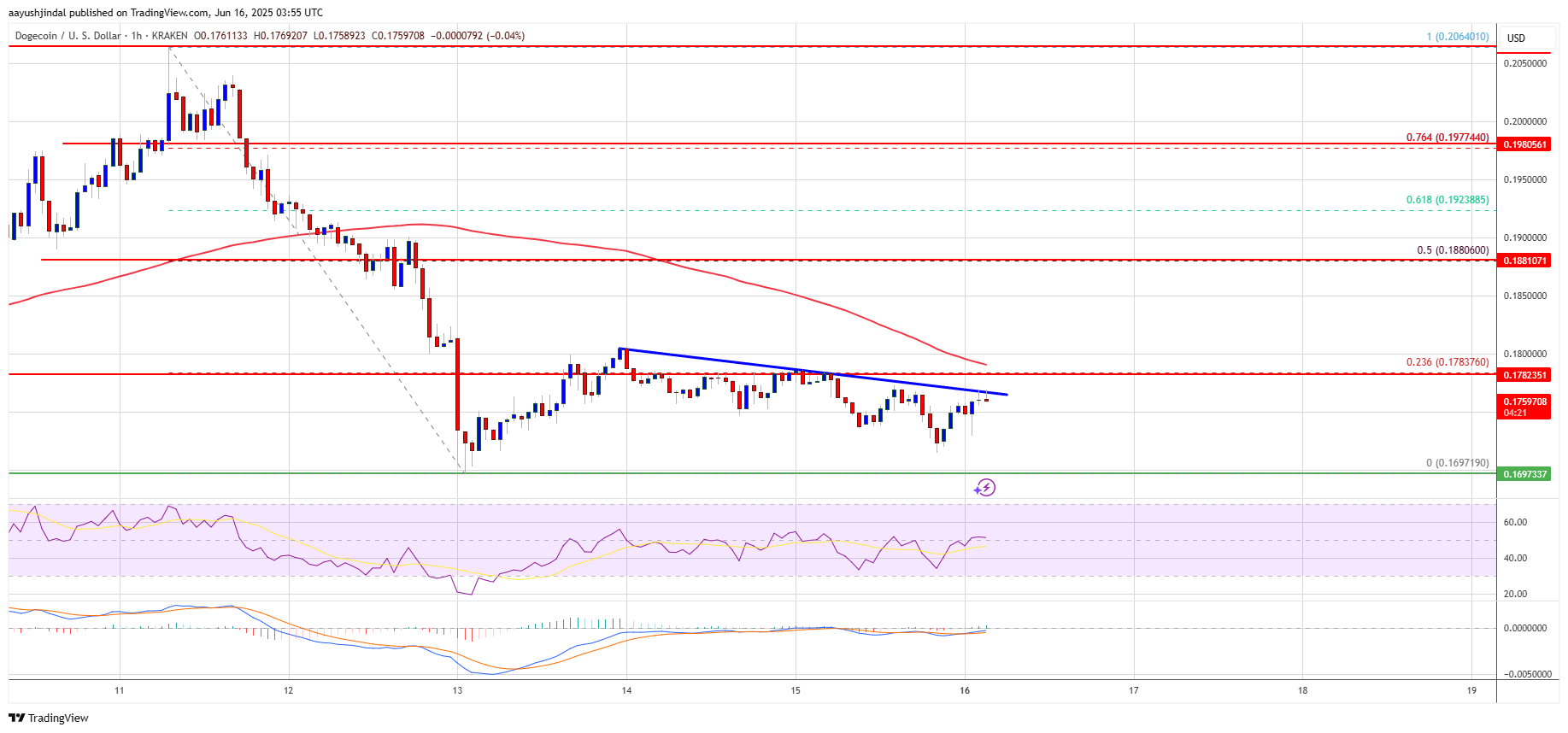
Any more gains might send the price toward the $0.200 level. The next major stop for the bulls might be $0.2120.
More Losses In DOGE?
If DOGE’s price fails to climb above the $0.180 level, it could start another decline. Initial support on the downside is near the $0.1720 level. The next major support is near the $0.1700 level.
The main support sits at $0.1680. If there is a downside break below the $0.1680 support, the price could decline further. In the stated case, the price might decline toward the $0.1550 level or even $0.1525 in the near term.
Technical Indicators
Hourly MACD – The MACD for DOGE/USD is now losing momentum in the bearish zone.
Hourly RSI (Relative Strength Index) – The RSI for DOGE/USD is now above the 50 level.
Major Support Levels – $0.1700 and $0.1680.
Major Resistance Levels – $0.1760 and $0.1800.
]]>Bitcoin and dogecoin? Mona darling, let’s stick to sona The Times of India
Source link ]]>
Dogwifhat Up 23% As This Solana Darling Ranks 5th By Memecoin Mcap: ‘The Doge Of This Cycle,’ Says Crypto Expert TradingView
Source link ]]>
Someone Just Put 90s Darling Game DOOM on Dogecoin CoinDesk
Source link ]]>
Solana Dog-Token Darling BONK, That Once Shot Up 3300%, Is Today’s Top Meme Coin Performer — Leaves Shiba Benzinga
Source link ]]>
New Crypto Darling: The Mass Exodus from Shiba Inu (SHIB) to Pomerdoge (POMD) Explained | Bitcoinist.com Bitcoinist
Source link ]]>
Shiba Inu Plunges: Is This The End For The Darling Meme Coin? NewsBTC
Source link ]]>
DApps). While the rage usually is about these cryptocurrencies’ market capitalisations and volatile prices, they are at the end of the day, a piece of software. And, like any piece of software, their worth is determined by how useful they are. After all, would Google have mattered if Search wasn’t what it is today?
Thinking from that point of view, a person can see how one cryptocurrency is a competitor to another, just as Yahoo Search or AOL once were to Google. And, that isn’t more true than for the three cryptocurrencies battling it out to win in the ‘smart contract’ space —
Cardano.
At the heart of all cryptocurrencies including these three, is the algorithm that runs them. In fact, Ethereum, Solana and
The Ethereum chain uses a token called ETH for trading, while
Solana and Cardano use the SOL and ADA tokens, respectively. So, when you talk about the differences between the three, you have to talk about how their algorithms differ.
All three of these cryptocurrencies can be traded on
WazirX, India’s leading crypto exchange. One can buy Ethereum, Cardano, Solana directly with rupees.
Before we get into the differences, let’s talk about the big similarities.
What are smart contracts?
Smart contracts are what makes
Ethereum, Solana, Cardano and even the Binance Smart Chain, different from Bitcoin. Defined in their algorithms are tiny pieces of code that execute when certain conditions are fulfilled. In essence, they are ‘if, when, then’ statements that execute automatically.
Imagine a rental agreement, which says your rent is supposed to go up by 10% every 11 months. In the traditional banking system, you could set up a standing payment instruction where the rent amount is paid to your landlord every month, but you will have to keep changing it every 11 months, right? On a smart contract, the system will know the rent has increased and could theoretically increase the amount whenever requapplicationsse smart contracts can be defined on a blockchain platform once, and they cannot be changed by anyone. The involved parties can set up as many ‘if, when, then’ conditions as they want within a smart contract.
How do Ethereum, Solana and Cardano fit into the picture?
As mentioned before, smart contracts is one of the reasons why the Ethereum, Solana and
Cardano platforms are similar. The other is the fact that they used — or in Ethereum’s case will us ise — a “proof of stake” system. More on this later.
Unlike Bitcoin, which is best suited to applications that involve the exchange of things, like paying for apps and services, smart contracts open up a world of possibilities. As a result, the three platforms mentioned above can be used to build
Think of it this way: the Bitcoin platform lets you define situations via algorithms where you could take a Bitcoin and exchange it for something. On smart contracts, you can literally have a contract being executed for and for the computers processing them, they’re just another transacti fewon on the network.
Remember the Google example? This basically means that platforms with smart contracts have much more functionality than those that do not.
Ethereum — the origin story
Bitcoin is, and always will be credited for introducing
In 19th century science, Ether was thought to be a weightless and frictionless material that filled all space and carried light waves. While this theory has been disproved, Buterin’s idea for his platform was to be the same — the invisible medium that powers possibly every book in the world, according to former Bloomberg journalist Camilla Russo’s 2020 book,
The Infinite Machine.
The introduction of smart contracts made Ethereum different from Bitcoin and answered one of the questions critics had at the time — why cryptocurrency? Bitcoin was an alternate to the world’s currencies, Ethereum was an alternative to that and everything else. It gave developers a way to take advantage of blockchains, and build things that didn’t have to make governments and central banks uneasy.
How does Cardano threaten Ethereum’s dominance in the market?
Ethereum grew fast between its launch in 2013 and today, but despite everything that was good about it, it had one big flaw — it ran on the proof of work system.
You see, crypto transactions are authenticated by computers, which are owned by large organisations called miners. These miners can only provide the computing power required to authenticate transactions and have no way to actually change the blockchain or the transactions that happen in it. And for doing this ‘work’, they get rewarded with new cryptocurrencies by the platform.
Essentially, the platform is like a bank, the miners are like Visa and Mastercard, and the bank pays Visa and Mastercard for authenticating the transactions their customers undertake all over the world.
The problem with this is that both Ethereum and Bitcoin reward every miner involved in a transaction, which means that there’s an overwhelming amount of computing power going into each transaction. Instead, Cardano has what is called the “proof of stake” system, which is more efficient.
In this system, miners have to first stake their own crypto to be eligible for rewards. The platform then chooses the top few miners — a predefined number — for authenticating transactions. As a result, the overall amount of computing power is reduced considerably, and in turn the amount of electricity required to power the computers is reduced too. All this makes Cardano much more environmentally sound than Bitcoin or Ethereum right now, and that’s true for Solana too.
Why are Solana and Cardano called Ethereum killers?
The proof of stake system is the main reason why these two crypto platforms are called Ethereum killers. At the moment, they’re more efficient and answer the one big concern that many world governments, experts and billionaires have about cryptos — their environmental footprint.
However, Ethereum is going to introduce version 2.0 of the platform next year, which brings the same system to the platform as well. It’s supposed to reduce Ethereum’s energy requirements by as much as 99%. Last month, the Ethereum London Hard Fork set the stage for version 2.0, by introducing the proof of stake system to the platform.
Platforms with smart contracts, like Ethereum, are expected to gain wider adoption which makes being environmentally sound absolutely essential.
Who is likely to come out ahead?
Needless to say, the two points in favour of Ethereum, Cardano and Solana are the fact that they will or already employ the proof of stake system, and that they offer smart contracts. The big problem with the Ethereum platform right now is scalability.
Each Ethereum transaction requires a transaction fee — also called gas fee — and it doesn’t matter what kind of transaction it is. At the moment, these gas fees can go up to as much as $150 or more and are very volatile, because of the volume of transactions happening on the network every second.
Imagine building a chat platform, where each new message is a transaction. Would a company be able to pay $150 for each message we, the users, send? Would the users want to pay a part of that cost? In comparison, transaction fees on the Cardano and Solana platforms cost a dollar or less right now.
“Solana has solved this (the problem of scalability) with a system of cryptographic time-stamping that currently can accommodate 65 000 transactions a second, which is astonishing. Nobody has come close to this, including Visa,” crypto investment analyst Brett Hope Robertson
told MoneyWeb.
On the other hand, as
explained by The Motley Fool, the problem with Cardano and Solana is adoption. Both these currencies have market capitalisations that are less than half of what Ethereum’s is right now, which means that they remain speculative right now. Whether you’re buying the ADA and SOL tokens or building an app on them, you will be taking a risk on a platform that works only in theory right now.
“Risk can be measured in a variety of different ways,” Meltem Demirors, chief strategy officer at Coinshares,
told CNBC last month. “But many of these assets are much more risky than bitcoin and ethereum,” he added.
Disclaimer: This is a sponsored post in partnership with WazirX.