Researchers at CryptoQuant, a crypto analytics platform, are now disproving the idea that Ethereum is “ultra-sound money,” especially after activating the highly anticipated Dencun Upgrade in mid-March.
Analysts observe that the hard fork has slowed the number of coins going to the “furnace.” Accordingly, ETH is now more deflationary, considering the rising daily supply over the past weeks.
The Impact Of Dencun On Gas Fees
Analysts say the Dencun Upgrade was one of the major updates after The Merge. With Dencun, Ethereum developers introduced proto-danksharding for more efficient and cheap transaction processing, especially by layer-2 platforms like Arbitrum.
Besides helping reduce gas fees for layer-2 solutions, the update enhanced the mainnet scalability. Accordingly, the primary layer could handle more transactions without congestion or gas fees spiking.
Though layer-2 gas fees have drastically fallen, activity on Arbitrum, Optimism, and Base have registered more activity. However, the problem with lower gas fees from layer-2 transactions, which are bundled and confirmed mainnet, means Ethereum is now increasing fewer coins.
As such, ETH gradually becomes inflation after months of supply reduction, reflecting the adoption of the mainnet and off-chain solutions.
The rate at which ETH became deflationary pre-Dencun meant the “ultra-sound money” narrative was valid. Due to the rapidly falling supply, ETH, like BTC or gold, could become a store of value.
Ethereum Is Becoming Inflationary: Study
However, CryptoQuant data now paints a concerning picture. A report found that shrinking gas fees from layer-2 platforms translates to lower ETH being taken from supply.

This “structural shift” researchers discovered, means that ETH supply is no longer decreasing as rapidly as before. In their assessment, they noted that in recent days, the ETH supply has been growing at the fastest daily rate since the Merge.
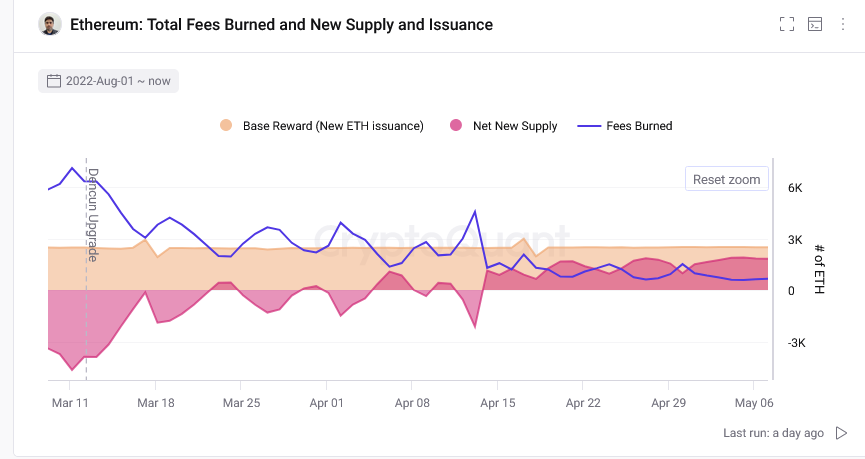
At this pace, if the rate of ETH burning continues to drop, Ethereum may no longer be on track to become deflationary. It will be especially so if activity shifts, as has been the case, to competition low-fee and scalable networks like Solana and Avalanche.
Falling Ethereum and Bitcoin prices will further exacerbate the burn rate. Whenever prices crumble, on-chain activity tends to contract sharply over time.
Feature image from Canva, chart from TradingView
Ethereum (ETH) is poised for a notable improvement with the impending Dencun upgrade to enhance the network’s scalability. However, amidst this anticipation, QCP Capital, a seasoned crypto asset trading firm, has shed light on an emerging trend that might influence Ethereum’s price trajectory.
The firm’s analysis reveals a shift in “risk reversals” for Ethereum, turning negative for upcoming expiries. This shift indicates growing concerns among investors about a potential decrease in ETH’s price, as a negative risk reversal often suggests a market leaning towards protective measures against a downturn.
Market Leverage And Correction Concerns
Notably, this trend towards negative risk reversals has been attributed to an increased interest in put options, which serve as a hedge against potential losses for those speculating on price increases.
Moreover, the broader altcoin market participants are similarly hedging their investments in Ethereum, aiming to mitigate risks associated with their altcoin holdings.
QCP Capital’s insights into the market dynamics also highlight an underlying nervousness about Ethereum’s price stability, especially in light of the considerable leverage within the market.
The firm cautions about the potential for a market correction, albeit with an expectation of strong buying interest in the event of any price dips. QCP noted in the report:
Altcoin speculators might also be buying ETH puts as a proxy to hedge altcoin downside. This makes us wary of a possible correction given the amount of leverage in the market. However, we think that the market will buy any dip aggressively.
Additionally, Ethereum’s spot-forward spreads have decreased slightly, contrasting with Bitcoin’s sustained high spreads. Commenting on the implication for investors, QCP Capital stated:
A sharp drop in spot price is likely to drag the forward spreads lower as leverage longs get taken out.
Ethereum Performance And Outlook
Despite the cautionary signals, Ethereum continues to perform “robustly” in the crypto market, closely trailing Bitcoin regarding price movements. Currently trading above $4,000, Ethereum has witnessed a modest increase of 0.6% over the past 24 hours.
Moreover, data from IntoTheBlock (ITB) reveals an encouraging statistic: over 94% of ETH addresses are presently profitable, suggesting a strong holding pattern among investors and a reduced likelihood of selling pressure. This scenario could potentially set the stage for a price uptick.
However, it’s important to note that Ethereum’s growth trajectory, while positive, has not mirrored the notable surge Bitcoin experienced following the approval of its spot Exchange-Traded Fund, indicating a more measured pace of appreciation for ETH.
Featured image from Unsplash, Chart from TradingView
Disclaimer: The article is provided for educational purposes only. It does not represent the opinions of NewsBTC on whether to buy, sell or hold any investments and naturally investing carries risks. You are advised to conduct your own research before making any investment decisions. Use information provided on this website entirely at your own risk.
Ethereum (ETH) has completed a major software upgrade, Dencun, that promises to make utilizing the network ecosystem more cost-effective. This update specifically targets Layer 2 (L2) networks, such as Arbitrum (ARB), Polygon (MATIC), and Coinbase’s Base, which are interconnected with Ethereum.
With Dencun, transaction costs on these networks have significantly decreased, with fees dropping from dollars to cents or even fractions of a cent.
Ethereum Dencun Upgrade And Cost Savings
Considered the most significant change in Ethereum’s end-user experience, the Dencun upgrade is expected to foster the development of new applications and services by significantly reducing expenses.
As NewsBTC reported on Tuesday, the update introduces a new data storage system, departing from the traditional approach of storing Layer 2 data on Ethereum itself. Adopting a new “blobs” repository reduces data storage costs since information is warehoused for only about 18 days instead of indefinitely.
One of the notable benefits of the Dencun upgrade lies in its impact on decentralized exchanges (DEXs) and gas costs. For instance, projected gas costs for popular Layer 2 networks, such as Arbitrum, Optimism, and Coinbase’s Base, are set to be significantly reduced.
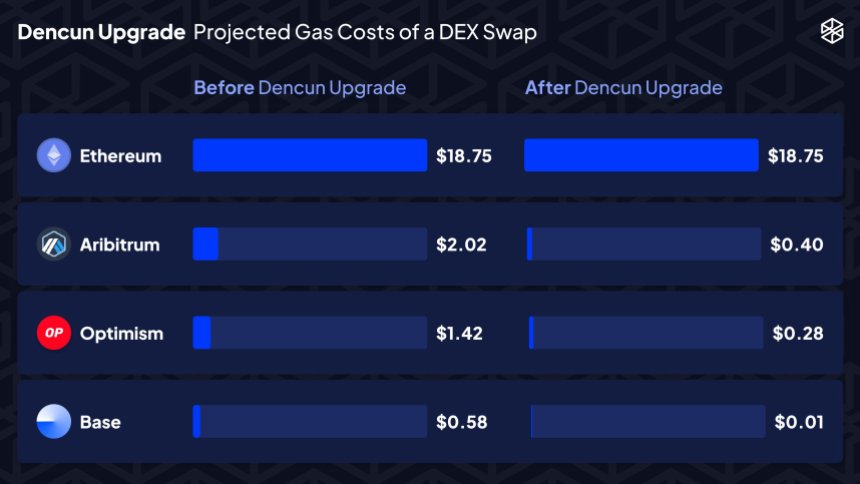
The projected savings translate into a reduction of Arbitrum’s swaps from $2.02 to $0.40, Optimism’s swaps from $1.42 to $0.28, and Coinbase’s Base swaps from $0.58 to $0.01, emphasizing the pivotal role of this upgrade.
As the upgrade was successfully launched on the mainnet, Tim Beiko, Ethereum Foundation core developer, expressed his satisfaction with the work accomplished and claimed:
Dencun is both the most complex fork we’ve shipped since the Merge, and tied for “most total EIPs in a fork” with Byzantium. There were more teams than ever involved in the process, and it somehow all worked out smoothly…! Grateful to work with all of them, onto the next one.
Blob Transactions And Pricing Changes
Layer 2 network Arbitrum has provided insights into the upgrade process. It will take around one to two hours for blob transactions to commence posting and for the new pricing changes specified by EIP-4844 to come into effect.
ArbOS Atlas, an upgrade that supports Arbitrum Chains, will introduce further fee reductions for Arbitrum One, set to be activated on March 18th. The updated configurations include a reduction in the Layer 1 (L1) surplus fee from 32 gwei to 0 per compressed byte and a reduction in the L2 base fee from 0.1 gwei to 0.01 gwei.
The Dencun upgrade unlocks cost-saving opportunities for Layer 2 networks and addresses congestion concerns by freeing up more space on the Ethereum network for additional transactions. While the upgrade offers enhanced efficiency, it does come at the cost of no longer retaining a complete record of all data indefinitely.
However, as Layer 2 networks embrace this new update to the Ethereum ecosystem, the stage is set for accelerated adoption, usage, and broader accessibility within the Ethereum community and its underlying protocols.
Dencun Upgrade Fails To Propel ETH Above $4,000
Despite the successful upgrade, ETH’s price remains unaffected, continuing to consolidate below the $4,000 threshold. The token attempted to surpass this crucial resistance level on Monday and Tuesday but failed to sustain its position above it.
For over 24 hours now, ETH has been trading between $3,930 and $3,970. Nevertheless, it’s worth noting that ETH has maintained its upward momentum, with gains exceeding 18% over the past fourteen days and nearly 60% over the past thirty days.
Additionally, introducing the Dencun upgrade is expected to drive increased demand for ETH, potentially sparking a renewed uptrend that could bridge the gap between current trading prices and its previous all-time high (ATH) of $4,878, achieved in November 2021.
Featured image from Shutterstock, chart from TradingView.com
Disclaimer: The article is provided for educational purposes only. It does not represent the opinions of NewsBTC on whether to buy, sell or hold any investments and naturally investing carries risks. You are advised to conduct your own research before making any investment decisions. Use information provided on this website entirely at your own risk.

- Ethereum’s Dencun upgrade went live on the mainnet on March 13, 2024 at 13:55 UTC.
- The upgrade introduces “blobs” which will see a significant reduction in transaction fees for Layer-2 protocols.
Ethereum core developers have activated the Dencun upgrade on the mainnet, with the highly anticipated implementation rolling out at epoch 269568 at 13:55 UTC.
Dencun had previously successfully deployed on the Holesky testnet in February.
Dencun upgrade is live
The upgrade introduces “blobs,” with the EIP-4844 set to see a significant decrease in transaction fees for Layer 2 protocols.
Ethereum and several L2 tokens surged earlier in the week as the Dencun upgrade approached. While prices have slightly retreated in the last 24 hours, the community is super bullish on what this hard fork means for the broader Ethereum ecosystem.
The last time the community vibe has been this positive was during the previous two major upgrades – the Shanghai upgrade in April 2023 and the Merge in September 2022.
Implementation of the Shanghai upgrade on the mainnet enabled ETH holders to unstake their tokens for the first time since deposits opened ahead of the Merge. Dencun’s rollout brings data blobs to the mainnet, with proto-danksharding set to enhance data availability and help cut transaction fees for L2s.
Users across Base, Arbitrum One, Optimism, zkSync and Starknet among other L2 platforms will benefit from this reduction. The Arbitrum team posted on X:
Once the upgrade starts executing, we expect it will take an hour or two for blob transactions to begin posting and for new EIP-4844 pricing changes to begin to be seen.
ArbOS Atlas also introduces additional Arbitrum fee reductions for Arbitrum One. We expect this to be…
— Arbitrum (
,
) (@arbitrum) March 13, 2024
The highly anticipated Dencun upgrade for the Ethereum (ETH) ecosystem is on the horizon, promising to bring significant cost reductions and notable changes to Layer 2 (L2) networks. The update, scheduled for March 13, will introduce a new data storage system known as blobs, reducing congestion on the Ethereum network and driving key new features in various areas.
Ethereum Dencun Upgrade
As highlighted in a recent Bloomberg report, Dencun aims to reduce the cost of Layer 2 networks such as Arbitrum (ABR), Polygon (MATIC), and Coinbase’s Base by enabling previously costly transactions to become significantly cheaper.
In particular, transactions that used to cost $1 can now cost as little as one cent, the report notes, while others that used to cost cents can be reduced to a fraction of a cent. This cost reduction is expected to improve the end-user experience greatly and is a significant improvement over previous upgrades such as the September 2022 “Merge.”
One of the most crucial aspects of the Dencun upgrade is the introduction of blobs, a new type of data repository for Layer 2 networks. Currently, Layer 2 blockchains store their data on the Ethereum network, leading to substantial storage costs passed on to applications and users.
However, with blobs, Layer 2s will store their data for a significantly shorter period, about 18 days, resulting in lower costs. While this shift sacrifices storing a complete record of all transactions forever, it frees up more space on the Ethereum network for other transactions, reducing congestion.
AI-Driven Trading Strategies
According to the report, introducing blobs through the Dencun upgrade also paves the way for using artificial intelligence (AI) in various applications. For example, games can incorporate AI-driven non-player characters, enabling advanced gameplay capabilities and a deeper experience.
In decentralized finance (DeFi), automated market makers can incorporate “complex trading strategies” driven by AI models. This newfound flexibility and complexity are expected to foster innovation and drive the development of advanced applications in the Ethereum ecosystem.
In addition, the Dencun upgrade is expected to reduce the operating costs of Layer 2 chains significantly. Previously, launching and operating a Layer 2 project required considerable venture capital backing. However, Bloomberg reports that with the cost reductions brought about by Dencun, small teams may be able to launch and maintain Layer 2 chains.
While the adoption of blobs and the associated cost advantages are expected to drive immediate benefits, it is worth noting that the cost of blobs may increase over time as demand grows.
How Could Dencun Boost ETH Price?
While the price of ETH has corrected by over 3% in the past 24 hours, resulting in a current trading price of $3,916, the Dencun upgrade holds the potential to have a positive impact on its price.
The upgrade aims to significantly reduce costs for Layer 2 networks and enhance the overall user experience, making Ethereum a more appealing platform for decentralized applications (dApps) and other use cases. By lowering transaction fees and improving scalability, Dencun could attract more users and developers to the Ethereum ecosystem, potentially driving up demand for ETH tokens.
Despite the ongoing correction, it is worth noting that the current price of ETH is not far from its two-year high of $4,084. However, it’s important to consider that the price has formed a double top pattern on the daily time frame for two consecutive days, which may present a near-term hurdle for ETH’s price. The market’s reaction and the ability of ETH to surpass its nearest resistance level remain to be seen.
Featured image from Shutterstock, chart from TradingView.com
Disclaimer: The article is provided for educational purposes only. It does not represent the opinions of NewsBTC on whether to buy, sell or hold any investments and naturally investing carries risks. You are advised to conduct your own research before making any investment decisions. Use information provided on this website entirely at your own risk.
The Ethereum Dencun upgrade is fast approaching and there have already been notable developments leading up to it. Besides the price of ETH rising to new two-year highs, there has been a significant increase in the amount of ETH that has been burned so far.
Over 50,000 ETH Burned
The Ethereum burn, which was brought with the EIP-1559 upgrade, has been ramping up over the past year. The ETH burned from fees on the blockchain quickly crossed the $100 million mark, and has now climbed to a new milestone.
According to Ultrasound Money, a website dedicated to tracking the performance of Ethereum since EIP-1559 was implemented, there have now been over 1.5 million ETH burned. A more accurate figure is 1,502,518.84 ETH at the time of writing, which is more than $5.6 billion at current prices.
The number of burned ETH has also greatly surpassed that of ETH issued, which means that the network has turned deflationary. Compared to the 1,502,518.84 ETH burned, there have been only 1,089,809.20 ETH issued in the same time period. This shows that the supply has not increased despite the new issuance, and ETH already in circulation is being burned as well.
At the time of the upgrade in 2022, the total Ethereum supply was 120,521,245. However, since then, the burn has been slowly eating into this figure and is currently sitting at 120,108,332 ETH. This means that the ETH supply has reduced by 412,706 ETH worth $1.55 billion since 2022.
Ethereum Dencun Upgrade Looms On The Horizon
The Ethereum Dencun upgrade is the latest in a long line of upgrades that have taken place in an effort to make it a better network. This upgrade is expected to come with a number of improvements for the network, including boosting its efficiency and capacity.
It was launched on all testnets last week which is expected to be the final phase before the launch. The launch itself has been scheduled to take place less than a week from now on March 13. Once completed, an increase in block space is expected to follow.
Presently, the ETH price is performing quite nicely leading up to the upgrade. It recently touched $3,900 for the first time since 2022, and while there has been a slight retracement, the altcoin continues to trend high above $3,700 at the time of writing.
ETH price moves toward $3,800 | Source: ETHUSD on Tradingview.com
Featured image from Crypto News, chart from Tradingview.com
Disclaimer: The article is provided for educational purposes only. It does not represent the opinions of NewsBTC on whether to buy, sell or hold any investments and naturally investing carries risks. You are advised to conduct your own research before making any investment decisions. Use information provided on this website entirely at your own risk.
Ye Zhang, the co-founder of Scroll, a layer-2 project using zero-knowledge proof, is cautiously optimistic about the upcoming Dencun upgrade. In a post on X, Zhang pointed out Dencun’s potential benefits, particularly the low transaction fees.
However, in the same post, the co-founder highlighted the likely challenges it could present for existing layer-2 scaling solutions using roll-ups.
Dencun Introduces EIP-4844 In Ethereum: What It Means
Ethereum developers plan to implement Dencun in mid-March. Implementing the Ethereum Improvement Proposal (EIP)-4844 is a big part of this hard fork. With this execution, the proposal will introduce a new “blob-carrying transaction” feature.
What’s unique about these transactions is that they allow users to cheaply attach blobs, which are large amounts of data, compared to traditional Ethereum transactions.
Based on observations from the Goerli testnet, Zhang anticipates blobs to be 3-5 times cheaper than traditional call data on Ethereum. Accordingly, the vast difference means innovative developers can come up with blob-inscriptions. These inscriptions will effectively compete with layer-2 solutions like Arbitrum or Optimism leveraging roll-ups.
This possibility cannot be discounted because, in essence, EIP-4844 aims to reduce layer-2 transactions through blob transactions. Effectively, the proposal means the foundation of Blob inscriptions.
This solution takes a different approach but could take on roll-up platforms if widely adopted. It will be the case if users transacting large chunks of data realize the advantage of going the blob inscription route.
Even so, roll-ups will carry distinct advantages over blob inscriptions. A notable one is the superior scalability of roll-ups. These solutions can inherently process more transactions every second. Additionally, they are secure since they inherit security from the Ethereum mainnet.
ETH Prices Steady Above $3,800
Still, until after Dencun is implemented, the impact of EIP-4844 will be thoroughly measured. Overall, the Ethereum and layer-2 communities are ecstatic for the upgrade, expecting it to thrust ETH even higher in the current bull run.
Ethereum is trading above $3,800. It has been up by double digits in the past week, and experts are predicting even more gains in the days ahead.
Related Reading: Analyst Cites Key Indicators That Signal Bitcoin Correction
In the medium term, bulls target $5,000, around the all-time high.
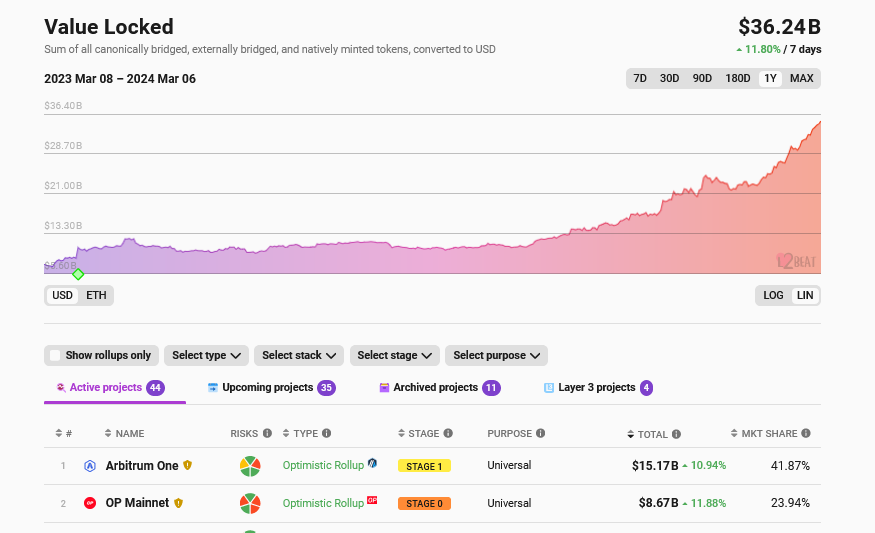
Amid the boom in ETH and crypto prices, interest in Ethereum layer-2 solutions continues to expand. The latest L2Beat data shows that Arbitrum, Optimism, and other alternatives manage over $36 billion. Arbitrum, enjoying its first-move advantage, manages nearly $16 billion.
]]>In a recent announcement, the Ethereum (ETH) Foundation revealed that the highly anticipated Dencun network upgrade had been successfully activated on all testnets.
The upgrade, scheduled to go live on the Ethereum mainnet on March 13, 2024, marks a significant milestone in the protocol’s efforts to enhance scalability and reduce user transaction costs.
Ethereum’s Latest Milestone
The Dencun upgrade, following the successful Shapella upgrade of last year, introduces several notable changes aimed at improving the Ethereum network’s efficiency and capacity.
One key feature is the introduction of temporary data blobs through Ethereum Improvement Proposal 4844, affectionately known as “protodanksharding.” This addition is expected to reduce layer-2 transaction fees, making Ethereum more accessible and cost-effective for users.
Blobs minimize storage and processing requirements by caching the necessary data for short-term transaction verification, further enhancing the network’s transactional capabilities.
As announced, these features are paramount in supporting the growing ecosystem of decentralized applications (dApps) and accommodating the number of users on the Ethereum platform.
Urgent Update Required
To ensure a smooth transition to the upgraded mainnet, the Ethereum Foundation has issued specifications for the community, particularly for stakeholders and node operators. Users are advised to update their node’s execution and consensus layer clients to the specific versions outlined by the Foundation.
Both the beacon node and validator client should be updated to ensure compatibility with the Dencun upgrade. Failure to participate in the upgrade by using an outdated Ethereum client would result in being stuck on an incompatible chain, unable to send Ether, or operating on the post-Dencun Ethereum network.
The Dencun upgrade initially launched on the Sepolia testnet in January 2024, following its successful deployment on the Goerli testnet. According to the official statement, this upgrade aligns with the network’s broader strategy to address scalability challenges and improve the protocol’s overall performance.
Once fully implemented, the Dencun upgrade is expected to significantly increase ETH’s transaction processing capacity, potentially enabling the network to handle over 100,000 transactions per second.
Related Reading: SEC Vs. Do Kwon: Trial Will Commence In Absence Of Terra Founder
Ultimately, the Foundation unveiled that “Dencun” for this upgrade follows Ethereum’s tradition of using star names for consensus and Devcon city names for execution layer upgrades. “Dencun” is a combination of “Deneb,” a prominent first magnitude star in the constellation Cygnus, and “Cancun,” the location of Devcon 3.
ETH, the second-largest cryptocurrency in the market, is currently trading at $3,242, reflecting a 3% increase in the past 24 hours and an impressive surge of over 42% in the past 30 days.
Featured image from Shutterstock, chart from TradingView.com
In an eagerly anticipated development, Ethereum’s (ETH) upcoming ‘Dencun’ upgrade, scheduled for March 13, is poised to bring about significant advancements in the scalability, security, and usability of the Ethereum network.
Renowned crypto analyst Miles Deutscher has highlighted this major hard fork upgrade, highlighting its potential to propel the entire ecosystem forward and sharing his top altcoin picks poised to benefit from the upcoming changes.
Ethereum Dencun Upgrade To Increase L2 Appeal?
The Dencun upgrade, part of Ethereum’s roadmap initiative known as “The Surge,” introduces a series of Ethereum Improvement Proposals (EIPs) that bolsters the network’s efficiency and functionality. EIP-4844 takes the spotlight by introducing Proto-Danksharding, a new development for Ethereum’s scalability.
According to Deutshcer’s analysis, one of the key improvements offered by EIP-4844 is the introduction of “blob-carrying transactions,” a new transaction type that significantly reduces transaction costs for both Layer-2 (L2) users and increases Ethereum’s transaction throughput.
This reduction in fees on Ethereum Layer-2s is expected to be the most substantial decrease in gas fees ever witnessed, making L2 chains a compelling choice for decentralized application (dApp) builders and users alike. Consequently, Deutscher suggests that Layer-2s are poised to outshine alternative Layer-1 solutions in attractiveness and adoption.
The implications of the Dencun upgrade extend across the entire Ethereum ecosystem, spanning decentralized finance (DeFi) applications, gaming platforms, and on-chain trading.
While all ETH Layer-2s stand to benefit from Dencun, Deutscher highlights several specific L2 altcoins that possess unique ecosystem catalysts alongside the advantages presented by EIP-4844.
Top Altcoins Poised For Growth
First on the altcoin list is Polygon (MATIC), which is undergoing a rebranding to POL and has made significant investments in implementing ZK technology. Deutscher believes Polygon could emerge as a strong performer in the coming weeks and months.
Next, Arbitrum (ARB), currently the leading L2 in Total Value Locked (TVL), continues to show significant metrics, making it a preferred choice for new dApp launches.
Optimism (OP), TVL’s second largest L2, is also highlighted by Deutscher, which he says has also shown resilience in transaction volume and recently announced its fourth airdrop, likely renewing interest and activity in its ecosystem.
According to Deutscher, COTI (COTI), with the introduction of its privacy-centric ETH L2, V2, and “Garbled Circuits,” offers promising prospects for preserving privacy on the blockchain.
Mantle (MNT), which is experiencing rapid growth, has accumulated over $1.5 billion worth of Ethereum staked as mETH (Mantle Staked ETH), and Deutscher suggests it will offer attractive airdrops for mETH stakers.
Metis (METIS) showcases a range of positive developments, including a substantial $400 million Ecosystem Fund, the upcoming alpha mainnet launch of its decentralized sequencer, and the ongoing Liquid Staking Blitz campaign.
Lastly, Deutscher’s analysis urges investors to closely monitor other notable L2s, including Manta Network, Starknet, zksync, and LineaBuild, as they exhibit promising activity and potential for growth.
While the Dencun upgrade is a few weeks away, Ethereum enthusiasts eagerly anticipate the expected mainnet rollout in March. With positive market performance thus far, Deutscher believes there is further room for growth and encourages investors to consider the potential benefits offered by Ethereum and its associated altcoins.
ETH is trading at $2,947, up 1.6% in the past 24 hours, with more gains expected as the upgrade draws closer.
Featured image from Shutterstock, chart from TradingView.com
The much-awaited and anticipated upcoming technological upgrade known as the Ethereum Dencun Upgrade has now been set for launch on the network’s mainnet in a month.
Ethereum Dencun Upgrade Goes Live In A Month
After Dencun was successfully deployed to the Holesky testnet on February 7, ETH developers decided on the date and shared the information on Geth v1.13.12, also called Edolus. The Ethereum Dencun upgrade, which will introduce Proto-Danksharding and blobs, will be unveiled on March 13.
Proto-Danksharding aims to increase the amount of block space on Ethereum layer 2s by implementing blob-carrying transactions. Transactions that carry blobs are akin to standard transactions, except they also carry an additional piece of data.
According to a previous report, proto-Danksharding will reduce the number of blobs in each block to 16, with each being no larger than 128 kilobytes (KB). As a result, it is anticipated to increase block space by roughly 2 megabytes (MB).
The additional data space will allow both optimistic and zero-knowledge rollups to post commitments to transaction data on-chain. In addition, it will provide the actual data in blobs rather than ‘calldata.’
The Dencun upgrade marks the most major update Ethereum has introduced since the Shanghai upgrade. The aforementioned Proto-Danksharding often known as ETH improvement Proposal 4844 (EIP-4844) is considered to be the cause of the excitement around the model.
Notably, the upgrade on the mainnet will take place precisely at slot 8626176 on the previously stated date. However, developers’ approval and GitHub confirmation are still needed for the date.
They are expected to publish their final versions of Ethereum clients that include Dencun functionality by February 22. As a result, validators will have just two weeks to install the updated client versions on their nodes.
When the Dencun model is finished, the Ethereum network’s capabilities will be improved. More specifically, the network would be anticipated to process between 30,000 and 100,000 Transactions Per Second (TPS).
Additionally, it should reduce gas prices, which have been a significant bottleneck to the network since it was introduced, processing between 13 and 60 TPS.
Dencun Deployed On the Holesky Testnet
Dencun Upgrade is currently on the Holesky testnet, which went live on Wednesday, February 7. Christine Kim, a core developer, took to X (formerly Twitter) to confirm the launch on the testnet.
According to Kim, it will be the final one to be released on the testnet before the mainnet is activated. Before now, Dencun was deployed on the Sepolia Testnet in January before transitioning to Holesky.
When ETH upgrades are made, they undergo multiple testnets in order to confirm that they are ready to be launched on the mainnet. This is because every testnet is designed to replicate conditions on the mainnet. Due to this, developers can simply look out for bugs and errors, which are then fixed before they are made available to users and the public.
Featured image from iStock, chart from Tradingview.com