Key facts: Cardano Foundation leads Project Catalyst; develops micromobility platform TradingView
Source link ]]>
Key facts: Plomin Hard Fork Boosts Cardano Governance; ADA Market Recovers; Midnight Team Develops Private Smart Contract Platform TradingView
Source link ]]>
Psy Develops First Trustless Bridge from Dogecoin to Solana Investing Haven
Source link ]]>
Psy Develops First Trustless Bridge from Dogecoin to Solana unchainedcrypto.com
Source link ]]>
Reason to trust

Strict editorial policy that focuses on accuracy, relevance, and impartiality
Created by industry experts and meticulously reviewed
The highest standards in reporting and publishing
Strict editorial policy that focuses on accuracy, relevance, and impartiality
Morbi pretium leo et nisl aliquam mollis. Quisque arcu lorem, ultricies quis pellentesque nec, ullamcorper eu odio.
Ethereum is under pressure after failing to break above the $1,874 high set on May 1st, a level that now acts as stiff resistance. As the broader crypto market begins to heat up, Ethereum remains stuck in a tight range, lacking the momentum to confirm a breakout. Currently trading just above $1,800, ETH sits at a critical level where bulls must step in to defend the structure and push the price higher.
Related Reading
Despite several attempts, Ethereum has been unable to establish a clear direction, and market participants are growing cautious. The asset is still down over 55% from its December highs, reflecting a prolonged period of weakness relative to other major cryptocurrencies. Without a strong push through resistance, Ethereum risks falling further behind.
Top crypto investor Michael Van de Poppe recently shared a technical analysis suggesting that Ethereum is still in an accumulation phase. According to Van de Poppe, ETH shows signs of strength and accumulation against BTC in the background, but needs confirmation through a decisive breakout above current levels. Until then, Ethereum remains range-bound and vulnerable to volatility. With market sentiment shifting and major moves looming, the coming days will be crucial for ETH’s short-term outlook.
Ethereum Accumulation: ETH/BTC Chart Hints At Imminent Move
Ethereum continues to struggle below the $2,000 mark, failing to reclaim key resistance levels despite broader market activity heating up. While ETH/USD remains directionless and still trades over 55% below its December highs, a closer look at the ETH/BTC chart reveals something more constructive brewing beneath the surface.
Van de Poppe recently shared an analysis highlighting a clear accumulation structure forming in the ETH/BTC pair. After months of consistent downside, the chart shows Ethereum breaking out of a falling wedge and consolidating in a tight range just below critical resistance at 0.0195 BTC. According to Van de Poppe, this is a classic accumulation pattern, signaling that Ethereum may be preparing for a significant breakout relative to Bitcoin.
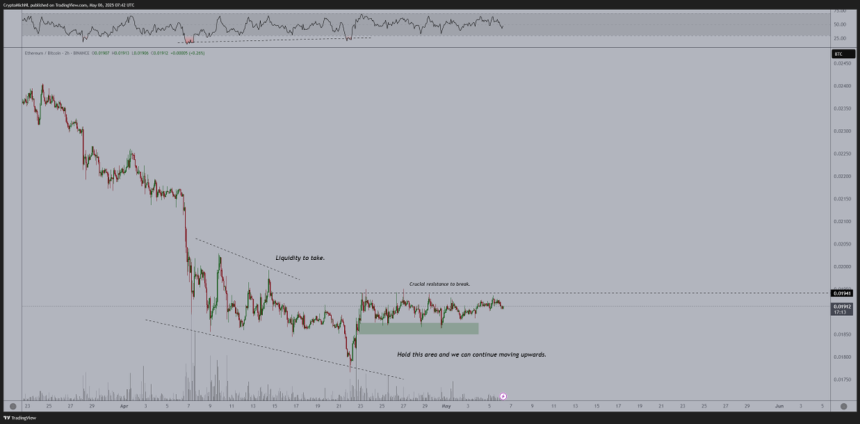
The chart also highlights a key demand zone around 0.0184 BTC—an area ETH has repeatedly held. As long as this level holds, Van de Poppe believes Ethereum could continue to grind higher and eventually take out liquidity above resistance. A successful breakout could mark the start of Ethereum outperforming Bitcoin, a trend often seen during the altcoin expansion phase of a bull market.
However, risks remain. The broader market is still heavily influenced by macroeconomic uncertainty, particularly surrounding U.S.-China tensions. For now, Ethereum’s upside case depends on holding current support and clearing the 0.0195 BTC resistance. If successful, this accumulation may become the base for a strong rally.
Related Reading
ETH Price Consolidates In A Tight Range
Ethereum is currently trading at $1,795.79 after a slight rejection from the $1,874 local high reached on May 1st. The daily chart shows ETH consolidating in a tight range following its rebound from April’s lows near $1,500. However, despite this stabilization, ETH remains well below both the 200-day simple moving average (SMA) at $2,709.54 and the 200-day exponential moving average (EMA) at $2,437.55—indicating that the broader trend is still bearish.
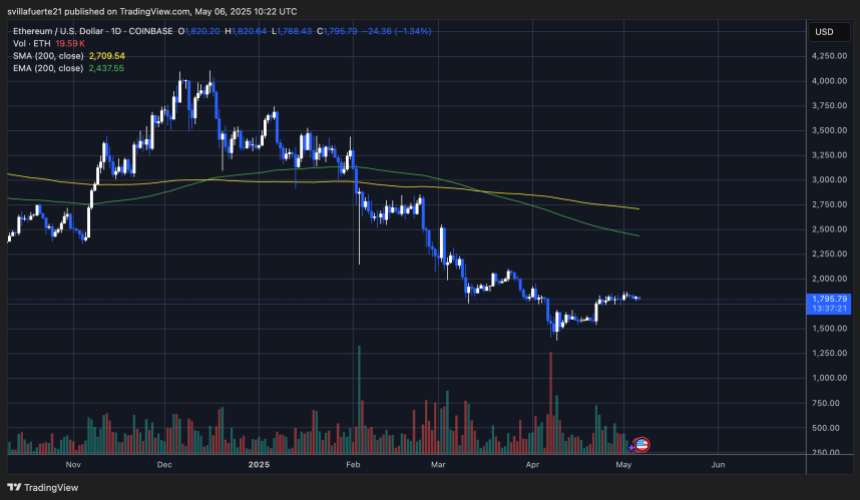
While bulls have managed to prevent further downside, Ethereum has yet to break out of its long-term downtrend. The failure to reclaim $2,000 as support continues to cap bullish momentum, and volume has remained modest during recent price action, showing a lack of conviction from both buyers and sellers.
The structure currently favors accumulation, but ETH must decisively clear the $1,875–$2,000 resistance area to shift sentiment and validate a trend reversal. If it fails to do so, the risk of a renewed pullback toward the $1,650–$1,700 support zone increases.
Related Reading
Overall, Ethereum is at a pivotal stage. The longer it consolidates below major moving averages, the more likely the market remains cautious. A breakout above $2,000 could trigger renewed upside and signal broader market strength.
Featured image from Dall-E, chart from TradingView
Meme News Today: Social Dating Crypto Develops AI APP Sending Shiba Inu Investors Into A Frenzy, Here’s Bitcoinist
Source link ]]>
Cardano price set to tank 10% as social media war between Reddit user, ADA founder develops FXStreet
Source link ]]>
A decentralized finance (DeFi) stablecoin project is gearing up for its debut on the Cardano (ADA) blockchain early next year.
In a new interview with Learn Cardano Podcast host Peter Bui, head of COTI (COTI) Shahaf Bar-Geffen lays out what’s ahead for the Djed stablecoin project starting in January.
“We kind of like lay the groundwork for Djed by signing over 40 partnerships with everything from all major DEXs [decentralized exchanges] to trading protocols, NFT [non-fungible token] marketplaces, launch pads, you name it. Now we’re going to execute on all of these partnerships.
So we’re going to start with selected DEXs. I think there’s going to be like three of them that we’re launching with. And they’ll be part of the launch process. They’ll give users substantial farming rewards for building liquidity. And we’re going to start there and then gradually roll out to all of these platforms.”
He says Djed Pay will also launch after the launch of the stablecoin, bringing more DeFi activity to the Ethereum (ETH) rival blockchain.
“Djed is essential for DeFi in Cardano, but I think there’s more actually: Payments. And we’re going to release Djed Pay… and we’re going to roll that out to get extra demand for the usage of Djed.”
Bar-Geffen says Djed will continue to advance its technology and capabilities on Cardano.
“Then there is the technical roadmap. The version that we launch in January is already compatible with Vasil. But it still doesn’t use Plutus V2 and all the benefits that come with Vasil. This is version 1.2. And that will be rolled out as well early next year.
The next version will actually use something that is called an extended Djed that is a bit more dynamic and has extra benefits to it and in between these times we are going to solve how staking is done through the smart contract and get all that benefit.”
I
Don’t Miss a Beat – Subscribe to get crypto email alerts delivered directly to your inbox
Check Price Action
Follow us on Twitter, Facebook and Telegram
Surf The Daily Hodl Mix
 

Disclaimer: Opinions expressed at The Daily Hodl are not investment advice. Investors should do their due diligence before making any high-risk investments in Bitcoin, cryptocurrency or digital assets. Please be advised that your transfers and trades are at your own risk, and any loses you may incur are your responsibility. The Daily Hodl does not recommend the buying or selling of any cryptocurrencies or digital assets, nor is The Daily Hodl an investment advisor. Please note that The Daily Hodl participates in affiliate marketing.
Featured Image: Shutterstock/vvaldmann
Cryptocurrencies have been suffering higher volatility since the bear took control. For example, the fledgling crypto coin Bitcoin price plummeted to a low of $18,363 on Oct 13 and then reversed to $19,354 today. Unlike the other top coins creeping, Uniswap’s native token, UNI, marks higher gains. Although its price touched $5.50 when BTC plummeted on Thursday, UNI added over 14% following the day and claimed a $6.49 high.
At the time of writing, the token’s value hovers around $6.20, up by 0.96% in the last 24 hours. The Uniswap market cap also indicates a bullish trend, signifying the crypto winter started to ignore the project. Its capitalization has increased to $4.70 billion, representing a 0.24% gain.
Financial Indicators MACD Line And RSI Suggest Bearish Divergence
In line with the daily price analysis, UNI against USD presents a bullish trend ahead. The price actions form a high-low pattern which signs an uptrend for the token. As recent price moves show, investors did not miss any opportunity and connected with all swing lows. Likewise, Uniswap ended its retracement phase below $5 in the last week and now seems to find resistance above this. The expected price range for the token in October remains between $5.3 to $7.
Opposite to the positive happenings within the UNI network, the Moving Average Convergence/Divergence (MACD) line, an oscillator used to indicate market trends, currently points toward the bearish signal for the token and crosses the line. Likewise, the Relative Strength Index (RSI) shows a bearish divergence as its peak continues falling toward the 50 zone.

Uniswap To Deploy On zkSync For Cheaper Fee And Enhanced Security
UNI is the governance token of the decentralized exchange Uniswap, which allows users to trade and sell cryptos using smart contracts. It seems users and organizations are pushing for privacy in the sector, driving adoption and positively affecting prices. For example, on Wed, 12 October 2022, Coin Center, a think tank on cryptocurrencies, filed a suit against OFAC over restrictions against Tornado Cash, a privacy mixer (decentralized cryptocurrency tumbler). In return, almost the whole market reacted by going green as the news spread.
Notably, today’s announcement by the Uniswap platform might become a catalyst to pump the token’s price further. The Uniswap exchange has declared to build on the zkSync for enhanced privacy and security.
zkSync uses novel technology, also known as ZK Rollups, to enable faster transactions with minimum gas cost. The company decided to deploy privacy-focused layer two after completing a governance vote. Offering a minimum fee without compromising on security will attract more users and accelerate the network’s activity.
The parent company of zkSync, Matter Labs, commented that this move would onboard new users. Furthermore, the low network fee than Ethereum will make the platform more attractive. The company noted in a statement;
There’s significant value in Uniswap being available on an EVM-compatible ZK Rollup. Deploying early on zkSync helps solidify Uniswap’s place as the number one DEX and a thought leader.
Therefore, with zkSynce launch on mainnet within the next six weeks, investors’ wallets may profit from the project’s growth. In addition, the token might enjoy resistance above $7 in the coming days, which the investors are hard to manage.
Featured image from Pixabay and chart from TradingView.com

Source: Akarat Phasura – Shutterstock
- A newly discovered bug was creating incompatible forks and causing a decrease in chain density.
- Cardano developer said that it seems they have been “rushing” through the Vasil upgrade but also gave a recovery plan.
It’s yet another bad news for the Cardano community as a major bug in the Cardano node has led to the breaking of the Cardano testnet. Prominent Cardano developer Adam Dean updated regarding the same on Thursday, August 18.
(1/n) It’s important to point out today that the #Cardano #Testnet is **catastrophically** broken due to a bug in Cardano Node v 1.35.2. This was the version that we had previously been told was “Tested and Ready” for the Vasil Hardfork. This bug was only discovered…
— Adam Dean (@adamKDean) August 18, 2022
Citing a major bug in the Cardano Node v 1.35.2, Adam Dean noted that the Cardano tested is “catastrophically broken”. This is supposedly the testnet version said to be “Tested and Ready” for the much-awaited Vasil Hardfork. In a detailed Twitter thread, Cardano developer Adam Dean writes:
This bug was only discovered because operators rushed to upgrade on #Mainnet and it was creating incompatible forks and causing a decrease to chain density.
Testnet is still broken, due to the majority of operators having upgraded to 1.35.2 on testnet to simulate a Vasil HFC event there, 1.35.3 is now incompatible and incapable of syncing the chain, legacy installations are still on one fork or another.
The Cardano developers are currently testing v 1.35.3 on two new testnets. However, these testnets do not have the block history like the previous ones.
Are Cardano developers “rushing through the Vasil Upgrade?
Cardano developers have been working on the Vasil hardfork for a while. The Vasil hardfork will improve the Cardano blockchain scalability by increasing the block size. This means that each block added to the Cardano blockchain will have more space to store data.
Last month, Cardano announced its first delay in the implementation of the Vasil hardfork. A few days back, Cardano chief Charles Hoskinson said that delays can take time considering that the entire testing process needs to go through a specific pipeline. It seems that there’s a sense of urgency building up among Cardano developers to implement the Vasil hardfork.
However, Cardano developer Adam Dean expressed his displeasure about it. “To say that this level of “rushing” gives me uneasy feelings is an understatement. If there were a “nuclear clock” for #Cardano we got perilously close to hitting midnight,” he wrote.
But some Cardano community members are also unhappy with the recent development. The @Cardano_HRguy wrote: “This is unacceptable for a blockchain that has built its reputation on the robustness of its research & technology”.
Meanwhile, the Cardano developer has also shared a complete recovery plan and the corresponding actions that need to be undertaken.
Cardano (ADA) Price Tanks 8%
Following the news, the price of Cardano’s native cryptocurrency ADA has tanked more than 8 percent in the last 24-hour. As of press time, ADA is trading at $0.49 with a market cap of $16.6 billion. It still continues to occupy a spot among the top-ten crypto list.