Dogecoin (DOGE) Price Prediction: Mining Difficulty Surges 10.68% in 30 Days While Price Compresses openPR.com
Source link ]]>
Dogecoin (DOGE) Price Prediction: Mining Difficulty Climbs 10.68% in 30 Days While Price Stays Flat openPR.com
Source link ]]>
Trump-Linked Firm Boosts Dogecoin Mining as Difficulty Peaks Yahoo Finance
Source link ]]>
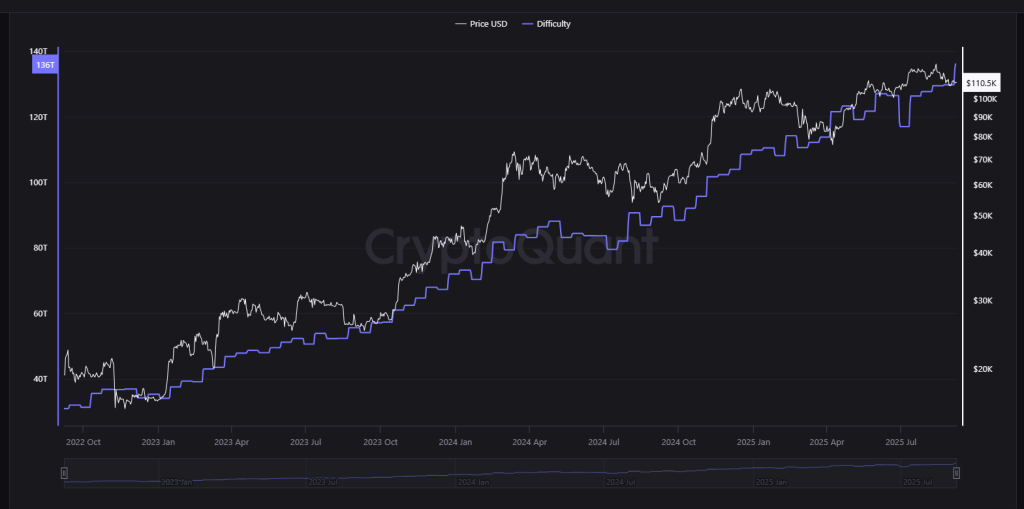
Bitcoin’s mining math hit a fresh high this week as the network’s difficulty climbed to a new all-time peak of 135 trillion. Miners now need more computing work than ever to win a block, while the overall hashpower available to the network has slipped from its summer peak.
Related Reading
Mining Difficulty Reaches New High
According to on-chain data, network hashrate fell to 967 billion hashes per second after topping 1 trillion hashes per second on August 4. That gap — rising difficulty paired with a lower hashrate — tightens margins for miners.
Reports have disclosed that higher difficulty makes mining more costly, and the pressure is felt most by smaller operations that run on narrow profit margins.
Big miners have room to scale. Smaller teams do not. Costs for electricity, machines and maintenance add up fast. The situation raises concern about concentration. As the cost to operate rises, larger pools and firms are better positioned to absorb the pain and keep hashing.
Solo Miners Still Score Big
Despite those headwinds, Three solo miners managed to land blocks in July and August, proving the system still hands out rewards to individuals now and then. Reports show the block subsidy is 3.125 BTC per block. On July three, a solo miner found block 903,883 and took home just under $350,000 in subsidy plus fees.
Another solo miner added block 907,283 on July 26, claiming over $373,000 when prices at the time were used to value the reward. On August 17, block 910,440 was mined by a solo operator, yielding roughly $373,000 in subsidy and fees.
Those payouts highlight two facts. First, solo success is rare but possible. Second, occasional large rewards do not erase the steady advantage of scale. Pools still smooth earnings for participants, and many miners use them to avoid long dry spells.
Seasonality And Market Patterns
Meanwhile, September has a poor historical record for Bitcoin, with an average return of -3.77% across 12 years beginning in 2013, researchers say.
Bitcoin endured six straight losing Septembers from 2017 through 2022. The streak reversed in 2023, and 2024 closed out as the best September on record at +7.29%.
Related Reading
What This Means Now
In short, the network’s math is becoming tougher at the same time mining capacity dipped slightly. That creates tighter margins and fuels debate over centralization as scale matters more.
Yet the ecosystem still shows variety: solo miners can and do win blocks, and market history gives investors a mixed picture where seasonal trends matter but do not guarantee outcomes.
For now, miners and market watchers alike will be tracking difficulty, hashrate and price swings as the fall unfolds.
Featured image from Unsplash, chart from TradingView

- Bitcoin’s network difficulty hits a record high of 90.67 trillion as of August 2, 2024.
- Bitcoin’s hash rate reached a record 677 EH/s on July 27th, boosting network security.
- Bitcoin’s RSI at 44 suggests potentially oversold conditions; the price may test $58,000
Bitcoin has set a new record for network difficulty, reaching 90.67 trillion on August 2, 2024 according to data on CoinWarz.
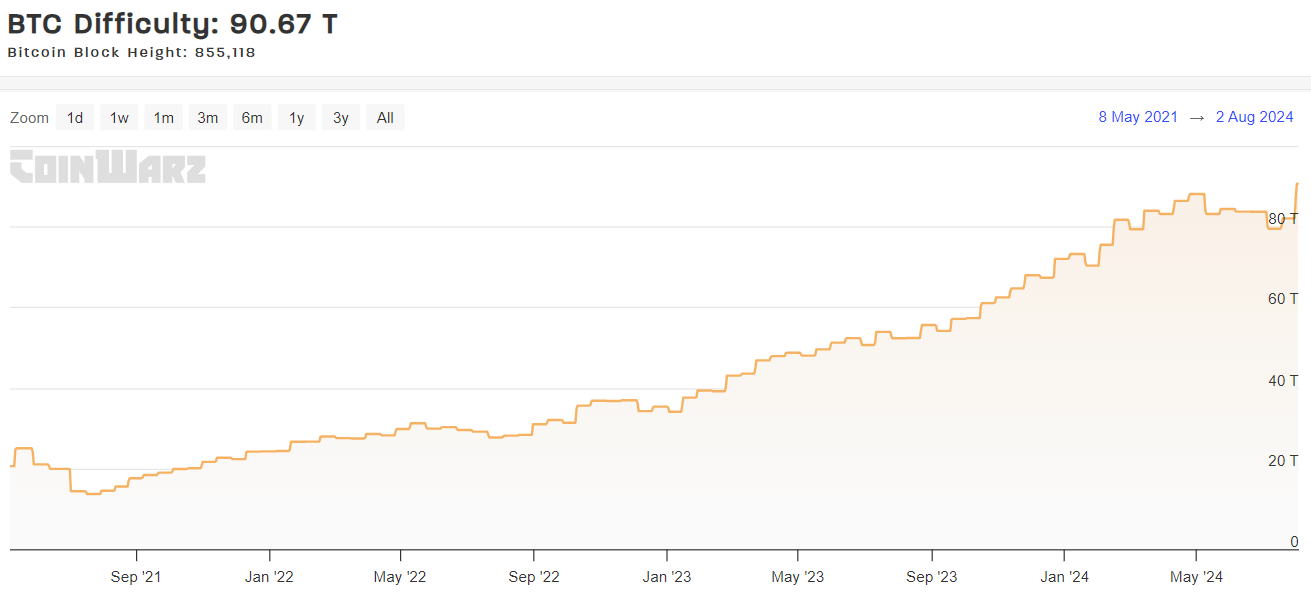
This milestone represents a significant rebound following three months of declining difficulty, signalling renewed confidence among miners in the cryptocurrency’s network.
The increased difficulty implies that mining new Bitcoin blocks now requires more computational power, potentially driving up operational costs and influencing Bitcoin’s future supply and pricing dynamics.
Bitcoin’s hashrate also hit an all-time high
On July 27th, Bitcoin’s hashrate surged to a record 677 EH/s, reflecting a robust and secure network infrastructure. This peak suggests intensified competition among miners and strengthens the network’s resilience against potential security threats.
A high hashrate not only indicates increased mining activity but also has the potential to positively impact Bitcoin’s price by boosting investor confidence.
BTC price under increased bear pressure
Currently, Bitcoin is trading at $63,103.42, showing a 0.17% increase over the past 24 hours. The cryptocurrency has been fluctuating between $62,248 and $65,593, suggesting a mild recovery trajectory despite recent volatility.
If this trend continues, Bitcoin may avoid the $62,000 resistance level, potentially paving the way for new highs.
However, the Relative Strength Index (RSI) for Bitcoin is at 44.64, indicating that the cryptocurrency is approaching oversold conditions.
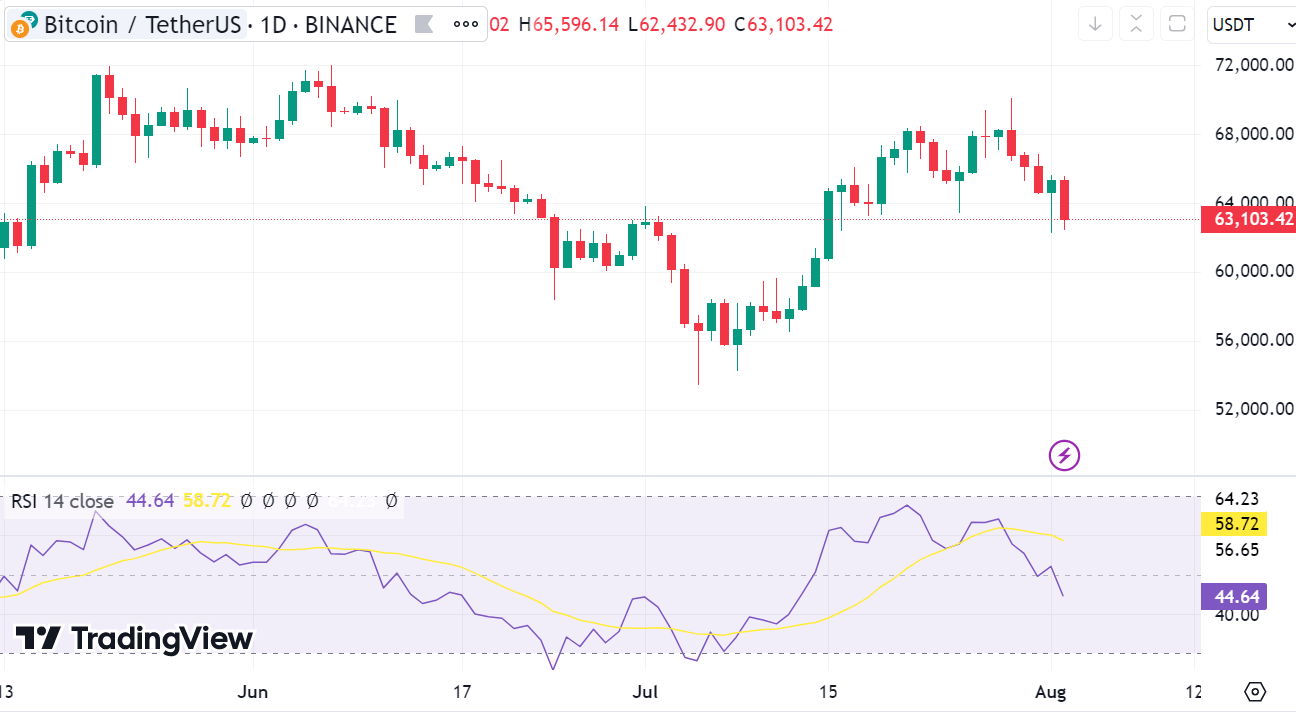
A declining RSI points to diminishing bullish momentum, and if bearish forces intensify, Bitcoin might test its next support level at $58,000. Further declines could follow if market pressure persists.
Overall, Bitcoin’s rising network difficulty and hashrate highlight a strengthened and competitive mining environment. These factors are essential for evaluating the network’s health and security as Bitcoin navigates through ongoing price volatility.
Recent data shows that the Bitcoin mining difficulty is on the decline and has hit its lowest since May. This is significant considering what this could mean for the Bitcoin ecosystem, specifically Bitcoin’s price.
Bitcoin Mining Difficulty Drops To 79.5 T
Data from CoinWarz shows that Bitcoin mining difficulty has dropped to 79.5 T at block 851,204 and hasn’t changed in the last 24 hours. This mining difficulty has continued to fall for a while, with further data from CoinWarz showing that it is down 5% in the last seven and 30 days.
Bitcoin mining difficulty refers to how hard it is for miners to mine a new block on the Bitcoin network. The difficulty usually reduces when there is less computational power on the power and increases when miners are mining faster than the block average time of ten minutes. The recent drop in mining difficulty suggests that more miners are leaving the Bitcoin network.
This is most likely due to the effects of the Bitcoin halving, which cut miners’ rewards in half. This has reduced the revenue from their mining operations, with many miners struggling to stay afloat, especially with increased competition. Bitcoin’s price action since the halving has also not helped, as the drop in the flagship crypto’s price has also affected their income.
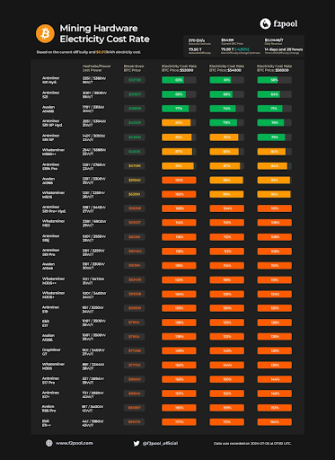
Bitcoin miner f2pool recently highlighted the profitability of various categories of miners at Bitcoin’s current price. The mining firm noted that only ASICs with a Unit Power of 26 W/T or less can make a profit at Bitcoin’s current price range.
Crypto analyst James Van Straten also recently highlighted how “weak and inefficient miners” continue to be purged from the Bitcoin network. He claimed that the recent drop in mining difficulty shows that miner capitulation is closer to ending. Due to the low profitability that miners have faced since the halving, some have had to offload a significant amount of their Bitcoin reserves to meet operational costs, and others have had to exit the Bitcoin ecosystem entirely.
What This Means For Bitcoin’s Price
The decline in mining difficulty suggests that miner capitulation might be ending soon, which is a positive for Bitcoin’s price considering the selling pressure these miners have put on it. Bitcoinist reported that Bitcoin miners sold over 30,000 BTC ($2 billion) last month, which ultimately caused the flagship crypto to experience significant price crashes.
Crypto expert Willy Woo also attributed Bitcoin’s tepid price action to these miners and mentioned that the flagship crypto will only recover when the “weak miners die and hash rate recovers.” He stated that Bitcoin would have to shed weak hands for this to happen, with inefficient miners going into bankruptcy while other mines are forced to buy more efficient hardware.
]]>In a riveting turn of events, Bitcoin mining difficulty recently reached unprecedented levels, hitting the 86.39 trillion hash mark ahead of the BTC halving. This primarily aligns with the sudden rise in Bitcoin miners rushing into mining as many coins as the 2024 halving approaches, resulting in higher hash rates that, in turn, offer higher network security.
BTC Mining Spikes Ahead Of Halving: What’s The Scoop?
Bitcoin miners race to mine as many coins as possible ahead of the upcoming halving, a four-year recurring event, since it significantly reduces rewards for mining new blocks. Miners anticipate this event negatively because it reduces the rate at which new BTC tokens are created. As a result, they try to accumulate as many coins as possible before the halving occurs, resulting in a spike in mining activity, as mentioned above.
Intriguingly, the rush of Bitcoin miners typically increases the overall hash rate of the Bitcoin network. This higher hash rate further enhances the network’s security by making it more difficult for any single entity to manipulate the blockchain or conduct malicious activities, adding a tint of optimism to the token.
Notably, Bitcoin mining’s difficulty gauges how hard and time-consuming it is to mine a new block or solve mathematical puzzles under Bitcoin’s proof-of-work (PoW) consensus mechanism. Further, BTC mining difficulty adjustment occurs every 2,016 blocks, or approximately every two weeks, as Bitcoin is programmed to self-adjust the difficulty level to maintain a target block time of 10 minutes.
Meanwhile, with the surge in mining difficulty, BTC’s price witnessed quite a flux in the past 24 hours.
Also Read: Bitcoin Options Expiry: How Traders Are Pricing For Bitcoin Halving
Bitcoin Price Flux: A Closer Look
As of writing, the Bitcoin token’s price noted a marginal 0.14% jump in the past 24 hours and is currently trading at $70,901. Notably, the token’s chart, per CoinMarketCap’s data, showcased a highly volatile movement over the past day, with 24-hour lows and highs of $69,571.81 and $71,256.24, respectively. This volatile movement aligns with the the rise in mining difficulty, as miners encounter burgeoning technical hurdles with the spike in miners partaking in this event.
Nonetheless, a tidal wave of optimism in the market persists with the upcoming BTC halving, as historical data fuels bullish sentiments on the token’s price action post-halving.
Also Read: Canada’s British Columbia Seeks To Block Bitcoin Mining Operations

The presented content may include the personal opinion of the author and is subject to market condition. Do your market research before investing in cryptocurrencies. The author or the publication does not hold any responsibility for your personal financial loss.
The Bitcoin (BTC) network has adjusted its difficulty level, hitting a new All-Time High (ATH) as industry giants prepare for the halving event slated for 26 days.
Bitcoin Mining Difficulty: Data Insight
According to data from Blockchain.com explorer, the Bitcoin mining difficulty as of March 21 when the last readjustment was computer comes in at 83,947,913,181,362. Since the inception of the digital currency, the hashrate has always been in an upward movement save mid-2021 and April 2022 when the Chinese government proscribed Bitcoin mining activities.

The growth of the Bitcoin mining difficulty metric comes with more miners plugging into the network, underscoring the growing interest to pick a share of the unmined BTC left from the total supply.
The interest of miners in this coming halving is sparking a lot of preparation overall. With the emergence of spot Bitcoin Exchange Traded Fund (ETF) products, the slash in miner’s revenue from 6.25 BTC per block to 3.125 BTC might mark a slowdown, but with the ready demand crunch, it might boost the value of Bitcoin over time.
This demand-supply imbalance that would be ushered in eventually is considered the needed catalyst to boost the price valuation of Bitcoin in the long term. With the upcoming halving event, many miners may not be able to compete with the Bitcoin mining difficulty adjustments and ultimately make their exits from the market.
However, the well-funded Bitcoin miners are investing and re-allocating in the latest mining equipment to score a competitive advantage overall.
Bitcoin Price Post Halving Projection
Besides the Bitcoin mining difficulty, the trends in the ecosystem have sparked a bout of predictions from industry experts on what the price of BTC can soar to in the long term. Among the top Bitcoin halving price targets shared comes from QCP Capital, a firm that believes the price of BTC will surpass its previous $73,000 ATH with heightened activity during the halving event.
When combined with the Bitcoin ETF, experts like “Rich Dad Poor Dad” Author Robert Kiyosaki are optimistic that the price of BTC will soar to $300,000 by the end of this year. Amid these bullish projections, a retest of $50,000 is not ruled out, especially if there is a considerable slowdown in BTC accumulation by the top spot ETF issuers.


The presented content may include the personal opinion of the author and is subject to market condition. Do your market research before investing in cryptocurrencies. The author or the publication does not hold any responsibility for your personal financial loss.
The winds of change are blowing through the Bitcoin landscape. On March 14th, 2024, the network witnessed a monumental shift – mining difficulty skyrocketed to a record-breaking 84 trillion hashes. This unprecedented challenge coincides with another significant event on the horizon: the Bitcoin halving slated for April.
According to BTC.com, the rate has risen by nearly 5.80% since the previous modification. The mining hashrate for the original coin has also peaked, indicating that more people are now participating in the mining process. At present, the value stands at 617 EH/s.
Source: BTC.com
Bitcoin Mining: The Difficulty Dilemma
Mining Bitcoin is no easy feat. Miners compete to solve complex cryptographic puzzles, and the difficulty of these puzzles adjusts based on the overall network hash rate. As more miners join the network, the difficulty increases to ensure a steady block production rate (roughly 1 block every 10 minutes).
This recent surge in difficulty signifies an influx of new miners, likely drawn by Bitcoin’s recent price rally that saw it peak at a staggering $73,800 on the same day.
The Halving Effect
The upcoming halving event in April throws another variable into the equation. Every four years, the block reward for miners – the amount of Bitcoin earned for successfully mining a block – is cut in half.
This economic policy is a cornerstone of Bitcoin’s design, aiming to control inflation and maintain scarcity over time. The last halving in May 2020 witnessed a significant price increase in the following months, and many analysts believe the upcoming halving will follow suit.
BTCUSD weakens today and trades at $68,178: TradingView.com
Here’s the logic: with the supply of new Bitcoins being halved, the existing ones become relatively more scarce, potentially driving the price up due to increased demand.
A Balancing Act For Miners
Despite the rising difficulty, the potential for Bitcoin’s price to appreciate after the halving could incentivize miners to weather the storm. This economic incentive is bolstered by the recent spike in mining rewards, which reached nearly $79 million
This suggests that even with the increased difficulty, miners are still reaping substantial profits due to the high Bitcoin price. However, the long-term sustainability of this model is debatable.
As difficulty continues to climb, the energy consumption required for mining will also rise. It raises concerns about the environmental impact of Bitcoin mining, especially considering the reliance on non-renewable energy sources in some regions.
Beyond The Headlines
The narrative surrounding Bitcoin’s recent surge often focuses on its price and the upcoming halving. However, there are crucial underlying factors to consider.
The ever-increasing mining difficulty raises questions about the long-term viability of proof-of-work, Bitcoin’s current consensus mechanism. Alternative, more energy-efficient mechanisms are being explored, but their widespread adoption remains uncertain.
Featured image from Unsplash, chart from TradingView
Disclaimer: The article is provided for educational purposes only. It does not represent the opinions of NewsBTC on whether to buy, sell or hold any investments and naturally investing carries risks. You are advised to conduct your own research before making any investment decisions. Use information provided on this website entirely at your own risk.
In readiness for the upcoming halving event this year, the Bitcoin mining difficulty has received a significant boost as it soared to unprecedented levels.
Bitcoin Mining Difficulty and Hash Rate Eyeing ATH
Data from BTC.com shows that Bitcoin mining difficulty which usually records the degree of difficulty involved in discovering new Bitcoin blocks through mining, has exceeded 80 trillion. Specifically, the Bitcoin mining difficulty is currently at 81.73 trillion with its hash rate now reaching 562.89 EH/s.
For perspective, having a higher Bitcoin mining difficulty for BTC’s Proof-of-Work (PoW) consensus mechanism means that miners would be required to exert more computational power and energy to discover the correct hash for each block. It is important to increase the difficulty in order to maintain the target block time.
Noteworthy, this milestone was discovered on February 16 and it comes with the much-anticipated Bitcoin halving event only about two months away. During the halving event, mining rewards for Bitcoin will be slashed and expectedly, the reward is projected to be dropped from 6.25 BTC to 3.125 BTC.
This cut may cause the hash rate to drop seeing that the less efficient miners are very likely to fall short on costs and eventually go offline. Galaxy Digital analysts are already certain that up to 20% of Bitcoin’s current hash rate could go offline after the Bitcoin halving, leaving only the most efficient mining rigs standing.
A decrease in hash rate will also trigger a drop in the Bitcoin mining difficulty.
Mining Difficulty Projected to Jump 6%
The progressive move in Bitcoin mining difficulty has been ongoing since the beginning of last year and trend observers are very positive that it could go as high as 100 trillion before the end of 2024.
Within the last year, mining difficulty has hit more than twice what it was the previous year. According to its automated readjustment of February 15, the Bitcoin difficulty is expected to increase by an estimated 6%. If this pulls through, BTC mining difficulty is bound to hit a new all-time high well above 80 trillion for the first time.
Meanwhile, Bitcoin is showing positive momentum as halving approaches. The coin has climbed to outstanding heights in the last few days and is currently trading at $50,758.92. Several analysts strongly believe that BTC can climb up to a higher price before the halving event.
The presented content may include the personal opinion of the author and is subject to market condition. Do your market research before investing in cryptocurrencies. The author or the publication does not hold any responsibility for your personal financial loss.
✓ Share: