Investors Wary Of Cardano And Chainlink’s Volatility May Have Discovered The Best Alternative: The Super App, BlockchainFX CoinCentral
Source link ]]>
Shiba Inu Price Prediction: Can SHIB Make A New High In 2025? Have Analysts Discovered The Next Shiba Inu? Analytics Insight
Source link ]]>
Last week, a Bitcoin developer Luke Dashjr raised alarm about a possible vulnerability in the network in relation to the Bitcoin Ordinals that could lead to a code exploit. After posting his findings to social media, Dashjr’s warnings were not taken seriously as community members believed it was a non-issue. However, the US government seems to be taking the vulnerability seriously, adding it to its vulnerability database.
Dashjr’s Finds Vulnerability In Bitcoin Network
Dashjr had first raised alarm about the bug in the Bitcoin network on December 6 through an X (formerly Twitter) post. As the developer explains, this bug was related to the BTC Inscriptions which have gained popularity in the last year. This capability has helped developers to create what could be referred to as Bitcoin’s version of non-fungible tokens (NFTs).
Elaborating on the mechanism of Ordinals, Dashjr explained that the Inscriptions were actually taking advantage of a vulnerability in the Bitcoin Core. Developers are able to hide their data as program code, thereby being able to bypass the preset limit on the size of extra data that can be included in BTC transactions.
Dashjr explained that he was working to fix this issue. However, the vulnerability remains as developers are still able to create inscriptions on the network. Even after being fixed in the “Bitcoin Knots v25.1,” the developer explains that the vulnerability still remains “in the upcoming v26 release.” As for when the vulnerability might be completely fixed, Dashjr said he hopes this will happen sometime in 2024.
As Bitcoinist reported, not everyone in the community agreed that this was actually a vulnerability. Some worried that if the ‘vulnerability’ is eventually fixed, Ordinals and BRC-20 tokens would disappear, to which Dashjr responded in the affirmative.
BTC price falls below $42,000 | Source: BTCUSD on Tradingview.com
NIST Adds BTC Bug To Vulnerability List
Despite the Bitcoin community not taking the warning of the vulnerability seriously, the United States government has chosen a more proactive approach. The National Vulnerability Database which is under the government agency, the National Institute of Standards and Technology (NIST), has moved forward to add the vulnerability to its Vulnerability List under ‘Common Vulnerabilities and Exposures.’
The agency has assigned the vulnerability with the code CVE-2023-50428 after identifying that it could be a potential risk for the network, especially when it comes to security or integrity. This means the agency believes this could lead to an exploit in the Bitcoin network.
The very existence of Ordinals and BRC-20 tokens is already identified as one of the ways that this vulnerability is already being exploited. Naturally, the agency is looking to prevent other ways in which the vulnerability could be further exploited in a way that could cause harm to its users.
Preparation for the final launch of the long-awaited Ethereum upgrade, the Merge, is getting on the higher side. For the past few months, the entire Ethereum ecosystem has been thrown into a state of activeness. There are now last-minute touches made for the Merge launch on September 15.
ETH has been working towards its transition to a Proof-of-Stake blockchain. The move would completely transform the Ethereum mainnet to operate with a PoS consensus mechanism that requires staking. Hence, users can conveniently stake their ETH according to the blockchain rules.
Recall that ETH rolled out the Beacon Chain as the engine that powers the network. Through the Beacon Chain, customers have been staking their Ether. But the Ethereum mainnet is still running using the Proof-of-Work mechanism that requires mining for its sustainability.

Hence, the Merge is the complete process that would merge the mainnet and the Beacon Chain for the Ethereum ecosystem.
In a new development, ETH clients released updates that mark part of the last steps for the launch. But there’s a shocking discovery of bugs in the mainnet update of the ETH clients, the Nethermind and Go ETH. While the former has the bug in v1.14.0, the latter has it in Geth v1.20.22 (Promavess).
As the anticipation for the Merge is surging, most Ethereum clients have released the necessary updates to facilitate the mainnet updates. These are Geth v1.10.22, Besu v22.7.1, Nethermind v1.14.0, Teku v22.8.1, Prysm 3.0.0, Lighthouse v3.0.0, and Erigon v2022.08.02-alpha.
Reports on the situation indicated that the discovery of the bugs would not influence the Merge between the Ethereum Mainnet and the Beacon Chain. Hence, the set date launch will still be on September 15. There are possibilities for customers to switch to other execution clients while the preparation for the Mainnet Merge continues.
Ethereum Team To Fix The Bugs
In a tweet on August 23, Peter Szilagyi, an Ethereum developer, disclosed a regression bug in the Geth v1.10.22 (Promavess). Szilagyi noted that it could be one of the pull requests (PR) that the blockchain team merged to the new storage model or online pruner. He stated that they are working to handle the bug.
Following the tweet of Szilagyi was a response from ‘DanielC,’ a Nethermind core developer. He stated the discovery of a similar regression bug in the release of v1.14.0. However, the team quickly fixed the problem by switching to a strict stabilization phase before the float of the Merge.
Recently we’ve had similar regressions in @nethermindeth so we’ve decided to switch to a strict stabilization phase before #TheMerge. We merge only fixes to the master branch currently. https://t.co/erzgN1Z0wV
— DanielC (@_D4nie1_) August 23, 2022
There are still progressive plans for Bellatrix and the Paris upgrades for the Merge. Also, Ethereum developers are earnestly hoping for the TTD of 58750000000000000000000 that will activate the Merge. Additionally, the Ethereum hash rate has hit the expected average of 872.2 TH/s which is strong enough to trigger the Merge.
Featured image from Pixabay, chart from TradingView.com
In a recent tweet, Tesla Inc (NASDAQ:TSLA) CEO Elon Musk spoke about the instinct for vengeance and whether the biblical method of turning the other cheek to an attacker is any good in this situation.
He mentioned that turning the other cheek to an aggressor is a very powerful idea.
The limbic instinct for vengeance is incredibly strong, which is why turn the other cheek is such a powerful idea
— Elon Musk (@elonmusk) March 19, 2022
Following his tweet, Musk’s fans started talking about it and one of his followers, going by the name @greg16676935420, jokingly assumed that Musk hid a secret message among the words of this tweet – “DOGE is powerful”.
Anyone else notice this? pic.twitter.com/8NEudLzsuj
— greg (@greg16676935420) March 19, 2022
To his reply, another Twitter follower said, “Musk’s tweet, allegedly meant that ETH, not DOGE, is powerful.”
Bro… pic.twitter.com/Y0lw4Ej7hT
— � Aquilae80085 � (@Aquilae_80085) March 19, 2022
Last week, Musk said that he still owns DOGE and has no plans to sell his cryptocurrency holdings despite being bearish on the U.S. dollar.
According to an IntoTheBlock chart shared by Ali Martinez, the number of addresses holding DOGE has fallen to 3.89 million from 4.55 million.
Musk has been a great supporter of Dogecoin (CRYPTO: DOGE) for a long time, and expresses his view very strongly on this on Twitter.
Last year, as the price of Dogecoin kept rising, Musk expressed his support for it via a series of tweets.
On Saturday morning, DOGE was trading at $0.1219, up 5.90% over the past 24 hours.
Saitama (CRYPTO: SAITAMA), a token launched at the end-May, has soared an impressive 673% in the past 90 days — eclipsing the negative 32.15% returns of Dogecoin (CRYPTO: DOGE) in the same period.
This wholesome increase in the coin’s value and the fact that I happen to be placed a short train ride away from Saitama — the Japanese prefecture after which the token takes its name — inspired me to make a very unique cryptocurrency pilgrimage this fall.
What is SAITAMA? SAITAMA cryptocurrency’s white paper makes mention of a mysterious “ghost dog” said to roam in the mountains of the eponymous region. As per the document, Mitsumine Shrine in Saitama is dedicated to the “wolf-like beast.”
Interestingly, there is a dichotomy in the name of the token — at least as per its white paper. In English, the token is called “The SAITAMA,” but, in Japanese, it is referred to as “Saitama Inu.”
See Also: How To Buy Saitama Inu (SAITAMA)
The SAITAMA ecosystem is composed of a “smart” wallet called SaitaMask, a marketplace dubbed SaitaMarket, and the non-fungible token launchpad platform SaitaMaker.
The whitepaper says the token carries out a 2% redistribution and above 2% burn on every transaction.
SAITAMA’s Telegram community channel had 49,174 members at press time, while the official Twitter page had 168,700 followers.
At press time, the token had a self-reported market cap of approximately $2.9 billion. The coin can be purchased, among others, through Uniswap and Poloniex exchanges; bulk of the volume is on the latter.
The Legend Behind SAITAMA: Mitsumine Shrine, the Shinto shrine referenced by the white paper, is approximately one-and-a-half hours from the Seibu Chichibu Station by bus. Since Mitsumine Shrine is also an excellent spot for watching Japan’s fall colors, I decided to kill two birds with one stone.
 Mitsumine Jinja Main Shrine
The shrine was founded by Yamato Takeru, who climbed atop Mount Mitsumine on his way to modern-day Gunma prefecture.

Statue Of Yamato Takeru — The Shrine’s Founder
Yamato Takeru, on a mission for his father Emperor Keiko, enshrined the two gods, Izanami-no-mikoto and Izanagi-no-mikoto, at the spot, as per the shrine’s website.
It is said that Yamato Takeru was guided to Mount Mitsumine by a Yamainu or mountain dog — In the olden times, wolves were often referred to as mountain dogs. Legend has it that the guide wolf was referred to with the honorific “O-inu-sama” by people.
See Also: Elon Musk Asks To Be Made New ‘Dogecoin CEO’ But Gets Snubbed In Favor Of This Good Girl
I visited the shrine when the maple leaves were just reaching their peak and the surrounding mountains were awash with bright colors of fall. This is a time when the shrine receives hundreds of visitors.
The entrance to the shrine has a giant Torii gateway. Two guardian wolves are established here to protect the path leading up to the shrine.
 The Entrance To Mitsumine Shrine Has Guardian Wolves
As you walk down a shady path, you reach an intersection with one path leading up to the main shrine.
The brightly colored shrine has a Torii of its own but this time the gateway is more ornate. Of course, this entrance too has its pair of guardian wolves.
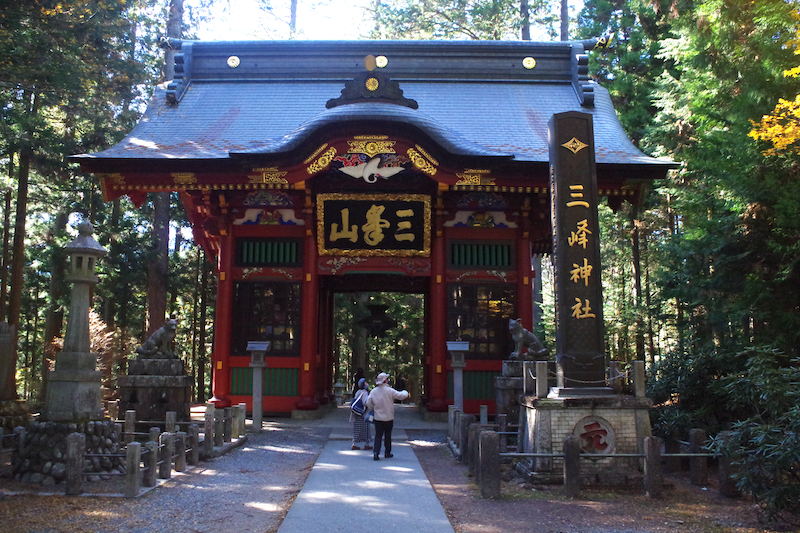 The Gate To The Main Shrine Is More Ornate And Wolves Guarding It As Well
A staircase leads up to the main shrine, where visitors can flip a coin into a box and pray. The method involves bowing twice, clapping your hand twice, and bowing once again to the enshrined gods.
 People Waiting To Pray At The Shrine
The beautiful ornate roof of the building is striking and immediately catches the eye of any visitor.
Near the shrine, it is possible for visitors to purchase protective charms called O-mamori.
 A Statue Of A Guardian Wolf At Mitsumine Shrine
The guardian wolf associated with the Mitsumine Shrine is said to have protective powers against various perils such as fire or theft and thus the charms sold by the shrine are meant to protect against such dangers.
Equally beautiful, although smaller, are some other shrines in the vicinity of the main building.
 There Are Some Smaller Shrines In The Complex As Well
Another staircase from the intersection leads to a picturesque viewing spot from where the beautiful fall scenery is visible.
 Fall Colors Visible In The Mountains From The Viewing Platform
The serene viewing platform faces the main complex of the shrine called Okunomiya, which is placed on yet another mountain.
A Feast In Saitama: At the entrance to the passageway are many shops and restaurants that sell souvenirs, snacks and serve delicious food.
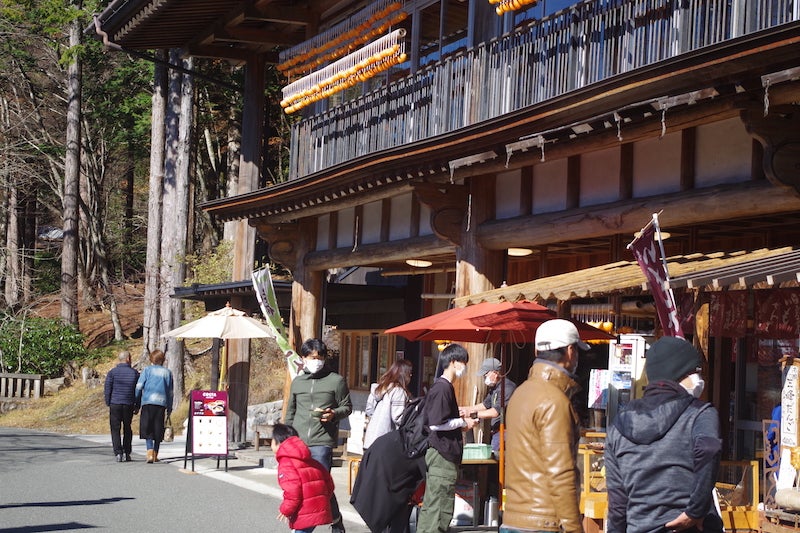 Shops And Restaurants At Mitsumine Shrine With Persimmons Hung To Air Dry
When I visited, persimmons were hanging to dry at one of the restaurants, which also served dumplings called dango, miso oden, which is a dish made of konjac and fermented soybean paste, roasted yamame — a trout-like fish.
 Mitsumine Shrine Restaurants, Shops Sell A Variety Of Dishes
Also on the menu was miso potato, which are potatoes grilled on skewers slathered with rich flavorful soybean paste.
I also ate katsudon, a dish of rice served with pork cutlets called waraji tonkatsu, which were delicious and a specialty of the region.
The only downer is that none of the restaurants or shops seem to accept SAITAMA, but with its growing popularity who is to say that won’t change in the future.
Read Next: Did CoinMarketCap FBI Warning Cause Saitama Inu Coin Price To Crash?