Whale distribution caps Cardano’s recovery prospects FXStreet
Source link ]]>
The previous Bitcoin market top may not have been marked by a dramatic crash or obvious sell signal, but by a highly coordinated, sophisticated wave of whale distribution. While most participants were driven by optimism and bullish conviction, large holders were quietly offloading positions in a way that blended seamlessly into normal market activity.
How Whale Distributed Bitcoin Without Triggering Warning Signals
The Bitcoin market top last year was less obvious than in past cycles, unfolding through a quiet, highly coordinated wave of whale distribution. ForeDex on X revealed that at a time when BTC participants were filled with optimism and conviction, a whale moved roughly 30,000 BTC to exchanges over 10 days via Galaxy Digital. Meanwhile, most market participants failed to recognize the significance of these flows.
Related Reading
ForeDex explained that BTC was split into smaller amounts and distributed across multiple exchanges, unlike previous cycles. In earlier market tops, large flows often ranging from several thousand to 10,000 BTC were sent directly to platforms such as Coinbase, Binance, or Gemini in a single transaction, making these movements relatively easy to detect.
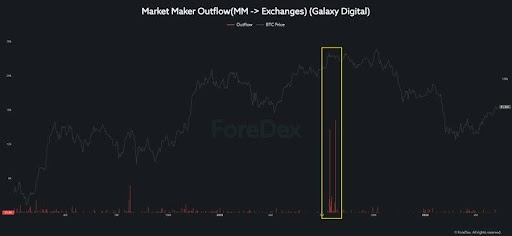
However, after the ETF approval, market structure and trading behavior became more sophisticated. As selling pressure was distributed across different exchanges, the historical exchange-specific sell premium became less reliable. Even the well-known Coinbase-Binance Gap data no longer shows these traces as clearly as it used to.
Ultimately, BTC market dynamics are evolving, and new patterns are constantly emerging. Even if some participants had identified unusual flows, the strong optimism and conviction at the peak would likely have led many to dismiss them.
Bitcoin Could Face Another Liquidity Sweep To The Downside
Bitcoin is showing signs of weakening market structure, with price forming lower highs following the rejection at $82,000. Crypto analyst Kaz has noted that one of the biggest warning signs is the sharp rise in Open Interest (OI) that is aggressively occurring, and both perpetual and spot Cumulative Volume Delta (CVD) are trending downward, indicating bullish traders are already starting to get squeezed out of the market.
Related Reading
At the same time, bears appear to be actively building short positions, a continuous liquidation that is adding fuel to the decline. Kaz argues that additional long positions could be flushed out, as perpetual and spot CVDs are currently declining, and there is still long liquidation at the downside.
Currently, BTC is retesting the $80,000 level with the highest OI bearish positioning seen at this level so far. In the bullish case, if price holds above the $80,000 zone and CVD starts rising, the market could trigger a short squeeze back toward the $82,000 resistance.
In the bearish scenario, a loss of the $80,000 level, combined with current weak internals, could lead to a liquidity sweep of the lows, with price potentially moving toward testing the point of weak order (pwO).
Featured image from Pixabay, chart from Tradingview.com
My name is Godspower Owie, and I was born and brought up in Edo State, Nigeria. I grew up with my three siblings who have always been my idols and mentors, helping me to grow and understand the way of life.
My parents are literally the backbone of my story. They’ve always supported me in good and bad times and never for once left my side whenever I feel lost in this world. Honestly, having such amazing parents makes you feel safe and secure, and I won’t trade them for anything else in this world.
I was exposed to the cryptocurrency world 3 years ago and got so interested in knowing so much about it. It all started when a friend of mine invested in a crypto asset, which he yielded massive gains from his investments.
When I confronted him about cryptocurrency he explained his journey so far in the field. It was impressive getting to know about his consistency and dedication in the space despite the risks involved, and these are the major reasons why I got so interested in cryptocurrency.
Trust me, I’ve had my share of experience with the ups and downs in the market but I never for once lost the passion to grow in the field. This is because I believe growth leads to excellence and that’s my goal in the field. And today, I am an employee of Bitcoinnist and NewsBTC news outlets.
My Bosses and co-workers are the best kinds of people I have ever worked with, in and outside the crypto landscape. I intend to give my all working alongside my amazing colleagues for the growth of these companies.
Sometimes I like to picture myself as an explorer, this is because I like visiting new places, I like learning new things (useful things to be precise), I like meeting new people – people who make an impact in my life no matter how little it is.
One of the things I love and enjoy doing the most is football. It will remain my favorite outdoor activity, probably because I’m so good at it. I am also very good at singing, dancing, acting, fashion and others.
I cherish my time, work, family, and loved ones. I mean, those are probably the most important things in anyone’s life. I don’t chase illusions, I chase dreams.
I know there is still a lot about myself that I need to figure out as I strive to become successful in life. I’m certain I will get there because I know I am not a quitter, and I will give my all till the very end to see myself at the top.
I aspire to be a boss someday, having people work under me just as I’ve worked under great people. This is one of my biggest dreams professionally, and one I do not take lightly. Everyone knows the road ahead is not as easy as it looks, but with God Almighty, my family, and shared passion friends, there is no stopping me.
Crypto pundit X Finance Bull has highlighted XRP’s mass adoption and its use across several continents. Given the altcoin’s global utility, the analyst noted that the token won’t remain undervalued forever, hinting it could still reach higher prices.
Pundit Points To XRP’s Global Adoption Among Different Countries
In an X post, X Finance Bull said that the estimated global distribution of XRP holders paints a picture most people miss. He revealed that Asia-Pacific leads with roughly 35% to 40% of holders and holds an average of 4,200 XRP. The primary uses of the altcoin among these Asia-Pacific holders are remittances and trading. The pundit noted that this is real people moving money across borders using XRP, highlighting the token’s utility.
Related Reading
Furthermore, North America accounts for 25% to 30% of XRP holders globally, with smaller average holdings of around 1,850 XRP. The use case for the token among these holders is shifting towards institutional positioning, the pundit stated. Notably, demand for the altcoin has increased since the XRP ETFs launched last year. Wall Street giant Goldman Sachs is currently the largest XRP holder among these institutional investors.
X Finance Bull also revealed that Europe accounts for 20% to 25% of holders, with an average of 2,100 XRP. These holders are said to be holding the token for portfolio diversification. Latin America is behind, accounting for between 8% to 12% of holders. As in the Asia-Pacific region, the primary use case in Latin America is cross-border payments.
In line with this, the pundit said that the altcoin isn’t limited to a single country and is a global asset, solving different problems for different people depending on where they live. He added that this kind of global utility doesn’t stay undervalued forever.
Bull Case For The Altcoin
In another X post, X Finance Bull made a bullish case for XRP, noting that 12 of the 30 banks SWIFT is collaborating with on a blockchain-based shared ledger for real-time, 24/7 cross-border payments are confirmed Ripple partners. He described this development as the moment he had been watching for.
Related Reading
The pundit remarked that these 12 banks are linked to Ripple through payment networks, custody, steering groups, or banking consortia. He noted that the regulatory framework and the infrastructure are arriving at the same time and that the banks designing SWIFT’s blockchain future are the same ones that have partnered with Ripple. X Finance Bull added that the architecture of the future is being built by institutions that already know the XRP Ledger inside and out.
At the time of writing, the XRP price is trading at around $1.32, down over 2% in the last 24 hours, according to data from CoinMarketCap.
Featured image from Adobe Stock, chart from Tradingview.com
Bitcoin’s latest stretch of sideways price action around $70,000 is being read by some traders as a sign that the cryptocurrency is finally settling down. However, technical analysis shows that the structure now forming on the daily chart might not actually be a recovery base at all but a distribution pattern before a new low that has already appeared once before during a bigger decline since late 2025.
Bitcoin’s Distribution Mechanism Is Still The Same
According to a crypto analyst that goes by the name Ardi on the social media platform X, Bitcoin’s distribution phases keep looking identical because the mechanism never really changes. This is in relation to Bitcoin’s current price action, which has been trading in a range between $63,000 and $72,000 since early February.
Related Reading
The idea behind this technical analysis is that Bitcoin’s behavior in bearish phases tends to follow a recognizable sequence. Price moves into a range, traders begin to treat the consolidation as stability, liquidity builds above local highs, and then a brief breakout above the range pulls in optimism from many crypto traders.
However, that optimism does not always last. Once the price fails to hold above the range highs, the structure starts to weaken, and the next breakdown to the range support takes place.
The chart attached to the analysis presents two nearly identical subsections. The first distribution range played out between roughly the mid-$80,000 region and the low-$90,000s between November 2025 and January 2026.
This move eventually concluded with Bitcoin pushing higher, touching highs around $96,000, failing to accept above the range, and then breaking down towards the lower end of the range. That decline led into a break below the low support level that eventually dragged the price to as low as $63,000 in early February.
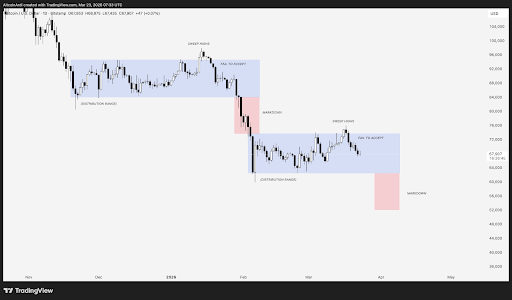
Bitcoin Price Chart. Source: @ArdiNSC On X
Why A Move Below $50,000 Is Now On The Table
A sweep of local highs above $76,000 in early March generated headlines about how the Bitcoin price is now recovering. However, the price ultimately failed to hold above the range and began rolling over again. As it stands, price action in the past few days has mostly been bearish candlesticks, which have caused the Bitcoin price to be pushing to the lower end of the current range again.
Related Reading
The most bearish part of the chart is the projected zone that follows the current range. Projecting the previous markdown in late January to the current price action would see the Bitcoin price break below the local $63,000 bottom.
Particularly, the chart projected a similar outcome, with the highlighted markdown box extending down to $50,000 and as low as $48,000. This projection follows similar outlooks from multiple analysts that have predicted Bitcoin might break below $50,000 before creating a new bottom.
Featured image from Dall.E, chart from TradingView.com
Shiba Inu (SHIB) 110B Exchange Inflow Signals Distribution, Yet Smart Money Suggests Taurox (TAUX) for 100x openPR.com
Source link ]]>
Major Shiba Inu Distribution Warning as Price Targets Sharp Flush to Major Support Cryptonews.net
Source link ]]>
Ethereum has taken a sharp turn after facing a firm rejection at the $3,220 level, with price breaking structure and slipping into a weaker posture. The speed of the drop and lack of strong buying interest raise an important question for traders: Is this merely an early warning sign within a broader uptrend, or the start of a deeper distribution phase that could pressure ETH further in the near term?
Rejection At $3,220 Signals Distribution, Not A Shakeout
Crypto analyst PEPE is Friend highlighted that Ethereum’s sharp rejection at the $3,220 level was deliberate rather than random. The drop was clean, with key structure breaking down, selling pressure accelerating, and price quickly flushing toward the $3,106 area, aligning with a classic distribution behavior rather than a simple shakeout.
Related Reading
Assessing the current price reaction, there are still no signs of a true reversal. The bounce has been notably weak, trading volume remains thin, and buyers have yet to show a strong commitment. Instead of signaling renewed bullish momentum, the move higher appears to be a technical pullback within a broader weakening structure.
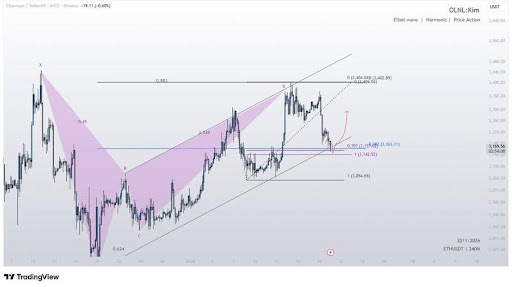
The key technical zone remains well-defined. ETH is trading below the former support band between $3,170 and $3,200. As long as the price stays below this range, any upside move is likely to be viewed as a selling opportunity rather than the start of a sustained recovery.
When this price action is viewed alongside Ethereum spot ETF data, the picture becomes clearer. While ETF flows remain positive daily, they lack strong momentum or a standout confirmation day. Capital appears to be absorbed rather than aggressively deployed, suggesting institutional demand is not yet strong enough to drive a decisive breakout. Until that changes, sellers are expected to remain in control below the $3,170–$3,200 resistance zone.
Ethereum Slips Below $3,062 As Bears Regain Short-Term Control
In an X post, Kamile Uray noted that Ethereum has closed below the $3,062 level, shifting attention toward the next major downside zone at $2,623. This level is now critical, as holding above it could allow ETH to stabilize and attempt another recovery move.
Related Reading
On the upside, a clean break above the pink-box resistance near $3,445 would activate bullish formations such as a cup-and-handle or an ascending triangle, opening the door for a move toward the $3,894 area.
Further strength would be confirmed if ETH manages to close above the $3,661 high, which would mark the first higher high on the daily chart relative to the previous downtrend, improving the bullish outlook. Still, $3,894 remains a key level, as it aligns with the 0.618 Fibonacci retracement of the last decline.
On the downside, a clear break below the $2,623 low would expose ETH to deeper losses, with the $2,274–$2,104 zone emerging as the next major support area. This region hosts a potential bullish “Libra” reversal setup, and Ethereum could once again attempt a bounce toward its previous all-time high if reversal confirmation appears there.
Featured image from iStock, chart from Tradingview.com
Dogecoin price shows distribution as rally stalls at $0.15 crypto.news
Source link ]]>
Dogecoin Cash, Inc. Becomes Among the First U.S. Public Companies to Complete a FINRA‑Notified Blockchain‑Linked Security Distribution The Manila Times
Source link ]]>