As Bitcoin (BTC) attempts to hold the $74,000-$75,000 area, an analyst suggested that the flagship crypto could see another 10% rally toward a key area, but warned that this level could be the ceiling.
Related Reading
Bitcoin Double Bottom Breakout Targets Key Level
In a Wednesday analysis, crypto analyst Rekt Capital shared an outlook for Bitcoin’s potential rally, as it holds the $73,000-$74,000 area as support for the first time in a month.
The analyst highlighted that BTC’s price continues to move between its 2021 and 2024 all-time highs (ATHs), which have been a major resistance area since the early February correction.
After the recent market rally, the flagship crypto retested the 2021 ATH as a new support level on the weekly timeframe, but ultimately rejected from the 2024 ATH during last week’s close.
According to the analyst, if Bitcoin can weekly close above the 2024 ATH, located around $74,000, then the price could move into the high $70,000. “Until that confirmation, however, price will continue to be sandwiched between 2021 and 2024 old All Time Highs,” he added.
Rekt Capital also noted that BTC has formed a double bottom pattern in the weekly timeframe, and is “now pressing beyond the resistance” of the formation. As he explained, the cryptocurrency would need a weekly close and a post-breakout retest of the top of the double bottom, around $72,810, to confirm a breakout.
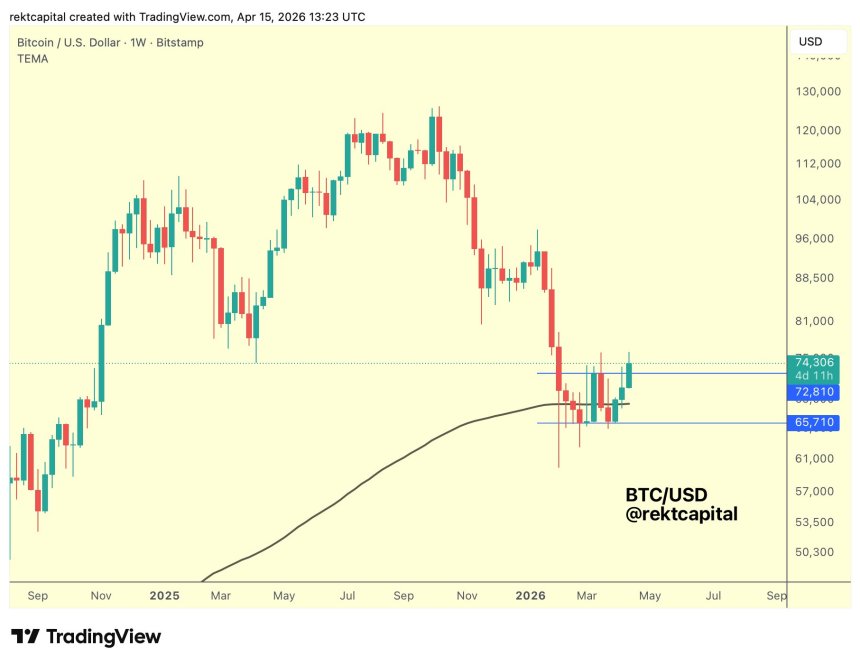
If it confirms a breakout from this formation, the price could rally toward the $81,000-$82,500 area in a Measured Move. Nonetheless, the analyst warned that, given the phase of the market cycle we are currently in, the price will likely develop a macro market structure that “will appear sufficiently bullish only to ultimately fail over time.”
“The failure could occur by virtue of rejecting from the Double Bottom resistance, by failed post-breakout retest to register a fake-breakout, or by falling short of a Measured Move once the breakout is confirmed.”
BTC Resembles 2014 Breakdown
Rekt Capital also analyzed BTC’s historical behavior to assess the ongoing rally’s potential failure. The analyst noted that whenever Bitcoin has broken down from its macro triangle formation, the price usually retraces until it forms a bear market bottom. However, the way the cryptocurrency does that has differed from cycle to cycle, he detailed.
In 2018 and 2022, the breakdown led to a very quick bearish acceleration toward the bear market bottom accumulation period. On the contrary, Bitcoin consolidated below the triangle base in 2014, retested it, and saw another leg down.
This time, BTC’s performance resembles its 2014 breakdown, as it has been consolidating behind the triangle base after losing it in January. To the analyst, if the cryptocurrency continues to mirror its 2014 performance, the price could consolidate a bit longer, potentially rally to the base at $82,500, before rejecting.
“Furthermore, Bitcoin tends to build major consolidation periods on breakdowns from Macro Triangles. In 2018 and 2022, these major consolidation periods developed at Bear Market bottoms,” Rekt Capital explained.
Related Reading
“Whereas in 2014, Bitcoin built two such periods: just beneath the Macro Triangle it broke down from, and then later at its respective Bear Market Bottom,” he continued.
The analyst concluded that if history repeats, BTC’s current consolidation could precede additional downside, and another major consolidation period could develop during the bear market bottom.
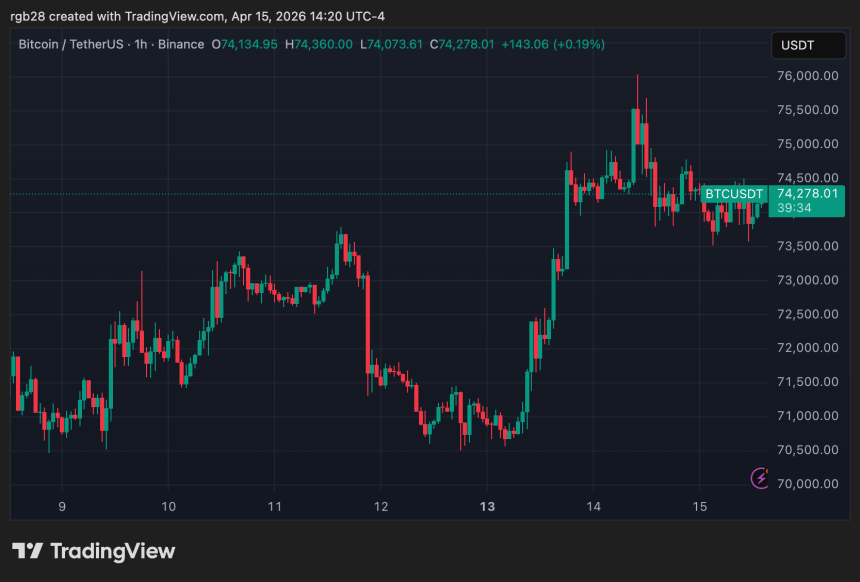
Featured Image from Unsplash.com, Chart from TradingView.com
Shiba Inu Price Prediction: SHIB at $0.00000588 as Double Death openPR.com
Source link ]]>
Shiba Inu Price Prediction: SHIB Double Death Cross Signals openPR.com
Source link ]]>
Shiba Inu Double Death Cross Completed Amid 5% Jump: Could This Be Bear Trap? Cryptonews.net
Source link ]]>
Shiba Inu Price Prediction: SHIB Burn Rate Explodes 191% As Double Bottom Targets $0.00000650 Cryptonews.net
Source link ]]>
Ethereum is flashing early warning signs as momentum begins to shift beneath the surface. The RSI trendline break on the USDT pair suggests weakening strength, while the ETH/BTC pair now sits on the edge of following suit. With a familiar breakdown pattern taking shape, the risk of a double confirmation is rising, one that could open the door to a sharper move lower.
RSI Breakdown Signals Early Weakness On Ethereum/USDT
According to a recent Ethereum analysis from Umair Crypto, the USDT pair has already seen its RSI trendline break, signaling an initial shift in momentum. The ETH/BTC pair is expected to follow suit shortly, making a new lower low a matter of when, not if.
This pattern mirrors a sequence recently observed with Solana. In that instance, the USDT pair’s RSI trendline fractured first while the BTC pair initially appeared to maintain its strength. Ethereum is now replicating this exact behavior, setting the stage for a similar recursive breakdown.
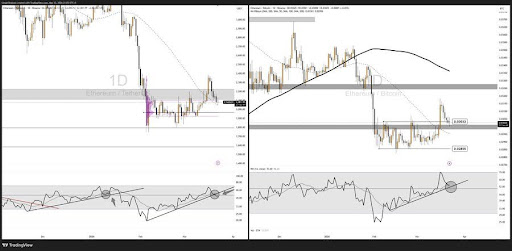
While the ETH/BTC pair is currently holding its levels, the analysis suggests this resilience is temporary. However, once the BTC pair loses its footing, the lack of support across both denominations will likely trigger a sharp move to the downside. This alignment represents the most volatile and high-risk version of a market breakdown for Ethereum.
Resilience Under Pressure, But At What Cost?
The analyst went on to emphasize that both Bitcoin and Ethereum have shown notable strength throughout the intensity of the broader macro battle. That resilience is undeniable, but it hasn’t come without a cost. Rather than forming a solid base, the market has effectively been running on borrowed time, and the fatigue now visible on the charts suggests that the cost of that strength is beginning to surface. From this point, a move toward a lower low should not come as a surprise.
A major catalyst is adding to the current tension. Over $2.1 billion in BTC and ETH options is set to expire today, alongside Wall Street’s massive $5.7 trillion Triple Witching event. While such large expiries don’t directly trigger market direction, they tend to magnify existing momentum. In this case, the underlying structure already points to the downside, meaning any move could be accelerated under these conditions.
The breakdown sequence is also becoming increasingly clear. The USDT pair was the first to show weakness, losing its key structure and signaling the initial shift in momentum.
Now, attention turns to confirmation from the ETH/BTC pair. When this alignment occurs, it typically leads to a more decisive and aggressive move lower as bearish pressure takes full control.
]]>Shiba Inu Targets Rebound Amid Double Bottom Formation Cryptonews.net
Source link ]]>
Bitcoin has returned to an extreme technical zone that has historically marked major cycle bottoms for the BTC price. According to crypto analyst @DurdenBTC, the Harmonic Oscillator has now printed its lowest possible reading, a level that previously preceded outsized one-year gains. The signal raises a direct question: Does history imply that Bitcoin is positioned to double from here?
Bitcoin Harmonic Oscillator Signals BTC Price Could More Than Double
A chart shared by the analyst highlights a striking signal for Bitcoin, showing the Harmonic Oscillator at -100, the lowest point on its long-term decaying price range, which spans from -100 to +100. This “Capitulation” zone marks periods when BTC trades far below its harmonic center and historical equilibrium, signaling extreme market pessimism.
Related Reading
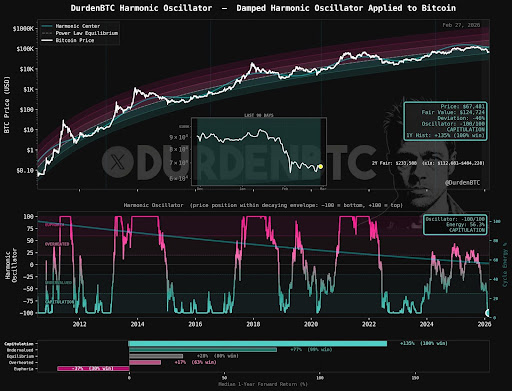
Historically, every time the oscillator has hit this level—late 2011, early 2015, late 2018, March 2020, and late 2022—Bitcoin reached major cycle lows before entering strong upward trends. The chart quantifies this pattern, showing a median one-year return of +135% from the capitulation zone, with a 100% success rate across all recorded signals.
For traders, this suggests that the BTC price could more than double over the next year if history repeats itself. The chart also contrasts other zones in the oscillator, illustrating the model’s cyclical reliability: the “Undervalued” zone historically produced +77% median returns, “Equilibrium” and “Overheated” zones delivered smaller gains, and the “Euphoria” band at the top often led to negative returns.
In essence, the chart emphasizes that Bitcoin’s current capitulation reading may mark a rare opportunity for a major rally. By connecting extreme market lows with historically consistent gains, the oscillator provides traders a clear framework for anticipating BTC’s next potential cycle.
Bearish Trend Model Meets A Generational Buy Signal
Although the oscillator has a strong historical record, @DurdenBTC notes that his broader trend system currently leans bearish. This creates a tension between momentum-based trend signals and the oscillator, which indicates extreme undervaluation. The oscillator works on a damped harmonic model, where price moves around a rising long-term center line while volatility gradually compresses.
Related Reading
The chart shows Bitcoin trading below its harmonic center and fair value, with a negative deviation reinforcing the capitulation signal. A 90-day inset highlights a sharp drop to this lower boundary. Meanwhile, the two-year fair value estimate remains well above the current price, showing a significant gap between current levels and the modeled equilibrium.
The oscillator also shows that cycle energy has reset to lower levels, similar to previous macro bottoms. Historically, these resets marked the shift from decline into accumulation phases.
This does not mean price will immediately reverse, but statistically, readings like this have marked generational buying opportunities. While the analyst maintains a cautious stance aligned with the bearish trend, the -100 oscillator reading represents one of the most asymmetric setups in Bitcoin’s cycle history.
Featured image created with Dall.E, chart from Tradingview.com
Dogecoin (DOGE) Price: Can DOGE Really Double From Here? The Chart Says It’s Possible CoinCentral
Source link ]]>
Dogecoin Price Eyes Fresh Breakout as Double Bottom and 36% Rally Pattern Reappear CryptoRank
Source link ]]>