
Ethereum is facing renewed volatility and uncertainty after several weeks of consolidation, with price action reflecting a market struggling to establish a clear direction. While ETH has remained relatively range-bound in recent sessions, underlying dynamics suggest that the current phase may be masking a deeper structural transition.
According to a CryptoQuant report, the Ethereum market may appear stagnant on the surface, but on-chain data points to a tightening supply environment combined with recovering demand. One of the most notable developments is the continued decline in exchange reserves, which have dropped to approximately 16.2 million ETH, the lowest level recorded since 2016. This trend indicates that fewer coins are readily available for sale on centralized platforms.
At the same time, a significant portion of supply is being removed from circulation through staking. Roughly 37 million ETH is now locked, further reducing the liquid supply in the market. This dual dynamic—declining exchange balances and rising staked supply—effectively compresses available liquidity.
In this context, even moderate increases in demand can have a disproportionate impact on price. While short-term volatility persists, the combination of shrinking supply and stabilizing demand suggests that Ethereum’s current consolidation phase could precede a more meaningful directional move.
Demand Recovery and Structural Reset Support Ethereum Thesis
The report further explains that Ethereum’s recovery is increasingly supported by genuine network activity rather than speculative flows. Active addresses have surged in recent weeks, with notable spikes signaling a meaningful increase in usage across the network. This trend reflects real demand, particularly as lower gas fees following EIP-4844 have accelerated Layer 2 adoption and boosted transaction throughput. Unlike previous cycles, where price appreciation drove activity, current conditions suggest that fundamentals are leading the recovery.

In derivatives markets, a similar normalization is taking place. Open interest (OI), which previously expanded to elevated levels, was flushed out during the correction and is now gradually rebuilding. This reset indicates that excessive leverage has been cleared. Importantly, the current increase in OI remains moderate and is not accompanied by extreme funding rates, pointing to healthier positioning and the return of fresh capital.
Institutional developments further reinforce this shift. The introduction of staking-based ETH ETFs, combined with improving regulatory clarity in the US, has lowered barriers to entry for larger investors.
Taken together, Ethereum’s structure is evolving. With tightening supply, rising organic demand, and normalized leverage, the market appears to be transitioning toward a more sustainable phase, potentially marking the early stages of a broader uptrend.
Ethereum Holds Key Weekly Support as Macro Structure Remains Uncertain
On the weekly timeframe, Ethereum is trading around the $2,100–$2,200 zone, a level that is emerging as a critical support area following the recent sharp rejection from the $3,500–$4,000 range. The chart shows that Ethereum has transitioned from a bullish expansion phase into a corrective structure, with lower highs forming since late 2025.
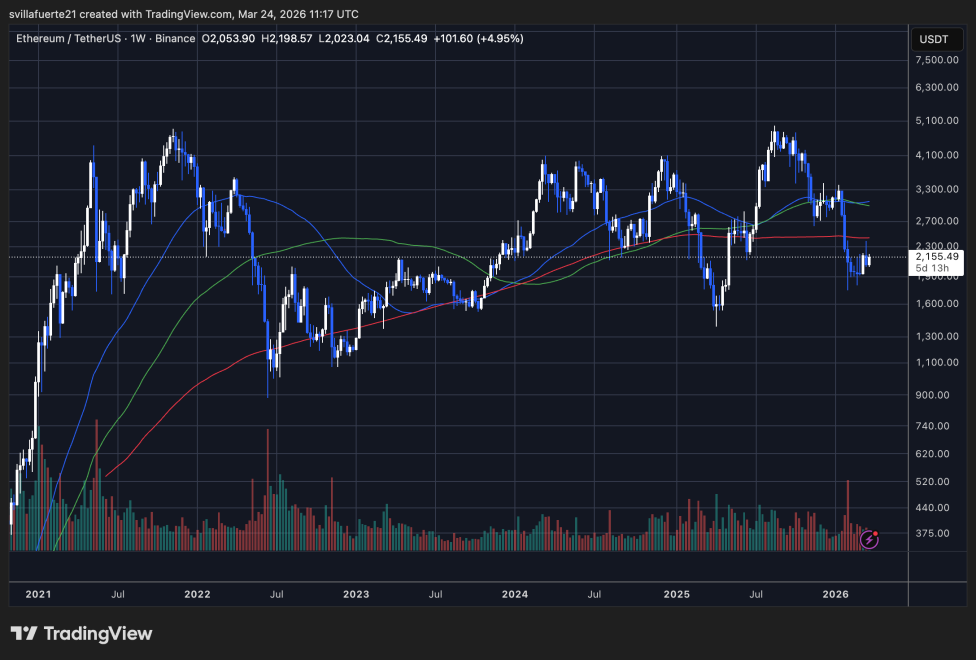
From a trend perspective, Ethereum is now testing the 200-week moving average, a historically significant level that often defines long-term market direction. Price is currently hovering just above this region, suggesting that buyers are attempting to defend it. A sustained hold above this level would indicate structural resilience, while a breakdown could expose deeper downside toward the $1,800 region.
The 50-week and 100-week moving averages are beginning to flatten and converge near current price levels, reflecting a loss of momentum and increasing compression. This typically precedes a larger directional move, though the direction remains unclear.
Volume analysis shows elevated activity during the recent selloff, pointing to distribution or forced selling. However, the subsequent stabilization suggests that demand is absorbing supply at current levels.
Featured image from ChatGPT, chart from TradingView.com
Editorial Process for bitcoinist is centered on delivering thoroughly researched, accurate, and unbiased content. We uphold strict sourcing standards, and each page undergoes diligent review by our team of top technology experts and seasoned editors. This process ensures the integrity, relevance, and value of our content for our readers.
Cardano’s Core Network Faces Liquidity Drain Amid Midnight Token Frenzy AD HOC NEWS
Source link ]]>
Shiba Inu Coin rebound looms as whales suddenly buy amid reserves drain crypto.news
Source link ]]>
Scammers Posing as Shiba Inu Drain Wallets in LEASH V2 Phishing Frenzy AInvest
Source link ]]>
Why Meme Coins Like Dogecoin and Shiba Inu Could Fade Into Abyss After Solana Scams Drain Liquidity CryptoDaily
Source link ]]>
Shiba Inu Makes Crucial Alert Against Threat That Can Drain Wallets The Crypto Basic
Source link ]]>
Bitcoin (BTC) price had recently lost momentum and extended below the $62,000 mark. However, the BTC price rebounded significantly and even neared $63,000 today. Amid the recent dip, Bitcoin whales have scooped up over 15,400 BTC from Coinbase alone that too within the last 24 hours. This accumulation could have spurred the latest recovery.
Whales Grab 15K BTC From Coinbase Pro
The total amount of BTC pulled out from crypto exchanges equals 13,782.83. Moreover, Coinbase Pro accounts for a massive contributor to this decline in the Bitcoin exchange reserve. According to Coinglass stats, Coinbase Pro witnessed a drain of 15,415.25 BTC, equivalent to $966.84 million, considering prevailing rates.
Earlier, Coinbase Pro recorded a lesser withdrawal of its Bitcoin reserve. In the past 30 days, the exchange witnessed an exit of 16146.36 BTC, out of which a whopping 15K was retracted in a single day. Hence, it’s safe to say that majority of Bitcoin whales accumulated cheaper BTC lately.
In addition, the OKX crypto exchange registered a withdrawal of 329 BTC in the 24-hour frame. Whilst, Gemini, another popular CEX, accounted for an accumulation of 108.18 BTC. Furthermore, Bitstamp and Korbit also boasted a significant share in the Bitcoin reserve pulled out from exchanges.
In a recent post on X, Whale Alert spotlighted that a whale ramped up 7,900 BTC, valued at a staggering $494.13 million, from Coinbase. This transaction alone accounts for over 50% of the total BTC withdrawn from Coinbase in the last 24 hours.

Earlier, on Tuesday, May 14, the Bitcoin Coinbase Premium Gap was in the ‘red’ owing to the massive selling pressure. However, the renewed accumulations by whales have turned the tables with the gap lowering to the neutral level.
Furthermore, JA Maartuunn, a certified author on CryptoQuant, referred to this metric and hinted at a potential upside. He took to X and wrote, “Yesterday’s intense selling pressure from Coinbase appears to have abated. This could potentially create some short-term upside opportunity.”
Also Read: Canada Banking Giants Pour Millions Into Bitcoin ETF Amid Inflow Resurgence
Bitcoin Price Rebounds
The Bitcoin price plummeted significantly amid the recent bearish downturn, however, the digital currency also boasted a robust comeback. As of writing, the BTC value was up by 1.32%, trading at $62,720.08. Moreover, its 24-hour trade volume rose by 3.39%, reaching $26.22 billion. Furthermore, the oldest crypto boasted a gigantic market capitalization of $1.22 trillion.
In contrast, there’s been a slight decline in derivatives traders’ interest in Bitcoin futures. The BTC open interest dropped by 0.61% to $29.73 billion. Notably, shorts have been leading the liquidations as traders try to mitigate losses amid the BTC recovery.
In just 4 hours, Bitcoin short liquidations have totaled $4.23 million, as reported by Coinglass. These short traders are expected to buy back their positions, accelerating the purchase pressure. This could lead to a further rally in the Bitcoin price.
Analyzing Bitcoin’s Relative Strength Index (RSI), it currently sits at 48. It indicates a balanced market sentiments without leaning towards overbought or oversold territory, which could be a good entry point. However, according to Trading View analytics, BTC is currently trading substantially higher than its 10-day and 100-day EMAs of 62,071 and 60,443, respectively. This suggests a short and long term bullish sentiment for the crypto.
Also Read: Binance Ceases Support For These BTC & TUSD Pairs, What’s Happening?

The presented content may include the personal opinion of the author and is subject to market condition. Do your market research before investing in cryptocurrencies. The author or the publication does not hold any responsibility for your personal financial loss.
Hackers Drain Over 346 Billion Shiba Inu Tokens in Heco Bridge … The Crypto Basic
Source link ]]>

Key Takeaways
- Nearly $24 billion of stablecoins have left exchanges since FTX collapsed last November
- The total marketcap of stablecoins has dipped $16 billion in that time
- Liquidity continues to fall in the crypto space, with capital moving elsewhere despite rising prices
- Strict regulatory climate in the US, high yields in trad-fi and uncertainty may be contributing to the pattern
Crypto prices have risen since the start of the year, but capital continues to flow out of the space. Last week brought the news that two prominent market makers, Jane Street and Jump Crypto, were scaling back operations in the US amid the continued regulatory crackdown on the sector.
For markets that have already been suffering from thin liquidity since the Alameda insolvency last year, the news amounts to the latest blow. While rising prices may have brushed the problem under the carpet for the time being, Bitcoin markets getting drained of capital is undoubtedly a hurdle that needs to be overcome for an asset that has ambitions of establishing itself in the mainstream.
Indeed, with liquidity so low, prices have been able to move up more rapidly, with less capital needed to shift the shallow order books on exchanges. In the short-term, this has been a boon. As inflation has come down and forecasts around the future path of interest rates have softened in the last six months, crypto has thus surged upward with less resistance in its way, Bitcoin expanding over 60% this year.
In the long-term, however, this is not a bullish development. Thin liquidity means amplified moves downward as well as upward. And looking at the regulatory climate, things only seem to be getting worse for crypto firms based in the US, which happens to be the centre of the financial world.
The SEC is on a warpath with the entire entire industry, clapping back at accusations that it is the lack of regulatory clarity that is causing so many issues, but rather “mass non-compliance” on the part of crypto firms.
The money is talking. We have discussed the recent announcements of market makers, but a glance at the liquidity on exchanges also reveals the capital flight that is occurring. This week, the total balance of stablecoins on exchanges dipped below $20 billion. At the start of the year, that figure read $37.7 billion. When FTX fell in November, it was $43.5 billion.
We have published research on this exodus before. But the flood shows no sign of drying up, and we are now at a place whereby 55% of the stablecoins on exchanges have departed since FTX and Alameda went poof in November.
This 55% outflow represents a funnelling out of nearly $24 billion, a massive chunk when considering the entire stablecoin market cap is currently only $130 billion. Interestingly, the market cap was $146 billion when FTX went down, meaning the total stablecoin drawdown has “only” been $16 billion.
This suggests stablecoins are being moved elsewhere in the blockchain world, as well as fleeing the crypto space altogether. But with T-bills yielding an easy 5% while the regulatory climate around crypto continues to worsen, it is not a surprise to see investors’ heads turned. When considering the fear around custody of assets after FTX collapsed, and the fact the macro climate remains uncertain, this makes more sense again.
Whatever happened, the main point here is that liquidity in the crypto space continues to be drained. Most order books are as shallow as they have been in over two years, and Bitcoin’s volatility remains high (even with the last couple of weeks feeling relatively serene, Bitcoin has still dropped 12%). As for other cryptos, the effect is even more pronounced. If this liquidity issue doesn’t change, crypto will have a tough time establishing itself as a force on the mainstream stage.

Cardano’s new privacy token Midnight being used by impersonators to drain wallets
Cardano development team member Tim Harrison has revealed a new scam case involving a new project called Midnight.
Using fake Twitter accounts made to look like well-known Cardano influencers, attackers are luring inattentive followers to the fake Midnight project website and offering to exchange ADA for DUST, the new project’s native token. Of course, their wallets are further emptied.
Be aware and please report: this is a scam site being pushed by a bot-supported impersonator of the legit and much loved @cardano_whale – Midnight is still in development and no token is available.
Official website: https://t.co/UOCamFGZrc pic.twitter.com/YARGgnjFXV— Tim Harrison (@timbharrison) December 9, 2022
The Midnight project is currently in development and has not yet been launched; furthermore there is no token yet, says Harrison. The Cardano wallet Eternl account also warned its followers about emerging scams but provided a link to a different site, which indicates a wide variety of fraudulent sites from attackers.
This is not the first such example of fraud that has been circulating on Twitter lately, and more specifically on its crypto branch. Recently, such attempts to hijack other people’s funds have become more frequent and more sophisticated.
Cardano’s Midnight (DUST)
A new privacy-linked project was announced by Cardano founder Charles Hoskinson this past November. The project, called Midnight, is to be powered by zero knowledge (zk) security technology and is one of Cardano’s sidechains.
As part of the launch, an anonymous DUST token, a kind of counterpart to Zcash (ZEC) or Monero (XRM), will be issued. With the latter, as reported by U.Today, a disagreement arose at the end of November, which was later resolved.
✓ Share: