Chasing the Best Cryptos? BullZilla’s Roar Echoes Across the Market as Bitcoin Cash Climbs and Cardano Holds Digital Journal
Source link ]]>
Peter Schiff Echoes Dogecoin Influencer’s Views On Mounting US Debt: ‘Remember, Government Overspending Is The Real Cause Of Inflation’ Benzinga
Source link ]]>
Arthur Hayes, the co-founder of crypto exchange BitMEX, has recently offered a comprehensive analysis in his latest essay, “Zoom Out,” drawing compelling parallels between the economic upheavals of the 1930s-1970s and today’s financial landscape, specifically focusing on the implications for the Bitcoin and crypto bull run. His in-depth examination suggests that historical economic patterns, when properly understood, can provide a blueprint for understanding the potential revival of the Bitcoin and crypto bull run.
Understanding Financial Cycles
Hayes begins his analysis by exploring the major economic cycles starting from the Great Depression, through the mid-20th century economic booms, and into the stagnant 1970s. He categorizes these transformations into what he terms “Local” and “Global” cycles, central to understanding the broader macroeconomic forces at play.
Local Cycles are characterized by intense national focus where economic protectionism and financial repression are prevalent. These cycles often arise from governmental responses to severe economic crises that prioritize national recovery over global cooperation, typically leading to inflationary outcomes due to the devaluation of fiat currencies and increased government spending.
Related Reading
Global Cycles, in contrast, are marked by periods of economic liberalization, where global trade and investment are encouraged, often leading to deflationary pressures due to increased competition and efficiency in global markets.
Hayes carefully examines each cycle’s impact on asset classes, noting that during Local cycles, non-fiat assets like gold have historically performed well due to their nature as hedges against inflation and currency devaluation.
Hayes draws a direct parallel between the creation of Bitcoin in 2009 and the economic environment of the 1930s. Just as the economic crises of the early 20th century led to transformative monetary policies, the financial crash of 2008 and subsequent quantitative easing set the stage for the introduction of Bitcoin.
Why The Bitcoin Bull Run Will Resume
Hayes argues that Bitcoin’s emergence during what he identifies as a renewed Local cycle, characterized by the global recession and significant central bank interventions, mirrors past periods where traditional financial systems were under stress, and alternative assets like gold rose to prominence.
Expanding on the analogy between gold in the 1930s and Bitcoin today, Hayes elucidates how gold served as a safe haven during times of economic uncertainty and rampant inflation. He posits that Bitcoin, with its decentralized and state-independent nature, is well-suited to serve a similar purpose in today’s volatile economic climate.
Related Reading
“Bitcoin operates outside the traditional state systems, and its value proposition becomes particularly evident in times of inflation and financial repression,” Hayes notes. This feature of Bitcoin, he argues, makes it an indispensable asset for those seeking to preserve wealth amidst currency devaluation and fiscal instability.
Hayes points out the significant surge in the US budget deficit, projected to reach $1.915 trillion in fiscal 2024, as a modern indicator that parallels the fiscal expansions of past Local cycles. This deficit, significantly higher than in previous years, marking the highest level outside the COVID-19 era, is attributed to increased government spending akin to historical periods of government-induced economic stimuli.
Hayes uses these fiscal indicators to suggest that just as past Local cycles led to increased valuation for non-state assets, the current fiscal and monetary policies are likely to enhance the appeal and value of Bitcoin.
“Why am I confident that Bitcoin will regain its mojo? Why am I confident that we are in the midst of a new mega-local, nation-state first, inflationary cycle?” Hayes asks rhetorically in his essay. He believes that the same dynamics that drove the value of assets like gold during past economic upheavals are now aligning to bolster the value of Bitcoin.
He concludes, “I believe fiscal and monetary conditions are loose and will continue to be loose, and therefore, hodl’ing crypto is the best way to preserve wealth. I am confident that today will rhyme with the 1930s to 1970s, and that means, given I can still freely move from fiat to crypto, I should do so because debasement through the expansion and centralisation of credit allocation through the banking system is coming.”
At press time, BTC traded at $62,649.
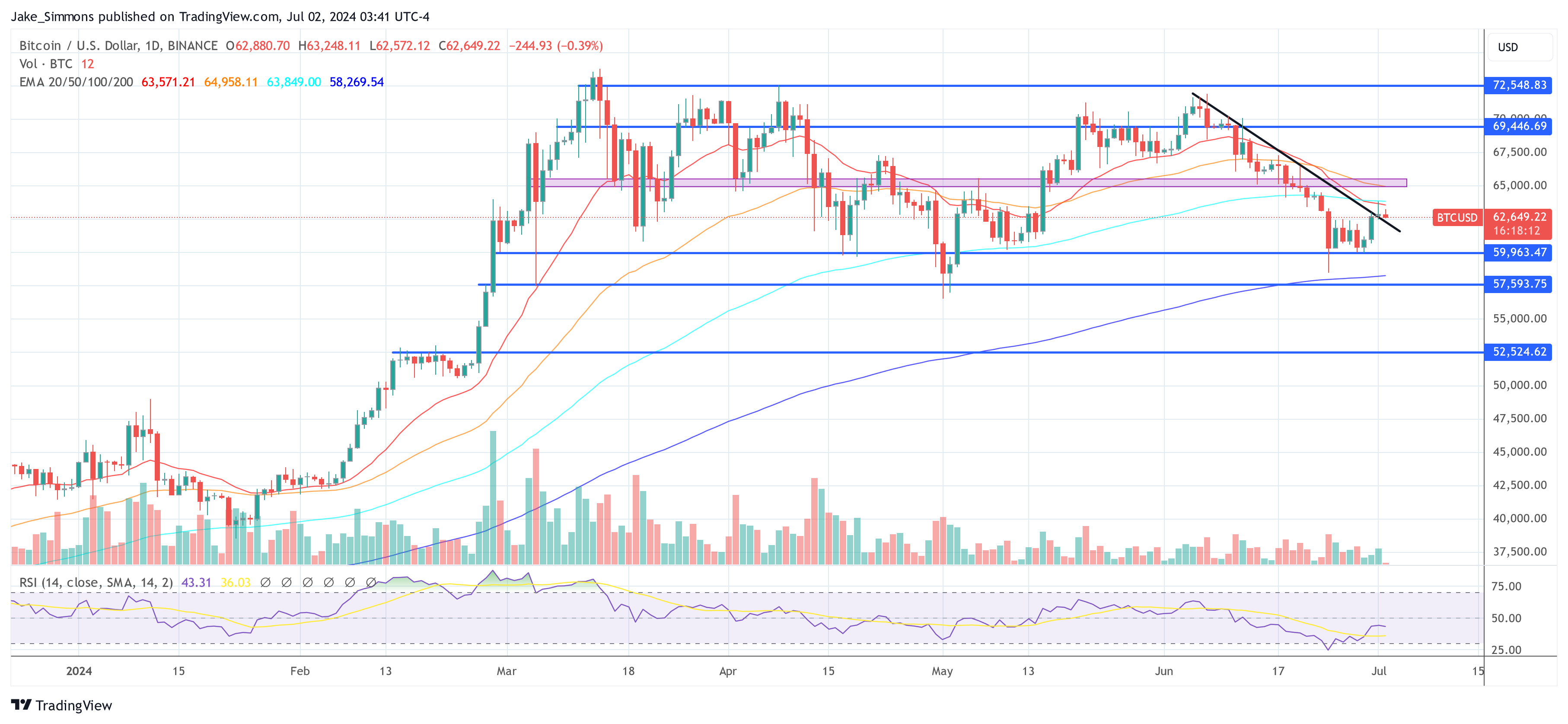
Featured image from YouTube / What Bitcoin Did, chart from TradingView.com
Cardano: $10 Price Echoes As ADA Looks To Embrace Chang Hard Fork Watcher Guru
Source link ]]>
CryptoQuant CEO Ki Young-Ju today pointed out significant similarities in Bitcoin’s market behavior between the current state and mid-2020, a period marked by stagnant prices but high on-chain activity. Young-Ju’s insights were illustrated with two key charts and shared via a post on X, drawing parallels that suggest a robust undercurrent of large volume transactions, potentially outside the public exchange networks.
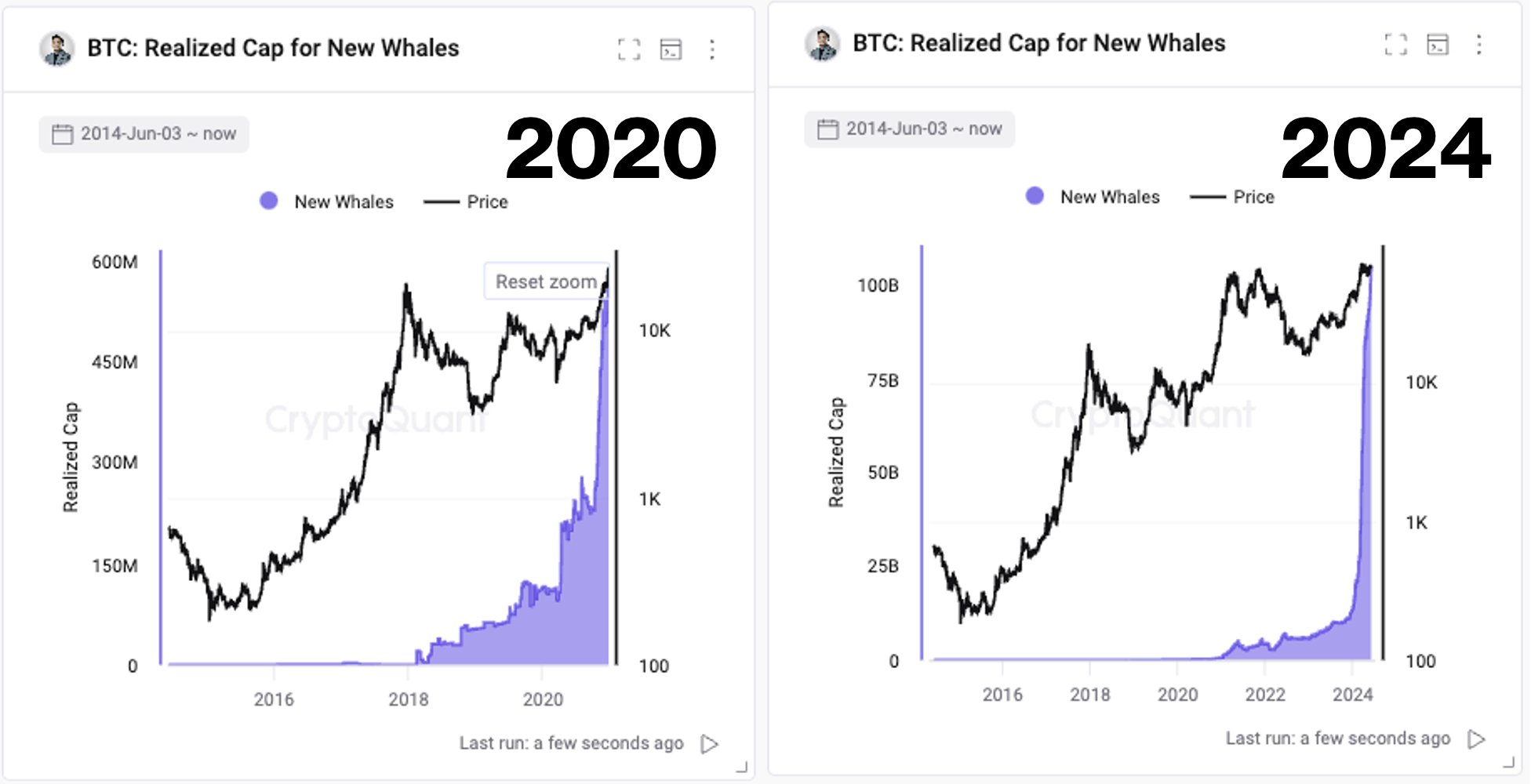
The first chart, representing data up until 2020, shows Bitcoin’s price alongside the realized cap for new whales – a metric that tracks the aggregate value at which the newly acquired Bitcoin by large investors was last moved. It’s a different form of market capitalization that assesses each UTXO at the price it last changed hands, rather than its present market price. This metric reflects the actual realized value of all the coins in the network, rather than their current market value.
Related Reading
This value experienced a sharp increase around mid-2020, precisely when Bitcoin’s price was caught in boredom just like in recent months, consistently trading around the $10,000 mark. According to Young-Ju, this period was characterized by high on-chain activity which later analysis suggested involved over-the-counter (OTC) transactions among institutional players.
In the second chart, extending to 2024, a similar pattern emerges with even more pronounced growth in the realized cap for new whales, despite Bitcoin’s price showing a sideways movement for almost 100 days now. The chart indicates a significant addition of about $1 billion daily into new whale wallets, a term typically referring to addresses holding large amounts of Bitcoin, often linked with institutional or highly capitalized individual investors.
What This Means For Bitcoin Price
Ki Young-Ju elaborated on these observations: “Same vibe on Bitcoin as mid-2020. Back then, BTC hovered around $10k for 6 months with high on-chain activity, later revealed as OTC deals. Now, despite low price volatility, on-chain activity remains high, with $1B added daily to new whale wallets, likely custody.”
Related Reading
He further referenced a tweet from September 2020 that corroborated his analysis, noting that the “number of BTC transferred hits the year-high, and those TXs are not from exchanges. Fund Flow Ratio of all exchanges hits the year-low. Something’s happening. Possibly OTC deals.”
This comparison and the sustained high level of the realized cap for new whales suggest an ongoing accumulation phase among large-scale investors, reminiscent of the activity observed in mid-2020. Such movements are generally not visible on traditional crypto exchanges and indicate a strong institutional interest that could be a precursor to significant market moves. Following Young-Ju’s tweet, BTC price rallied by 480% from September 2020 till November 2021.
If a similar move is brewing for Bitcoin price remains to be seen, but the continuous growth in Bitcoin holdings among new whales, along with sustained price levels, points to a potential buildup of pressure beneath the apparent calm of the market surface. As observed in the past, such conditions may lead to substantial price movements once the accumulated Bitcoin begins to impact the broader market through either increased liquidity or renewed trading interest.
At press time, BTC traded at $68,271.
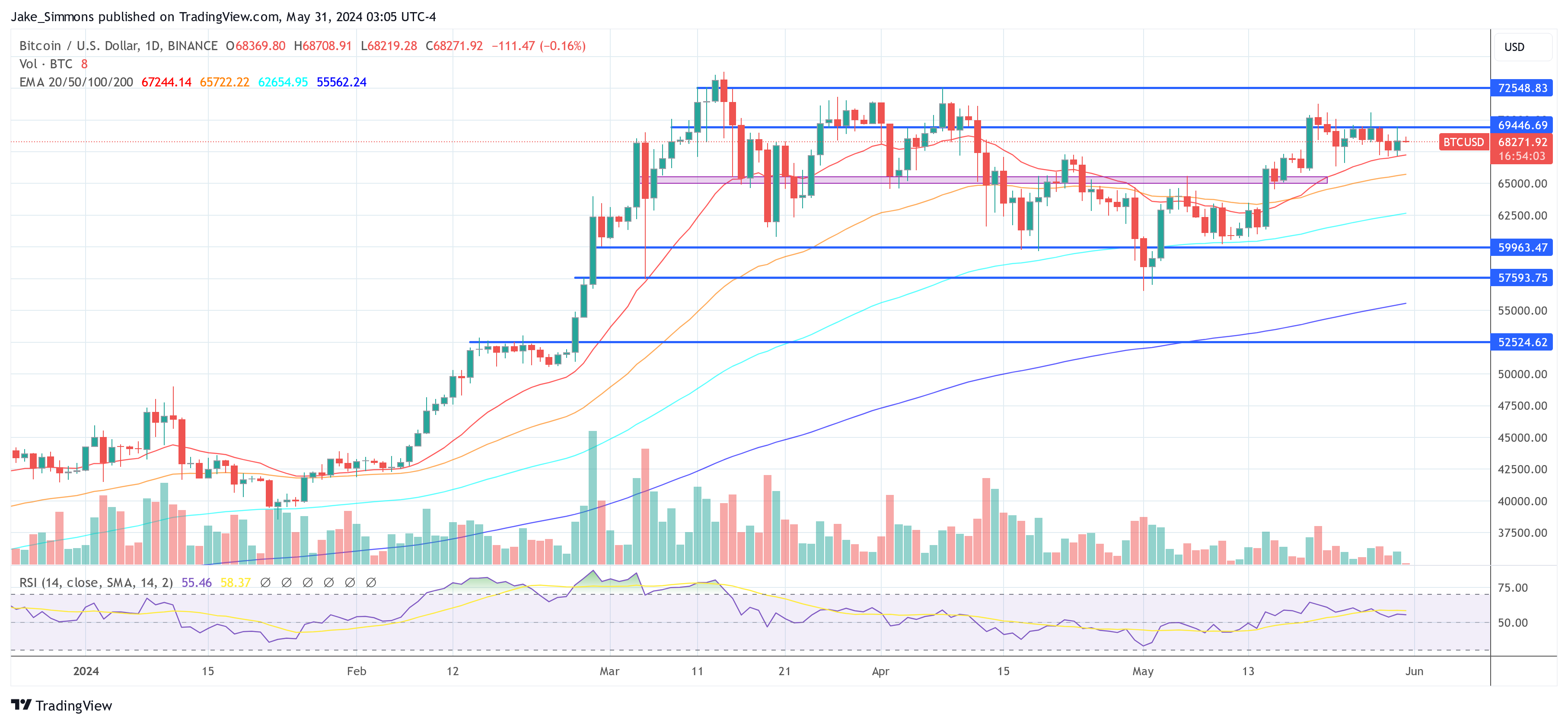
Featured image created with DALL·E, chart from TradingView.com
In the ever-evolving world of cryptocurrency, Marcel Knobloch also known as Collin Brown, a crypto expert has offered an audacious prediction for Bitcoin, foreseeing a significant rally to unprecedented heights post-BTC Halving event scheduled to take happen this month.
Bitcoin Poised For Massive Growth Post-Halving
According to Collin Brown, the fourth mining reward Halving for Bitcoin will take place in the next 48 hours. This event will cut down the current 6.25 BTC per block output to 3.125 BTC per block.
Brown noted that following the last Halving event, Bitcoin witnessed over 700% growth, bringing the crypto asset to its previous all-time high of $69,000 achieved at the peak of the 2021 bull cycle. Given the impact of the previous Halving, the crypto expert has predicted the coin will reach $455,000 should BTC mirror this pattern.
The post read:
In just forty-eight hours, Bitcoin’s fourth mining reward halving will occur. This quadrennial occurrence will slash the per-block emission of BTC to 3.125 BTC from the current 6.25 BTC. After the last halving, Bitcoin prices surged 700%, which would now bring $455,000.
It is worth noting that since the cryptic developer of Bitcoin, Satoshi Nakamoto, introduced the coin about 15 years ago, the Halving has been ingrained in the crypto’s program. This year’s event will happen when block 840,000 is created, which might increase BTC’s value by reducing supply.
Historically, the three previous halvings have caused the price of the digital asset to soar significantly, amassing substantial gains. Data shared by Brown shows that following the first halving event, Bitcoin saw a whopping 9,360% rise, topping out around $1,135 from $12.
However, it took the crypto asset approximately 371 days to reach the aforementioned figure after the Halving. Furthermore, the second halving, which occurred in 2016, drove Bitcoin’s price from $650 to $19,640, indicating an over 2,920% increase.
Meanwhile, the last instance secured a 700% rally, taking prices from $8,626 to the previous peak of $69,045. Primarily, it took BTC more than 500 days in the preceding two cycles to reach new records.
Considering the past trends, Brown’s forecast appears to be reasonable and possible. Should any of these trends reoccur, the crypto expert’s prediction might manifest in the following year.
BTC On The Downside
Collin Brown remains optimistic despite Bitcoin showing signs of weakness to retest its new all-time high of $73,000. Since reaching its new peak in mid-March, the value of BTC has plummeted by over 10%.
Today, the price of Bitcoin fell sharply, reaching a low of about $60,000 and reaching its lowest level since late February. At the time of writing, BTC was trading at $62,916, down more than 10% over the past week. While its trading volume has increased by over 20%, its market cap is slightly down by 0.20% in the last day.
The decline in BTC’s price is considered to be triggered by recent geopolitical tensions or global turmoil. The conflict between Israel and Iran caused major sell-offs among investors, leading to a broader market downturn.
Featured image from iStock, chart from Tradingview.com
Disclaimer: The article is provided for educational purposes only. It does not represent the opinions of NewsBTC on whether to buy, sell or hold any investments and naturally investing carries risks. You are advised to conduct your own research before making any investment decisions. Use information provided on this website entirely at your own risk.
Dogecoin Bull Run on the Horizon? DOGE’s RSI Signal Echoes Past Trends CCN.com
Source link ]]>
BEFE Coin’s Meteoric Surge: Echoes of SHIBA INU and PEPE COIN’s Rise? Analytics Insight
Source link ]]>
Shiba Inu Lead Developer Kusama Echoes Dot Com Era Ahead Of Key Launch As SHIB Tops Charts: ‘Can Get Ther Benzinga
Source link ]]>
Dogecoin (DOGE) Price Echoes of 2020 Surge Emerge Amid Familiar Patterns CryptoPotato
Source link ]]>