A market expert has outlined five distinct phases in the Bitcoin (BTC) bear market that could indicate when the leading cryptocurrency has hit a bottom. The analysis concludes that the cryptocurrency could still face additional downward pressure before ultimately reaching its final price floor this year.
The Early Phases Of Bitcoin’s Price Bottom
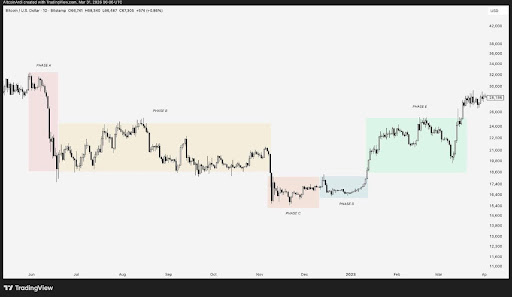
Ardi, a technical analyst on X, has used the market structure and price movements during the 2022 bear market to predict when Bitcoin could reach a price floor in this current bear cycle. In his analysis, he shared the five phases that could indicate that a bottoming process is already underway.
According to the analyst, these five distinct stages have repeated across multiple assets, eras, and cycles, meaning they are not just limited to Bitcoin and could be used to determine the bottom timeline of other cryptocurrencies. He noted that Phase A is marked by an abrupt halt in the previous trend that has been pushing the Bitcoin price downward. He stated that a violent event usually takes place here, breaking the old momentum and forcing the market out of a clean downtrend.
Related Reading
In Phase B, Ardi emphasized that this is where Bitcoin’s trading range will likely begin building. The analyst noted that the market is currently in this stage, suggesting that Bitcoin could still be months away from hitting a bottom. He explained that this stage is typically the longest of the five, often causing investors and traders to lose interest as prices consolidate and move sideways without a clear direction for weeks or months.
After this comes Phase C, which the analyst described as a critical “test.” During this period, BTC is expected to make one final move in the direction of its previous downtrend, shaking out the weak hands and trapping bulls. Based on the analyst’s chart, Phase C will likely mark Bitcoin’s final market bottom. However, Ardi expects this move to trigger breakout traders into taking wrong positions, allowing the market to determine whether any significant pressure remains.
The Final Stages Of The Bottoming Process
Moving forward, Ardi noted that Phase D likely marks the end of the Bitcoin bear market, with a new trend gradually taking shape ahead of a bullish breakout. During this period, Bitcoin’s market structure could begin to strengthen, even as overall sentiment remains cautious, and participants may still feel uncertain about the safety of entering long positions.
Related Reading
For the final phase of this bottoming process, Ardi expects Bitcoin to break out of its range-bound movement, making the emerging bullish trend more visible to the broader market. He noted that most traders trust this stage because it is the first point at which the market’s direction appears clear.
However, he warned that this can be a trap. Traders often buy only when conditions feel safe and sell when the trend seems obvious, but by then, they may have already lost their advantage and missed the opportunity to accumulate at lower prices.
Featured image created with Dall.E, chart from Tradingview.com

The Ethereum price had hit a new all-time high above $4,900, but had quickly retraced as a result of heavy selling. This has since turned sentiment around the cryptocurrency toward the negative. However, not everyone is on the bandwagon as crypto analyst JACKIS believes that the digital asset is still bullish. In fact, the analyst explains that the Ethereum price is bullish for years to come, despite saying that one of the major bull market indicators has come to an end.
End Of An Era: Forget The Crypto 4-Year Cycle
The crypto 4-year cycle remains the most prominent of all cycles, having served as a pointer toward each of the previous bull markets. This cycle coincides with the Bitcoin halving, which occurs roughly every four years, and precedes each bull market by a year. This means the year after each Bitcoin halving has often seen the start of a market-wide bull run.
However, this time around, the market seems to be deviating, especially as digital assets such as Ethereum have not followed Bitcoin straight to new all-time highs. This is something that crypto analyst Jackis alludes to in their post, telling investors to forget about the 4-year cycle.
According to the analyst, for Ethereum specifically, the 4-year cycle had ended back in December 2024. This coincides with the year in which Spot Bitcoin and Ethereum ETFs were approved, leading to what many believe is a premature high for Bitcoin, although Ethereum did not enjoy the same fate.

Given this, the analyst believes that investors must evolve with the fact that there is no longer a 4-year cycle for Ethereum. But this does not mean that Ethereum is no longer bullish. Quite the opposite, in fact, as the analyst says Ethereum is bullish for years to come.
Ethereum Price Set For New Highs
With the current state of the market, the analyst points out that the recent rejection from all-time highs has led to a 6th touch of the outlined trendline. However, this is no cause for alarm because historically, there has been an MTF shakeout before an HTF expansion.
In the present case, it is possible for more sell-offs to take the Ethereum price below $4,000 again. This would be a pre-bull market shakeout, leading bears into a possible trap with beliefs that the cycle top is in. But as the analyst explains, the ETH price could rally from here toward highs above $7,000. “If the price wants to immediately continue, then it needs to accept above 21 ATHs straight from here,” Jackis said.
Featured image from Dall.E, chart from TradingView.com
Editorial Process for bitcoinist is centered on delivering thoroughly researched, accurate, and unbiased content. We uphold strict sourcing standards, and each page undergoes diligent review by our team of top technology experts and seasoned editors. This process ensures the integrity, relevance, and value of our content for our readers.
XRP: $3 Is Next Target, Shiba Inu (SHIB) Price Just Faked It, 145 Days of Ethereum (ETH) Pain Has Ended U.Today
Source link ]]>
Ethereum (ETH) Volume Explosion, Shiba Inu (SHIB) Skyrocketing Brutally Ended, Dogecoin (DOGE): Is $0.20 Still Possible? U.Today
Source link ]]>
Shiba Inu (SHIB): This Price Move Ended It U.Today
Source link ]]>
Bitcoin, Ethereum, Dogecoin Take A U-Turn As Jerome Powell’s Statements Dampen Rate Cut Expectations: Analytics Firm Explains Why BTC Bull Market Has Not Yet Ended Benzinga
Source link ]]>
Dogecoin Moving Averages Say Accumulation Has Ended, Here’s Where Price Is Headed Next NewsBTC
Source link ]]>
Ethereum (ETH) which is addressed as ultra-sound money due to its deflationary supply method, now appears to be facing new challenges that have prompted some analysts to question whether this narrative still holds.
A prominent crypto analyst, Thor Hartvigsen, recently highlighted this issue in a detailed post on X, where he discussed the current state of Ethereum’s fee generation and supply dynamics.
Is ETH No longer Ultra-Sound money?
Hartvigsen pointed out that August 2024 is “on track to be the worst month in terms of fees generated on the Ethereum mainnet since early 2020.” This decline is largely attributed to the introduction of blobs in March, which allowed Layer 2 (L2) solutions to bypass paying significant fees to Ethereum and ETH holders.
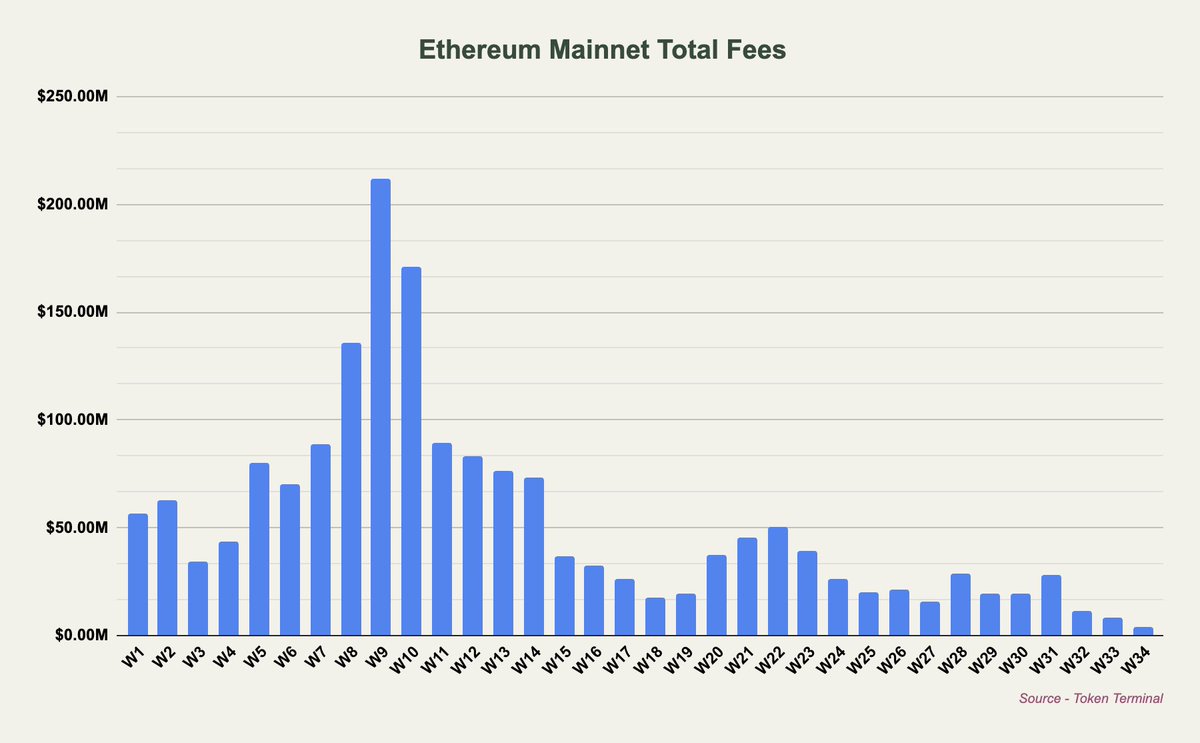
As a result, much of the activity has shifted from the mainnet to these layer two (L2) solutions, with most of the value being captured at the execution layer by the L2s themselves.
Consequently, Ethereum has become net inflationary, with an annual inflation rate of approximately 0.7%, meaning that the issuance of new ETH currently outweighs the amount being burned through transaction fees.
Hartvigsen disclosed the impact of this on Non-Stakers and Stakers: According to the analyst, non-stakers primarily benefit from Ethereum’s burn mechanism, where base fees and blob fees are burned, reducing the overall supply of ETH.
However, with blob fees often at $0 and the base fee generation decreasing, non-stakers are seeing less benefit from these burns. At the same time, priority fees and Miner Extractable Value (MEV), which are not burned but rather distributed to validators and stakers, do not benefit non-stakers directly.
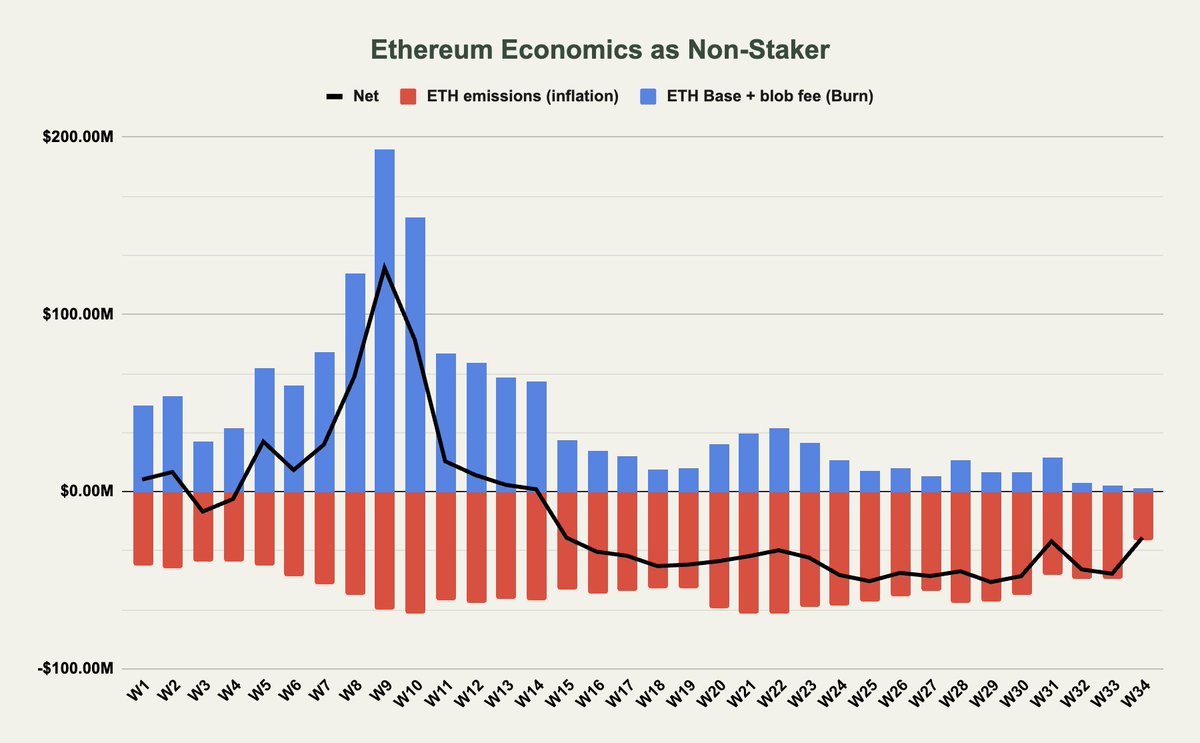
Additionally, the ETH emissions that flow to validators/stakers have an inflationary effect on the supply, which negatively impacts non-stakers. As a result, the net flow for non-stakers has turned inflationary, especially after the introduction of blobs.
For stakers, the situation is somewhat different. Hartvigsen revealed that stakers capture all the fees, either through the burn or via staking yield, meaning that the net impact of ETH emissions is neutralized for them.
However, despite this advantage, stakers have also seen a significant drop in the fees flowing to them, down by more than 90% since earlier this year.
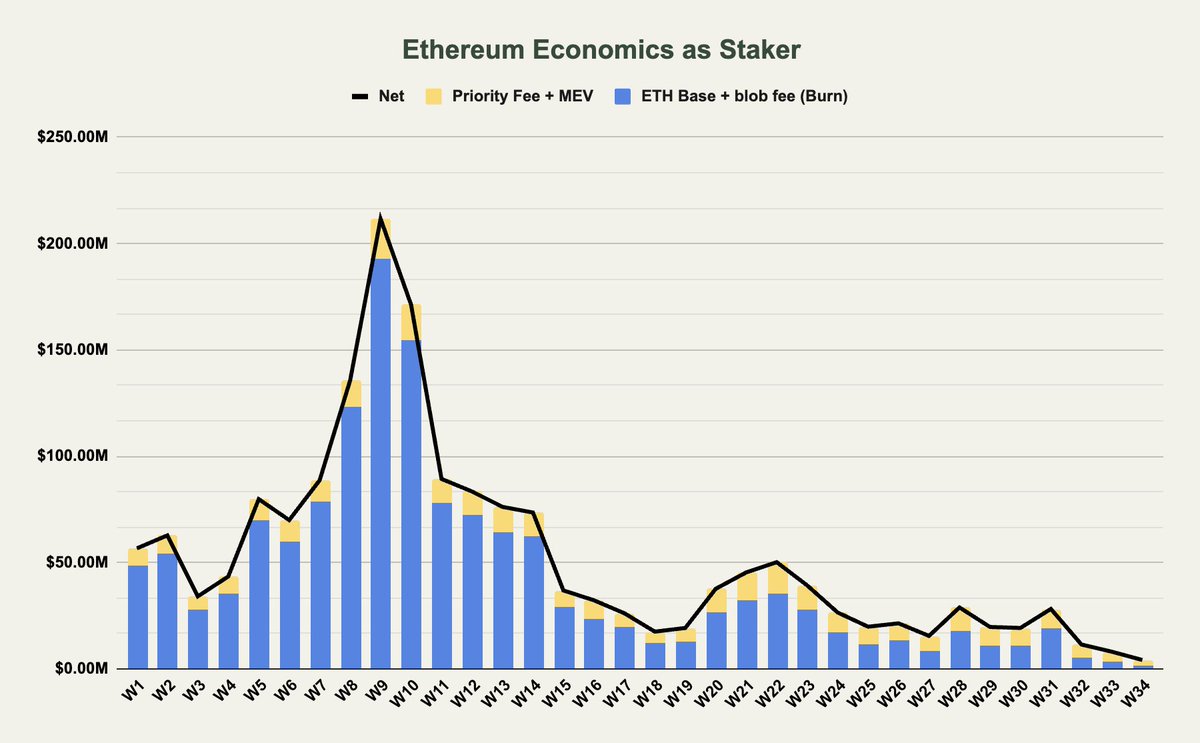
This decline raises questions about the sustainability of the ultra-sound money narrative for Ethereum. To answer that, Hartvigsen sated
Ethereum no longer carries the ultra sound money narrative which is probably for the better.
What’s Next For Ethereum?
So far, it is quite evident with the current trends that Ethereum’s ultra-sound money narrative may no longer be as compelling as it once was.
With fees decreasing and inflation slightly outpacing the burn, Ethereum is now more comparable to other Layer 1 (L1) blockchains like Solana and Avalanche, which also face similar inflationary pressures, says Hartvigsen.
Hartvigsen notes that while Ethereum’s current net inflation rate of 0.7% per year is still significantly lower than other L1s, the decreasing profitability of infrastructure layers like Ethereum may necessitate a new approach to maintaining the network’s value proposition.
One potential solution the analyst discussed is increasing the fees that L2s pay to Ethereum, though this could pose competitive challenges. Concluding the post, Hartvigsen noted:
Zooming out, infra-layers are in general unprofitable (study Celestia generating ~$100 in daily revenue), especially if viewing inflation as a cost. Ethereum is no longer an outlier with a net deflationary supply and, like other infra-layers, require another way to be valued.
Featured image created with DALL-E, Chart from TradingView
In an unprecedented development within the crypto landscape, data hinting at a potential BTC miner capitulation end has taken the crypto market by storm. Today, June 25, on-chain insights revealed a substantial dip in miners’ OTC BTC selling, hinting at a possible market recovery ahead.
Following this year’s Bitcoin halving event, mining rewards diminished significantly, impacting miner activity. This prompted a surge in miners to sell Bitcoin, primarily to cover mining operation costs.
BTC price encountered extreme volatility in its post-halving phase, aligning with the abovementioned factor. However, recent on-chain insights glimmer hope for future market movements.
Miners’ Selling Pressure Declines
According to the on-chain insights streamlined by CryptoQuant, miners’ BTC selling has taken a substantial dip since May this year. This means that the impact of selling pressure on Bitcoin is dwindling, birthing optimistic market sentiments.
Notably, should the market successfully absorb the total volume of miners’ selling, a promising path for upward momentum looms. This optimistic outlook, as projected by CryptoQuant, can be witnessed by the third quarter of this year.

Besides, it is also worth noting that Bitcoin’s price started trading sideways since May. Nonetheless, with decreasing selling pressure, a bullish road for BTC price action looms.
Also Read: Kraken Co-Founder Donates $1M In ETH To Donald Trump
BTC Market Performance
At press time, the BTC price saw a 0.96% increase in value, trading at $61,357.47. This price surge comes against the backdrop of three consecutive days of inflows in BTC ETFs.
However, BTC Futures OI dipped 1.56% to $31.56 billion, underscoring the presence of some volatility. Conversely, the derivatives volume spiked 9.32% to $42.48 billion.
Bitcoin’s RSI moved along 35, validating its recent turbulent action with downside pressure. Nonetheless, should the token enter an oversold territory, a potential price rebound looms.
Moreover, with Bitcoin options expiry set to take place today, the market brims with optimism for an upside momentum ahead. Contrarily, it’s also worth noting that the U.S. and German governments were recently reported to have offloaded colossal amounts of BTC, adding a layer of intrigue to the future price action.
Also Read: Binance Lists ETHFI, MEME, PYTH Among 7 New FDUSD Trading Pairs

The presented content may include the personal opinion of the author and is subject to market condition. Do your market research before investing in cryptocurrencies. The author or the publication does not hold any responsibility for your personal financial loss.
Following the recent halving event, Bitcoin transaction fees have undergone a significant reduction. This decline is evident in the latest data from Mempool.space, where medium-priority transactions are now priced at $8.48, while high-priority transactions cost $9.32. Such a decrease in transaction fees comes as a welcome relief for users engaging in transactions on the Bitcoin network.
Notably, this decline in fees coincides with Bitcoin’s stability above $65,000, suggesting a potential easing of the financial burden associated with conducting transactions on the network. As Bitcoin continues to maintain its value, the lower transaction fees could incentivize increased activity on the network, benefiting users and facilitating smoother transactions.
Fallout from Runes Saga Impacts Bitcoin Ecosystem
The aftermath of the Runes saga, sparked by the recent DOG Runes snapshot at block height 840,269, has sent ripples throughout the Bitcoin ecosystem. Particularly noteworthy is the dramatic plummet in the floor price of the Pre-Runes concept Ordinals NFT Runestone, which has dropped to a mere 0.03 BTC, representing a staggering decrease of over 60%. This significant decline in the value of Runestone NFT collections underscores the turbulent nature of the post-halving landscape and the uncertainties introduced by initiatives like the Runes protocol.
Despite initial expectations that Casey Rodarmor’s Runes protocol would serve as a buffer against revenue cuts for miners post-halving, the reality has been starkly different. The disappointing performance of the Runes protocol has left miners grappling with diminished earnings, exacerbating the challenges posed by the halving event.
Also Read: Peter Schiff Discredits Bitcoin As Digital Currency, States Post-Halving Flaws
Miners Face Revenue Challenges Amid Hashprice Index Drop
In the wake of the halving, Bitcoin miners find themselves confronted with mounting revenue challenges, exacerbated by a pronounced drop in the hashprice index. This index, which serves as a key metric for quantifying miners’ expected earnings from a specific quantity of hashrate, has plummeted from $182.98 per hash/day to a meager $81 post-halving. The sharp decline in the hashprice index underscores the financial strain facing miners in the post-halving era.
Despite hopes that the introduction of the Runes protocol would inject new life into on-chain activity and offset revenue reductions, the protocol’s impact has failed to meet expectations. As a result, miners are left navigating a landscape characterized by diminished earnings and heightened uncertainty. The sharp decline in floor prices for Runestone NFT collections further compounds the challenges facing miners, highlighting the complexities of the post-halving environment.
Also Read: Justin Sun Reportedly Scooped $890 Million Worth of Ethereum, ETH Price surge Ahead?

The presented content may include the personal opinion of the author and is subject to market condition. Do your market research before investing in cryptocurrencies. The author or the publication does not hold any responsibility for your personal financial loss.
✓ Share: