Best Presale Crypto: Solargy ($SOLGY) Leads with ESG & Cardano Parallels openPR.com
Source link ]]>
Setting the Standard for Blockchain ESG Ratings with the Cardano Foundation at the Point Zero Forum DisruptionBanking
Source link ]]>
ESG positions at Cardano filled by Martine Snoek, Dennis van der … Pensions & Investments
Source link ]]>
Ethereum ($ETH) Tops Crypto ESG Ranking, Topping Solana … CryptoGlobe
Source link ]]>
Understanding the Importance of ESG and Real Life Usage of … The Fintech Times
Source link ]]>
Disclaimer: The following op-ed represents the views of the author, and may not necessarily reflect the views of Bitcoinist. Bitcoinist is an advocate of creative and financial freedom alike.
No oceans. No blue sky. Only wrecks of its formal glory. We burned the planet down and now our children will have to fight over the remaining resources. This is the world 40 years from now. It’s a Mad Max world.
Imagine the opposite. A futuristic utopia. A world powered by renewable energy where there is no pollution, no contamination. A new world of perpetual happiness.
In the narrative that steers the future of planet earth, there is no contrast. No middle ground. It’s either hell or paradise. Friend or foe. You are either with the saviors or against them.
That’s what they, the saviors of the world, want you to believe. That’s the power of this narrative, do you want to contribute to the destruction of your home and your children’s home?
The saviors are those that controlled environmental investments. Only they have the power to support this narrative.
There are over 200 countries and 8 billion people living in the world. Only two of these countries have an economy large enough to reach $10 trillion or $20 trillion: the United States and China.
You could take a big portion of earth with its people, their dreams, and experiences, and they would barely reach the size of the U.S. economy.
However, if you take the combined capital of environmental, governance, and social investments (ESG) since 2020 you get $17 trillion. Enough money to rank in the top 5 economies in the world.
This gives the so-called saviors a lot of ammunition to back you up if you are on their side or destroy you if you resist. 17 trillion dollars are destined to create a green utopia. Most of this money was gathered in 2020.
Remember this. $17 trillion is a massive number. In the future, this could be a fraction of ESG-related assets. They are expected to reach $53 trillion by 2025.
I think the so-called saviors of the planet are ready to crown Ethereum in their favor. This will inject a percentage of those $17 trillion right into the cryptocurrency.
Only 1% of that amount would be enough to increase Ethereum’s market capitalization by 5x. Pushing the price above $10,000 and beyond.
ESG saviors are ready to take Ethereum under their wing, and separate allies from enemies. Let me tell you the clues that are sketching this vision of the future, and how the cryptocurrency will benefit.
For the saviors of the world, crypto is the enemy. You have seen it on the news with more and more frequency. A narrative is taking shape.
Crypto is burning the oceans, they say, crypto mining consumes more energy than this country or the other. It doesn’t matter if this is true. All great causes need a public enemy and a hero.
For this particular story, Ethereum will become the latter. The cryptocurrency is transitioning from a Proof-of-Work (PoW), used by Bitcoin, to a Proof-of-Stake (PoS) consensus. As a result, it will reduce its energy consumption by 99%. It will fit the ESG narrative.
This has happened in the past. Tesla was chosen as an ESG champion and in 2020, when environmental investments accelerated, the price of the stock followed.

Tesla rose more than 10x from $100 per share to $1,200 at its all-time high. This happened fast, in less than a year.
Imagine something similar happening to Ethereum (ETH). Trading at $2,800 today. A 10x increase in a year could put the price per ETH at $28,000 by 2023 or a year after the so-called saviors of the world decide to give it their blessing. Probably when Ethereum migrates to a PoS consensus.
Tesla has no competitors. As Ethereum could have no competitors in the coming years. Politicians and mainstream media are working to accomplish that.
Those cryptocurrencies labeled as public enemies will see many doors shut down on them. There is legislation making its way to the political machinery with one target: try to put a leash on that which refuses to be controlled. On Bitcoin.
How Fast Can Money Flow Into Ethereum?
If you think ESG is a thing of the past, think again. In 2021, PricewaterhouseCoopers (PwC) discovered that a majority of people in the U.S., China, Korea, and Germany, invest or buy products from companies trying to protect the environment.
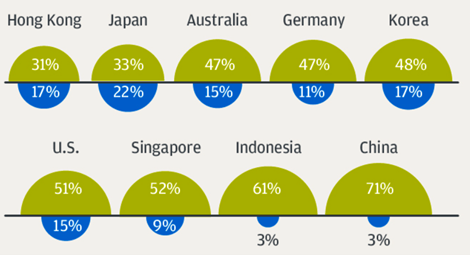
Despite the $17 trillion flowing to environmental investments, this movement is in its early stages. Investment products with environmental objectives have been seeing more money stream into them.
Here is how fast money has been pouring into ESG investment products since 2015.
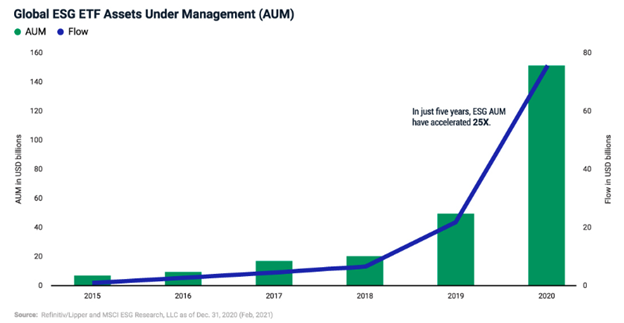
Imagine something similar, but with Ethereum. How fast can money flow into it?
What was the catalyzer for that growth? The COVID-19 pandemic, people care more about the planet today, there is better technology. Take your pick. All that matter is that the narrative is growing stronger.
Again, imagine a portion of that going into Ethereum in the coming years, with mainstream media backing it, and politicians blocking the competition. These are the ingredients for massive appreciation.
And sure, ESG is a label. A meme. But if the past two years have proved something is that meme driven investments are powerful. A 17 trillion-dollar meme movement is a force to be reckoned with.
Intel is dedicated to becoming a key player in the blockchain space. The multinational semiconductor manufacturer has unveiled its second-generation chip for proof-of-work crypto mining.
Intel launches Blockscale Technology that will enable energy-efficient Bitcoin mining
In a press release today, Intel revealed details of its new application-specific integrated circuit (ASIC), named Intel Blockscale ASIC. The chip is billed to be revolutionary in providing an energy-efficient solution to blockchain hashing.
The specifications of the second-generation mining chip include a dedicated secure hash algorithm-256 (SHA-256) ASIC processor that will reach up to 580 GH/s hash rate operating and up to 26 J/TH power efficiency. This would make it more energy-efficient than Bitmain’s Antminer S19J which has an energy efficiency of 34.5 joules per terahash.
Similarly, the ASIC will also feature on-chip temperature-and-voltage-sensing capabilities, and will support up to 256 integrated circuits per chain. It will also ship with reference hardware design and software stack to help point users in the right direction.
Jose Rios, general manager of Blockchain and Business Solutions in the Accelerated Computing Systems and Graphics Group at Intel, stated that the ASIC would be a game-changer for POW blockchains and especially Bitcoin. He said:
The Intel Blockscale ASIC is going to play a major role in helping bitcoin mining companies achieve both sustainability and hash rate scaling objectives in the years ahead.
Argo Blockchain, Block Inc., Hive Blockchain Technologies, and GRIID Infrastructure will be among the first customers to lay hands on the chip when it starts to ship in Q3 of this year.
Meanwhile, this is the second ASIC Intel has released this year that will be dedicated to energy-efficient crypto mining. Back in February, the California-based company released Bonanza Mine (BZM), a first-generation ASIC.
Intel’s vice president and general manager of Custom Compute in the Accelerated Computing Systems and Graphics Group, Balaji Kanigicherla, disclosed that the company is bringing its years of R&D in cryptography, hashing techniques, and ultra-low voltage circuits to bear on the blockchain industry.
Ultimately, the company sees miners moving away from using energy-consuming GPUs, while also scaling their operations without higher energy consumption.
Other energy efficiency Bitcoin mining solutions are being considered
Asides from Intel’s approach, other solutions to the high energy consumption of the Bitcoin and crypto mining industry as well as its use of fossil fuels are also being seriously considered. According to a report by the Australian, Bengal Energy, a Canadian oil and gas miner, is set to begin its trial project of accessing formerly “stranded” gas wells with portable Bitcoin mining rigs.
Meanwhile, on the flip side, Greenpeace has started a campaign supported by Chris Larsen, the founder of Ripple, to change Bitcoin’s consensus mechanism from proof-of-work to proof-of-stake.
Disclaimer
The presented content may include the personal opinion of the author and is subject to market condition. Do your market research before investing in cryptocurrencies. The author or the publication does not hold any responsibility for your personal financial loss.
About Author

Even Wikipedia fell for the environmental FUD surrounding Proof-Of-Work mining. A proposal to “stop accepting cryptocurrency donations” is currently under discussion. It starts with the same thin arguments that the whole mainstream media irresponsibly uses. However, it gets better and more interesting. In general, it’s amazing to see both sides of the argument unfolding. Even though there might be some information suppression going on.
Related Reading | Human Rights Foundation Accepts Fully Open Source Bitcoin Donations
Well do our best to summarize the whole thing, but people interested in the topic should take time to read it all. It’s full of twists and turns. The most amazing thing about the document is that real people wrote it. Wikipedia editors are not a sample of the world’s population, but, they’re heterogeneous enough to make the discussion interesting.
Wikipedia Falls For The Environmental FUD
The original proposal poses three problems with receiving cryptocurrency donations, but, in reality, we can summarize them all in the ESG FUD category. The three points are:
-
“Accepting cryptocurrency signals endorsement of the cryptocurrency space.”
-
“Cryptocurrencies may not align with the Wikimedia Foundation’s commitment to environmental sustainability.”
-
“We risk damaging our reputation by participating in this.”
It’s a shame that, to try to prove their points, the original author uses a questionable source and a discredited one.
“Bitcoin and Ethereum are the two most highly-used cryptocurrencies, and are both proof-of-work, using an enormous amount of energy. You can read more about Bitcoin’s environmental impact from Columbia or Digiconomist.”
Counterpoint: That Data Is Compromised
Even though it’s widely cited, an “employee of the Dutch Central Bank” posing as a neutral journalist runs Digiconomist. That fact alone disqualifies him as a credible source. However, his data is also under question because the “Digiconomist Bitcoin Electricity Consumption Index is not being driven by real world metrics and profitability as stated in the methodology.” So, we’re dealing with an intellectually dishonest individual who’s presumably paid to attack the Bitcoin network.
For more information on this shady character, go to the section “The Digiconomist is Disinformation.”
The Columbia report is newer, but it cites outdated data and debunked studies. Like the ridiculous one that doesn’t understand how PoW scales, or even works, and irresponsibly claims that crypto-mining could raise the Earth’s temperature by two degrees. Columbia’s main source, though, is the “University of Cambridge analysis.” That same organization literally said that “There is currently little evidence suggesting that Bitcoin directly contributes to climate change.”
However, they suspiciously erased that part from their FAQ. They changed the wording and now it just contains a “radical thought experiment” in which “all this energy comes exclusively from coal.” Even under those extreme circumstances, which are far-far away from reality, the energy use would be marginal. “In this worst-case scenario, the Bitcoin network would be responsible for about 111 Mt (million metric tons) of carbon dioxide emissions1, accounting for roughly 0.35% of the world’s total yearly emissions.”

ETH price chart for 01/13/2022 on Poloniex | Source: ETH/USD on TradingView.com
Protecting The Process Or Information Suppression?
Under the whole thread, there’s a section called “Discussion moved from proposal section.” It contains several suppressed pro-cryptocurrencies arguments. The reason is that the accounts that made them had “no other editing records”. What do the people proposing that those opinions should be removed argue? That they “risk that both vote gaming and manipulation of discussion to introduce bias and fake “bitcoin” news.”
Coincidentally, those low-edit accounts are the ones bringing forward the information on how bogus the original poster’s sources are. Someone had to say it and they did. And the administrators removed them from the main thread. Is this really what Wikipedia is about.
Luckily, other Wikipedia contributors managed to say that “Bitcoin is therefore a green energy stimulus, aligned with the Wikimedia Foundation’s commitment to environmental sustainability. “ Another user urged “everyone to understand more about Bitcoin as a whole package beyond its energy footprint (negligible when compared to the cost in oil and warfare of backing the US Dollar) as well as the continual exponential progress that has been made in making Bitcoin greener and greener.” Yet another one said “bitcoin core is a FLOSS project attempting to promote monetary freedom.”
In any case, the crypto detractors trying to game the vote might have a point. Except for the ridiculous “fake “bitcoin” news” claim. The header of the discussion says, “this is not a majority vote, but instead a discussion among Wikimedia contributors”. And the administrator tells them that they can’t remove opinions or votes. However, “an optimal RfC scenario would not actively silence any voices, but would allow community members to inform each other which participants are not community members, who may have alternative interests.” That’s fair.
What About The Votes? Is Wikipedia Banning Crypto Donations?
The vote doesn’t look good for crypto donations, but that doesn’t mean Wikipedia will ban them. At the time of writing, the “support” votes are approximately double than the “oppose” ones. And roughly 150 Wikipedia persons have voted. Does this mean the ESG FUD worked and cast a shadow over the whole crypto space that will be hard to shake? Absolutely it does.
Related Reading | New Contender Emerges Despite Wikipedia’s Begrudging Listing of Cardano
It also means that people WANT to believe. And are not willing to accept the overwhelming evidence that points to PoW mining being a net positive for the environment.
Fortunately, Bitcoin doesn’t care. Tick tock, next block.
Featured Image by James on Unsplash | Charts by TradingView
Will the ESG FUD ever stop? As a Congressional subcommittee prepares to take a good look at Proof-Of-Work mining, “more than 70” national, international, state and local organizations wrote a letter to the “Congressional leadership.” In it, they use old and unreliable data to get their point across. They completely ignore all of 2021’s research and progress on the matter, because it would invalidate their argument.
The question is, will Congress buy their poorly researched, alarmist letter? The ESG FUD hit PoW mining like a ton of bricks in 2021. It might be based on a poor understanding of the subject at hand, but the public in general definitely bought it. And they quote the bogus numbers that their authorities invented left and right on social media.
Related Reading | Despite Crackdown, Bitcoin Mining Is Still Alive And Well In China
Also, the whole argument completely ignores Bitcoin’s main virtue. The orange coin provides a framework and tools for the world’s transition to a disinflationary system. Paraphrasing “The Price Of Tomorrow’s” author Jeff Booth, in the inflationary system that we live in, there’s a clear incentive for consumption. If your money’s purchasing power decreases by the minute, everybody will logically buy, spend, and consume everything in sight. That is the real monster that the planet’s facing. And Bitcoin fixes it.
In any case, Bitcoin’s resident ESG FUD expert, Nic Carter, took it upon himself to reply to the ESG organizations that sent misinformation to Congress. Let’s see how each part did.
The ESG Organizations Make Their Point, Nic Carter Counterpoints
The ESG organizations come out swinging from the introduction on:
“We, the more than 70 climate, economic, racial justice, business and local organizations, write to you today to urge Congress to take steps to mitigate the considerable contribution portions of the cryptocurrency markets are making to climate change and the resulting greenhouse gas (GHG) emissions, environmental, and climate justice impacts it will have.”
And their accuracies start from the get-go, also:
“In 2018, scientists writing in Nature warned that Bitcoin’s growth alone could singlehandedly push global emissions above 2 degrees Celsius within less than three decades.”
Those numbers are ridiculous. The study assumes a progression relative to the number of users of the network, and that’s simply not how Bitcoin works. Even if the whole planet adopted the Bitcoin standard, the network would still produce one block every ten minutes. Energy consumption is not directly related to the number of users.
What did Nic Carter respond? That the claim is “false, based on a debunked paper with a completely erroneous model of bitcoin.”
2. bitcoin’s energy consumption will ‘only get worse over time’
most likely will trail off over time, after peaking in the next decade (see https://t.co/8x0koM6nR9 for actually rigorous projections)
— nic carter (@nic__carter) January 6, 2022
Right after that, the ESG organizations even throw Ethereum under the bus:
“The Digiconomist’s Ethereum Energy Consumption Index estimates that the Ethereum blockchain will consume 71 terawatt-hours this year, nearly the same as the energy consumption of Colombia.”
Since the letter is about PoW mining, it makes sense. The Ethereum community seems to have completely ignored the letter, at least over at Twitter.

BTC price chart for 01/07/2021 on Bitstamp | Source: BTC/USD on TradingView.com
Bitcoin Incentivizes Green Energy Infrastructure
The ESG organizations continue their poorly-researched attack with:
“The GHG emissions from this exorbitant and unnecessary energy consumption is staggering.”
It’s not unnecessary at all. In fact, PoW mining is absolutely essential for a decentralized, permissionless system. And the energy consumption is directly proportional to the security of the network. Plus, it anchors it to the real world. Not to mention the fact that Bitcoin actually incentivizes and finances green energy infrastructure.
Then, the ESG crowd accuses Bitcoin of “exacerbating” the global chip shortage:
“Increased demand for these machines are exacerbating a global shortage of semiconductors. A bipartisan bill by Senators Maggie Hassan and Joni Ernst has called for a report on how cryptocurrency mining operations are impacting semiconductor supply chains.“
With ease, Nic Carter counterattacks with: “Bitcoin miners are not tier 1 clients, they don’t compete with Apple/Qualcomm/NVIDIA for space; the shortage is due to money printing and the demand shock. See section on semis here.”
5. Atlas/ greenidge increased power prices in NY.
The Atlas mine brought back online a fallow coal plant (converted to natgas) which now provides energy to the grid (in addition to mining). That’s energy supplied to the grid which wasn’t being produced beforehand
— nic carter (@nic__carter) January 6, 2022
Texas Doesn’t Know What Its Doing, The ESG Crowd Does
Then, the ESG researchers make wild, unbacked assumptions about Texas power:
“Following a crackdown on cryptocurrency miners in China, many miners are moving to Texas, due to its deregulated grid, taking away the power that Texans need.”
This completely ignores the fact that the state of Texas went to great lengths to attract those miners. And that, unlike the ESG organizations that signed the infamous letter, power companies in Texas regularly attend Bitcoin meetings. They are making an effort to understand the technology and the opportunities it brings to them. Also, as Carter puts it, “Majority of mining is in west texas where transmission bottlenecks mean prices routinely go negative. Huge overcapacity and limited demand for power outside of mining.”
Miners also participate in demand response, meaning they aren’t online when the grid is overburdened. Their presence dramatically improves economics for renewables and does not compete with households during scarcity events.
— nic carter (@nic__carter) January 6, 2022
The state of Texas knows what it’s doing, they see Bitcoin’s future is bright. These ESG organizations think they know better, though:
“Adding more energy-guzzling crypto mining operations to Texas could exacerbate the sorts of blackouts the state already saw during the extreme cold in February — outages that reporting shows hit communities of color the hardest.”
Wow, playing the race card there. So low. And unrelated. Anyway, answering the claim that miners “could exacerbate” the February blackouts, Carter says. “Miners were/ would have been offline during this time, as we demonstrate here. They also help alleviate ‘black start’ issues through primary frequency response.”
9. Stronghold mining with coal waste is bad (implied)
The coal waste was going to oxidize naturally. It was going to combust anyway. This is an incentive to clean up a nasty site leeching into groundwater etc. Neutral from a CO2 perspective and ++ from an ecology view
— nic carter (@nic__carter) January 6, 2022
Three Other Prominent Bitcoiners’ Response
Are these direct responses to the ESG organizations’ letter? It’s not clear, but the authors published them in the same timeframe. The first one refers to SHA256, the set of cryptographic hash functions that Bitcoin uses. Nunchuk founder Hugo Nguyen said, “Once you understand that SHA256 is close to being 100% efficient at what it does, you’d stop calling it a “waste”. In fact, 100% efficiency is the exact opposite of “waste”. There’s nothing else like it.”
Once you understand that SHA256 is close to being 100% efficient at what it does, you’d stop calling it a “waste”. In fact, 100% efficiency is the exact opposite of “waste”. There’s nothing else like it. https://t.co/SLuVrAPfU2
— Hugo Nguyen (@hugohanoi) January 7, 2022
For his part, Swan Bitcoin’s Brandon Quittem attacks the concept of energy consumption being inherently bad. “Energy consumption is directly correlated with GDP. Want to help developing countries? Help them harness more energy. Interestingly, Bitcoin acts as a free market subsidy for energy investment.”
3/ Energy consumption is directly correlated with GDP.
Want to help developing countries? Help them harness more energy.
Interestingly, Bitcoin acts as a free market subsidy for energy investment.
Incentivizes developing otherwise uneconomical energy sources. pic.twitter.com/DJ6yYoz6WO
— Brandon Quittem (@Bquittem) January 6, 2022
And Kraken’s Dan Held states that “Bitcoin’s energy consumption is not “wasteful.” Why? Because “It is much more efficient than existing financial systems.” And we’re talking orders of magnitude, here. Not only that, “No one has the moral authority to tell you what is a good or bad use of energy (ex: watching the Kardashians).”
1/ Bitcoin’s energy consumption is not “wasteful.”
– It is much more efficient than existing financial systems
– No one has the moral authority to tell you what is a good or bad use of energy (ex: watching the Kardashians)Let’s debunk this FUD
— Dan Held (@danheld) January 6, 2022

Do you know how much energy American households use for their Christmas lights? As much as the whole Bitcoin network, that’s how much.
Related Reading | Is This The Reason China Banned Bitcoin Mining? Carvalho’s Mind Blowing Theory
Where is the letter to Congress protesting Christmas lights, ESG organizations?
Featured Image by Karsten Würth on Unsplash | Charts by TradingView
The world’s largest crypto exchange, Binance’s Australian arm has extended its reached beyond trade and exchange, and has announced that it will also begin reportage on Environmental, Social, and Governance (ESG) metrics, under a universal framework developed by the World Economic Forum. This has made Binance Australia, the world’s first-ever crypto exchange platform to simultaneously report on ESG issues, while continuing its trade and exchange services.
1/6 We are excited to announce that @Binance_AUS has taken a huge step forward and become the world’s first Digital Currency Exchange to commence reporting on Environmental, Social, and Governance (ESG) metrics, under a universal framework developed by the World Economic Forum.
— Binance Australia
(@Binance_AUS) December 9, 2021
Binance Australia’s official Twitter handle made the announcement public, noting that it is high time to address the biggest hurdle in way of decentralised industry’s growth. The Chief Executive Officer of Binance Australia, Leigh Travers argued that “negative commentary and misinformation based on carbon emissions” has weighed the decentralised industry down for a long time.
He claimed that despite the industry’s efforts to enhance innovative and technological development for economies across the world, malicious headlines spread misinformation, that trigger negative market sentiment. Nevertheless, with Binance’s exclusive initiative to become an ESG entity, it will focus on facilitating transparency of the ESG footprint of organisations in the digital asset industry.
“One of the biggest headwinds the digital asset industry has faced is negative commentary and misinformation based on carbon emissions from the sector. The industry is led by people and organisations determined to have a positive impact on society and the negative headlines have triggered a lack of education and awareness of ESG conscious crypto businesses,” said Leigh Travers.
Binance Experiences Exceptional Development Despite Centralisation News
Since Binance has opted to follow a centralised approach, given it had suffered the wrath of the regulators for a considerable timeframe, the crypto exchange is only climbing upwards. The crypto exchange has experienced global growth, from the announcement of establishing its Head Offices in France, to expanding business in Singapore despite exit speculations. Binance may be under oversight, but it has continued to display exceptional growth.
While maintaining a regulator-friendly strategy, Binance is driven by the decentralised system at its core. Binance CEO, CZ recently noted that Binance only seeks to establish in countries with a pro-crypto approach, despite agreeing to become centralised.
Disclaimer
The presented content may include the personal opinion of the author and is subject to market condition. Do your market research before investing in cryptocurrencies. The author or the publication does not hold any responsibility for your personal financial loss.
About Author
