Cardano’s Strategic Position Amid Regulatory Uncertainty: Blockchain Resilience and Capital Allocation Timing in ETF-Driven Markets AInvest
Source link ]]>
Executives from VanEck and Coinbase are raising alarms over the U.S. Securities and Exchange Commission’s (SEC) handling of spot Bitcoin ETFs. They pointed to increased borrowing costs as a direct consequence of the regulatory framework. According to these industry leaders, the SEC’s refusal to allow in-kind creation and redemption of Spot BTC ETFs has created inefficiencies. This has forced market participants to take on significant capital costs.
VanEck & Coinbase Execs On Spike In Borrowing For Bitcoin ETFs
Matthew Sigel, Head of Digital Assets Research at VanEck, a prominent player in the BTC ETF market, has been vocal about the challenges brought on by the SEC’s rules. “The SEC’s refusal to allow the in-kind creation and redemption of spot Bitcoin ETFs forces market participants to pre-fund many of their Bitcoin ETF-related transactions,” Sigel said.
Furthermore, he emphasized that this requirement has made the ETF process more capital-intensive and expensive than necessary. Sigel believes that if the SEC were to approve in-kind transactions, trading spreads would tighten. Also, the discount to net asset value (NAV) of Bitcoin ETFs would narrow, eventually benefiting investors.
Coinbase, a prominent crypto exchange, has also been navigating the challenges posed by the SEC’s framework. Matt Boyd, Coinbase’s Head of Prime Finance, highlighted the financial strain caused by the settlement mismatch between cash and Bitcoin transactions.
“Our financing costs are not particularly expensive. They are similar to emerging market financing costs. Anyone allowing a purchase prior to receiving cash is providing a loan and is getting compensated for that in some way,” Boyd explained, according to a report by Risk.Net.
The mismatch stems from the differing settlement cycles for cash and cryptocurrencies. Bitcoin transactions typically settle on the same day. However, the cash required for these trades, provided by authorized participants (APs) such as banks and high-frequency trading firms, follows a T+1 cycle. Hence, this discrepancy forces ETF managers to either pre-fund Bitcoin purchases from their own balance sheets or seek short-term loans from exchanges like Coinbase.
Also Read: Coinbase Firmly Opposes CFTC’s Proposed Ban On Prediction Markets
Calls For Broader Solutions
The SEC’s regulatory stance has had ripple effects across the industry, affecting other major players. For instance, Duncan Trenholme, TP Icap’s Global Co-Head of Digital Assets, noted the significant strain on ETF managers. “Our clients are having to manage a settlement mismatch on the physical hedging of the ETF, which is a strain on their own inventory or balance sheet,” Trenholme said.
This funding challenge is particularly evident with BlackRock’s iShares Bitcoin Trust, the world’s largest spot Bitcoin fund. The fund has attracted substantial inflows since its launch with over $19.5 billion in assets under management. The IBIT Bitcoin ETF average daily inflows have reached $144 million, with a peak of $849 million in a single day, illustrating the scale of the capital involved.
Moreover, the increasing borrowing costs and counterparty risks have led some in the industry to call for broader solutions. Rob Strebel, Head of Relationship Management at DRW, which operates the crypto trading firm Cumberland, discussed the adjustments his firm has made to cope with these challenges.
“Crypto ETFs require settlements that look like what you see in traditional finance versus spot crypto,” Strebel explained. Additionally, he noted that Cumberland has had to internalize the flow from its market-making activities to mitigate additional balance sheet costs.
Others, like Michael Lie, Flow Traders’ Global Head of Digital Assets, suggest that an industry-wide facility to support short-term borrowing could alleviate some of the pressure. “Being able to source hundreds of millions of capital is quite expensive. It’s not so easy. Market-makers need to free up the cash just for one or two days,” Lie pointed out.
Also Read: Zetachain Soars 17% As Coinbase Confirms Roadmap Listing

Kritika Mehta
Kritika boasts over 2 years of experience in the financial news sector. Currently working as a crypto journalist at Coingape, she has consistently shown a knack for blockchain technology and cryptocurrencies. Kritika combines insightful analysis with a deep understanding of market trends. With a keen interest in technical analysis, she brings a nuanced perspective to her reporting, exploring the intersection of finance, technology, and emerging trends in the crypto space.
Disclaimer: The presented content may include the personal opinion of the author and is subject to market condition. Do your market research before investing in cryptocurrencies. The author or the publication does not hold any responsibility for your personal financial loss.
In their latest market update, QCP Capital, a crypto asset trading firm headquartered in Singapore, has dissected the recent Bitcoin price movements, attributing the rally to macroeconomic factors rather than the much-anticipated approval of a spot ETF. To recall, the Bitcoin surged from $34,500 to almost $36,000 on Wednesday.
The Main Reason For The Bitcoin Price Rally
The firm’s technical analysis highlighted that Bitcoin reached the 38.2% Fibonacci retracement level at $35,912 and touched the upper channel trendline before retreating, a move that was keenly observed by market participants.
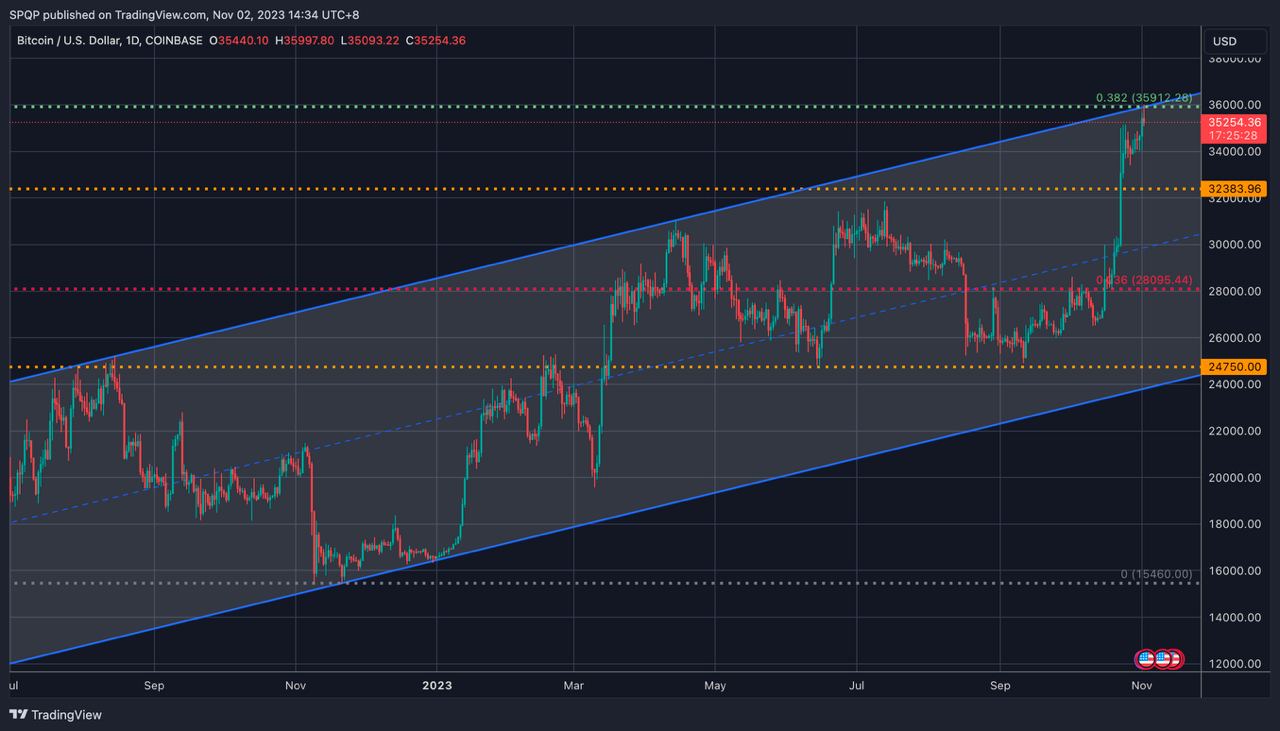
QCP Capital’s report states, “This latest rally, however, was less about spot ETF developments and more about macro forces.” These macro forces were identified following a dovish stance from the Federal Open Market Committee (FOMC) and a smaller than expected Treasury Q1 supply estimate, which led to a significant drop in bond yields. This, in turn, has had a bullish effect on risk assets, including Bitcoin and the broader crypto market.
However, the firm also had a word of caution, saying, “Whether this marks the start of a new global equity and bond uptrend remains to be seen, as the macro picture essentially remains unchanged, outside a correction of overly bearish bond sentiment.”
The firm also noted the Bitcoin derivatives market, where “perp funding, and term forwards, implied volatility and risk reversals across the curve continue to remain or extend further at extreme elevated levels.” This suggests a market bracing for a significant move, with derivative traders positioned for a potential upside breakout that hinges on the approval of a spot ETF.
Looking at the broader financial landscape, the bond market has been experiencing notable fluctuations. Recently, the 30-year Treasury yield has reached another 16-year high, climbing above 5%. This level of yield has not been seen since 2007, and it represents a rise of over 4 percentage points in just three years. Such movements in the bond market are critical for the Bitcoin and crypto market as they affect the risk sentiment among investors.
However, Bitcoin is currently following the example of gold as a safe haven asset. ”The market is starting to price in the Fed’s overtightening and weakening economics. Combined with geopolitical tensions + war, the need for QE in the future is increasing rapidly. This is causing insurance assets (Gold, Bitcoin) to absolutely rip in unison,” Carpriole Investment’s Charles Edwards remarked recently.
In summary, QCP Capital’s insights into Bitcoin market dynamics versus current bond market trends suggest that while the Bitcoin market is influenced by a variety of factors, including speculation about exchange-traded fund approval, macroeconomic indicators such as bond yields play a larger role in determining market sentiment and price action than other pundits believe.
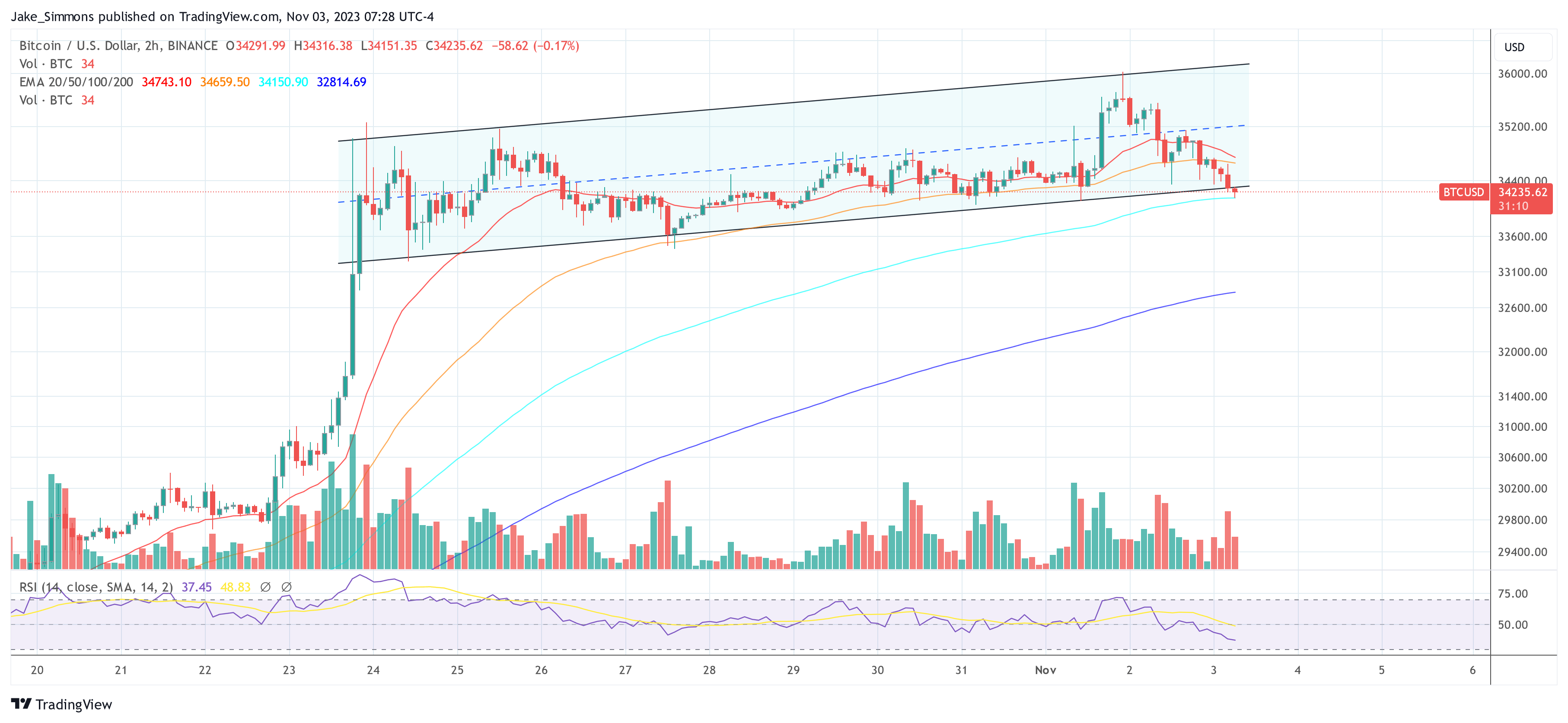
At press time, Bitcoin was trading at $34,235 and at risk of breaking out of the established uptrend channel to the downside. If that happens, low price levels could come next.
Featured image from iStock, chart from TradingView.com
✓ Share: