Government authorities in Ethiopia are preparing to issue digital, blockchain-based IDs to students at select schools in the country.

The project is the result of a partnership with Input Output HK (IOHK), the company behind the Cardano cryptocurrency. It’s being orchestrated by the education ministry’s department of ICT and digital education, and is part of a larger “digital foundations project” being implemented by the Ministry of Innovation and Technology.
Starting next month, students at about two dozen schools will receive their blockchain ID credentials. By the end of the year, government authorities are aiming to have a million IDs issued. Ultimately, the plan is to provide blockchain IDs to five million students and 750,000 teachers across 3,680 schools.
The digital IDs will be used to track students’ academic performances and to eliminate the possibility of ‘academic dishonesty’. According to a report from Ethipia’s Fortune, the country’s Higher Education Relevance & Quality Authority detected 15,000 fraudulent diplomas and certificates in 2021.
The initiative reflects a broader enthusiasm for digital ID technology in Ethiopia. This past summer, TECH5, a biometric ID specialist, announced the success of a pilot program undertaken as part of the National ID Program of the Ethiopian Government Entity, or NIDP Ethiopia. Government officials used TECH5’s technology to register participants’ face, fingerprint, and iris data, and to issue them digital IDs for use on their mobile devices.
All of these efforts illustrate an appetite for the kind of “Digital Public Infrastructure” to which the Gates Foundation committed $200 million in funding last week. And the student ID project in particular shows that blockchain technology could end up playing an important role in that digital infrastructure.
Sources: Fortune, Crypto News Flash

The National Bank of Ethiopia (NBE) has said it does not recognize cryptocurrencies as a legitimate method of payment and that residents must avoid using them. The bank insists the local birr currency is the only lawful means of settling transactions in Ethiopia.
Illegal Transactions
The Ethiopian central bank has warned citizens against engaging in “illegal” cryptocurrency transactions, a report has said. The report adds that the central bank still does not recognize cryptocurrencies like bitcoin as a payment method.
In its report, the state-affiliated media outlet Fanabc refers to a statement from the National Bank of Ethiopia (NBE) which reminded the country’s residents that the birr currency remains Ethiopia’s only legal tender.
“Ethiopia’s national currency is the Ethiopian Birr, with any financial transaction in Ethiopia to be paid in Birrs, according to the law,” the central bank reportedly said.
Residents Urged to Report Crypto Transactions
Like many of its peers across Africa, Ethiopia has not completely banned the use of cryptocurrencies, but has adopted a wait-and-see approach. This approach has, however, not stopped the Ethiopian government from establishing a working relationship with Cardano.
The embrace of Cardano as well as the government’s apparent warming to blockchain technology has not stopped the NBE from repeating the claim that cryptocurrencies are primarily used for money laundering schemes. The central bank also urged residents to report such transactions should they come across them.
What are your thoughts on this story? Let us know in the comments section below.
Source: Bitcoin.com
Original Source: https://cryptobreaking.com/ethiopian-central-bank-urges-residents-to-stop-engaging-in…
Disclaimer: Cardano Feed is a Decentralized News Aggregator that enables journalists, influencers, editors, publishers, websites and community members to share news about the Cardano Ecosystem. User must always do their own research and none of those articles are financial advices. The content is for informational purposes only and does not necessarily reflect our opinion.
Founded by Charles Hoskinson, who co-founded Ethereum, Cardano uses the proof-of-stake consensus mechanism, to which Ethereum is now moving. Its native token, ADA, has jumped 9% since April 26, the day before IOHK announced the Ethiopia project. On a 24-hour basis, it was down 0.8% to $1.35 at press time.
- Cardano’s development team, IOHK, announced a partnership with the Ethiopian government.
- The blockchain-based, student-teacher solution – Atla PRISM – will be built on Cardano.
- ADA price hints at a pullback as the MRI indicator flashed a sell signal, indicating a 10% correction underway.
Cardano adoption sees a new shift as the research and development company behind ADA, IOHK, revealed a new partnership. However, ADA price fails to perform as it hints at a correction shortly.
Biggest Blockchain deployment
Earlier today, IOHK notified the public that it was partnering with the Ethiopian government to implement a national blockchain-based, student-teacher ID and attainment recording system.
This solution can be used to digitally verify grades, remotely monitor school performance, and boost education and employment nationwide.
The announcement reads,
We’ll deliver this using our identity solution – Atala PRISM, built on Cardano – which will enable authorities to create tamper-proof records of educational performance across 3,500 schools, 5 million students, and 750,000 teachers to pinpoint the locations and causes of educational under-achievement and allocate educational resources effectively.
Cardano blockchain development has increased rapidly over the past year. This progress has not only caused ADA price to catapult but also help increase its collaborations.
IOHK further added that it is in talks with two other multi-million user applications, hinting that more partnerships are likely heading toward Cardano.
ADA price looks to correct 10%
ADA price recently sliced through the 50% Fibonacci retracement level at $1.26 but is heading back lower due to bullish exhaustion. Adding credence to this down move is the Momentum Reversal Indicator’s (MRI), which flashed a red ‘one’ candlestick on the 6-hour chart. This cycle top signal forecasts a one-to-four candlestick correction.
Considering that the demand zone for Cardano ranges from $1.02 to $1.13, a minor correction seems likely. Investors can expect a bounce from within this zone to extend to the local swing top at $1.48.
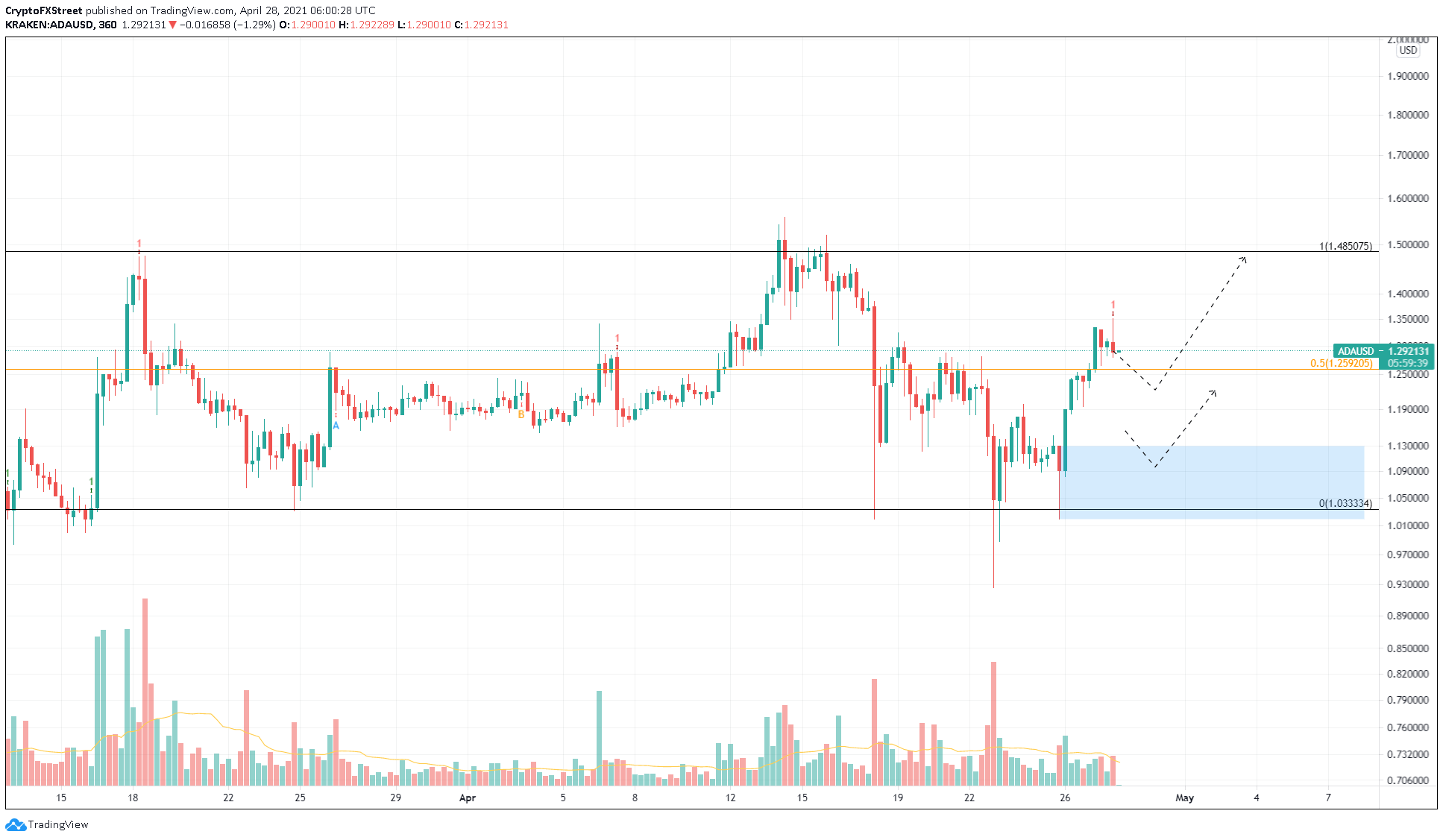
ADA/USD 6-hour chart
If the buyers fail to cushion the price in the said demand zone and cause a breakdown of the $0.99 level, it will invalidate the bullish thesis.
If this were to happen, ADA price could slide 7% to $0.92.
SaveTigray is selling digitised photos of the tragedy on its NFT marketplace and donating the proceeds to charities
In the Ethiopian region Tigray, citizens have been ravaged by war since fighting broke out eight months ago. The result, UNICEF estimates, is 400,000 people experiencing famine, 1.8 million on the verge of famine and tens of thousands already dead.
However, the charitable organisation SaveTigray has come up with an innovative method of raising funds for the victims: non-fungible tokens (NFTs).
Mirna Saraswati of SaveTigray explained, “Last year we planned to create NFTs from Fair Trade Art created by women from Tigray. But the advent of the war in November put an end to those plans. So instead, we are making NFTs based on interpreted photos of the tragedy. We will sell them on our NFT marketplace, and donate the proceeds equally to four groups: the World Food Program, International Rescue Committee, UNICEF, and Save the Children”.
On Monday, the World Food Program tweeted that it had sent a humanitarian convoy to the region but that it would need “to continue delivering 1000 metric tons of life-saving food on 40 trucks a day to #Tigray to meet the emergency food needs of 2.1 million people”.
Roads and bridges into Tigray have been blocked or destroyed by government forces, though they denied blocking aid, while the Ethiopian government and Eritrean troops stationed in the region have been accused of war crimes.
SaveTigray COO, Savannah Partridge, commented, “As much as we want to raise funds for victims, we really want to spread the news to millions. The Ethiopian government has announced that aid flights can resume from the capital, but so far none have been given approval. An outcry from the public can compel them to act”.
As most NFTs are minted and traded on the Ethereum blockchain, which currently uses the energy-intensive Proof of Work mechanism, a pressing issue has been their impact on the environment.
Partridge added, “We believe that NFTs are here to stay. We’ve solved the biggest problem associated with them, which is energy usage. Our platform uses 10 million times less energy than the standard Ethereum-based [sic] ones. Like any NFT, the provenance of each work can be easily traced through the Blockchain. And buyers can continue to use each image to raise more for the cause, if they so choose. NFTs earn Royalties every time they are sold, so they can keep fundraising forever”.