
As the blockchain sector gradually goes worldwide, the Ethereum Network is turning up as the top contender for blockchain infrastructure across the sector. Currently, the ETH network is the settlement layer for many stablecoins and real-world applications in the crypto space.
Euro Stablecoin Plans Eye Ethereum
A new chapter in blockchain adoption may be unfolding, and the Ethereum network is at the center of this transition as countries across the globe adopt the blockchain. Amid the shift, Ethereum is increasingly being considered as the settlement layer for a potential euro-denominated stablecoin.
Crypto Tice, a market expert and investor, took to the social media platform X to share the development, which has triggered a frenzy in the ETH community. The action demonstrates the increasing interest of politicians and financial institutions in utilizing Ethereum’s well-established infrastructure for practical financial applications.
According to the expert, this move is not a pilot or a sandbox test, as blockchain solutions are being incorporated into Europe’s changing digital banking environment. Rather, it is Europe evaluating real infrastructure in the financial sector. By acting as the foundation for such a project, the network could be crucial in integrating traditional finance with decentralized technology.
Furthermore, the expert has offered insights into why this move matters for the network and the blockchain sector. The first reason is that public blockchains are being increasingly assessed for sovereign-grade settlement infrastructure.
Based on the risks associated with finance, this move would offer transparency, uptime, and security, which are now policy considerations. ETH being considered as a settlement layer for a Euro stablecoin implies that crypt rails are moving from markets, especially from the institutional level, to the governmental stage.
Crypto Tice has debunked every speculation of hype around the move, claiming that this is about who settles money in the future. “Public blockchains just entered the sovereign conversation,” the expert added.
Stablecoin Market To Get A Boost?
In the meantime, the stablecoin market has slowed down. CW, a crypto investor and data analyst at CryptoQuant, highlighted that the stablecoin market cap has recently stalled at a certain level since October last year. Once this move is confirmed, the news is likely to bolster interest and demand for stablecoins, causing a wave of fresh capital into the market.
However, the growth of the stablecoin market cap is largely linked to the impending CLARITY Act, as the bill will trigger an explosive inflow of funds. In that scenario, the increase in the market cap will lead to a rally in the broader cryptocurrency market.
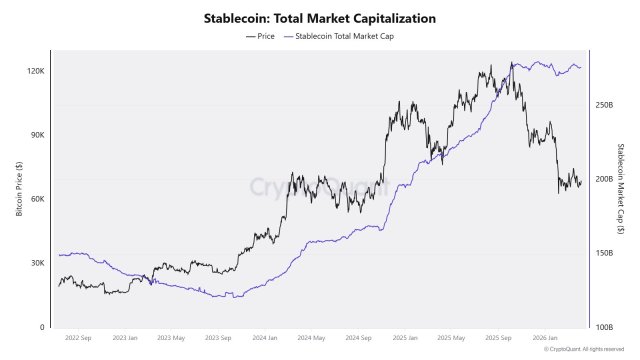
On crypto exchanges, stablecoin reserves are growing, with Binance experiencing a jump from $45.5 billion following a $2.5 billion March inflow. This jump comes after 3 months of persistent outflows. Darkfost stated that this turnaround is somewhat surprising considering the macroeconomic context.
Despite the escalating geopolitical tensions and unfavorable conditions in March, liquidity flows have started to return to the crypto market. April is already moving in alignment with the pattern, recording more than $1 billion in net stablecoin inflows since the month began.
Featured image from Freepik, chart from Tradingview.com
Editorial Process for bitcoinist is centered on delivering thoroughly researched, accurate, and unbiased content. We uphold strict sourcing standards, and each page undergoes diligent review by our team of top technology experts and seasoned editors. This process ensures the integrity, relevance, and value of our content for our readers.
Dogecoin Price Stabilizes at $0.24 Amid Low Volatility and Bitcoin Correlation – Key Levels for Euro AD HOC NEWS
Source link ]]>
XRP Price News: EU Backs Digital Euro as XRP Slips, Cardano openPR.com
Source link ]]>
Why is Elon Musk’s Dogecoin surging so high? Euro Weekly News
Source link ]]>
Independent member of the German Bundestag, Joana Cotar, has advocated for Bitcoin (BTC) again. Furthermore, she voiced strong opposition to the European Central Bank’s (ECB) push for a digital Euro. In a speech delivered to the parliament, Cotar questioned the necessity of the digital Euro, which was proposed by ECB President Christine Lagarde. Moreover, she stated that no one has clearly explained its benefits.
German Lawmaker Pits Bitcoin Against Digital Euro
Cotar emphasized that the demand for a digital Euro seems limited to the ECB and a select group of politicians. In addition, she expressed concerns about the financial risks posed by this new form of currency. “The promises that the ECB makes on privacy are not worth the paper they are written on,” Cotar declared, reflecting widespread skepticism.
Cotar further criticized the ECB’s assurances on privacy. Moreover, she noted that the ultimate responsibility for balancing privacy and policy objectives would fall on European lawmakers. “We know your trick,” she said, accusing authorities of gradually increasing surveillance and control under the guise of harmless initiatives. Cotar ended her speech with a call to “Study Bitcoin.”
Furthermore, Cotar took to social media to amplify her message. Sharing a video of her speech on X, she wrote, “It’s not about another means of payment. It’s about control. The #digitaleEuro is the path to total surveillance. A minute of speaking time isn’t much, but I couldn’t remain silent on the topic. #CBDC #Bitcoin.”
In recent weeks, the German government has been active in the crypto market. They currently hold 39,826 Bitcoin valued at approximately $2.30 billion. This follows the offloading of over 10,000 BTC from their reserve of 50,000 BTC, as reported on June 18. On Thursday, July 4, the government allegedly offloaded another 1,300 Bitcoin to major crypto exchanges.
Also Read: German Govt Transfers Another 700 Bitcoin Amid Price Recovery
German BTC Liquidation
Blockchain analytics firm Arkham Intelligence reported that 500 BTC worth $29.05 million went to Bitstamp on Thursday. Similarly, 400 BTC worth $23.24 million were transferred to Coinbase, and another 400 BTC to Kraken. In total, the government offloaded nearly $76 million worth of Bitcoin. This massive liquidation coincided with a drop in Bitcoin’s price below $58,000, raising concerns about a further dip.
On July 5, the German government sent 547 BTC valued at $30 million to the market maker Flow Traders. Additionally, they have been moving Bitcoins to various BTC wallets and sending them to three crypto exchanges – Kraken, Bitstamp, and Coinbase.
On the same day, they moved 700 BTC worth $39.53 million to a new wallet address, 139PoP…, which has recently received significant amounts of Bitcoin from the government. Moreover, the following day, as Bitcoin’s price rebounded past $56,000, the government shifted another 700 BTC worth $40.47 million to the same address.
Cotar has been vocal about the government’s recent Bitcoin liquidations. Earlier this week, she directed her grievances to CDU Deputy Chairman Michael Kretschmer, Christian Lindner, the Federal Minister of Finance, and Chancellor Olaf Scholz. Cotar described the government’s actions as “counterproductive” and urged them to hold Bitcoin.
Cotar believes that Bitcoin offers a unique opportunity for investors to diversify their assets. She argued that Bitcoin could mitigate the risks associated with traditional investments. She compared Bitcoin’s capabilities to those of traditional assets, highlighting its potential benefits.
Moreover, Cotar also invited these officials to attend her upcoming lecture on October 17. The event will also feature Bitcoin maximalist Samson Mow as a guest speaker. Hence, Cotar is determined to continue advocating for Bitcoin and against the digital Euro. Moreover, she positioned herself as a prominent voice in the debate over the future of digital currencies in Europe.
Also Read: Bitcoin Maxi Hints What Comes Next After Germany, Mt Gox Selloff

The presented content may include the personal opinion of the author and is subject to market condition. Do your market research before investing in cryptocurrencies. The author or the publication does not hold any responsibility for your personal financial loss.
Bitcoin (BTC) is rallying strong and has successfully hit an all-time high (ATH) in Euro.
BTC Hits ATH in EUR and GBP
Precisely, Bitcoin reached an ATH of €60,447 and £51,736 on the American cryptocurrency exchange Coinbase, marking new ATHs. It is worth noting that BTC is yet to surpass its ATH in the United States. In November 2021, the coin reached a market value of over $69,000 on Coinbase.
Within the last 24 hours, the flagship digital asset has registered more than a 6% increase and at press time, it was trading at $66,190.83.
The surge in Bitcoin price is driven by several events including the growth in the spot Bitcoin ETF market. Only BlackRock’s IBIT has registered up to $7.8 billion in inflows, followed by Fidelity’s FBTC with $4.8 billion in inflows.
February turned out to be the month with the longest green candle in Bitcoin’s history. Beyond its price, BTC’s market capitalization has jumped in tandem, now reaching $1.244 trillion. This growth further attenuates its position as Bitcoin dominates the digital asset ecosystem.
Investors’ interest and activities in the Bitcoin market have also increased significantly, a position that is clearly expressed in the trading volume of the coin which also soared by 65.6% to reach $34.75 billion. Buyers seem not to be in losses anymore as the number of addresses in profit has hit almost 100% at 51.94 million
Only about two weeks ago, the volume of BTC addresses in profit had only topped 90%, underscoring the rapid rally in the coin’s metrics.
Impact of Inflation on Bitcoin Price
The dollar index of the coin showed a positive momentum from last week. Notably, the dollar index is a key indicator that tests the strength or relative value of the U.S. currency against six major rivals. A rise in the index is indicative of the dollar’s strength against the other top currencies and vice versa. In January and February, the index cumulatively gained 2.7%.
A recently published statement from Grayscale reiterated the steady decline in U.S. inflation since the year started. To this end, analysts from the popular spot Bitcoin ETF issuer released a cautionary note, warning about the adverse effect of inflation on higher interest rates and consequently, on crypto.
For context, growing inflation would decrease the likelihood of interest rate cuts by the U.S. Federal Reserve, a scenario that could dampen the prospects for further crypto accumulation and valuation increases as traditional investment instruments will be fairly attractive with limited risks.


The presented content may include the personal opinion of the author and is subject to market condition. Do your market research before investing in cryptocurrencies. The author or the publication does not hold any responsibility for your personal financial loss.
The Chicago Mercantile Exchange (CME) has revealed that it plans to launch Euro-denominated micro Bitcoin and Ether futures contracts, due to commence on March 18, upon regulatory approval. This development is a significant expansion of CME’s cryptocurrency derivatives suite after successfully launching its U.S. dollar-denominated micro futures for these dominant digital assets.
Bitcoin and Ether Futures
Euro-denominated contracts scheduled to be launched soon shall be introduced to service the need for Bitcoin and Ether exposure while being cost-effective. The size of each microcontract will be one-tenth of the coin involved in the corresponding cryptocurrency, thus representing the pattern of their U.S. dollar equivalents.
The move is a reaction to the growing demand for advanced tools by worldwide investors to manage the risks of investments in cryptocurrencies.
Giovanni Vicioso, CME Group’s Global Head of Cryptocurrency Products, pointed out the quadrupled volume in USD-denominated micro Bitcoin and Ether futures, reflecting growing demand for these digital assets. The emergence of Euro futures will provide clients with other investment instruments to hedge their Bitcoin and Ether positions properly, especially in Europe, where considerable trading activity is beginning.
A Strategic Move Amid Growing Interest
The launch of the Euro-denominated future is made in significant growth in the crypto futures market, which is mainly USD-contract based. The CME’s move is anticipated to bring an extra level of versatility to investors who wish to hedge their cryptocurrency exposure in the context of the Euro, the second most traded fiat currency.
This achievement is striking, considering that the CME was among the first to create a crypto derivatives market. Since introducing Bitcoin futures in December 2017, the exchange has been ranked as one of the leading locations for trading cryptocurrency derivatives. Euro futures market entry is expected to add firmer shape to CME’s standing in this challenging area.
Trading Activity Record Signals Strong Interest.
The months have witnessed substantial growth in the trading volume of the CME’s cryptocurrency products. The open interest in Bitcoin futures peaked, and the trading volumes reached an all-time high. Similarly, open interest and trading volume in Ether futures have increased but are still below the highest value recorded in November 2021.
Micro Bitcoin and Ether Euro futures are anticipated to leverage off this uptrend, allowing traders a multitude of opportunities to participate in the crypto market. With the help of contracts, which are a fraction of the size of the real cryptocurrencies, CME seeks to make cryptocurrency derivatives trading more available to numerous investors.
Moreover, the move to introduce Euro futures also coincides with the overall direction of the crypto market, which sees a rising demand for Bitcoin and Ether exchange-traded funds (ETFs). These ETFs have attracted significant attention from investors, further underscoring the need for diverse derivative products like the Euro futures.
Read Also: Stellar (XLM) Eyes New Era With Mega Upgrade, Will Validators Fall in Line?

The presented content may include the personal opinion of the author and is subject to market condition. Do your market research before investing in cryptocurrencies. The author or the publication does not hold any responsibility for your personal financial loss.
Mastering the Art of Claiming Free Tokens: Crypto Euro Shiba Inu $EShib Essentials Medium
Source link ]]>
Is the Elon Musk Effect As Strong As It Once Was? How Can … Euro Weekly News
Source link ]]>
Shiba Inu And Dogecoin Whales Turn to Scorpion Casino Token … Euro Weekly News
Source link ]]>
✓ Share: