DOGE and Shiba Inu Predictions Excite Traders, but Ozak AI Could Outshine Them Both openPR.com
Source link ]]>
Crypto Rally Incoming? Dogecoin Price Predictions and Remittix Major Updates & Upcoming Listings Excite Market Mitrade
Source link ]]>
Shiba Inu’s (SHIB) 2025 Growth Prospects Fail to Excite, While This Coin’s 15700% Forecast Sends Investors Scrambling Analytics Insight
Source link ]]>
Dogecoin and Solana Price Predictions Unable To Excite Investors Like Analysts 5000% Remittix Forecasts TronWeekly
Source link ]]>
Shiba Inu, Dogecoin Caged As AI Coins Like Fetch.AI And Render Network Excite Market: Here’s Why Benzinga
Source link ]]>
In more than a decade since the MtGox exchange was exploited, the trading platform’s former CEO, Mark Karpeles has made a new revelation that might be intriguing to the platform’s creditors.
The New MtGox Disclaimer
Karpeles was dragged into a conversation concerning Dr. Craig Wright and the claims bordering on approximately 80,000 BTC that is resident on a wallet address starting with 1Feex. While in the numerous lawsuits and copyright ownership claims from Wright has hinted that he owns the 80,000 BTC in that address which was sent from MtGox, the community called on Karpeles to hear his thoughts on the claims.
Karpeles promptly noted that the transfer of funds from MtGox into the wallet address was not authorized by anyone from the defunct crypto trading platform. As such, he implied that whoever is laying claims to the funds in the address must have also exploited the trading platform altogether.
In his exact words, Karpeles wrote;
“I hereby certify that the 79956.55 Bitcoins sent to the 1Feex address on March 1st 2011 were transferred without proper authorization from MtGox’s original bitcoin wallet, and are considered stolen property belonging to the MtGox estate for the profit of the MtGox creditors.”
I hereby certify that the 79956.55 Bitcoins sent to the 1Feex address on March 1st 2011 were transferred without proper authorization from MtGox’s original bitcoind wallet, and are considered stolen property belonging to the MtGox estate for the profit of the MtGox creditors.
— Mark Karpelès (@MagicalTux) August 1, 2023
The declaration has opened up another intrigue to the MtGox creditor claims which remains unsolved at this time. It remains unclear whether or not any additional claims can be made to add the 80k Bitcoins to the coins claimable by the MtGox creditors.
The 80,000 BTC is worth the sum of $2,306,044,800, a sum that can make a difference to creditors across the board.
MtGox Creditor Claims: Current Update
For a hack that was carried out back in 2011, creditors are yet to be refunded. However, with registrations for repayment closed back in April this year, creditors are expecting their payment by October, barring any last-minute changes.
While the schedule remains intact, the timeline may still change should the restructuring committee deem it fit and secure necessary approvals from the Tokyo District Court. Despite the delay, there are projections that the repayments might be worth the wait in the long run.

The presented content may include the personal opinion of the author and is subject to market condition. Do your market research before investing in cryptocurrencies. The author or the publication does not hold any responsibility for your personal financial loss.

-
Polygon’s MATIC lost 2.49% on Wednesday
-
Polygon partnered with LGND and Warner Music
-
MATIC could correct back to the $0.77 support
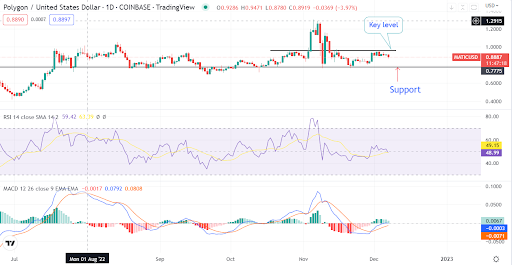
Polygon’s (MATIC/USD) fell by 2.49% on Wednesday as the cryptocurrency continued to face resistance at $0.96. As of press time, MATIC was trading at $0.88 and on a slight slide from the resistance level. Should the bears continue to exert pressure on MATIC price, it could fall back to the $0.77 support. But key fundamental developments continue to pop up for MATIC.
Interactive platform builder and ecommerce LGND announced a multiyear partnership with Polygon and Warner Music Group. According to the announcement, Polygon will enable LGND to build a Web3 platform dubbed LGND Music. The platform will launch in January 2023 and support digital collectibles from other blockchains via a proprietary layer. Through the partnership, Warner Music artists will launch digital collectibles on the app and desktop platforms.
The announced partnership is a validation of the growing role of Polygon in Web3. The Layer 2 blockchain offers low fees and faster transactions, making it a top choice for firms entering Web3. Consequently, its native token has been relatively stable compared to most cryptocurrencies in a sustained bear market.
MATIC price outlook and analysis
MATIC/USD Chart by TradingView
The technical indicators show MATIC is slightly bearish. The RSI is slightly below the midpoint. The MACD indicator is neutral, although the momentum has weakened slightly. MATIC price dynamics show the token is correcting slightly.
When is MATIC likely to become bullish?
The trading is mixed for MATIC. A bullish view can be confirmed if the token closes above $0.96. Similarly, a bear market can be confirmed if the price closes below $0.77. At the moment, MATIC may continue to consolidate between support and resistance.
Where to buy MATIC
eToro
eToro offers a wide range of cryptos, such as Bitcoin, XRP and others, alongside crypto/fiat and crypto/crypto pairs. eToro users can connect with, learn from, and copy or get copied by other users.
Bitstamp
Bitstamp is a leading cryptocurrency exchange which offers trading in fiat currencies or popular cryptocurrencies.
Bitstamp is a fully regulated company which offers users an intuitive interface, a high degree of security for your digital assets, excellent customer support and multiple withdrawal methods.
Vitalik Buterin, the co-founder of Ethereum is undoubtedly one of the most influential figures in the Ethereum ecosystem.
In a new blog post, Buterin has now revealed his hottest trends and most exciting use cases that excite him. The post covers money, DeFi, digital identity, DAOs, and hybrid applications.
Ethereum Founder Shares His Excitement
On the topic of money, Buterin notes that this is still the first and most important application. Unlike wealthy countries where financial transactions are easy and 8% inflation is considered extreme, for many countries with high inflation, access to global currencies is foreclosed.
Cryptocurrencies are a solution here, although fees are a concern, as Buterin admits, particularly with regard to Ethereum. Therefore, he is enthusiastic about scaling technologies such as Optimistic and ZK rollup, but also social recovery and multisig wallets, through which abstraction of accounts is becoming more practical.
In payments, Buterin says stablecoins have proven their worth, “realistically combining the benefits of digitization with cash-like respect for privacy.”
However, centralized stablecoins are not a long-term solution to withstand surveillance, according to the Ethereum founder.
Therefore, he considers DAO-managed risk-weighted asset (RWA)-backed stablecoins, such as DAI as a “happy medium”, and governance-minimized crypto-backed stablecoin, such as RAI and LUSD, as a riskier approach.
To make the [RAI] system stable (so, not be vulnerable to collapse like LUNA), every holder of RAI must be matched by a holder of negative RAI who puts in ETH as collateral.
DeFi And Digital Identity
Buterin criticizes the current DeFi sector as an “overcapitalized monster” that relies on unsustainable forms of yield farming.
The most important DeFi product, according to the Ethereum co-founder, are decentralized stablecoins. Buterin also calls prediction markets an important pillar.
I expect prediction markets to not make extreme multibillion-dollar splashes, but continue to steadily grow and become more useful over time.
In his assessment of the growth of digital identity, the co-founder said the trend is helping to protect user privacy. He pointed to the Sign In With Ethereum (SIWE) as an effective identity method.
The Sign In With Ethereum (SIWE) standard allows users to sign in to websites in a similar way that Google or Facebook accounts can be used today, without giving sites access to private files or the ability to take over or block the account.
The most well-known project is the Ethereum Name Service (ENS), which assigns a human-readable name to an Ethereum address. The names usually end in .eth.
DAOs And Hybrid Applications
On the topic of DAOs, Buterin explains that while there are many structures that work, many others do not, or at least are not aligned with the goals they are trying to achieve.
Therefore, there are two key questions to answer: What types of governance structures are useful, and for what use cases? Does it make sense to implement these structures in the form of a DAO, or through regular corporate incorporation and legal contracts?
Basically, there are two options: one type of non-financialized governance and a bicameral hybrid where decisions are made not only by token holders but also by another class of users.
Buterin is also enthusiastic about hybrid applications. These are applications that do not rely solely on blockchain, but use both blockchains and other systems to improve their trust models.
Use cases include voting, government registries, enterprise accounting, gaming, supply chain management and credential tracking.
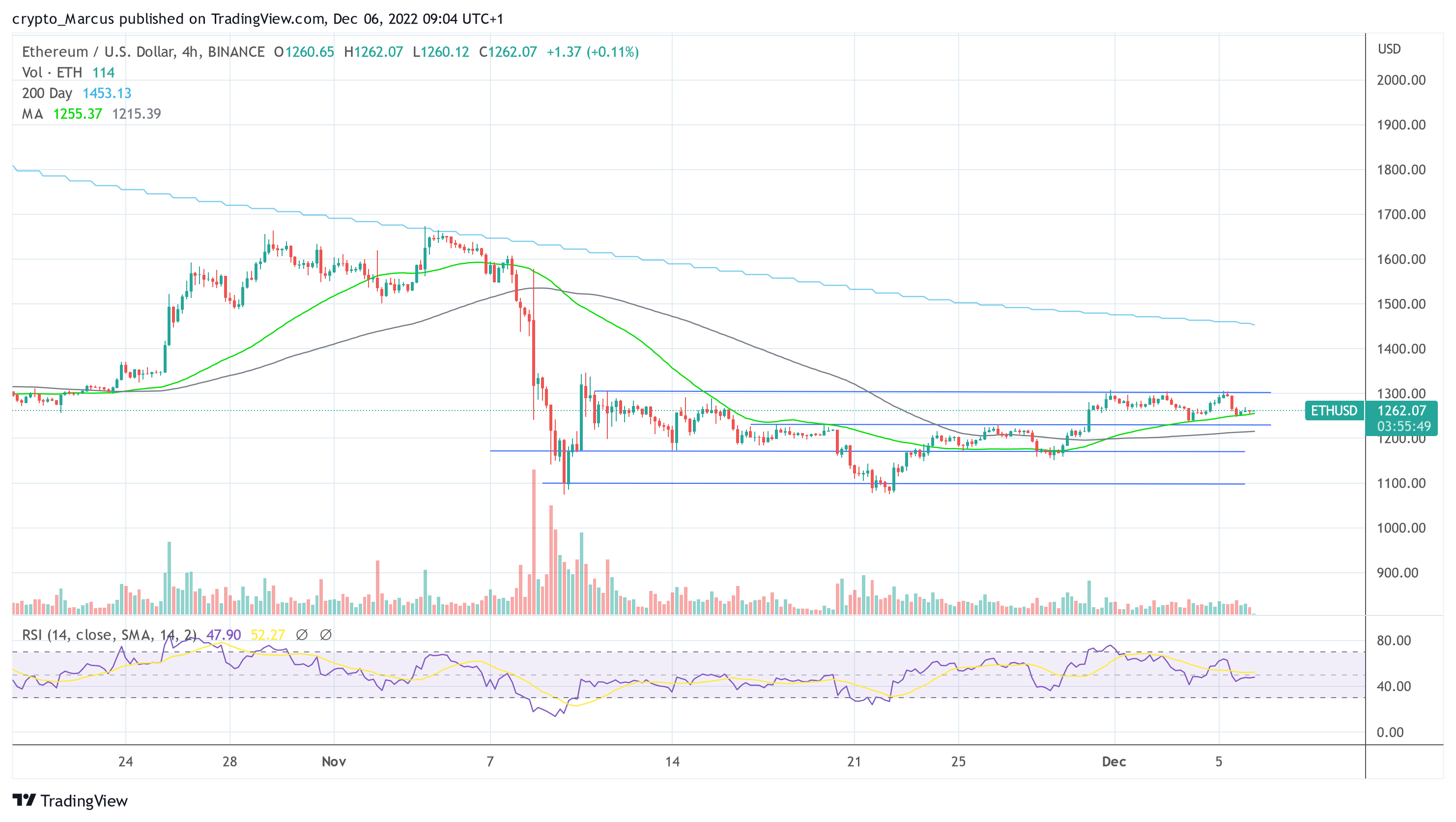
At press time, the ETH price is still stuck underneath the key resistance at $1.300.