For over a decade, Ripple and its executives have been steadily dumping XRP into the open market. Because XRP was fully created at launch, every token sold came from a known and finite supply. By comparing the original allocations from 2012 with current on-chain holdings, it is now possible to calculate how much XRP Ripple and its executives have offloaded so far.
How XRP Was Allocated And Where The Tokens Went
XRP was launched in 2012 with a fixed supply of 100 billion XRP, all created at once on the XRP Ledger. There has never been mining, staking, or inflation. Of that total supply, 80 billion XRP were transferred to the company that later became Ripple, while the remaining 20 billion XRP were allocated to founders and early insiders. The core individuals involved at launch were Jed McCaleb, Arthur Britto, and David Schwartz.
Related Reading
More than a decade later, the remaining holdings of Ripple and its executives provide a clear benchmark for calculating how much XRP has been sold. Combined, Ripple and named executives currently control about 41.485 billion XRP. Ripple itself holds approximately 37.685 billion XRP, split between 3.5 billion XRP in wallets that can be accessed directly and 34.185 billion XRP locked in escrow.
Among executives, Chris Larsen, Ripple’s chairman, holds about 2.5 billion XRP across eight wallets, while Arthur Britto controls roughly 1.3 billion XRP spread across seven wallets. David Schwartz, despite being a co-founder, holds a significantly smaller amount, peaking historically at around 26 million XRP, far below the multi-billion-token balances of other insiders.
When current holdings are subtracted from the original allocations, the numbers indicate that Ripple and its executives have sold or distributed approximately 58.515 billion XRP since 2012.
What Those Sales Mean In Price And Market Terms
The scale of these sales often raises concerns about long-term price pressure, but timing is critical. XRP’s earliest recorded market price was approximately $0.00587 in August 2013. Today, it trades near $1.88, reflecting a remarkable increase of roughly 31,756% over that period.
These gains unfolded even as billions of XRP entered circulation gradually rather than in sudden waves. In 2017, Ripple implemented an escrow system that locked up 55 billion XRP, allowing up to 1 billion XRP to be released each month. Any unused portion is returned to escrow, effectively limiting unexpected supply shocks. As of 2026, 34.185 billion XRP remain locked under this system.
Related Reading
Cumulatively, the 58.515 billion XRP sold over 13 years would be valued at approximately $109 billion at today’s prices. These sales occurred alongside ongoing ecosystem development, legal challenges, and multiple market cycles, highlighting that distribution happened in a managed, phased manner.
Overall, while Ripple and its executives have distributed a significant portion of their holdings, the careful, escrow-managed approach over more than a decade coincided with sustained price appreciation. This suggests that strategic, phased selling has not undermined XRP’s long-term market growth.
Featured image created with Dall.E, chart from Tradingview.com
Bitcoin slipped below $90,000 this week, a level it had not touched in seven months, according to data. Traders watched nervously as the flagship token moved around $90,700, leaving it roughly 25% beneath its recent all-time high of just over $126,000 reached on Oct. 6. Markets noted that a big liquidation event on Oct. 10 still echoes through trading desks.
Analysts See A Near-Term Bottom
According to an interview on CNBC, BitMine chairman Tom Lee said the Oct. 10 liquidations and ongoing uncertainty about whether the US Federal Reserve will cut rates in December have kept pressure on crypto.
He described signs of exhaustion among sellers and cited technical work suggesting a bottom could appear soon.
Bitwise Asset Management chief investment officer Matt Hougan shared a similar line of thinking, calling current pricing a “generational opportunity” and urging longer-term investors to take notice. He added that traders are jittery about the economy, high AI valuations, and US President Donald Trump’s tariffs, which may have added to selling.
Selling Fueled Mostly By Short-Term Holders
According To XWIN Research, a review of on-chain measures showed short-term holders did much of the heavy lifting in the recent decline.
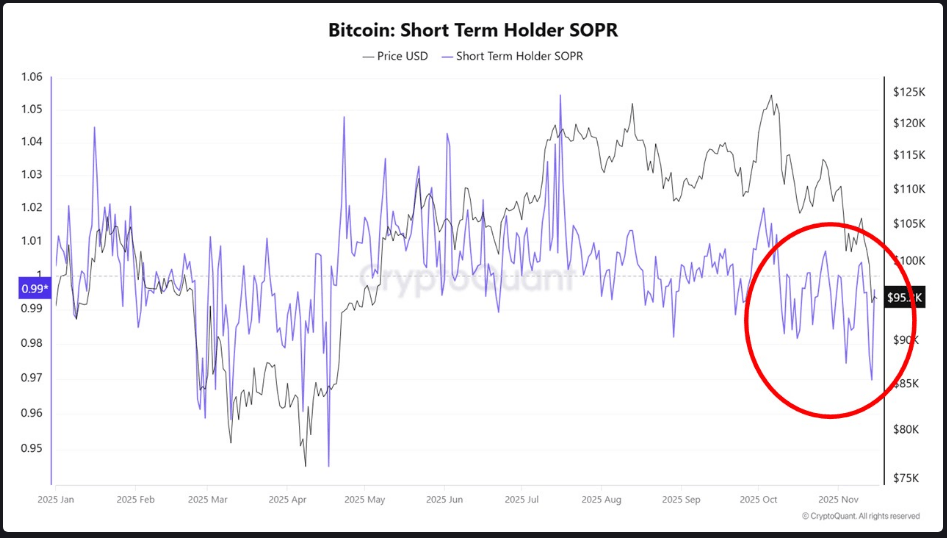
The Short-Term Holder Spent Output Profit Ratio fell below 1 on multiple occasions, which signals many short-term owners sold at a loss. XWIN also said coins younger than three months made up most of the spent volume during the worst of the drop.
That pattern points to panic-driven exits by recent buyers rather than mass, late-cycle distribution by longtime holders.
At the same time, metrics such as Coin Days Destroyed, Realized Profit, and Long-Term Holder Net Position Change registered increased distribution by long-term holders since September, but XWIN argued this behavior matches routine profit-taking during a bull run rather than blow-off top selling.
Flow From ETFs And Whales Adds Pressure
Reports have disclosed that exchange-traded fund outflows and large sales by whales also contributed to the weakness, while rising geopolitical tensions added a further layer of risk.
Market participants described Bitcoin as an early mover that started to weaken before other risk assets, which some investors took as a warning signal for broader markets.
Outlook Hinges On Stocks And Policy
Lee expects a rebound if equities rally later this year, saying a stronger stock market would likely lift Bitcoin back to fresh highs before year-end.
Hougan agreed that a recovery could come quickly and that the current window offers an attractive entry for investors planning to hold for 12 months or more.
Yet traders remain split; a few see the recent data as clear exhaustion, while others warn macro events and policy decisions could push prices lower before confidence returns.
Featured image from Unsplash, chart from TradingView
]]>Executives from VanEck and Coinbase are raising alarms over the U.S. Securities and Exchange Commission’s (SEC) handling of spot Bitcoin ETFs. They pointed to increased borrowing costs as a direct consequence of the regulatory framework. According to these industry leaders, the SEC’s refusal to allow in-kind creation and redemption of Spot BTC ETFs has created inefficiencies. This has forced market participants to take on significant capital costs.
VanEck & Coinbase Execs On Spike In Borrowing For Bitcoin ETFs
Matthew Sigel, Head of Digital Assets Research at VanEck, a prominent player in the BTC ETF market, has been vocal about the challenges brought on by the SEC’s rules. “The SEC’s refusal to allow the in-kind creation and redemption of spot Bitcoin ETFs forces market participants to pre-fund many of their Bitcoin ETF-related transactions,” Sigel said.
Furthermore, he emphasized that this requirement has made the ETF process more capital-intensive and expensive than necessary. Sigel believes that if the SEC were to approve in-kind transactions, trading spreads would tighten. Also, the discount to net asset value (NAV) of Bitcoin ETFs would narrow, eventually benefiting investors.
Coinbase, a prominent crypto exchange, has also been navigating the challenges posed by the SEC’s framework. Matt Boyd, Coinbase’s Head of Prime Finance, highlighted the financial strain caused by the settlement mismatch between cash and Bitcoin transactions.
“Our financing costs are not particularly expensive. They are similar to emerging market financing costs. Anyone allowing a purchase prior to receiving cash is providing a loan and is getting compensated for that in some way,” Boyd explained, according to a report by Risk.Net.
The mismatch stems from the differing settlement cycles for cash and cryptocurrencies. Bitcoin transactions typically settle on the same day. However, the cash required for these trades, provided by authorized participants (APs) such as banks and high-frequency trading firms, follows a T+1 cycle. Hence, this discrepancy forces ETF managers to either pre-fund Bitcoin purchases from their own balance sheets or seek short-term loans from exchanges like Coinbase.
Also Read: Coinbase Firmly Opposes CFTC’s Proposed Ban On Prediction Markets
Calls For Broader Solutions
The SEC’s regulatory stance has had ripple effects across the industry, affecting other major players. For instance, Duncan Trenholme, TP Icap’s Global Co-Head of Digital Assets, noted the significant strain on ETF managers. “Our clients are having to manage a settlement mismatch on the physical hedging of the ETF, which is a strain on their own inventory or balance sheet,” Trenholme said.
This funding challenge is particularly evident with BlackRock’s iShares Bitcoin Trust, the world’s largest spot Bitcoin fund. The fund has attracted substantial inflows since its launch with over $19.5 billion in assets under management. The IBIT Bitcoin ETF average daily inflows have reached $144 million, with a peak of $849 million in a single day, illustrating the scale of the capital involved.
Moreover, the increasing borrowing costs and counterparty risks have led some in the industry to call for broader solutions. Rob Strebel, Head of Relationship Management at DRW, which operates the crypto trading firm Cumberland, discussed the adjustments his firm has made to cope with these challenges.
“Crypto ETFs require settlements that look like what you see in traditional finance versus spot crypto,” Strebel explained. Additionally, he noted that Cumberland has had to internalize the flow from its market-making activities to mitigate additional balance sheet costs.
Others, like Michael Lie, Flow Traders’ Global Head of Digital Assets, suggest that an industry-wide facility to support short-term borrowing could alleviate some of the pressure. “Being able to source hundreds of millions of capital is quite expensive. It’s not so easy. Market-makers need to free up the cash just for one or two days,” Lie pointed out.
Also Read: Zetachain Soars 17% As Coinbase Confirms Roadmap Listing

Kritika Mehta
Kritika boasts over 2 years of experience in the financial news sector. Currently working as a crypto journalist at Coingape, she has consistently shown a knack for blockchain technology and cryptocurrencies. Kritika combines insightful analysis with a deep understanding of market trends. With a keen interest in technical analysis, she brings a nuanced perspective to her reporting, exploring the intersection of finance, technology, and emerging trends in the crypto space.
Disclaimer: The presented content may include the personal opinion of the author and is subject to market condition. Do your market research before investing in cryptocurrencies. The author or the publication does not hold any responsibility for your personal financial loss.
Solana, Cardano ‘left out to dry’ in SEC-Binance case, claim Ripple execs AMBCrypto News
Source link ]]>
‘Dogecoin purer than Ethereum:’ Elon Musk, execs react to Top 10 move AMBCrypto News
Source link ]]>
Messari Report Irks Cardano Execs over Chain’s Omission DailyCoin
Source link ]]>
Cardano founder Charles Hoskinson warns Ledger against breaking social contracts, joins Binance, Polygon execs FXStreet
Source link ]]>
Ripple, Cardano execs double down on their criticism of U.S banking system AMBCrypto News
Source link ]]>
 Crypto Flipsider News – Crypto Execs Get Hearing at Capitol, Reddit Crypto Rewards Expand, France & Switzerland CBDC, Cardano Stakers Pass 1 Million, Kickstarter Will Move to Blockchain
Read in the Digest
- Top Crypto Execs Ask for Clearer Rules, U.S. Comptroller Backs Crypto to Enhance Financial Sector
- Reddit Crypto Rewards Expands, Cryptocurrency Most Talked About Topic, and Trending in 2021
- France and Switzerland Were Successful in Multi-Currency Wholesale CBDC Trial
- Unique Addresses Grow by 7%, with More than 1 Million Stakers
- Kickstarter Plans to Move Its Crowdfunding Platform to Blockchain
Top Crypto Execs Ask for Clearer Rules, U.S. Comptroller Backs Crypto to Enhance Financial Sector
Wednesday, December 8, was a big day for the crypto industry as top execs from six major companies, including Coinbase (NASDAQ:) and Circle, were granted a hearing at the Capitol. This is the first hearing between crypto execs and U.S. lawmakers.
At the hearing, the execs explained that while they understood more regulation is coming to the $3 trillion industry, they want clearer rules that won’t squelch or send crypto firms to other countries.
Some lawmakers praised the crypto execs for leading the way on what could be a pivotal technology. Representative Pete Sessions said,
“I am tremendously impressed. I see a lot of ingenuity, a lot of entrepreneurial spirit. We need to be supportive of you.”
In a win for the crypto industry, the Office of the Comptroller of the Currency (OCC) has noted that cryptocurrencies can enhance the functionality of financial services.
While advising caution for banks involved in crypto-related activities, in the Semiannual Risk Report, the OCC opines that the adoption of cryptos can lead to improved financial services and can offer many benefits to both banks and their customers.
Flipsider:
- Despite the meeting, analysts believe that Congress is unlikely to make new crypto rules anytime soon
Why You Should Care
Cryptocurrencies have come a long way since they were first introduced, and clearer, more favorable rules could guide the development of the industry.
Reddit Crypto Rewards Expands, Cryptocurrency Most Talked About Topic, Dogecoin and Ethereum Trending in 2021
Two years after launching an Ethereum-based crypto token reward, Reddit has expanded the initiative to a larger audience. Reddit has launched a new website for its Community Points beta program, allowing users to request the reward feature for their community or subreddit.
Cryptocurrencies have enjoyed remarkable growth in 2021, and Reddit is one platform that played an important role. Confirming this, Cryptocurrency has emerged as the most talked-about topic across the 100,000+ active communities on Reddit. In addition, GameStop (NYSE:) stole the top three upvoted posts on Reddit.
Google (NASDAQ:) Trends, a website that analyzes the popularity of top search queries, has confirmed the increasing search for crypto. “Dogecoin” and “Ethereum Price” were on the list of top 10 trending hot news for 2021.
Dogecoin made the list at number four, while the Ethereum price was the 10th most searched topic in 2021.
Flipsider:
- Despite the growth of cryptocurrencies, countries are still adamant about embracing the technology, with some moving to outlaw cryptos
Why You Should Care
The growth of cryptocurrencies across multiple platforms confirms it is slowly gaining mainstream interest and adoption.
France and Switzerland Were Successful in Multi-Currency Wholesale CBDC Trial
Joining the growing trend of countries experimenting on a Central Bank Digital Currency (CBDC), the Banque de France and the Swiss National Bank have shared the results of Project Jura, a joint CBDC project involving both central banks.
Project Jura is the first time a digital euro and Swiss franc were fully tested as a CBDC. Jura aimed at testing wholesale instant foreign exchange settlement in the euro and Swiss franc.
It also experimented with wholesale CBDC as a payment option for tokenized commercial paper transactions. Benoît Cœuré, Head of the BIS Innovation Hub, said:
“Project Jura confirms that a well-designed wholesale CBDC can play a critical role as a safe and neutral settlement asset for international financial transactions.”
Flipsider:
- While CBDCs are becoming increasingly popular, the Australian Reserve Bank governor has remained skeptical about implementing a CBDC
Why You Should Care
With projects like Jura, it won’t be long before central banks find more use cases for CBDCs and begin to implement their adoption.
Unique Cardano Addresses Grow by 7%, with More than 1 Million Stakers
Technology-driven project Cardano has reached yet another milestone, with its network now home to more than 1 million active stakers.
According to data from Staking Rewards, the number of unique addresses staking Cardano (ADA) has grown nearly 7% in the last 30 days. As of December 9, 1,008,241 unique wallet addresses were staking ADA.
Cardano now has one of the most active staking pools among crypto projects. 70.34% of its current market cap has been staked, $32.594 billion has been staked out of a $43.848 billion market cap.
Cardano is now the third-largest staking network, trailing only ($72.788 billion staked) and Ethereum 2.0 ($36.283 billion).
Flipsider:
- Despite network growth, ADA is still struggling to reclaim its previous highs of $3.10 recorded on September 10
Why You Should Care
Cardano’s growth is a result of the dedication of the IOHK to continually improve and add new features to the network
Kickstarter Plans to Move Its Crowdfunding Platform to Blockchain
Global crowdfunding platform, Kickstarter, is betting big on blockchain technology, as it announced plans to create an open-source protocol that will create a decentralized version of Kickstarter’s core functionality.
When the building of the crowdfunding blockchain platform is ready, Kickstarter.com will transition to the new infrastructure. The company says the goal is for multiple platforms to embrace the protocol.
Development is scheduled to begin in Q1 of 2022, with Kickstarter.com aiming to transition sometime in 2022. Kickstarter will leverage the Celo blockchain, which uses a less energy-intensive consensus mechanism.
To oversee the blockchain platform development, Kickstarter has launched a new organization called Kickstarter PBC. The company also established an “independent governance lab” to publish research and get community feedback on protocol governance.
Flipsider:
- While they started with cryptocurrencies, blockchains have now grown more than cryptocurrencies
Why You Should Care
The use of blockchain is spreading across traditional tech giants, with many firms now seeing the benefits of running an open-source protocol.
EMAIL NEWSLETTER
Join to get the flipside of crypto
Upgrade your inbox and get our DailyCoin editors’ picks 1x a week delivered straight to your inbox.
[contact-form-7]
You can always unsubscribe with just 1 click.
✓ Share: