
- SBI Crypto was breached, losing $21 million in assets via a suspected laundering operation.
- A phishing scam targeting GMGN tricked 107 users into approving fake transactions.
- Honeypot token scams rose 600% month-on-month, with over 2,100 tokens detected.
Web3 has entered a new phase of cyber threats, with attackers now leveraging artificial intelligence, automation tools, and complex social engineering to exploit users across decentralised networks.
According to GoPlus Security, over $45.84 million was lost in October alone from a surge of scams, phishing attacks, token exploits, and wallet hacks.
The data reveals how scammers are evolving their methods, creating high-impact exploits that have affected thousands of users and platforms across Ethereum, Binance Smart Chain, and Base.
Hackers use AI and automation to boost phishing campaigns
GoPlus observed a sharp increase in phishing attacks that led to more than $3.5 million in losses.
A growing number of these scams are powered by “Phishing-as-a-Service” platforms, where threat actors use AI tools to rapidly generate fake websites and deploy large-scale campaigns with lower operational costs.
One of the largest phishing cases involved the trading platform GMGN.
In this incident, 107 users were misled by a fake third-party website into authorising harmful transactions. Losses totalled more than $700,000.
The phishing scam replicated legitimate wallet interactions, tricking victims into signing approval requests that gave attackers control over their funds.
In another case, a trader approved a malicious “increaseAllowance” command, resulting in a $325,000 loss in Coinbase Wrapped Bitcoin.
Separately, another user was hit with a $440,000 loss after signing a fraudulent “permit” transaction.
Both exploits highlight the rise in fake contract approvals, often enabled by deceptive interfaces mimicking trusted apps.
Sophisticated exploits linked to state-style laundering tactics
The single largest exploit came from SBI Crypto, which suffered a breach that drained $21 million worth of digital assets. The losses included Bitcoin, Ethereum, Litecoin, Dogecoin, and Bitcoin Cash.
Although SBI Crypto did not officially confirm the source of the breach, a joint investigation by ZachXBT and Cyvers suggested patterns similar to those used by North Korean hacker groups.
The attackers allegedly funnelled funds through Tornado Cash, a known crypto mixer previously sanctioned for its role in laundering state-sponsored thefts.
This laundering method closely mirrors activity linked to the Lazarus Group, though the report stressed that the connection remains unverified.
Web3 platforms under attack from honeypot tokens
Alongside phishing and exploits, the report found a dramatic spike in honeypot tokens.
These are malicious smart contracts that allow users to buy tokens but prevent them from selling or withdrawing funds.
Honeypot tokens surged 600% last month, reaching 2,189 identified tokens—though still far fewer than the 40,000 recorded in June 2025.

The Binance Smart Chain accounted for the bulk of these tokens at 1,780, followed by 216 on Ethereum and 131 on Base.
These tokens are embedded with hidden restrictions that block transactions, stranding investor funds in illiquid assets.
Their increase underscores a shift toward embedded contract-level fraud, which can bypass basic security tools.
Tokens and socials compromised in wider exploits
The wider ecosystem also saw losses from social media and platform-based breaches.
Astra Nova’s official social account was hijacked, triggering a large-scale sell-off of its native token RVV and causing losses of approximately $10.3 million.
In a separate exploit, decentralised finance platform Garden Finance was hit with a vulnerability that cost users around $10.8 million, according to ZachXBT.
These incidents reflect a widening surface of attack across both user-facing interfaces and backend contract code.
Hacker Exploits Dogecoin (DOGE) Flaw, Causing 69% of Nodes To Crash The Daily Hodl
Source link ]]>
Shiba Inu’s Cryptic Announcements, BlockDAG’s Innovative Low-Code, No-Code and Uniswap’s Resilience to Security Exploits CoinCodex
Source link ]]>
Bitcoin core developer, Luke Dashjr has slammed the Runes protocol noting that it exploits design flaws within the network. In an April 26 post on X (formerly Twitter), the BTC core developer restated fears echoed by the crypto community on the Runes protocol.
According to him, Runes merely exploit fundamental design flaws while Ordinals exploit vulnerabilities. Both protocols were rolled out by Casey Rodarmor marking his second huge innovation on the original blockchain.
Dashjr and some developers have recently been mindful of both protocols citing a deviation from the original principles according to critics. The projects are also criticized for clogging the network although Bitcoin miner fees increased significantly.
Bitcoin Ordinals were likened to non-fungible tokens on the blockchain which differs in impact from Runes. On April 26, a crypto enthusiast stated that Ocean Mining mined their first block after the Bitcoin halving made up of 75% Runes. He called on Dashjr to explain why he mined Runes which was referred to as shitcoins or if he now has a change of heart.
“Scammy” Dashjr Mounts Criticisms
In his response, Dashjr notes that they don’t dictate blocks for miners but empower them to decide while reiterating Runes as scams.
“That being said, while it’s unfortunate many scammy Runes got mined, they did meet the policies OCEAN has recommended from the start. While Ordinals are a 9-vector attack that exploits vulnerabilities in Bitcoin Core, Runes are “only” a 5-vector attack that technically follows the “rules”.
Runes Debates Continue
Crypto enthusiasts share divided opinions on the importance of Runes to the Bitcoin community. On one hand, critics say that an issue with the protocol is the design flaw which can lead to failed transactions getting mined.
Others opine that it will lead to scam transactions in the network. On the other side of the coin, Bitcoin miners are the biggest beneficiaries of the protocol after recording huge gains after the halving. The Bitcoin halving slashed rewards by 50% spurring most miners making a case for Runes.
Also Read: AI News: Sam Altman To Serve In Government’s AI Safety Board

The presented content may include the personal opinion of the author and is subject to market condition. Do your market research before investing in cryptocurrencies. The author or the publication does not hold any responsibility for your personal financial loss.
-
Algorand is bearish despite World Cup sponsorship
-
The token has crashed due to a bear market
-
ALGO may face further weakness unless bulls recover above $0.28
Algorand (ALGO/USD) was a cryptocurrency expected to shine as the FIFA World Cup kicked off last month. As the official blockchain sponsor of this year’s sporting event, the native token was expected to perform. Already, FIFA created its own NFT platform in September on the Algorand platform. That made it possible for football fans to buy World Cup-themed NFTs powered by Algorand. But as the event enters the best 8, ALGO price remains bearish. Why is this so?
The price action of ALGO is not something new in the crypto world. Tokens of blockchains such as Cardano and Ethereum have failed to take off after major platform upgrades. Consequently, cryptocurrencies tend to make a move after the initial announcement, underlining speculation as the cause of price spikes. ALGO became bullish in May when the sponsorship news came up and has since succumbed to the bear market.
It is certain that Algorand’s partnership with FIFA builds use cases for the platform. For ALGO, investors may have to wait longer for the price of the native token to become bullish. That can’t happen in a bearish market that has swept across all markets. But when can ALGO become bullish?
ALGO analysis and price outlook as the bear market continues
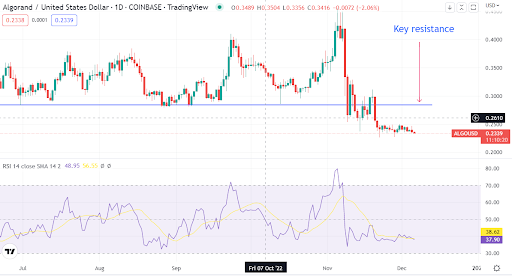
From the technical outlook, ALGO is bearish. Although the cryptocurrency has found stability at $0.23, it remains extremely bearish. The RSI remains below the midpoint but above the oversold zone. There is room for the cryptocurrency to fall lower.
When will ALGO recover?
A sustainable bullish momentum is possible if the general crypto sentiment improves. Cryptocurrencies are reeling from the bear market, and ALGO is no exception.
In the meantime, ALGO bulls must recapture $0.28 to consider short-term price appreciation possible. That is the crucial level that supported the token before the FTX-inspired crash last month.
Where to buy ALGO
eToro
eToro offers a wide range of cryptos, such as Bitcoin, XRP and others, alongside crypto/fiat and crypto/crypto pairs. eToro users can connect with, learn from, and copy or get copied by other users.
Bitstamp
Bitstamp is a leading cryptocurrency exchange which offers trading in fiat currencies or popular cryptocurrencies.
Bitstamp is a fully regulated company which offers users an intuitive interface, a high degree of security for your digital assets, excellent customer support and multiple withdrawal methods.
✓ Share: