Notice: Function _load_textdomain_just_in_time was called incorrectly. Translation loading for the updraftplus domain was triggered too early. This is usually an indicator for some code in the plugin or theme running too early. Translations should be loaded at the init action or later. Please see Debugging in WordPress for more information. (This message was added in version 6.7.0.) in /home/aonyeani76/cryptocurrencypanther/wp-includes/functions.php on line 6131
Notice: Function _load_textdomain_just_in_time was called incorrectly. Translation loading for the hustle domain was triggered too early. This is usually an indicator for some code in the plugin or theme running too early. Translations should be loaded at the init action or later. Please see Debugging in WordPress for more information. (This message was added in version 6.7.0.) in /home/aonyeani76/cryptocurrencypanther/wp-includes/functions.php on line 6131
Notice: Function _load_textdomain_just_in_time was called incorrectly. Translation loading for the wpforms-lite domain was triggered too early. This is usually an indicator for some code in the plugin or theme running too early. Translations should be loaded at the init action or later. Please see Debugging in WordPress for more information. (This message was added in version 6.7.0.) in /home/aonyeani76/cryptocurrencypanther/wp-includes/functions.php on line 6131 exposes – Cryptocurrencypanther
https://cryptocurrencypanther.com
Latest Crypto NewsThu, 26 Mar 2026 12:53:45 +0000en-US
hourly
1 https://wordpress.org/?v=6.9.4https://cryptocurrencypanther.com/wp-content/uploads/2021/07/cropped-Cryptocurrency-e1626714913653-32x32.pngexposes – Cryptocurrencypanther
https://cryptocurrencypanther.com
3232Hashdex Nasdaq ETF Exposes Investors to XRP, Solana and Cardano – mexc.co
https://cryptocurrencypanther.com/2026/03/26/hashdex-nasdaq-etf-exposes-investors-to-xrp-solana-and-cardano-mexc-co/
https://cryptocurrencypanther.com/2026/03/26/hashdex-nasdaq-etf-exposes-investors-to-xrp-solana-and-cardano-mexc-co/#respondThu, 26 Mar 2026 12:53:45 +0000https://cryptocurrencypanther.com/2026/03/26/hashdex-nasdaq-etf-exposes-investors-to-xrp-solana-and-cardano-mexc-co/
Source link
]]>https://cryptocurrencypanther.com/2026/03/26/hashdex-nasdaq-etf-exposes-investors-to-xrp-solana-and-cardano-mexc-co/feed/0Cardano Price Prediction: Insider Exposes Ethereum Flaw After $4M Hack – Is ADA the Safer Bet Now? – Cryptonews
https://cryptocurrencypanther.com/2026/01/28/cardano-price-prediction-insider-exposes-ethereum-flaw-after-4m-hack-is-ada-the-safer-bet-now-cryptonews/
https://cryptocurrencypanther.com/2026/01/28/cardano-price-prediction-insider-exposes-ethereum-flaw-after-4m-hack-is-ada-the-safer-bet-now-cryptonews/#respondWed, 28 Jan 2026 19:04:08 +0000https://cryptocurrencypanther.com/2026/01/28/cardano-price-prediction-insider-exposes-ethereum-flaw-after-4m-hack-is-ada-the-safer-bet-now-cryptonews/
Source link
]]>https://cryptocurrencypanther.com/2026/01/28/cardano-price-prediction-insider-exposes-ethereum-flaw-after-4m-hack-is-ada-the-safer-bet-now-cryptonews/feed/0Truebit protocol hack exposes DeFi security risks as TRU token collapses
https://cryptocurrencypanther.com/2026/01/09/truebit-protocol-hack-exposes-defi-security-risks-as-tru-token-collapses/
https://cryptocurrencypanther.com/2026/01/09/truebit-protocol-hack-exposes-defi-security-risks-as-tru-token-collapses/#respondFri, 09 Jan 2026 09:40:44 +0000https://cryptocurrencypanther.com/2026/01/09/truebit-protocol-hack-exposes-defi-security-risks-as-tru-token-collapses/
The TRU token collapsed from $0.1659 to near zero, wiping out market value.
Liquidity on decentralised exchanges dried up following the exploit.
The attacker wallet was linked to a Sparkle protocol attack 12 days earlier.
A serious security breach at Truebit Protocol has triggered one of the sharpest collapses seen in decentralised finance this year.
The blockchain project, which focuses on verified computing, lost around $26.5 million after an attacker exploited a weakness in its smart contract system.
The incident sent the protocol’s native TRU token crashing to near zero and left liquidity across decentralised exchanges severely strained.
On-chain movements following the exploit show how quickly funds were siphoned away, highlighting ongoing risks around smart contract design and monitoring across the DeFi sector.
Analysis showed that the attacker drained nearly 8,500 ETH from Truebit Protocol.
At the time of the exploit, the stolen cryptocurrency was valued at about $26.5 million.
On-chain data indicates that the funds were quickly split and transferred to two separate wallet addresses, identified as 0x2735…cE850a and 0xD12f…031a60.
Dividing funds in this way is a commonly used technique to complicate tracking and reduce the chances of recovery.
PeckShield’s preliminary findings suggest the exploit targeted a flaw within the protocol’s contract structure, although a detailed technical breakdown has not yet been published.
Token collapse and liquidity shock
The market impact was immediate. Truebit’s native TRU token suffered a near-total collapse, falling from a daily high of $0.1659 to a low of $0.000000018.
The move effectively erased the token’s market capitalisation within hours.
Liquidity across decentralised exchanges also dried up rapidly.
With pools depleted and confidence shaken, many token holders were unable to exit positions.
The episode underlined how tightly token valuations are linked to protocol security, particularly for smaller DeFi projects where confidence can evaporate quickly once an exploit is confirmed.
The team confirmed that a specific smart contract had been compromised and warned users not to interact with it until further notice.
The protocol stated that it is working alongside law enforcement authorities and taking steps to limit further damage.
Users were also advised to rely only on official communication channels for updates as investigations continue.
No timeline has yet been shared for remediation or potential recovery efforts.
Link to earlier DeFi attack
PeckShield further reported that the wallet involved in the Truebit exploit had been connected to a separate attack on the Sparkle protocol roughly 12 days earlier.
In that case, the attacker acquired tokens and later routed funds through Tornado Cash, a privacy service often used to obscure transaction trails.
The repeated use of similar techniques points to an experienced exploiter actively scanning for vulnerabilities.
The connection has raised broader concerns across the DeFi ecosystem, where a series of linked attacks can amplify risk perception beyond the affected projects.
]]>https://cryptocurrencypanther.com/2026/01/09/truebit-protocol-hack-exposes-defi-security-risks-as-tru-token-collapses/feed/0Crypto Alert: Ledger Confirms Network Breach After Global-e Incident Exposes User Data
https://cryptocurrencypanther.com/2026/01/05/crypto-alert-ledger-confirms-network-breach-after-global-e-incident-exposes-user-data/
https://cryptocurrencypanther.com/2026/01/05/crypto-alert-ledger-confirms-network-breach-after-global-e-incident-exposes-user-data/#respondMon, 05 Jan 2026 17:20:49 +0000https://cryptocurrencypanther.com/2026/01/05/crypto-alert-ledger-confirms-network-breach-after-global-e-incident-exposes-user-data/
Hardware wallet giant Ledger confirmed a network breach on Monday after unauthorized access occurred within systems operated by an external payment provider. The incident may have exposed limited customer order information. Ledger stressed that wallets, devices, and recovery phrases remained secure and unaffected. The Ledger breach originated from infrastructure used to process payments and manage
]]>https://cryptocurrencypanther.com/2026/01/05/crypto-alert-ledger-confirms-network-breach-after-global-e-incident-exposes-user-data/feed/0Ethereum Price Prediction: Billionaire Tom Lee Exposes the Real Market Risk – What He Just Revealed Is Concerning
https://cryptocurrencypanther.com/2025/11/19/ethereum-price-prediction-billionaire-tom-lee-exposes-the-real-market-risk-what-he-just-revealed-is-concerning/
https://cryptocurrencypanther.com/2025/11/19/ethereum-price-prediction-billionaire-tom-lee-exposes-the-real-market-risk-what-he-just-revealed-is-concerning/#respondWed, 19 Nov 2025 21:27:47 +0000https://cryptocurrencypanther.com/2025/11/19/ethereum-price-prediction-billionaire-tom-lee-exposes-the-real-market-risk-what-he-just-revealed-is-concerning/
However, he revealed a deeper, more troubling risk that may be driving the current correction to $3K.
To me, the weakness in crypto has the all the signs
– of a market maker (or two) with a major “hole” in their balance sheet
Sharks circling to trigger a liquidation / dumping of prices $BTC
— Thomas (Tom) Lee (not drummer) FSInsight.com (@fundstrat) November 15, 2025
According to Lee, this risk has nothing to do with fundamentals, adoption, or regulation. It’s something much more structural.
Extreme Fear as ETH Risk Looms
According to CoinMarketCap, the Fear and Greed Index has crashed to 16, firmly in extreme fear territory. Meanwhile, the average RSI across major tokens has dropped below 40.
Bitcoin hovered near $91K while Ethereum held around $3K both displaying muted daily movement. In his recent statement, BitMine chairman Lee said that the current crypto weakness may be the result of one or more large market makers suffering a hole in their balance sheets.
That kind of liquidity gap can trigger a series of liquidations if “sharks” push prices far enough to force automated selling. According to Lee, the pattern of price action, order book behavior, and sudden liquidity pockets indicates that a major player could be under stress or competitors may be intentionally driving prices lower.
Meanwhile, forced liquidations are increasing volatility. However, he stressed that this scenario represents short-term pain, not the start of a long-term collapse. Lee argues that Ethereum, like Bitcoin in 2017, may be entering a multi-year supercycle.
ETH Price Analysis: Where Is ETH Heading Next?
Ethereum is nearing the lower boundary of a long-term rising wedge. A breakdown from this structure could send ETH toward deeper support levels.
The chart also shows a potential target to $10,000, but only if the asset first survives a potential retest of lower support.
Source: TradingView
Indicators like the RSI and MACD continue to flatten, as traders remain undecided regarding potential future moves.
As Ethereum Takes a Breather, This New Doge Presale Just Hit New Highs
While ETH eyes the $10K mark, Maxi Doge ($MAXI) enters the meme coin space with the relaxed confidence of a brand built by and for real traders.
The project is creating a vibrant space where crypto traders connect, share high-upside setups, and trade ideas with one another – all while embracing the fun side of the market.
Built on Ethereum and backed by top-tier audits, $MAXI has already raised over $4 million in presale.
Early holders can stake their tokens for up to 76% APY and get direct access to events, trading competitions, and a non-stop feed of alpha from the community.
Disclaimer: Coinspeaker is committed to providing unbiased and transparent reporting. This article aims to deliver accurate and timely information but should not be taken as financial or investment advice. Since market conditions can change rapidly, we encourage you to verify information on your own and consult with a professional before making any decisions based on this content.
A crypto journalist with over 5 years of experience in the industry, Parth has worked with major media outlets in the crypto and finance world, gathering experience and expertise in the space after surviving bear and bull markets over the years. Parth is also an author of 4 self-published books.
]]>https://cryptocurrencypanther.com/2025/11/19/ethereum-price-prediction-billionaire-tom-lee-exposes-the-real-market-risk-what-he-just-revealed-is-concerning/feed/0Shiba Inu’s 88% Crash From ATH Exposes Brutal Truth About Meme Coins With Weak Utility, Here’s a Stronger Alternative in 2025 – Analytics Insight
https://cryptocurrencypanther.com/2025/11/10/shiba-inus-88-crash-from-ath-exposes-brutal-truth-about-meme-coins-with-weak-utility-heres-a-stronger-alternative-in-2025-analytics-insight/
https://cryptocurrencypanther.com/2025/11/10/shiba-inus-88-crash-from-ath-exposes-brutal-truth-about-meme-coins-with-weak-utility-heres-a-stronger-alternative-in-2025-analytics-insight/#respondMon, 10 Nov 2025 22:11:50 +0000https://cryptocurrencypanther.com/2025/11/10/shiba-inus-88-crash-from-ath-exposes-brutal-truth-about-meme-coins-with-weak-utility-heres-a-stronger-alternative-in-2025-analytics-insight/
Source link
]]>https://cryptocurrencypanther.com/2025/11/10/shiba-inus-88-crash-from-ath-exposes-brutal-truth-about-meme-coins-with-weak-utility-heres-a-stronger-alternative-in-2025-analytics-insight/feed/0Balancer’s $70 million breach exposes DeFi’s fragile foundation
https://cryptocurrencypanther.com/2025/11/03/balancers-70-million-breach-exposes-defis-fragile-foundation/
https://cryptocurrencypanther.com/2025/11/03/balancers-70-million-breach-exposes-defis-fragile-foundation/#respondMon, 03 Nov 2025 12:10:46 +0000https://cryptocurrencypanther.com/2025/11/03/balancers-70-million-breach-exposes-defis-fragile-foundation/
The moved assets included StakeWise Staked Ether (OSETH), Wrapped Ether (WETH), and Lido wstETH (wSTETH).
In September 2023, Balancer suffered a phishing attack that resulted in a loss of about $238,000.
A separate August exploit drained nearly $1 million after a vulnerability was found in Balancer’s liquidity pools.
A suspected exploit involving nearly $70 million worth of digital assets has once again placed Balancer, one of Ethereum’s leading decentralised exchanges, under scrutiny.
The incident has reignited debate over the security of decentralised finance (DeFi), where transparency and automation often coexist with deep structural vulnerabilities.
It also shows how core DeFi features such as permissionless access, open-source code, and composable smart contracts can quickly turn into liabilities when targeted by skilled attackers.
For Balancer, the breach adds to a growing record of cyber incidents that are reshaping risk perceptions across digital finance and prompting calls for stronger, coordinated defences across the DeFi ecosystem.
$70 million in Ether-linked assets transferred to new wallet
Blockchain records on Etherscan show that $70.9 million in assets were moved from Balancer liquidity pools to a newly created wallet via three transactions.
Data from analytics firm Nansen identified the transferred assets as 6,850 StakeWise Staked Ether (OSETH), 6,590 Wrapped Ether (WETH), and 4,260 Lido wstETH (wSTETH).
On-chain analysts began tracking the wallet’s behaviour, observing similarities to previous DeFi drain patterns.
Blockchain security firm Cyvers reported that up to $84 million in suspicious transactions across multiple chains may be linked to Balancer.
The firm is currently analysing whether the transfers were coordinated through smart-contract vulnerabilities or facilitated by an external exploit exploiting inter-protocol liquidity flows.
History of attacks at Balancer
In September 2023, the protocol’s website was compromised through a domain name system (DNS) hijack that redirected users to a phishing interface.
Hackers executed malicious smart contracts designed to capture private keys and drain funds, resulting in losses of approximately $238,000, according to blockchain investigator ZachXBT.
Just a month earlier, in August, Balancer reported a stablecoin exploit that cost liquidity providers nearly $1 million.
That incident occurred shortly after the team disclosed a “critical vulnerability” affecting certain liquidity pools, which had been partially mitigated but remained exploitable in specific configurations.
The recurrence of incidents within such a short timeframe suggests that DeFi’s open-source nature, while fostering innovation, also provides attackers with an evolving blueprint to target protocol weaknesses.
These breaches demonstrate that security audits alone are insufficient without continuous on-chain monitoring and real-time risk mitigation systems.
DeFi’s security paradox
The Balancer case illustrates a paradox at the heart of decentralised finance.
By removing intermediaries, protocols achieve transparency and autonomy, while also eliminating the possibility of intervention when funds are misappropriated.
Unlike centralised exchanges that can freeze or reverse transactions, DeFi protocols operate on immutable smart contracts.
Once exploited, losses are permanent and typically unrecoverable.
This structural rigidity has drawn criticism from institutional investors who view such vulnerabilities as barriers to large-scale adoption.
In response, some DeFi projects have introduced layered defences such as decentralised insurance pools, advanced audit frameworks, and formal verification of contract code.
However, these measures remain inconsistent across the ecosystem.
Balancer’s repeated security issues may therefore serve as a case study in how liquidity incentives and composability can amplify systemic exposure.
As DeFi protocols become more interconnected through shared token standards and cross-chain bridges, a single compromised smart contract can trigger cascading financial risks across multiple platforms.
Source link
]]>https://cryptocurrencypanther.com/2025/10/31/shiba-inu-shib-chart-exposes-brutal-truth-about-cryptocurrency-market-analyst-warns-tradingview/feed/0New America Healthcare Vision Exposes the Need for Midnight: Cardano Founder Reacts – The Crypto Basic
https://cryptocurrencypanther.com/2025/06/26/new-america-healthcare-vision-exposes-the-need-for-midnight-cardano-founder-reacts-the-crypto-basic/
https://cryptocurrencypanther.com/2025/06/26/new-america-healthcare-vision-exposes-the-need-for-midnight-cardano-founder-reacts-the-crypto-basic/#respondThu, 26 Jun 2025 07:08:48 +0000https://cryptocurrencypanther.com/2025/06/26/new-america-healthcare-vision-exposes-the-need-for-midnight-cardano-founder-reacts-the-crypto-basic/
Source link
]]>https://cryptocurrencypanther.com/2025/06/26/new-america-healthcare-vision-exposes-the-need-for-midnight-cardano-founder-reacts-the-crypto-basic/feed/0Is The Bitcoin Price Manipulated? Expert Exposes The Truth
https://cryptocurrencypanther.com/2025/02/24/is-the-bitcoin-price-manipulated-expert-exposes-the-truth/
https://cryptocurrencypanther.com/2025/02/24/is-the-bitcoin-price-manipulated-expert-exposes-the-truth/#respondMon, 24 Feb 2025 14:04:44 +0000https://cryptocurrencypanther.com/2025/02/24/is-the-bitcoin-price-manipulated-expert-exposes-the-truth/
In a new research report shared on X, Joe Consorti, Head of Growth at Theya, has dispelled ongoing rumors alleging that the Bitcoin price is being artificially held down. Consorti lays out a comprehensive examination of on-chain data, pointing to the normal cyclical behavior of long-term holders (LTHs) and their profit-taking patterns as key drivers of bitcoin’s current trading dynamic.
Is The Bitcoin Price Currently Manipulated?
One of the core arguments Consorti addresses is the suspicion that “the boring period of consolidation” might be engineered through hidden market forces. In his words: “Claims of artificial price suppression is a gold-era argument that doesn’t work in bitcoin, whose ledger is auditable in real time, meaning we can see exactly who is buying and selling through their own node on the network.”
Consorti underscores that any concerted effort to artificially cap Bitcoin would be visible to on-chain observers. Instead, the data points to a well-trodden pattern: after accumulating BTC in the lower price ranges—between $15,000 to $25,000—LTHs sell portions of their holdings into higher prices, redistributing coins to new market participants who continue bidding bitcoin upward. “This is normal. Those who held for years start offloading as price moves higher, transferring coins to new buyers stepping in to bid the price to even higher highs.”
Related Reading
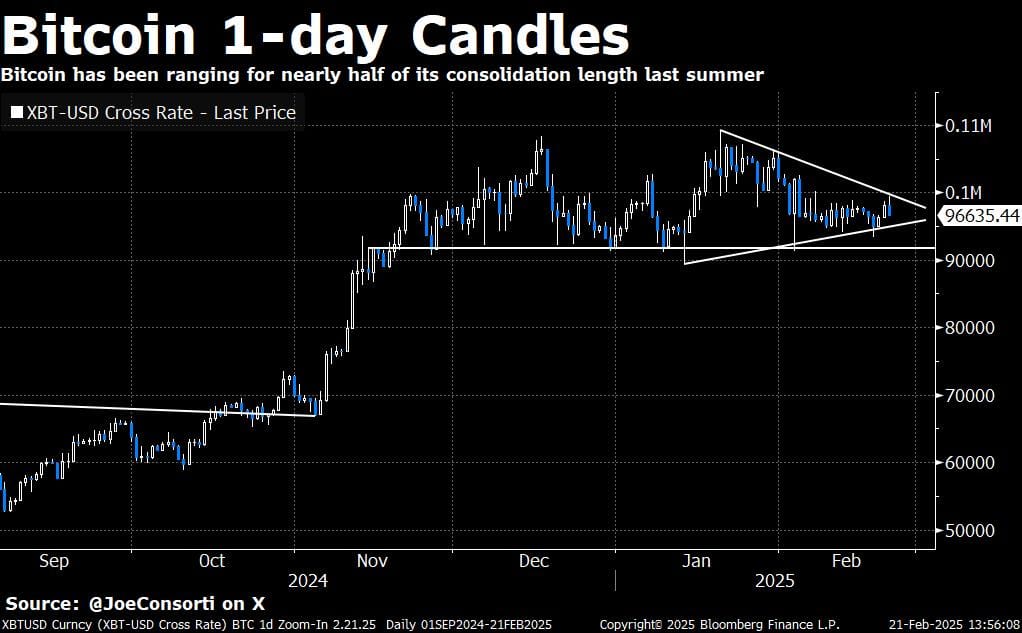
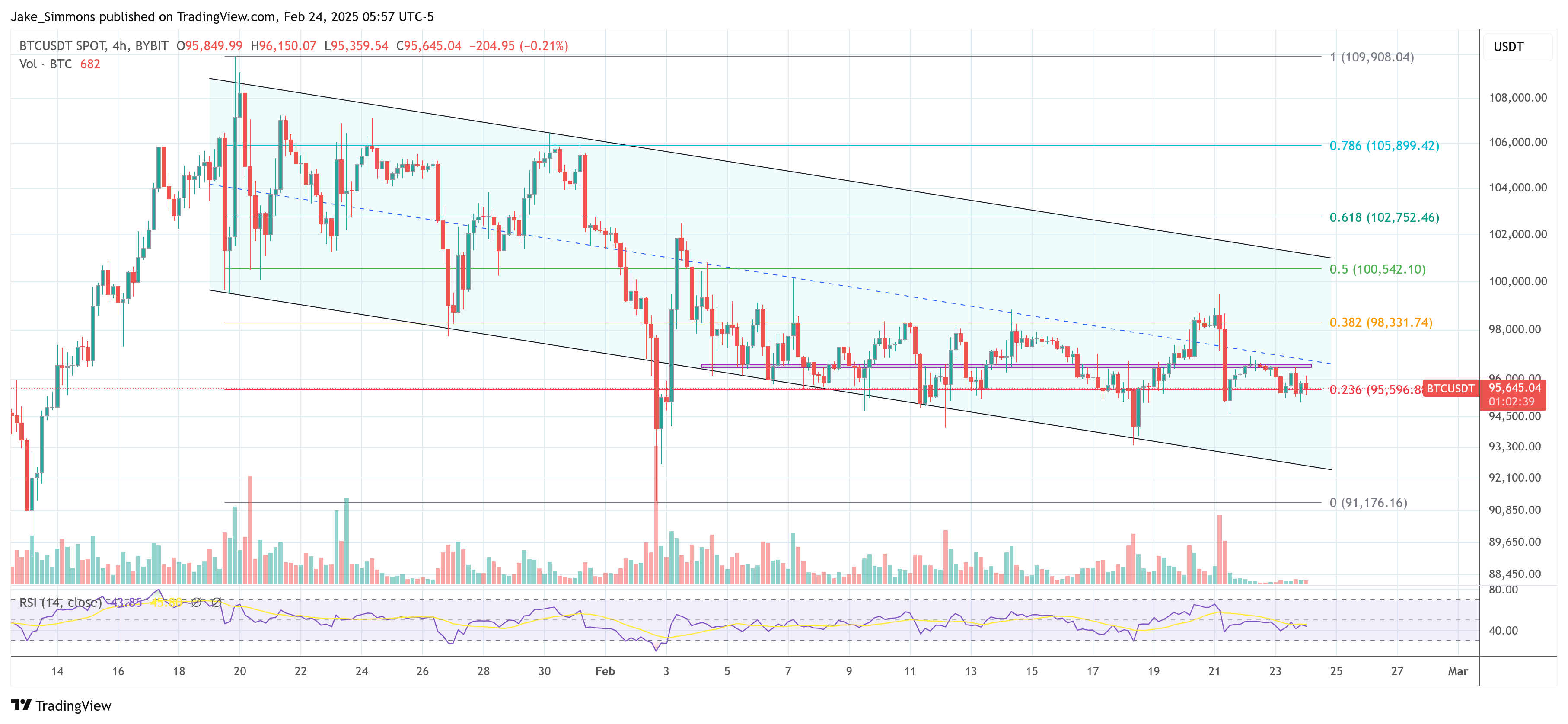
According to Consorti, Bitcoin has now entered its 100+ day consolidation range around $95,000—a stretch he compares to previous multi-month consolidation phases that eventually resolved in major price expansions.
The research provides a retrospective look at how LTHs behaved in previous price climbs: “LTHs accumulated BTC from $15k to $25k, before selling to new market entrants (short-term holders) who bid the price up to the next ‘step’. They did the same from $25k to $40k, from $40k to $65k, and from $65k to the ~$95,000 range we find ourselves in now.”
Consorti notes that LTHs have lately turned back into net accumulators. Although the shift is slight, he contends this behavior usually marks the tail end of consolidation before another breakout.
The researcher also points to a recent $1.4 billion Ethereum hack on Bybit—allegedly the largest in crypto’s history—as a factor momentarily knocking bitcoin off an attempt to break out of its falling wedge pattern. Despite the market disruption, bitcoin only slipped 1.75% on the day, which Consorti says is a testament to the leading BTC’s “outright strength” and diminishing correlation to broader crypto assets.
Overall, Consorti expects the falling wedge to “resolve itself by the first week of March,” barring additional black swan events. He also observes that Bitcoin’s current consolidation zone may stretch beyond 101 days, cautioning that “maximum pain in the market” could see it extend to 236 days, mirroring last summer’s protracted consolidation period.
Bitcoin consolidates inside a falling wedge | Source: X @JoeConsorti
Consorti also references the possible impact of President Trump’s working group on Bitcoin, which is set to decide on the viability of a Strategic Bitcoin Reserve by the end of June. Should a final decision come sooner, he suggests it may provide a major spark for the market—either bullish or bearish, depending on the outcome.
Spot ETF inflows, once seen as a main propeller of Bitcoin’s price, have diminished since early January. Although they still show 7–8 figure daily inflows, these are down significantly from the 9–10 figure levels that occurred throughout last spring and fall, hinting that other market forces, such as institutional and on-chain dynamics, might be more influential in this cycle’s price movement.
Another topic is Bitcoin’s dislocation from global M2 money supply, which had tracked the price with uncanny accuracy for nearly 18 months. That correlation broke when global M2 suggested a deeper downturn for bitcoin, yet BTC continued to hover around $95,000. Now that M2 is edging upward again on a weaker US dollar, the research suggests the possibility of Bitcoin aligning for its next leg higher.
Comparing Bitcoin to gold with a 50-day lead likewise implies that gold’s recent trajectory may “point to an upside resolution”, albeit less precisely than M2 correlations. If this holds, a push towards $120,000 appears plausible.
Related Reading
Consorti concludes by shifting attention to the evolving landscape of US Treasury (UST) demand. Major foreign holders such as China and Japan have progressively reduced or flatlined their positions—China’s holdings have reached a 2009 low of $759 billion, while Russia has fully exited, and Japan remains at $1.06 trillion for 13 years. “It’s not just China. Russia has fully exited USTs. Japan, the largest foreign holder, has been sitting flat at $1.06 trillion for 13 years.”
Meanwhile, the US Federal Reserve’s share of outstanding marketable USTs has surged from 22% in 2008 to 47.3% in 2025, stepping in as foreign demand wanes. But a new player is joining the market in the form of stablecoins, which collectively hold about $200 billion in Treasuries to back their dollar-pegged tokens. According to Consorti, this stablecoin demand: “Could lower long-term interest rates. The proliferation of stablecoins and their use of Treasuries as a reserve asset means they’re functioning like an entirely new foreign central bank.”
He argues that stablecoins effectively ensure fresh demand for Treasuries, helping the US government offset declining foreign involvement and sustain its borrowing needs. White House AI & Crypto Czar David Sacks has publicly echoed this perspective, saying stablecoins help maintain liquidity for US debt.