
Trusted Editorial content, reviewed by leading industry experts and seasoned editors. Ad Disclosure
The Ethereum market has seen a modest price decline in the past day as the broader crypto market reacts to news of US-China trade talks potentially yielding a negative result. Amidst this decline, Ethereum prices have dipped to around $2,550 before showing a minor rebound in the past few hours.
Meanwhile, renowned market analyst with X username Daan Crypto states the altcoin now faces a major price resistance, the outcome of which is influential on the future price trajectory.
Why Ethereum Bulls Must Reclaim Pivotal $2,800 Zone – Analyst
In an X post on May 30, Daan Crypto shares an insightful technical analysis that indicates Ethereum is now facing a significant price barrier at $2,800 price zone.
Notably, the popular analyst explains that $2,800 has proven to be an important price level in the ETH market regardless of the price trend. Historically, a decisive close above or below this zone has often led to significant price movement. in the corresponding direction. This instance was seen when prices traded as high as $4,000 in late 2024 followed an extended market correction which forced prices as low as $1,400.
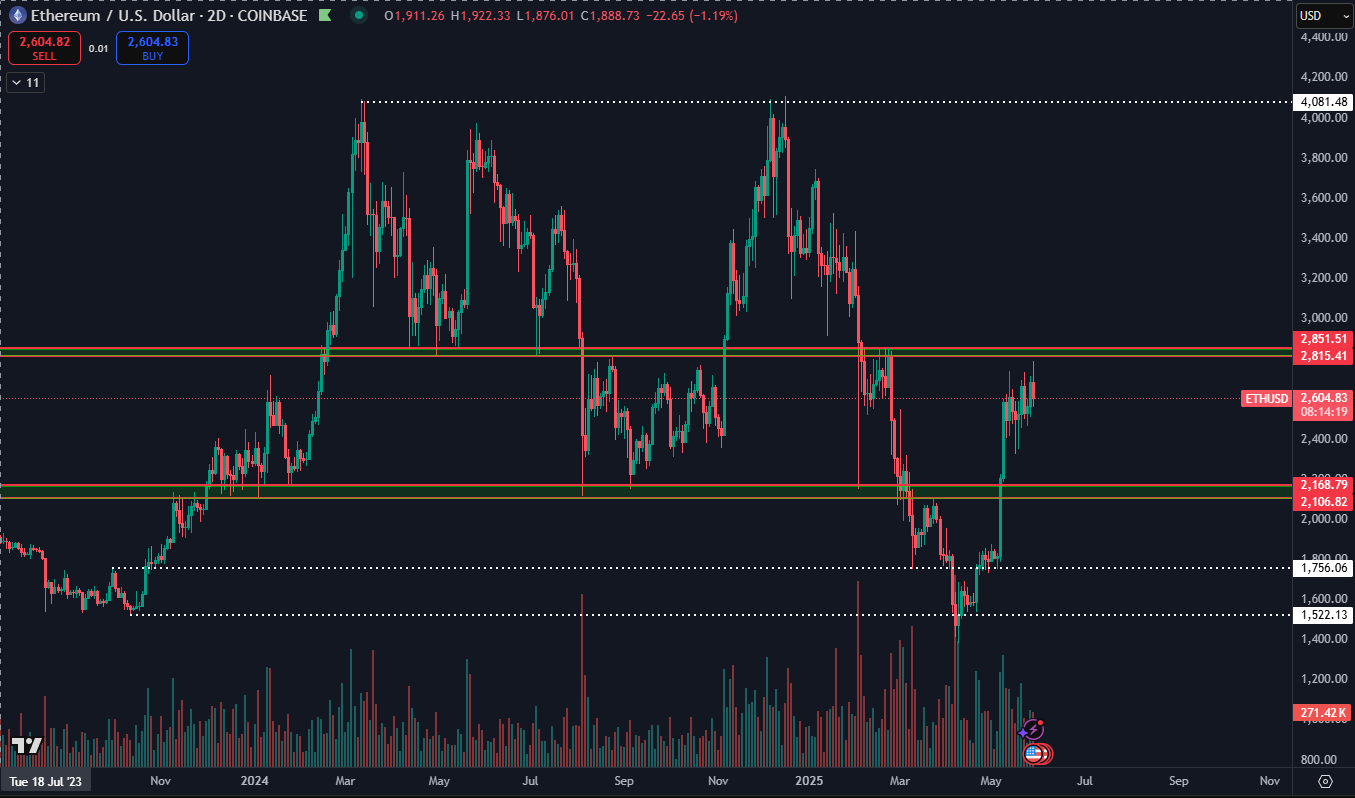
Since the crypto market rebound began in April, Ethereum has already faced one rejection at $2,800 indicating the presence of a robust selling pressure at this price zone. With the altcoin now recovering from its most recent dip in the past week, Ethereum bulls are now expected to take another swipe at this key resistance level. Daan Crypto nudges investors to watch this price level as a successful breakout would signal major price gains ahead.
At the very least, the altcoin becomes likely to reclaim the $4,000 price zone which represents the peak price of the current bull market.
Ethereum Network Fees Fall By Over 2%
In other news, prominent blockain analytics firm Sentora reports the Ethereum network saw a 2.3% decline in weekly network fees suggesting a fall in transaction numbers as well as general network engagement. Nevertheless, exchange net outflows of $516 million strongly indicates that ETH investors still remain bullish as they opt to move their holdings into private wallets despite the recent price fall.
At the time of writing, Ethereum continues to trade at $2,514 reflecting a price decline of 3.58% in the past day. However, market gain of 43.22% on the monthly chart respectively suggest the current market trend remains bullish. With a total market cap of $311.69 billion, Ethereum is ranked as the second-largest cryptocurrency and largest altcoin in the world.
Featured image from Pexels, chart from Tradingview
Editorial Process for bitcoinist is centered on delivering thoroughly researched, accurate, and unbiased content. We uphold strict sourcing standards, and each page undergoes diligent review by our team of top technology experts and seasoned editors. This process ensures the integrity, relevance, and value of our content for our readers.
Shiba Inu (SHIB) Just Faced Enormous Price Rejection: Details U.Today
Source link ]]>
Shiba Inu Faced With Negative Pressure – SHIB’s Price Stuck Below $0.00002045 Bitcoinist
Source link ]]>
Shiba Inu Faced With Negative Pressure – SHIB’s Price Stuck Below $0.00002045 | Bitcoinist.com Bitcoinist
Source link ]]>
How Shiba Inu faced the brunt of a hacked Satoshi account AMBCrypto News
Source link ]]>
Charles Randell, former chair of the UK’s Financial Conduct Authority (FCA), dropped a bombshell during a conference hosted by the Prudential Regulation Authority. He claimed that the FCA faced significant political pressure to greenlight crypto firms. Moreover, some of these firms are now under criminal investigation by the U.S. Department of Justice. Randell led the FCA from April 2018 to May 2022, which saw several crypto firms’ approval, including Bitpanda, Gemini, Revolut, and eToro.
Additionally, Randell highlighted that the FCA had evidence suggesting that approving these firms was not prudent. He emphasized that the political pressure posed a “governance challenge” for regulators. Consequently, he called for robust safeguards against agency capture by industry or political interests.
Randell Exposes FCA’s Struggle with Political Pressure
Randell’s revelations highlight the complex challenges that regulatory bodies like the FCA face. Balancing political pressures with the need for stringent oversight is a delicate act. Hence, Randell’s comments underscore the need for safeguards against agency capture. This involves industry interests and political pressures that may not align with regulatory wisdom.
Significantly, the FCA’s recent moves to regulate crypto advertising indicate a shift towards stricter oversight. This is an attempt to correct past decisions influenced by external pressures. Moreover, it serves as a cautionary tale for other regulatory bodies grappling with the rapid expansion of the crypto industry.
UK’s FCA Tightens Rules on Crypto Promotions
Earlier this summer, the FCA issued a directive to crypto companies advertising in the UK. The regulator gave these firms until October 8 to align with its existing financial promotion regime. Companies must apply and pay a fee to gain approval. However, the FCA’s reach extends beyond domestic firms. If a company’s marketing influences British customers in any way, it falls under the FCA’s jurisdiction.
The FCA outlined four routes for legally communicating financial promotions to UK customers. All of these require approval from an FCA-regulated body, and a Failure to comply could result in two years imprisonment, a fine, or both.

The presented content may include the personal opinion of the author and is subject to market condition. Do your market research before investing in cryptocurrencies. The author or the publication does not hold any responsibility for your personal financial loss.
 Cardano Faced Scrutiny Because it is Not VC-Backed: Charles Hoskinson
- Charles Hoskinson recently sat for a virtual interview with crypto influencer Dan Gambardello.
- Hoskinson shared the reasoning behind the scrutiny revolving around ADA
- In related news, ADA’s price has fallen 1.06% over the past 24 hours.
Cardano’s CEO and co-founder, Charles Hoskinson recently sat for a virtual interview with crypto influencer Dan Gambardello wherein they spoke about why (ADA) is facing such scrutiny from the media.
I sat down and talked with @IOHK_Charles about life, Cardano, scalability, the path to 3 billion users, governance, decentralization, 3 upcoming hard fork combinator events (dates), and crypto.$ADAhttps://t.co/wLAkKonU7i
— Dan Gambardello (@cryptorecruitr) January 11, 2022
Hoskinson attributed the scrutiny to the fact that ADA is not backed by venture capitalists, and that European and American VCs missed the opportunity to get in on ADA at the ground level.
Furthermore, Hoskinson added that VCs control the media outlets, and since they missed out on the opportunity to get in on ADA at the early stages, they are constantly attempting to bring down the project.
In related news, the price of ADA is at $0.4934 at the time of writing, after it dropped 1.06% over the past 24 hours, as per crypto market tracking website, CoinMarketCap. ADA’s price is still falling as it has dropped 0.22% within the last hour. Fortunately for bulls, ADA’s price is performing well on the weekly chart, as its price has risen 13.49% over the past 7 days.
ADA’s price movement has taken Cardano’s total market cap to an estimated $16,653 billion – ranking it at number 8 on CoinMarketCap’s list of the biggest cryptos by market cap. Compared to the two crypto market leaders, bitcoin (BTC) and ethereum (ETH), ADA’s price has strengthened against BTC by a slim 0.05% margin and has weakened against ETH by approximately 0.38%. ADA’s daily trading volume has cooled off as the weekend begins. The daily trading volume currently stands at $791,147,785, which is a 2.61% fall over the last 24 hours.
In this article, we’ll take a look at a Cardano-based DEX that aims to address scalability issues faced by Ethereum dapps.


Gabriel Mangalindan
Into tech, AI, startups and blockchain
Scalability is currently one of the largest concerns for the Ethereum network. Despite being the most popular blockchain development platform, the network still suffers from scalability issues, from slow transactions to high gas costs once the network gets congested. This can have a negative effect on decentralized applications (dapps) due to high transaction costs as well as stablecoins such as USDC and USDT which require users to use ETH to pay for transactions.
There are protocols that are working on tackling these issues faced by protocols on the Ethereum network, one of which is
The platform aims to provide a cheaper and more scalable alternative to Ethereum-based dapps and services including a decentralized exchange (DEX) with an automated market maker (AMM) as well as stablecoins (USDT and USDC). Before we look into the platform, let’s delve into the scalability concerns with Ethereum.
Ethereum and its Scalability Issues
Scalability is an issue for Ethereum, as we’ve seen with Bitcoin in previous years. The most widely used smart contract platform was released as a proof-of-work network in 2015. Despite being the most popular blockchain development platform, it has to develop an infrastructure that can be used by billions of people all over the globe without raising issues around scale or security.
When it comes to the Ethereum network, one example of its scalability problem was the blockchain game CryptoKitties. CryptoKitties is an Ethereum-based blockchain game that was released in 2017. The game allows players to buy, collect, breed, and trade virtual cats. The game became very popular and users buying and selling kittens on the network caused the Ethereum network to become congested since there were so many transactions.
The large number of transactions was a problem since Ethereum is only capable of processing around 30 transactions per second in its present form. Ethereum will need a much higher throughput to become truly scalable for global use.
Furthermore, all of the nodes on the Ethereum network must process each transaction and smart contract. This restricts Ethereum’s transaction throughput since the amount of work needed by a single node is effectively capped.
Another reason is that the Ethereum platform utilizes the same blockchain for all dapps. Due to the massive volume of network transactions generated by CryptoKitties, the Ethereum platform’s other dapps got clogged and delayed as well. As a consequence of this, a greater quantity of ETH was needed to be used whenever a transaction or contract was executed on the network.
Due to the high volume of transactions, users were forced to compete for faster transaction speeds by spending more ETH (or gas) to incentivize nodes to process their transactions. Miners on the network automatically processed the more expensive transactions since they were more lucrative.
Cardano is a Suitable Platform for Scalable Dapps Whilst Ethereum Transitions to ETH 2.0
Whilst proof-of-work is progressively being phased out of Ethereum, slow transactions, scalability issues, and other issues persist. Blockchain developers now have a choice with the Cardano blockchain’s proof-of-stake model, and WingRiders makes it available to investors. Within six days of coming online on April 12, WingRiders had accumulated over
The platform has a double yield farming functionality, which allows liquidity providers to earn additional tokens from the automatic staking in ADA-containing pools and yield farming of platform tokens. Those earnings are in addition to the standard exchange fees that liquidity pools receive.
WingRiders uses the extended unspent transaction output (EUTXO) protocol. UTXO is the amount of cryptocurrency left behind after a transaction, some crypto users refer to this as “dust”. In simple terms, it’s like the change left over after transferring crypto out of your wallet.
The platform’s DEX has also incorporated Ledger hardware wallets into its platform, making it possible to conduct transactions with increased security. In order to address the problems that have plagued DEXs on Ethereum, WingRiders’s exchange platform uses the advantages of Cardano. Due to Cardano’s Ouroboros Proof-of-Stake (PoS) protocol, the DEX is less likely to experience excessive gas prices or failed transactions, issues that have been present with Ethereum-based DEXs.
Conclusion
WingRiders aims to address issues related to scalability of Ethereum-based dapps and protocols by using Cardano’s PoS blockchain to reduce transaction fees, improve speeds and prevent network congestion. If the platform succeeds, it could work as a suitable alternative for developers and users of decentralized applications and stablecoins.
Disclosure: This story was submitted to HackerNoon by an independent contributor. Hence the information contained therein has also been researched and compiled independently.
Welcome to the Decentralized Internet Contest!
Scalability is currently one of the largest concerns for the Ethereum network. Despite being the most popular blockchain development platform, the network still suffers from scalability issues, from slow transactions to high gas costs once the network gets congested. This can have a negative effect on decentralized applications (dapps) due to high transaction costs as well as stablecoins such as USDC and USDT which require users to use ETH to pay for transactions.
There are protocols that are working on tackling these issues faced by protocols on the Ethereum network, one of which is
The platform aims to provide a cheaper and more scalable alternative to Ethereum-based dapps and services including a decentralized exchange (DEX) with an automated market maker (AMM) as well as stablecoins (USDT and USDC). Before we look into the platform, let’s delve into the scalability concerns with Ethereum.
Ethereum and its Scalability Issues
Scalability is an issue for Ethereum, as we’ve seen with Bitcoin in previous years. The most widely used smart contract platform was released as a proof-of-work network in 2015. Despite being the most popular blockchain development platform, it has to develop an infrastructure that can be used by billions of people all over the globe without raising issues around scale or security.
When it comes to the Ethereum network, one example of its scalability problem was the blockchain game CryptoKitties. CryptoKitties is an Ethereum-based blockchain game that was released in 2017. The game allows players to buy, collect, breed, and trade virtual cats. The game became very popular and users buying and selling kittens on the network caused the Ethereum network to become congested since there were so many transactions.
The large number of transactions was a problem since Ethereum is only capable of processing around 30 transactions per second in its present form. Ethereum will need a much higher throughput to become truly scalable for global use.
Furthermore, all of the nodes on the Ethereum network must process each transaction and smart contract. This restricts Ethereum’s transaction throughput since the amount of work needed by a single node is effectively capped.
Another reason is that the Ethereum platform utilizes the same blockchain for all dapps. Due to the massive volume of network transactions generated by CryptoKitties, the Ethereum platform’s other dapps got clogged and delayed as well. As a consequence of this, a greater quantity of ETH was needed to be used whenever a transaction or contract was executed on the network.
Due to the high volume of transactions, users were forced to compete for faster transaction speeds by spending more ETH (or gas) to incentivize nodes to process their transactions. Miners on the network automatically processed the more expensive transactions since they were more lucrative.
Cardano is a Suitable Platform for Scalable Dapps Whilst Ethereum Transitions to ETH 2.0
Whilst proof-of-work is progressively being phased out of Ethereum, slow transactions, scalability issues, and other issues persist. Blockchain developers now have a choice with the Cardano blockchain’s proof-of-stake model, and WingRiders makes it available to investors. Within six days of coming online on April 12, WingRiders had accumulated over
The platform has a double yield farming functionality, which allows liquidity providers to earn additional tokens from the automatic staking in ADA-containing pools and yield farming of platform tokens. Those earnings are in addition to the standard exchange fees that liquidity pools receive.
WingRiders uses the extended unspent transaction output (EUTXO) protocol. UTXO is the amount of cryptocurrency left behind after a transaction, some crypto users refer to this as “dust”. In simple terms, it’s like the change left over after transferring crypto out of your wallet.
The platform’s DEX has also incorporated Ledger hardware wallets into its platform, making it possible to conduct transactions with increased security. In order to address the problems that have plagued DEXs on Ethereum, WingRiders’s exchange platform uses the advantages of Cardano. Due to Cardano’s Ouroboros Proof-of-Stake (PoS) protocol, the DEX is less likely to experience excessive gas prices or failed transactions, issues that have been present with Ethereum-based DEXs.
Conclusion
WingRiders aims to address issues related to scalability of Ethereum-based dapps and protocols by using Cardano’s PoS blockchain to reduce transaction fees, improve speeds and prevent network congestion. If the platform succeeds, it could work as a suitable alternative for developers and users of decentralized applications and stablecoins.
Disclosure: This story was submitted to HackerNoon by an independent contributor. Hence the information contained therein has also been researched and compiled independently.
Tags
Related Stories
Dogecoin Pulls Back Amid Weakness In Altcoins
Dogecoin is currently trying to settle below the support level at $0.2190 while Bitcoin is trying to get to the test of the resistance at the 50 EMA at $45,300.
Bitcoin managed to get from $40,000 to $45,000 in just two days as traders rushed to buy the world’s leading cryptocurrency after the major pullback. Currently, it is stuck near the $45,000 level.
Meanwhile, other cryptocurrencies are moving lower. Ethereum is trying to settle below $3,100. XRP continues its attempts to settle below $0.97 while Shiba Inu is testing the support at the 50 EMA at $0.0000073.
Altcoins are clearly under pressure today, which is bearish for Dogecoin. However, the situation may change quickly in case Bitcoin settles above the 50 EMA as this move will likely provide additional support to crypto markets.
Technical Analysis

Dogecoin faced strong resistance near $0.23 and declined towards the support level at $0.2190. In case Dogecoin settles below this level, it will move towards the next support at $0.2130. RSI remains in the moderate territory, and there is plenty of room to gain additional downside momentum in case the right catalysts emerge.
If Dogecoin settles below $0.2130, it will head towards the support at $0.2050. A move below this level will open the way to the test of the support which is located near the recent lows at $0.20.
On the upside, the nearest resistance level for Dogecoin is located at $0.2255. A successful test of this level will push Dogecoin towards the resistance at the recent highs at $0.23. This resistance level has already been tested several times and proved its strength.
If Dogecoin manages to settle above the resistance at $0.23, it will head towards the next resistance level at $0.2350. A successful test of this level will open the way to the test of the resistance which is located at the 20 EMA at $0.24.
For a look at all of today’s economic events, check out our economic calendar.
This article was originally posted on FX Empire
✓ Share: