Concerns over quantum computing are weighing on Bitcoin’s price and slowing some investment flows, amid a sharp divide between developers and many investors.
Related Reading
Developers Call Threat Distant
According to Bitcoin developer Adam Back of Blockstream, quantum machines remain far from able to break Bitcoin’s protections. He said the tech is still “ridiculously early” and that research hurdles persist.
Back expects no real threat within the next decade and argued that even if parts of Bitcoin’s cryptography were compromised, the network would not automatically be emptied.
Security, he noted, does not rest solely on encryption in a way that would allow mass theft on the blockchain.
i think the risks are short term NIL. this whole thing is decades away, it’s ridiculously early and they have massive R&D issues in every vector of the required applied physics research to even find out if it’s possible at useful scale. but it’s ok to be “quantum ready” and
— Adam Back (@adam3us) December 18, 2025
The Risk That Keeps Some Awake
Other voices in the community disagree. Jameson Lopp, a well-known Bitcoin engineer, has warned about the worst-case outcome if quantum advances allowed attackers to break the ECDSA signature scheme that secures many wallets.
In that scenario, forged signatures could be used to move funds, and user confidence might erode quickly. That warning has been repeated as a technical possibility, not as something imminent.
How should we treat quantum vulnerable coins in a future where quantum computing becomes a threat? This panel from the Presidio Quantum Bitcoin Summit features myself, @theblackmarble, and @cryptoquick.https://t.co/jhr6hjLXru
— Jameson Lopp (@lopp) September 14, 2025
Investors Worry, Capital Shifts
Nic Carter, a partner at Castle Island Ventures, told observers that it is “extremely bearish” when influential developers appear to dismiss any quantum risk outright.
He said the gap between investor concern and developer assessment is large. Reports have disclosed that some capital is being held back while large holders consider spreading risk into other assets.
Craig Warmke of the Bitcoin Policy Institute added that perceived quantum risk has already pushed some holders to reduce their Bitcoin positions.
Quantum risk is stemming the flow of capital into bitcoin, and encouraging large holders to diversify out of bitcoin.
When non-technical people express concerns, they sometimes use technically incorrect language. It’s frustrating to see technical people dismiss concerns with an… https://t.co/MtSNY7Ivg3
— Craig Warmke (@craigwarmke) December 18, 2025
Current Technology Falls Short
Most cryptographers agree quantum computers today are not powerful enough to crack Bitcoin’s cryptography. That assessment is widely reported by analysts who follow both fields.
Metaculus’s median date for when quantum computers will break modern cryptography is 2040:https://t.co/Li8ni8A9Ox
Seemingly about a 20% chance it will be before end of 2030.
— vitalik.eth (@VitalikButerin) August 27, 2025
Still, the timeline is debated. Based on reports from researchers and public comments from industry figures like Vitalik Buterin, there is a measurable chance — about ~20% — that a machine capable of breaking today’s crypto could exist by 2030. That estimate has prompted calls for proactive steps.
Related Reading
Calls For Preparedness Grow
Financial institutions and national programs, the reports say, are investing heavily in quantum work, and tools like AI are accelerating research in the field. As a result, many in the crypto world argue contingency plans should be ready well before any practical threat appears.
Suggestions include moving to quantum-resistant signature schemes and improving wallet practices so funds are not left exposed while upgrades take place. Some experts point out that banks and other big targets may face attacks earlier, which could give the crypto sector time to respond.
Featured image from Shutterstock, chart from TradingView
This $0.035 Token Feels Like Cardano’s (ADA) Early Big Run. Is it the Next Crypto to Explode? Cryptopolitan
Source link ]]>
Investing in This Altcoin Feels Like Early Dogecoin and Shiba Inu – Potential 10,000x Gains in 2025 BlockchainReporter
Source link ]]>
Bitcoin’s recent climb has been calm and measured, a sharp contrast to the explosive rallies of the past. It’s trading above its historical growth path, but far from overheating. Long-time holders remain mostly inactive, while the bulk of trading activity is coming from fresh faces in the market.
Bitcoin Growth Remains On Track
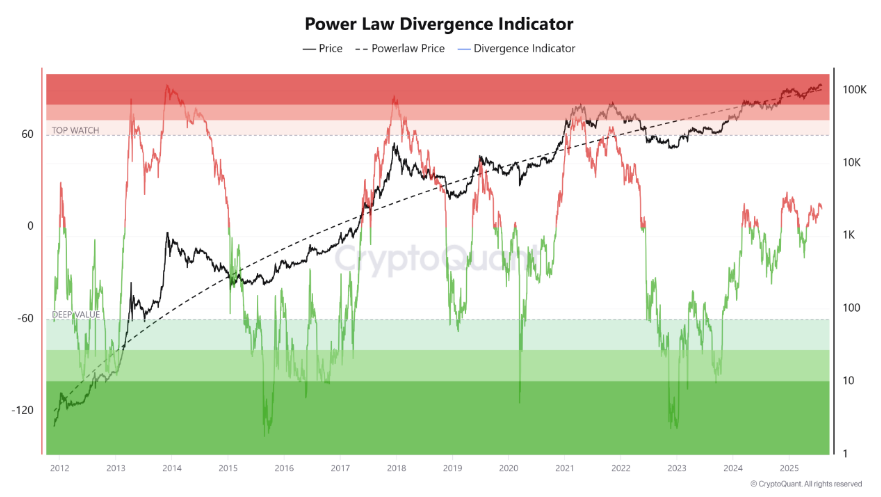
Based on reports by Arab Chain using CryptoQuant data, Bitcoin’s price is tracking a Power Law trend that suggests a smooth, logarithmic rise over time.
That model creates a curved path rather than sudden spikes. Right now, BTC sits above the expected growth line but well below the upper “red zone” that signals overheating.
The divergence indicator is positive, yet far from levels seen in past bubbles. This pattern hints at natural growth or perhaps the early stages of renewed betting.
Divergence Keeps Room For Upside
Analysts note that staying below the top watch zone leaves room for more gains before panic sets in. In prior cycles, prices shot through that red zone and then collapsed.
Today, Bitcoin is about $50,000 under its most recent peak level. That gap suggests buyers still have breathing room if they choose to push prices higher.
On-chain data from Glassnode shows short-term holders (STHs) are behind most of the action. Around 86% of Bitcoin’s spent volume over the last 24 hours came from wallets active less than 155 days, totaling $18 billion.
Long-term holders (LTHs) accounted for only 14.5% of spent volume, or $3.10 billion. That split means newer entrants are driving swings, while veteran holders stay largely on the sidelines.
Long-Term Holders Show Conviction
That dichotomy between STHs and LTHs tends to indicate intense conviction among core believers. When long-term owners remain in place, price drops tend to be more subtle. Buyers who have hung on for years or months typically view dips as opportunity to add rather than times to sell.
Bitcoin was trading around $114,113 at press time following a pullback from recent highs of about $118K. The daily Relative Strength Index had fallen to 43, indicating a loss of bullish momentum without going into oversold levels. On-Balance Volume has been declining in the past week, indicating weakening buying pressure.
Market Cooling Doesn’t Mean Collapse
Reports have disclosed that this mix of signals fits a market that’s cooling rather than crashing. Traders are taking profits, yet they aren’t rushing for the exits. The overall picture points to a maturing market that still has room to run but won’t likely repeat the manic swings of years past.
Featured image from Pexels, chart from TradingView
]]>Is Cardano Heading to $6? This ADA Setup Feels Familiar CryptoRank
Source link ]]>
Reason to trust

Strict editorial policy that focuses on accuracy, relevance, and impartiality
Created by industry experts and meticulously reviewed
The highest standards in reporting and publishing
Strict editorial policy that focuses on accuracy, relevance, and impartiality
Morbi pretium leo et nisl aliquam mollis. Quisque arcu lorem, ultricies quis pellentesque nec, ullamcorper eu odio.
Bitcoin’s price saw a wild swing last week, briefly rising above $111,800 on May 23 before dropping to $109,600 today. Despite the sudden dip, the world’s largest cryptocurrency ended the week near $110,000, trading at $109,770 at last check. While short-term volatility continues to rattle some nerves, a growing number of investors and analysts are focusing on Bitcoin’s bigger picture.
Related Reading
Frustration And Patience Seem To Go Hand In Hand
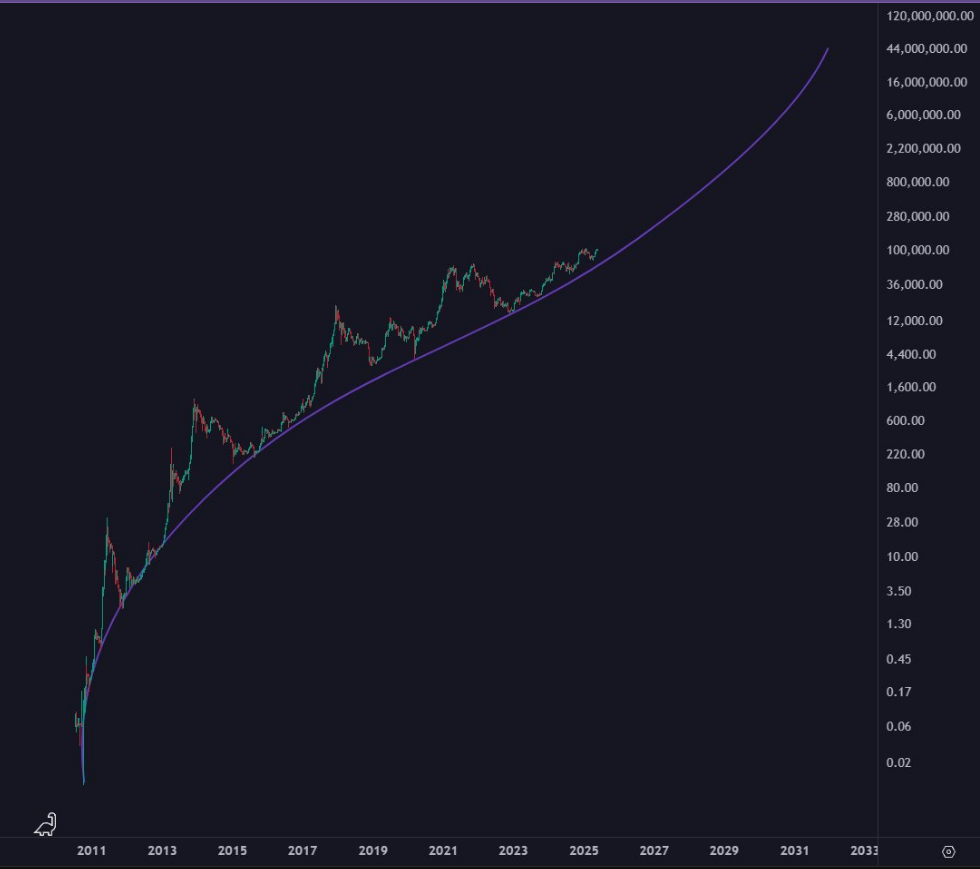
Thomas Fahrer, co-founder of Apollo, has been vocal about the emotional side of owning Bitcoin. According to him, holding Bitcoin is often frustrating—about 90% of the time, he said. But he believes it pays off for those who stick around. Fahrer shared a price chart stretching from 2011 to a projection for 2031, using a curved trendline on a logarithmic scale to show Bitcoin’s consistent upward pattern over time.
Several moments stood out on the chart. In 2015, Bitcoin crashed to around $212. In 2020, it found support near $5,000. And in 2022, after reaching a peak above $67,000 the year before, it fell to around $16,000. But through all the noise, Fahrer says Bitcoin has followed its long-term curve.
Holding Bitcoin means getting rich while feeling frustrated 90% of the time.
Deflationary money – designed to increase in value – forever.
It’s difficult for the human mind to comprehend. Most still don’t get it. pic.twitter.com/d604FyoQn3
— Thomas Fahrer (@thomas_fahrer) May 25, 2025
A Deflationary Design That’s Hard To Grasp
Fahrer also pointed to Bitcoin’s design as a deflationary currency. Unlike the US dollar, which loses value as more of it enters the system, Bitcoin has a hard cap—only 21 million coins will ever exist. Every four years, the number of new coins created is cut in half through a process called halving. That makes it harder for new supply to outpace demand over time.
Fahrer believes that many people still don’t fully understand this. The idea that money can grow in value instead of losing it goes against how most people were raised to think about spending and saving.
Numbers Tell Their Own Story
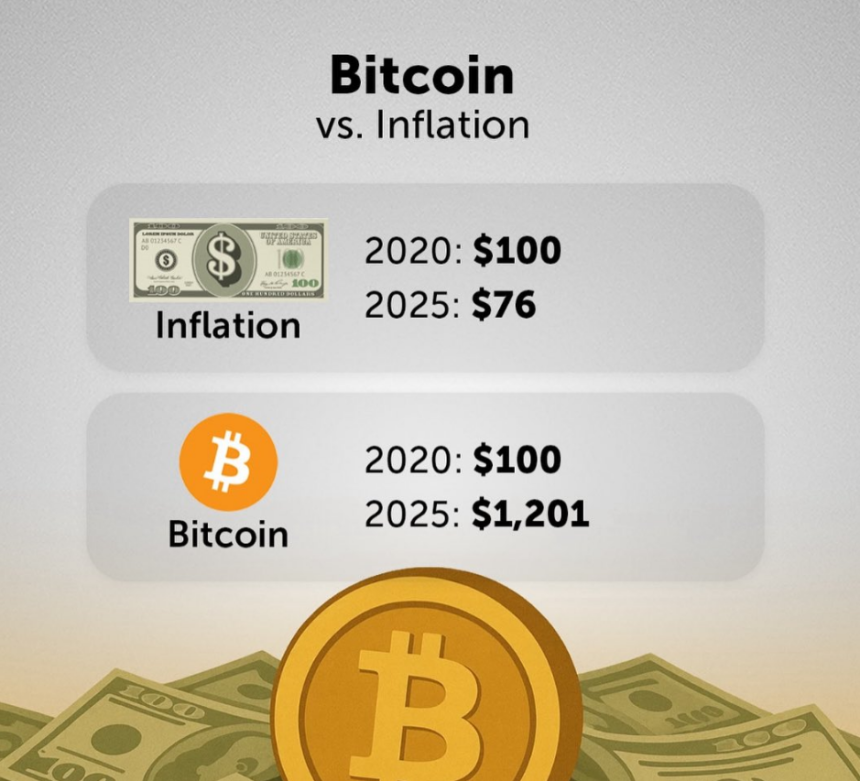
One Bitcoin investor, using the name Carl Menger, shared a comparison that got attention. According to his data, if someone held $100 in cash from 2020 to 2025, its buying power would shrink to just $76. But that same $100 put into Bitcoin would grow to $1,201 over the same stretch of time.
It’s a sharp contrast. While inflation chips away at fiat savings, Bitcoin, with its fixed supply, shows the opposite effect when prices go up. That’s the kind of visual that sticks.
Once you see it, you can’t unsee it. #Bitcoin pic.twitter.com/4OBqOLgm3n
— Carl ₿ MENGER
(@CarlBMenger) May 24, 2025

Related Reading
You Don’t Need A Whole Coin
Robert Kiyosaki, the author known for “Rich Dad Poor Dad,” also joined the conversation. He said people often think they need to buy a whole Bitcoin to benefit, but that’s not true. Even owning 0.01 BTC, he said, could have a major impact down the line if Bitcoin continues to perform as it has in the past.
Kiyosaki also mentioned that Bitcoin has made it easier to build wealth without relying on things like gold. It’s a view that matches the mindset of many younger investors who are looking for alternatives.
While the market remains unpredictable day to day, the long-term message coming from these voices is clear: Bitcoin may test your patience, but it hasn’t broken its trend yet.
Featured image from Gemini Imagen, chart from TradingView
This Crypto Presale Feels Like Early Dogecoin — But Smarter Modern Diplomacy
Source link ]]>
Buying This Token at $0.20 Feels Like Getting in on Shiba Inu Before Vitalik Burned 410 Trillion SHIB or Dogecoin Before Elon Analytics Insight
Source link ]]>
This Feels Like Buying Dogecoin or Shiba Inu in 2021, Analyst Says About Lightchain AI’s Rally NewsWatch
Source link ]]>
Cardano Whale Feels Their Pockets With Mpeppe (MPEPE) Currently At $0.00107 NewsBTC
Source link ]]>