Shiba Inu Price Prediction Faces a 93% Gap From ATH While Pepeto Presale Hands Early Wallets 100x Math openPR.com
Source link ]]>
Japan’s cabinet approves a bill to classify XRP and other crypto assets as financial products under the Financial Instruments and Exchange Act (FIEA) on Friday. This comes as the Financial Services Agency (FSA) aims to regulate crypto assets as financial instruments, shifting from the Payment Services Act (PSA). Ad Ad Japan Appoves Crypto Bill to
The post Japan Classifies XRP as Financial Asset amid Ripple’s Vision to Bridge Crypto-TradFi Gap appeared first on CoinGape.
]]>Cardano (ADA) DeFi TVL Crosses $1.1B but Token at $0.27 Shows Value Capture Gap, Analysts Respond openPR.com
Source link ]]>
Shiba Inu (SHIB) Metaverse Has No Release Date After Years Next to Taurox (TAUX), Analysts See Gap openPR.com
Source link ]]>
Cardano’s community funding pipeline just stopped mid-cycle.
Project Catalyst, the on-chain grants mechanism that has distributed over $150 million across 2,200 projects since launch, recently announced that stewardship is moving from Input Output Global to the Cardano Foundation.
Additionally, Fund15 and Fund16 won’t proceed in their proposed form until the transition completes. The Catalyst team will migrate to the Foundation to maintain continuity for existing grantees. Still, the pause leaves hundreds of applicants who prepared proposals for the next rounds without a voting timeline or clarity on funding.
This isn’t routine administrative housekeeping. Catalyst operates as Cardano’s capital allocation engine, the mechanism through which ecosystem participants vote on treasury disbursements to builders, infrastructure projects, and community initiatives.
Reorganizing that machinery mid-cycle while returning earmarked ADA to the treasury signals a decision to treat grants infrastructure as requiring governance-grade oversight before issuing new obligations.

What actually changes
The immediate mechanics are straightforward.
Stewardship transfers from IOG, the development organization that built and operated Catalyst since inception, to the Cardano Foundation, the Swiss nonprofit responsible for protocol standards and ecosystem coordination.
Catalyst team members join the Foundation to ensure existing commitments are not broken during the handover. Fund14 milestone administration continues, meaning projects already approved and working through delivery checkpoints face no disruption.
Yet, Fund15 and Fund16 effectively vanish. Fund15’s published budget showed 18.5 million ADA plus 250,000 USDM, Midnight’s stablecoin, earmarked for distribution.
That allocation is now being returned to the treasury, aligned with Intersect, the member-based organization coordinating Cardano governance.
The transition leaves applicants who spent months preparing proposals and reviewers who invested time in evaluating them without a path forward.
The language matters. The update doesn’t say Fund15 is “delayed” or “postponed,” it says running it “in its proposed form is not feasible.” That phrasing suggests structural questions about how Catalyst should operate, who administers it, and what controls govern capital deployment.
| Funding round / item | Status now | What happens to money | Who is affected | What’s confirmed in update (short phrasing) |
|---|---|---|---|---|
| Fund14 (and earlier) | Continues | Existing allocations continue under milestone disbursements | Current grantees (Fund14 and earlier) | “Commitments up to Fund14 will continue… under the milestone process.” |
| Fund15 | Paused/reset (won’t run as proposed) | 18.5M ADA + 250,000 USDM (published budget) returned to treasury | Fund15 applicants + reviewers + teams planning runway | “Running Fund15… in its proposed form is not feasible.” Funds earmarked for Fund15 to be returned to treasury. |
| Fund16 | Paused/reset (won’t run as proposed) | Earmarked ADA returned to treasury | Future applicants; ecosystem teams counting on the next round | “Running Fund…16 in its proposed form is not feasible.” Funds earmarked for Fund16 to be returned to treasury. |
| Stewardship (Catalyst operator) | Changing hands | N/A (governance/ops shift) | Ecosystem governance; anyone relying on Catalyst cadence | “IOG and the Cardano Foundation agreed to move stewardship of Catalyst to the Foundation.” |
| Operations (team + continuity) | Continuity preserved | N/A | Existing grantees; Catalyst admin workflows | “Catalyst team members will join the Cardano Foundation to maintain continuity.” |
| Applicants / reviewers | In limbo | No new disbursements via Fund15/16 until redesign | Proposal authors, community reviewers, voters awaiting a timeline | Update acknowledges impact and lack of a clear path/timeline during transition (“deeply regret the impact…”) |
Why reorganize now
Cardano’s announcement cites the need to “reassess strategy, operations, and the best path forward” after cross-entity alignment meetings in February involving IOG, the Foundation, and Intersect.
That framing points to questions beyond simple logistics: what governance structure should oversee community funding, how should accountability mechanisms work, and what administrative standards apply when distributing treasury assets at scale.
Catalyst has operated for years under IOG’s stewardship, serving as a recurring grant lottery in which community members vote on proposals using weighted ADA.
The model helped bootstrap ecosystem development, but as the program scaled to administer over 500 active projects simultaneously, the operational complexity and capital risk profile changed.
Moving stewardship to the Foundation shifts control from the product organization that built the system to the entity responsible for long-term ecosystem stability.

The broader pattern visible across blockchain ecosystems: grants programs that begin as product features eventually migrate to foundation-level infrastructure when the stakes justify formal governance.
The shift from “team-run grants” to “foundation-administered capital allocation” typically occurs when funding levels reach levels that require audit trails, milestone accountability, and legal clarity about fiduciary responsibilities.
Cardano is making that transition mid-cycle rather than waiting for a natural break between funding rounds.
That creates short-term disruption but potentially reduces long-term governance debt, the accumulation of process shortcuts and structural ambiguities that become harder to unwind as obligations compound.
The budget reset question
Returning earmarked ADA to the treasury isn’t equivalent to funds disappearing.
It’s a reallocation decision that increases optionality. Instead of automatically flowing into Fund15 and Fund16 under the existing process, that capital returns to governance control while the operating model gets redesigned.

Intersect’s role provides context. The organization maintains documentation describing a treasury administration model in which funding contracts can be deployed with milestone gates and sweep-back mechanisms, and a smart contract infrastructure that allows treasury funds to be conditionally released and automatically returned if conditions aren’t met.
That technical capability suggests the redesigned Catalyst might operate less like a recurring grant lottery and more like a treasury program with explicit administration and tighter disbursement controls.
The numbers involved make the stakes clear. At current prices, Fund15’s 18.5 million ADA allocation is worth tens of millions of dollars.
When a system regularly deploys capital at that scale based on community votes, the administrative infrastructure needs to match the financial materiality.

Who bears the cost
The immediate cost falls on Fund15 applicants. Teams that spent time drafting proposals, building community support, and preparing to participate in the voting process now face an indefinite pause with no clear timeline.
The Catalyst announcement explicitly acknowledges this: “We deeply regret the impact on those who invested considerable time and energy preparing Fund15 proposals or serving as reviewers.”
Existing Fund14 grantees receive explicit continuity assurances. Milestone administration continues, meaning the stewardship transition doesn’t disrupt projects already approved.
That protection matters because maintaining trust with current grantees is a prerequisite to any future funding mechanism working effectively.
The broader builder ecosystem faces uncertainty about pipeline timing. Cardano’s developer activity depends partly on Catalyst, a mechanism that enables teams to secure runway without external fundraising.
Pausing the pipeline doesn’t stop existing projects, but it removes a known capital formation path for teams in earlier stages.
What the new model might look like
Catalyst may return less like a recurring grant lottery and more like a structured treasury program.
Instead of large funding rounds where hundreds of proposals compete in batch voting processes, the redesigned system could shift toward targeted tracks with narrower scopes, more rigorous milestone gating, and tighter administrative controls.
That model would trade some of Catalyst’s original democratic accessibility for increased accountability and capital efficiency. Fewer proposals funded per cycle, but higher confidence in delivery metrics. More gatekeeping at intake, but clearer standards for what qualifies.
The Foundation’s approach to stewardship prioritizes durability. Foundations exist to outlive product cycles and maintain infrastructure across governance transitions. IOG operates on product roadmaps that change as the protocol evolves.
Moving Catalyst to the Foundation implies treating it as permanent ecosystem infrastructure.
What happens next
The immediate question: when will the transition be complete, and what will the redesigned process look like?
The Catalyst announcement promises “further updates once the transition is complete,” but doesn’t specify a timeline.
Several signals will clarify what’s actually changing. Evidence of treasury return mechanics appearing on-chain will show whether the new administration model relies on programmatic controls.
Whether Fund15’s published budget reappears in a modified form or is replaced entirely by different funding structures reveals the scope of the redesign.
Timeline matters: a fast restart implies mostly administrative changes, a longer redesign quarter suggests rethinking voting mechanics and eligibility criteria.
The Catalyst team’s move to the Foundation preserves institutional knowledge of community funding administration. They’ve run over 2,200 grants through completion, managing milestone verification and grantee support at scale.
That expertise doesn’t transfer through documentation, as it requires the people who learned through iteration to keep operating the machinery while the organizational structure changes.
The decision to pause mid-cycle rather than waiting for a natural break reveals priorities. Letting Fund15 and Fund16 proceed under the old model would have avoided applicant disruption but would have perpetuated the governance gaps the transition aims to close.
Choosing the disruptive path suggests treating those gaps as material enough to justify immediate correction.
Cardano’s community funding isn’t disappearing. It’s being reorganized to match the scale and risk profile it reached. The framework exists. The budget exists.
The demand from builders exists. What’s being redesigned is the governance surface that connects them, and that infrastructure determines whether ecosystem funding operates as political theater or actual capital formation.
On Jan. 30, Cardano founder Charles Hoskinson announced that he has signed an integration agreement to bring USDCx, a Circle-linked stablecoin product, to the Cardano ecosystem.
The infrastructure move represents a strategic effort to lower the network’s DeFi growth ceiling by establishing a sustained, reliable flow of on-chain dollar liquidity.
In a social media post from Japan, Hoskinson characterized the deal as a milestone for the network, which has historically trailed behind rival smart-contract platforms in accessing high-liquidity stablecoins.
He said:
“We [now] have access to Circle’s network, Circle’s protocol, Circle’s technology, and the great liquidity of the Circle network as a whole, and the added privacy benefits of USDCX and all the technologies therein.”
The agreement comes as the Cardano community has repeatedly sought “Tier 1” stablecoin depth, viewing it as a mandatory prerequisite for more competitive pricing on decentralized exchanges (DEXs), deeper lending markets, and robust derivatives liquidity.
While the announcement marks a diplomatic victory for the ecosystem, key execution details, including the rollout timing and the initial scope of the integration, remain unconfirmed.
What is USDCx?
The introduction of USDCx requires a nuanced understanding of its technical structure, as it is not a “native USDC” asset minted directly by Circle on the Cardano blockchain. Instead, Circle positions USDCx as a USDC-backed stablecoin issued on a partner or “remote” chain.
Under this framework, reserves are held as USDC and deposited into Circle’s xReserve on a “source” chain. These assets are then represented on the partner chain, such as Cardano, via an automated attestation and minting flow.
Circle introduced xReserve in late 2025 to reduce the industry’s reliance on third-party bridges and wrapped assets, which have historically been targets of security exploits.
Notably, the xReserve model is designed to enable interoperability without the risks associated with traditional bridging.
For Cardano, this distinction is critical. Rather than relying on a fragmented, wrapped version of a dollar token, USDCx is intended to function as a direct conduit to Circle’s broader liquidity network.
Hoskinson explained that this setup is designed specifically for ecosystems outside the Ethereum Virtual Machine (EVM) sphere.
According to him:
“USDCX is basically the same asset [as USDC], and how it works is there’s a one-to-one reserve. For the non-EVM chains like Stacks and Aleo and others, there’s a mirroring effect that occurs, and then dApp developers, under the hood, can build a bunch of stuff. Then it’s easy through their network to access the same liquidity as USDC.”
USDCx could help Cardano narrow the liquidity gap
Cardano’s aggressive push for stablecoin depth is driven by stark on-chain data.
According to DeFiLlama data, the network currently holds approximately $36.6 million in circulating stablecoins.

This figure is notably small when compared to leading DeFi hubs. For comparison, ecosystems like Base and Solana have become heavily “USDC-native,” reporting stablecoin market caps in the billions and DEX volumes that are orders of magnitude larger than Cardano’s current output.
While Cardano supporters often argue that the network’s architecture prioritizes security and decentralization over rapid expansion, the market has consistently rewarded ecosystems that can pair those values with deep dollar liquidity.

Meanwhile, the USDCx agreement is the centerpiece of a broader institutional effort within Cardano to fix its “plumbing.”
A recent ecosystem proposal sought community approval to allocate 70 million ADA (approximately $30 million at the time) to onboarding tier-one stablecoins, custody providers, cross-chain bridges, and pricing oracles.
This capital allocation reflects Cardano’s leadership’s realization that these utilities, often treated as baseline infrastructure by other chains, must be proactively secured to remain competitive.
What USDCx could unlock for Cardano?
The potential upside for Cardano hinges on its ability to capture a fraction of the Circle’s $70 billion USDC supply.

If Cardano, through the USDCx integration, captured even 0.10% of that notional liquidity, it would imply an additional $70 million in dollar value, which is roughly double the network’s current stablecoin base.
Should that share reach 0.25%, the figure would rise to approximately $180 million. Such a shift could materially tighten spreads for ADA/stablecoin trading pairs and make lending markets more viable for institutional participants.
However, market analysts note that stablecoins do not simply create DeFi activity by existing; they provide the necessary conditions for liquidity, which must then be met by credible market-making and user adoption.
By plugging into this network, Cardano is betting that USDCx will provide the “fast integration time” needed to jumpstart its lagging DeFi sector.
Considering this, Hoskinson noted:
“We have to make sure that we get USDCX integrated into all of the Cardano applications, so there’s a seamless user experience, and a seamless user experience with exchanges, so you can go from USDC and back without any additional steps or work.”
Implementation risks
Despite the optimism surrounding the signed agreement, several caveats remain.
Hoskinson’s announcement confirms a legal and strategic partnership, but it does not mean USDCx is live. Notably, Circle’s developer documentation for xReserve does not yet explicitly list Cardano as a supported remote chain, indicating that the implementation is still in early stages.
Execution risk is a primary concern for investors. The success of the integration will depend on how quickly major Cardano decentralized applications (dApps) can incorporate the new token.
Furthermore, the ecosystem must attract professional market makers and ensure that cross-chain routing is frictionless enough to compete with chains that already possess native USDC and USDT deployments.
Hoskinson, however, remains confident in the timeline. “This is not something that’s six months out,” he stated, noting that the “ink is on paper” and the deal is signed.
He cited Circle’s prior work with networks such as Aleo and Stacks as evidence that the integration can be completed quickly.
The Cardano founder added:
“One of the advantages of this new USDCX is fast integration time. It doesn’t require a ton of custom work to get working with Cardano because they’ve already done these types of things. So we are very excited to see that come on in.”
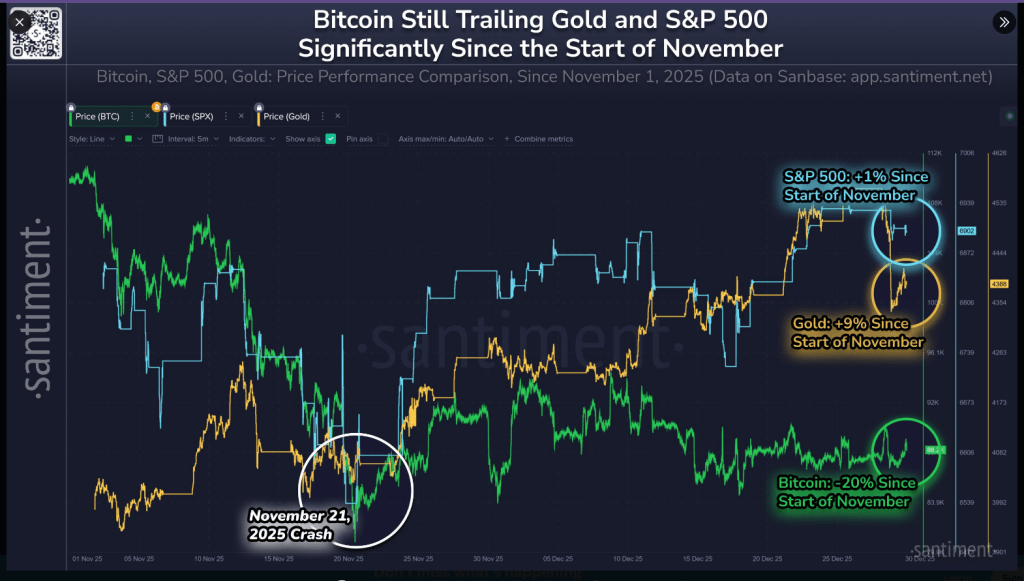
According to market intelligence firm Santiment, Bitcoin is trailing both gold and the S&P 500 after a sharp pullback in November. Gold has climbed 9% since early November, the S&P 500 is up 1%, and Bitcoin is down about 20%, trading near $88,000 as of Wednesday. Based on reports, that gap has left crypto quieter while other markets show modest rebounds.
Related Reading
Whale Accumulation Signals
Santiment’s data points to a split in behavior among holders. Small wallets were busy buying in the second half of 2025, while large wallets largely held steady and sold after pushing up to October’s all-time high.
Large holders are often treated as market movers, so their cautious posture has kept pressure on prices. Historically, a shift where big holders start buying while retail eases off has marked real trend shifts, but that condition is not fully obvious yet.
The correlation between Bitcoin & crypto compared to other major sectors is still lagging behind. Since November began, price performances are:
Gold: +9%
S&P 500: +1%
Bitcoin: -20%
Heading to 2026, there will remain an opportunity for crypto to play “catch up”. pic.twitter.com/FW8JaQboTV
— Santiment (@santimentfeed) December 30, 2025
On-Chain Data Mixed
Reports note some signs of stabilization. Long-term Bitcoin holders trimmed holdings from 14.8 million coins in mid-July to 14.3 million by December, then paused further selling. Active Bitcoin addresses rose 5.51% in the last 24 hours, yet transactions fell almost 30% over the same window.
That mismatch suggests more people are watching the market, while fewer are committing funds. The raw numbers show interest, but not a clear shift back to broad trading activity.
Market Voices Weigh In
Garrett Jin, who once ran exchange BitForex, said traders are already reallocating capital, arguing that money moves from one market to another when opportunities appear. Capital is the same and as always, it is wise to sell high and buy low, Jin wrote, according to posts on social channels.
Another analyst, CyrilXBT, described the current setup as late-cycle positioning before a possible rotation: when liquidity turns, gold could cool, Bitcoin might lead, and other tokens could follow.
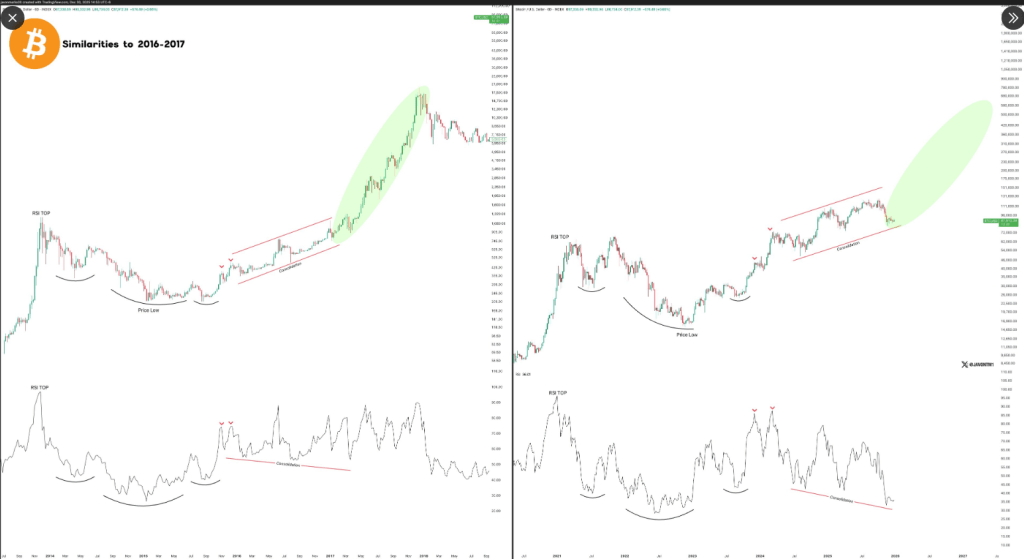
Bitcoin right now continues to look just like the 2016-2017 period, just before a parabolic move.
These two setups continue to flash in our mind due to the extreme similarities and bullish signals are even holding & flashing here too.$BTC‘s looking ready to absolutely GO
… pic.twitter.com/H1hInYwix8
— JAVON
MARKS (@JavonTM1) December 30, 2025
Price Calls And Technical Views
Technical commentators remain split. Javon Marks has pointed to parabolic patterns in Bitcoin’s chart that echo the 2016–2017 build-up and continues to forecast a rally toward $125K.
Based on CoinCodex data, a more modest move is expected first: the platform forecasts BTC could reach $91,500 by January 30, 2026, a rise of 3.68% from current levels.
Related Reading
CoinCodex lists sentiment as bearish and the Fear & Greed Index at 23 (Extreme Fear). The site also notes Bitcoin had 15/30 green days and 2.11% volatility over the past 30 days, with the last update on Dec 31, 2025.
Short-term traders should focus on whether large wallets resume buying in volume, and whether transactions pick up alongside rising active addresses. If whales start accumulating again while long-term holders stop reducing positions, that combination would give a stronger signal than either metric alone.
In the meantime, reports point to stabilization rather than a confirmed reversal, leaving room for a catch-up move in 2026 if liquidity and sentiment turn.
Featured image from Unsplash, chart from TradingView
Key facts: Cardano’s Midnight upgrade boosts DeFi; Hoskinson notes DEX gap; Solana bridge planned TradingView — Track All Markets
Source link ]]>
Since the market-wide crash in early October, the Bitcoin price has struggled to resume any significant movement to the upside. The flagship cryptocurrency has continued to fall even deeper into bearish territory, breaching multiple support zones in the process.
With the crypto market’s situation painting a bleak picture, the prevailing sentiment around its leader can hardly be said to be bullish. Interestingly, a recent on-chain evaluation puts into perspective the key players behind Bitcoin’s weakness.
BTC Coinbase Premium Gap Reads –$57
In a recent post on the social media platform X, on-chain analyst Maartunn shared that a substantial portion of sell pressure seen in the Bitcoin market might be from the activities of US investors. This on-chain observation is based on the Coinbase Premium Gap metric, which measures whether US based investors are buying or selling Bitcoin more aggressively than the rest of the global market.
Related Reading
For context, the metric tracks the price gap between Bitcoin on Coinbase and Bitcoin on major offshore exchanges (for example, Binance). A positive reading typically indicates that Bitcoin is more expensive on Coinbase, meaning that US traders are buying aggressively. On the other hand, negative readings are interpreted as increased sales or reduced interest among investors in the United States.
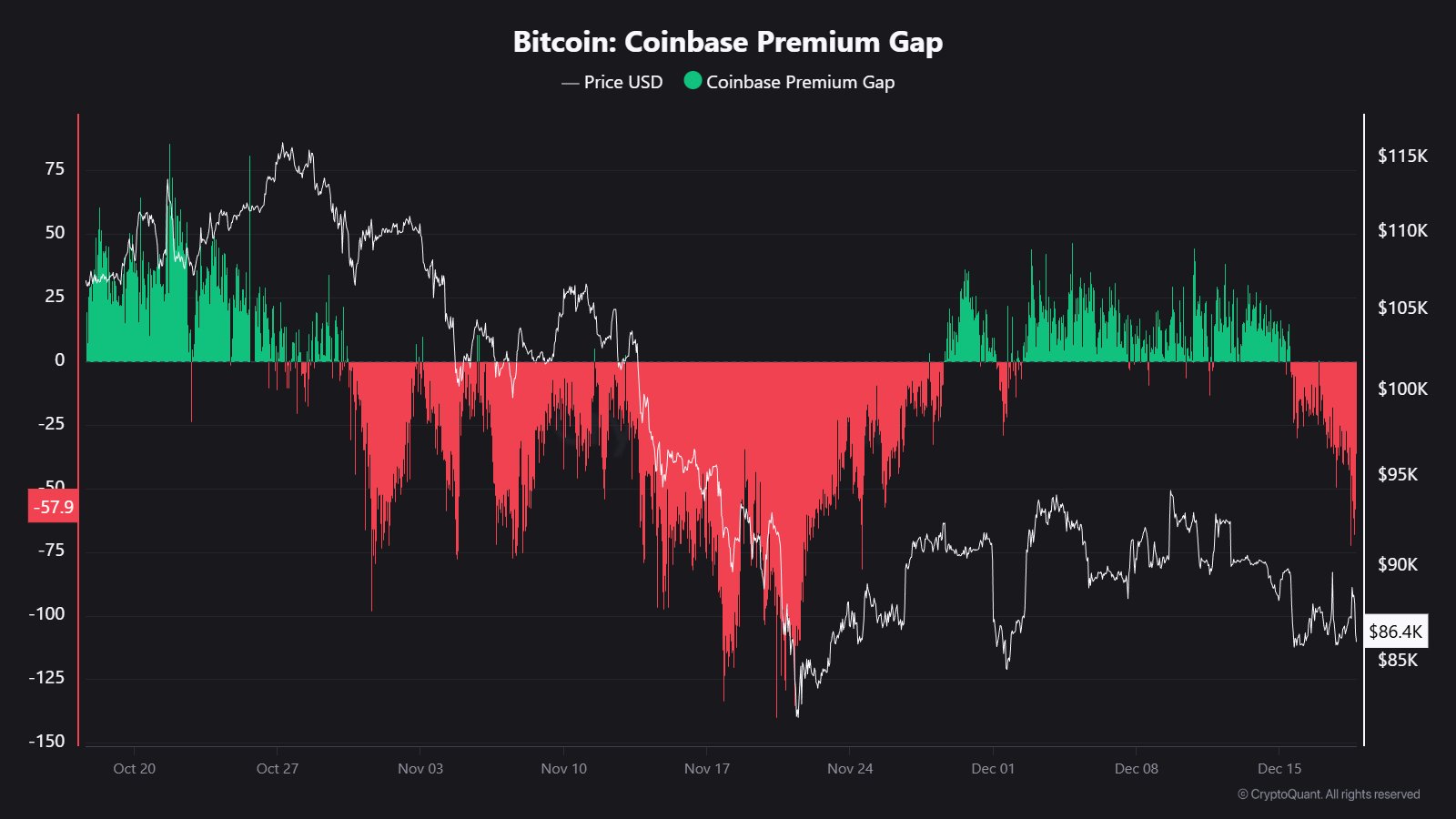
According to the analyst, the Coinbase Premium Gap recently dropped to a -$57 reading. As has been earlier implied, this deep negative value reveals that traders from the US are actively offloading, rather than accumulating Bitcoin.
Interestingly, this heightened selling activity accompanies Bitcoin’s price momentum towards lower levels. Thus, it becomes clear that the sell-pressure reflected on Bitcoin’s price is due mainly to the absence of US demand.
BTC Market Outlook
According to historical data, Bitcoin’s direction in the long-term could go either way. While a negative Coinbase Premium Gap reading is usually indicative of a bearish phase in the short term, the long-term perspective is a little less straightforward.
In past cycles, prolonged periods of negative readings have preceded the formations of market bottoms, after which prices saw recoveries to the upside. This often happens when sell-side pressure dwindles, and fresh demand enters the Bitcoin market.
Related Reading
Hence, if this negative reading deepens and there is no fresh demand in the market, the Bitcoin price could follow suit and continue south. However, a reversal of the Coinbase Premium Gap to the upside — pushing it towards neutral or positive levels — could prove pivotal for the world’s leading cryptocurrency.
As of this writing, Bitcoin holds a valuation of $88,260, reflecting no significant price movement in the past day.
Featured image from Dall-E, chart from TradingView
Cardano’s new roadmap assumes a 500% price explosion to mask an alarming gap in real protocol revenue CryptoSlate
Source link ]]>