Claim Your Block DAG at $0.0000061 Today! Ethereum Tackles Network Gaps & Cardano Price Fails to Break $0.275 openPR.com
Source link ]]>
Cardano Founder Slams Ripple CEO’s Support for CLARITY Act Despite Policy Gaps CoinGape
Source link ]]>
Reason to trust

Strict editorial policy that focuses on accuracy, relevance, and impartiality
Created by industry experts and meticulously reviewed
The highest standards in reporting and publishing
Strict editorial policy that focuses on accuracy, relevance, and impartiality
Morbi pretium leo et nisl aliquam mollis. Quisque arcu lorem, ultricies quis pellentesque nec, ullamcorper eu odio.
Ethereum is facing renewed downward selling pressure, with the entire crypto market entering a fresh downtrend in the past 24 hours. This renewed selling pressure has seen the Ethereum price lose a strong support level at $1,800, causing it to fall by about 14.5% from its price 24 hours ago at the time of writing.
The trading trend shows that the Ethereum price is about to break below $1,500, with one analyst even suggesting a potential break to $1,000. Yet, despite the sharp decline, technical patterns suggest the possibility of Ethereum revisiting much higher price levels upwards to $3,933, specifically to fill multiple CME futures gaps that are still open above.
Ethereum Breaks Below Key Support, Larger Breakdown Ahead
The loss of the $1,800 support has strengthened the bear case for Ethereum, especially amid broader weakness in the altcoin market. One of the more blunt takes comes from crypto analyst Andrew Kang, who argued that the price of Ethereum is actually overvalued. He described Ethereum’s $215 billion market cap as “ridiculous” for what he calls a “negative growth/profitability asset.”
Related Reading
According to Kang, the momentum of speculative winds that used to ignite Ethereum’s price surge has run dry, and a revisit of the $1,000 to $1,500 zone is not only likely but overdue. What adds weight to Kang’s warning is how quickly the market appears to have validated his concerns.
Since his statement, Ethereum’s market cap has dropped significantly, sliding to $186.5 billion at the time of writing. Although the decline is due to other market factors, the pace and depth of this decline suggest that investor confidence in Ethereum may be lower than expected, with no immediate signs of reversal in sight. If bearish pressure continues, Ethereum could soon find itself trading at the lower end of Kang’s projected range at $1,000.
CME Gaps Above $2,500 Offer A Technical Outlook For Rebound
Even as price action trends lower, Ethereum’s CME futures chart tells a different story. Titan of Crypto pointed out that three distinct CME gaps are unfilled above the current market level. These include a gap between $2,550 and $2,625, another between $2,890 and $3,050, and a partially filled third gap between $3,917 and $3,933.
Related Reading
The CME gap theory is rooted in the observation that asset prices often return to fill these voids, even if the move takes weeks or months. In the case of Ethereum, the odds of a return to the CME gaps are very low in the short term.
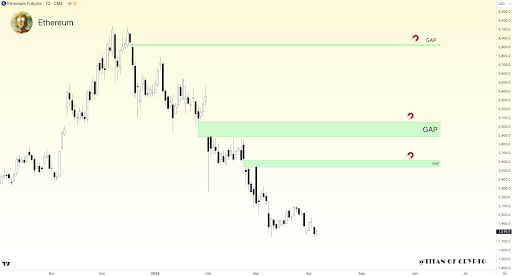
However, considering Q2 2025 is only just starting, there is still enough time to witness the buying pressure needed to fill these levels before the end of the year. At the time of writing, Ethereum is trading at $1,540, down by 14.5% in the past 24 hours.
Featured image from Unsplash, chart from Tradingview.com
$ADA: EMURGO CEO Outlines Plans to Address 21 Key Gaps in Cardano CryptoGlobe
Source link ]]>

With our MVP getting closer each week we thought we’d look at some of the issues around bridges once more. This is a topic that most commonly hits the headlines when an exploit has been used to drain funds locked within the bridge, so the more our community understands the concept, the more informed decisions they can make.
As previously explained a bridge is a part of blockchain technology that allows otherwise incompatible chains to transfer tokens between each other. This is usually done through a swap mechanism of some form where the native tokens are locked within a smart contract and their equivalent counterparts are issued on another chain.
In general, bridges are therefore only as safe to use as their smart contract. If there’s a flaw or weakness in the contract it can be exploited. Since there’s usually a high value locked in such contracts from many different users one exploit can yield devastating results.

If the vulnerability of bridges is considered in this context then naturally the question arises whether all smart contracts are at risk of exploitation. The answer to this is yes, which is precisely why we never rush our internal quality assurance testing and external audits. Our approach to bridges will follow the same rationale.
As Simon, our CTO explains, “Unfortunately nothing in cyberspace is 100% secure. However, we will make sure to use official bridges developed by the core team of a blockchain wherever possible. For example, the Arbitrum team offers their own bridge that is a fundamental part of their ecosystem.”
Security is paramount to the ethos of Paribus. Given that we’re a DeFi platform we are acutely aware of the trust involved when people choose to use our platform. When exploits occur they often drain hundreds of millions of dollars from the people involved which is a staggering sum. That equates to tens of thousands of people losing significant sums, which is why we always adopt a steady and cautious approach.
When developing an effective product security also has to take into account, but not be compromised, by other factors. As Deniz, our CEO says, “Although security wasn’t the only reason we chose Arbitrum, it was part of the main three deciding factors. These factors come down to scalability, security, and ease of use relative to other solutions.”

We empathize with the eagerness we often hear from our community about adopting different bridges or transitioning to a Cardano Native Token. Just like everyone else, we always wince when thinking about gas fees on Ethereum. That’s why we’re working hard to continually test and develop methods that will help us achieve all these goals.
We’re often asked which bridge we’ll use and Wilson, our COO explains, “We haven’t made a specific choice yet as we are still internally testing which will deliver the best results for our platform. However, the bridge we are going to use will be a 2-way bridge in order to support our cross-chain strategy.”
How that bridge will be integrated into Paribus or operate alongside it is further detailed by Simon, “The MVP won’t directly include a bridge in the interface or smart contracts but bridge technology will be important for our cross-chain development. Allowing individuals to transfer tokens to different chains will be key to a truly open cryptocurrency market.”
In this world of seemingly endless possibilities, a new product or technology appears almost every week. Our attitude is to take a measured approach that errs on the side of caution, which is why we’re releasing the MVP on Arbitrum. This approach may not be as fast-paced as some would like but it gives us the safest, most effective route to launch.
As Deniz says, “There aren’t any specific technical challenges to implement on Arbitrum over Ethereum. With the large number of experienced Solidity developers on our team, it is a task they are more than capable of completing.”
Twitter || Telegram || Linkedin || Website || Medium
Original Source: https://blog.paribus.io/paribus-bridging-the-gaps-6cfb2167eddf
Cybercrime surged in 2021 and hackers and other cyber criminals are looking for another bumper year this year. As cyber criminals become more sophisticated, crypto platforms need to be even smarter to protect investors and users from hacks and other types of criminal activity.
Ransomware, Hacks, and other Illicit Activity Hurt Digital Asset Value
Late last week, we reported on prelim ransomware numbers for 2021 and likely finalized numbers. Based on prelim figures and upward revisions to 2020 numbers, ransomware alone could hit more than $1bn in 2021. There was also news of North Korea funding its missile program with stolen crypto.
With the likes of North Korea actively hitting the crypto market for source of funds, government scrutiny has also increased. In late January, the White House announced an imminent crypto executive order to task agencies with crypto oversight in the interest of national security.
As governments and regulators look to take a more active role in the crypto market, crypto platforms will also need to step up or face the wrath of regulators.
The issue doesn’t just lie with crypto exchanges, however, with the NFT marketplace and the Metaverse also considered as a medium for illegal activity. China, India, the UK, and a number of other governments have highlighted the need to clamp down on illicit activity.
Cardano and Coinbase Look Outside to Tighten Security
This week, the Cardano Foundation (ADA) announced a 6-week promotion running from 14th February to 25th March. The Foundation doubled its bounty amounts for the period. Hackers can earn up to $20,000 for identifying critical Cardano Node security vulnerabilities. The security community can also earn up to $15,000 for identifying critical Cardano-Wallet security vulnerabilities.
Coinbase was also in the news this week, with a lone hacker reportedly assisting Coinbase with a security flaw. A hacker going by the name Tree of Alpha tweeted over the weekend of a “potentially market-nuking” security flaw. Tree of Alpha tweeted a submission of a hacker1 report but also the pressing need for direct contact with the Coinbase team.
Anyone here can get me a direct line with someone at @coinbase , preferably management or dev team, possibly @brian_armstrong himself?
I’m submitting a hacker1 report but I’m afraid this can’t wait. Can’t say more either, this is potentially market-nuking.
DMs open.
— Tree of Alpha (@Tree_of_Alpha) February 11, 2022
Hackerone is a platform started by hackers and security experts with the aim of making the internet a safer place. The platform partners with hackers to uncover security issues for customers before they are exploited by criminals. Users include Starbucks, Nintendo, PayPal, Spotify, Toyota, the European Commission, among others.
The collaboration and effectiveness of Hackerone was evident in the Coinbase fix. Brian Armstrong himself replied directly to Tree of Alpha to give thanks.