Grayscale Investments has secured approval to begin trading on NYSE Arca tomorrow. Also, the fund will be traded under a new name called Grayscale CoinDesk Crypto 5 ETF. Grayscale Converts $GDLC Trust Into CoinDesk Crypto 5 ETF on NYSE The ETF, formerly known as the Grayscale Digital Large Cap Fund ($GDLC), will hold a basket
The post Grayscale’s XRP, SOL, ADA Fund To Begin Trading Tomorrow Following SEC’s Greenlight appeared first on CoinGape.
]]>
Grayscale’s conversion of its Digital Large Cap Fund (GDLC) into an exchange-traded fund (ETF) has been frozen by a stay order, despite receiving approval from the Securities and Exchange Commission (SEC) on July 1.
Bloomberg ETF analyst James Seyffart said in a social media post on July 2 that the stay blocks the conversion “for now” and that the SEC gave no timeline for removal.
Two theories
Seyffart shared two working theories for the temporary block that came with the approval. The first is that staff in another division may still vet GDLC’s structure, or the SEC may prefer to keep every crypto listing on hold until it finishes a broader rule set for token-based ETFs.
Meanwhile, Bloomberg senior ETF analyst Eric Balchunas assessed that the SEC could be waiting for the first spot ETFs tracking Solana, Cardano, and XRP to hit the market before allowing Grayscale to trade its multi-asset fund.
The approval amended NYSE Arca Rule 8.500-E, allowing the trust’s units to trade on the exchange once the operational details are cleared.
GDLC holds Bitcoin, Ethereum, Solana, XRP, and Cardano. Grayscale reports roughly $775 million in assets under management for the product.
When the stay is lifted, the fund will transition to an in-kind creation and redemption format, replacing the current closed-end structure.
Standardized framework
Recent reports suggested that the SEC and US exchanges are working on drafting a generic listing standard for token ETFs.
Under the proposal, an issuer would file only a Form S-1, wait the customary 75 days, and launch if the registration becomes effective. The framework would allow issuers to sidestep the current Rule 19b-4 change each product now needs.
Seyffart called the prospect “very good news” because a single standard would shorten timelines and supply clear thresholds for market capitalization, trading volume, and liquidity.
Other crypto basket funds, including filings submitted by Bitwise, Hashdex, and Franklin Templeton, are awaiting SEC approval.
Based on one of Seyffart’s theories, the regulator might be waiting to give GDLC full clearance so it can approve the other ETFs under the same standards.
Notably, the deadline for a decision on Bitwise’s filing expires on July 31, which could be a key date to watch and expect for the rumored framework.
Mentioned in this article
Reason to trust

Strict editorial policy that focuses on accuracy, relevance, and impartiality
Created by industry experts and meticulously reviewed
The highest standards in reporting and publishing
Strict editorial policy that focuses on accuracy, relevance, and impartiality
Morbi pretium leo et nisl aliquam mollis. Quisque arcu lorem, ultricies quis pellentesque nec, ullamcorper eu odio.
A major breakthrough has just arrived for Bitcoin and the crypto industry from one of the most influential financial regulatory bodies in the United States. The Federal Housing Finance Agency (FHFA), which oversees the country’s largest mortgage liquidity providers, has issued a directive that could change how digital assets are viewed.
Under this directive, mortgage liquidity providers have been officially ordered to begin preparations for considering cryptocurrencies as part of a borrower’s asset portfolio during mortgage evaluations.
Crypto As Mortgage-Eligible Asset
In a recent post on the social media platform X, FHFA Director Bill Pulte issued a directive instructing Fannie Mae and Freddie Mac to prepare proposals that allow homebuyers to count cryptocurrency holdings held on US-regulated exchanges as part of their asset reserves for mortgage applications without converting them into dollars.
Related Reading
Crypto assets have always been excluded from mortgage risk assessments unless converted to U.S. dollars before closing. However, this recent move breaks that barrier. This policy shift aligns with former President Donald Trump’s campaigns to establish the United States as the crypto capital of the world. Pulte, who was recently sworn in as the 5th Director of U.S. Federal Housing FHFA in March 2025, is now part of those taking steps to make this vision a reality.
According to the order, both Fannie Mae and Freddie Mac must also factor in market volatility and enforce strong risk-based adjustments before implementing the new assessment method. Fannie and Freddie are government-sponsored enterprises that do not issue mortgages themselves but play an important role in the housing market by purchasing home loans on the secondary market and setting the criteria for the loans they are willing to acquire.
Bitcoin To Benefit The Most, But Where Does XRP Stand?
Bitcoin is going to benefit the most from this policy update. Being the largest and most widely held cryptocurrency, Bitcoin has long been considered the digital gold standard, which makes it a natural candidate for institutional recognition.
Related Reading
Its established presence on U.S.-regulated exchanges and deep liquidity profile through Spot Bitcoin ETFs tick nearly every box laid out in the FHFA’s directive.
However, the decision raises an important question for XRP holders as to whether the same regulation will be extended to XRP. Unlike Bitcoin, XRP has had a complicated history with regulatory agencies in the US, most notably the SEC. Although recent legal clarity around XRP has allowed the crypto to resume trading on major US-based exchanges, it isn’t really certain whether Fannie Mae and Freddie Mac will be quick to include it under this new directive.
Nonetheless, the FHFA’s directive doesn’t specify eligible tokens. It simply refers to cryptocurrencies held on US-regulated exchanges. As such, the directive could be quick to include US-based cryptocurrencies like XRP and Ethereum alongside Bitcoin. Other countries are already far ahead with XRP in real estate. In Japan, for instance, Open House Group allows XRP payments for property purchases in cities such as Tokyo and Osaka. Dubai is also using the XRP Ledger to tokenize real estate.
Featured image from Pixabay, chart from Tradingview.com
Crypto News: XRP Price Sinks After Legal Troubles, But Cardano (ADA) and This $0.04 Crypto Have Greenlight Bitcoinist
Source link ]]>
SolidProof KYC Greenlight Gives DTX Exchange a Boost as Cardano, Polkadot, and Kaspa Traders Take Notice Crypto Reporter
Source link ]]>
Shiba Inu’s Shytoshi Kusama Teases SHIB ETF Amid Ethereum ETF Greenlight CoinGape
Source link ]]>
In a bipartisan effort, Representatives Mike Flood and Wiley Nickel are urging the U.S. Securities and Exchange Commission (SEC) to greenlight options trading on Spot Bitcoin ETFs. These lawmakers have written a letter addressed to SEC chair Gary Gensler, pushing him to consider their request.
SEC Chair Gary Gensler Under Pressure To Approve Bitcoin ETF Options
The significance of this push lies in the delay issuers have faced in launching options following the historic approval of Spot Bitcoin ETFs in January. The ETFs secured the SEC approval following a long delay that too after a court ruling. Now, Flood and Nickel are adamant that the SEC doesn’t perpetuate discrimination against these newly established funds.
Expressing the critical nature of approving options trading on Bitcoin ETFs, the letter emphasizes its importance to the investors whom the SEC aims to safeguard. Flood and Nickel, representing both Republican and Democrat perspectives, underscore the need for prompt action. Moreover, they also encourage a transparent explanation for treating options for Bitcoin futures ETFs differently from Spot Bitcoin ETFs.
According to a report by Axios, the letter sent to Gensler read, “We urge you, without delay, to approve options on spot Bitcoin ETPs or to provide an explanation for the Commission’s difference in treatment between options for Bitcoin futures ETFs—which are currently trading—and options for the spot Bitcoin ETPs.”
Also Read: U.S. Bitcoin ETF Outflows Jump Past $560 Million, More Pain Ahead?
Will CFTC Be Involved?
The broader context reveals a disparity in the approval process between market stock ETFs. The stock ETFs typically see options trading approval shortly after launch while commodity trust-based fund face a more intricate and prolonged process. This complexity arises from the necessity of obtaining approval from multiple government agencies, including the Commodity Futures Trading Commission (CFTC).
Moreover, insiders close to the matter anticipate the CFTC to pose the primary obstacle rather than the SEC. The CFTC’s involvement in approving such products also stems from the recent contradiction from the SEC over the Ethereum (ETH) controversy. Hence, it remains to be seen if the CFTC and the SEC would collaborate on deciding whether the Bitcoin ETF options should be approved or not.
Also Read: European Bank With $600B AUM Invests In BlackRock Bitcoin ETF

The presented content may include the personal opinion of the author and is subject to market condition. Do your market research before investing in cryptocurrencies. The author or the publication does not hold any responsibility for your personal financial loss.
The global cryptocurrency landscape is witnessing a seismic shift as Hong Kong gears up to launch Bitcoin Exchange-Traded Funds (ETFs) this month. Meanwhile, this move comes hot on the heels of the U.S. Securities and Exchange Commission’s (SEC) groundbreaking decision to greenlight Spot Bitcoin ETFs, indicating a growing acceptance of digital assets in traditional finance circles.
Notably, Hong Kong’s embrace of these investment vehicles is set to reshape the investment landscape for both institutional and retail investors alike.
Hong Kong To Launch Spot Bitcoin ETF
In a groundbreaking development, the Hong Kong Securities Regulatory Commission (SFC) has fast-tracked the approval process for four Bitcoin Spot ETFs, slated to be announced this April. According to recent announcements, Harvest International, China Asset Management, Boshi Fund, and Value Partners Financial are at the forefront of this crypto investment revolution.
However, while Boshi Fund and Value Partners Financial await inclusion pending regulatory criteria, Harvest International and China Asset Management have already made significant strides.
Meanwhile, the Hong Kong SFC’s recent update includes Harvest International and China Asset Management among the first batch of virtual asset management fund companies. This move signifies a pivotal moment as these established public fund companies step into the virtual asset realm, signaling a broader acceptance of cryptocurrencies within traditional finance circles.
Notably, according to industry insiders, the plan to launch Spot Bitcoin ETFs in Hong Kong involves a rigorous process, including collaboration with at least 20 institutions, such as Bitcoin custodians and market makers. Despite the meticulous procedures, the timeline for the launch has been accelerated, with expectations set for completion within 10 days of regulatory approval.
Also Read: Senator Tillis Advocates for Light Crypto Regulations Pre-Election
Implications for Investors
The imminent approval of Bitcoin Spot ETFs in Hong Kong presents a plethora of opportunities for both institutional and retail investors. With retail investors gaining access to Bitcoin investments through ETF subscriptions, the investment landscape is poised for a radical transformation.
Meanwhile, this development comes at a time when traditional institutional investors are increasingly eyeing cryptocurrency investments amid a sluggish stock market performance. In addition, the anticipated launch of these ETFs is expected to pave the way for a more diversified investment portfolio and could potentially mirror the success witnessed in the United States, albeit on a smaller scale.
Notably, the approval of the U.S. Spot Bitcoin ETF approval has been a boon for the crypto market, as well as for the Bitcoin price. The increasing institutional interest in the flagship crypto has sent the Bitcoin price to its all-time high recently.
Also Read: Japan’s PM Kishida Aims to Forge Stronger AI Collaboration on US Visit


The presented content may include the personal opinion of the author and is subject to market condition. Do your market research before investing in cryptocurrencies. The author or the publication does not hold any responsibility for your personal financial loss.
US SEC is expected to greenlight the first spot Bitcoin ETF this week, opening the door for a possible $10 billion inflow in 2024.
People in the Bitcoin community are waiting with bated breath for the United States Securities and Exchange Commission’s (SEC) greenlight on spot BTC exchange-traded funds (ETFs). Starting this week, the SEC should begin to take action on these applications, accepting or denying proposals from applicants.
The SEC has until Wednesday to decide on the ETF application from 21Shares and Cathie Wood’s ARK Invest, the first proposal submitted last year. The Commission may also decide on other applications on the date, or delay their decision until the stated deadline for each of the other proposals.
SEC Greenlight Likely as Agency Deliberates on Proposals
According to reports, applicants had until Monday morning in Washington to make any last-minute submissions. Reports also suggest that the SEC may publicize some of these changes on that day. The crypto community is now waiting for word from the SEC, with many observers and analysts predicting a high chance of a green light.
There have been several deliberations between the SEC and a few applicants, with some making changes to their proposals. In some cases, applicants had to amend their filings to disclose market-makers. In other cases, the SEC preferred for applications to directly specify any included fees.
A Reuters report states that the SEC asked a few applicants to ready written requests for the effective dates of these ETFs. This lends credence to the optimism around approval because the SEC’s ask is unusual. Typically, the Commission would engage the prospective issuers more informally.
The SEC has never approved a spot Bitcoin ETF application since the Winklevoss Twins’ Gemini exchange applied for the first one in 2013. Since then, the agency has rejected all applications, citing several problems with fraud and market manipulation. The existing applications before the SEC have addressed the agency’s concerns, with some of them introducing a surveillance-sharing agreement (SSA). The SSA requires information sharing and coordination to significantly reduce the chance of market manipulation and fraud in the ETF market.
The SEC’s greenlight for spot Bitcoin ETFs involves two requirements. The agency must first approve the 19b-4 filings submitted by exchanges seeking approval for proposed rule changes. The other is the approval of S-1 forms, which are registration applications for the public sale of these products.
Impact of SEC ETF Greenlight on the Bitcoin Market
The predictions surrounding a likely ETF green light from the SEC are considerably bullish. Amid the general optimism, Bitcoin jumped 7% to $45,806 on the first day of 2024, landing at a 21-month high. Although the king coin has corrected back to $44,000 as of press time, the market sentiment is still quite bullish.
Analysts Mahika Sapra and Gautam Chhugani at AllianceBernstein said 2024 would be a “breakout inflection year for crypto.” The analysts bullishly predict that Bitcoin will scale its current $69,000 all-time high from 2021 and could potentially end the year around $80,000. They also said that while Bitcoin ETF inflows would initially be gradual, applicants would try to get ahead of each other by “tuning up advertising and Bitcoin branding leading to a snowball effect.”
The analysts expect $5 billion to enter the Bitcoin market in H1 2024, and $10 billion by H2. Also, they said that about 10% of Bitcoin would be in the ETF market by 2028.
Ethereum Core Developers have officially approved EIP-7514 for inclusion in the upcoming Dencun upgrade which is slated for late 2023. This Ethereum Improvement Proposal (EIP) primarily aims to decelerate the growth rate of ETH staking, thereby providing the Ethereum community additional time to craft an improved validator reward scheme.
The main modification brought by this EIP is setting the Max Epoch Churn Limit, the validator activation queue upper limit, to a constant value of 8. Previously, the churn limit was calculated by taking “The total number of validators/65536,” which at present equates to about 12/epoch.
The decision followed an Ethereum Core Dev Meeting, as described in a tweet by Tim Beiko: “Wrapped up another Ethereum #AllCoreDevs: we covered devnet updates, additions to Dencun, and had a full overview of Reth. […] EIP-7514 will be part of the Dencun upgrade! Expect the EIP and associated CL specs PR to be updated to reflect all of this in the coming days.”
Beiko’s statement underscored the importance of this change and provided insights into the consensus among Core Developer teams. Dankrad Feist, a Researcher at the Ethereum Foundation, outlined the importance of the approval. Feist stated:
My reasoning on why I’m for EIP-7514. It is currently unclear if (especially liquid) staking will keep growing indefinitely. In the case that the withdrawal queue does not empty over the next few months, the lower churn limit will give the Ethereum community the time needed to research, debate and implement solutions.
Implications For Ethereum Price
The staking ratio’s continual rise could result in a diminishing amount of liquid ETH available for trading. Should the staking ratio near 100%, it might produce a supply scarcity, thereby influencing the ETH price positively. However, from the information presented, Ethereum developers are not advocating for this scenario due to potential technical and security implications.
EIP-7514, therefore, indirectly impacts the ETH price by manipulating its supply side, though immediate, direct effects on the price aren’t anticipated. Instead, any potential influence on price would likely manifest over an extended period.
The motivation behind EIP-7514, as detailed on GitHub, is to “mitigate the negative externalities of very high level of total ETH supply staked before a proper solution is implemented.” If the deposit queue stays 100% full, the share of ETH supply staked will reach 50% by May 2024, 75% by September 2024, and 100% by December 2024.
Remarkably, the modest returns don’t necessarily deter further capital staking, especially with the frequently substantial and erratic returns from MEV. Therefore, EIP-7514 serves as an interim measure, buying time for the community to deliberate and develop comprehensive solutions to the emerging challenges.
In summary, while the immediate effects of EIP-7514 on the ETH price remain to be seen, its long-term implications, especially in terms of staking growth and supply side management, could be substantial. The community and investors alike will closely monitor the aftermath of this EIP’s implementation in the Dencun upgrade.
ETH Price Builds Momentum
At press time, ETH was trading at $1,628. On Monday, ETH price bounced off the 78.6% Fibonacci retracement level at $1,536. A breakout above the 20-day EMA at $1,639 and consequently above the 61.8% Fibonacci level at $1,665 is critical to maintain upside momentum.
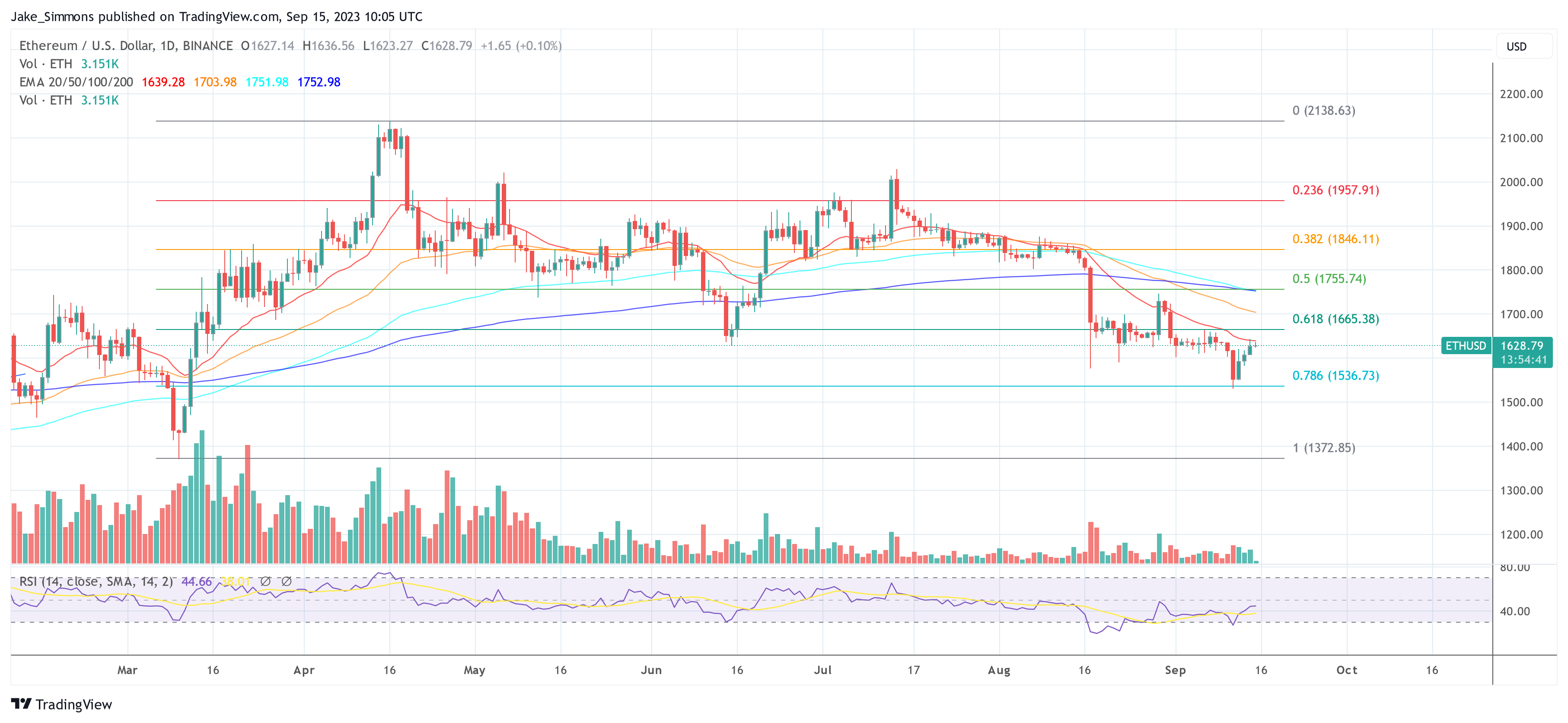
Featured image from iStock, chart from TradingView.com
✓ Share: