Bitcoin mining is entering a new era in Japan, where it’s no longer viewed as an energy drain. The transformation is being spearheaded by Canaan (CAN), a forward-thinking initiative that integrates BTC mining into Japan’s renewable energy ecosystem to balance power demand and supply.
This Is How Bitcoin Fits Into National Energy Policy
In an X post, crypto analyst TheGentleTraveler has shed light on a significant and innovative development at the intersection of Bitcoin mining and energy infrastructure. CAN (Canaan Inc.) has announced a 4.5 MW smart BTC mining deployment set to power Japan’s energy grid.
Related Reading: China’s Bitcoin Mining Isn’t Dead — It’s The World’s No. 3 Contributor
According to TheGentleTraveler, CAN has secured a 4.5 MW contract in Japan to deploy its advanced Avalon A1566HA hydro-cooled mining servers for power-grid load balancing and energy-efficiency optimization. The project, which runs in collaboration with a major Japanese utility, will use Canaan’s smart-control chip capable of dynamically adjusting frequency, hashrate, and voltage in real time. This flexibility helps to stabilize the grid amidst rising AI and residential power demand.
The GentleTraveler noted that this initiative reflects Canaan’s expanding strategic role, which combines BTC mining with renewable energy and AI infrastructure. Furthermore, it aligns seamlessly with Japan’s recent crypto-asset regulatory reforms. Canaan CEO Nangeng Zhang emphasized that this technology allows utilities to utilize BTC mining as a digital load balancer. Zhang confirmed that similar deployments have already been launched in the Netherlands, with further expansions planned for 2026.
Despite this groundbreaking news, CAN’s stock is currently down – 7% after the announcement. This short-term dip is attributed to a combination of the general weakness in the broader BTC sector and the At-The-Market (ATM) announced by Canaan last Friday.
How Bitcoin Miners Become Long-Term Investors
A key observer in the Bitcoin landscape, GoMining, has stated that every block mined secures the network and strengthens BTC’s role in the modern economy. GoMining has highlighted several standout developments from the past week that collectively underscore this accelerating trend of institutional and sovereign adoption.
The expert first draws attention to the strategic actions of mining companies in the US, exemplified by American Bitcoin Corp boosting its reserves to 3,865 BTC. According to GoMining, this is proof that miners are not just securing the network; they are becoming long-term institutional holders. Meanwhile, France’s National Assembly has advanced a bill to create a national BTC reserve, a signal that sovereign adoption is moving from concept to policy.
Furthermore, GoMining explains that the public companies now collectively hold over $117 billion in BTC, representing a substantial 38% increase in Q3 alone. Such a surge indicates a growing trend where corporate balance sheets are becoming part of BTC’s security layer. GoMining concluded that every hash is a vote for an open institutional future.
]]>Reason to trust

Strict editorial policy that focuses on accuracy, relevance, and impartiality
Created by industry experts and meticulously reviewed
The highest standards in reporting and publishing
Strict editorial policy that focuses on accuracy, relevance, and impartiality
Morbi pretium leo et nisl aliquam mollis. Quisque arcu lorem, ultricies quis pellentesque nec, ullamcorper eu odio.
XRP’s price action in the past seven days has been marked by a consistent decline from $2.25, putting the target at a probable break below $2. If XRP were to lose this support level, there’s a risk of a further crash until it reaches $1.6, as there isn’t a realistic support base between these levels. Nonetheless, an interesting technical indicator suggests that the cryptocurrency is headed for $9 by September 2025.
Analyst Eyes $9 XRP Target Using Gann Angle Resonance Grid
A crypto analyst recently posted a technical projection on the social media platform X, showcasing a long-term XRP price chart structured around the 1×1 Gann Angle Resonance Grid on the 3-day candlestick timeframe chart. According to the chart, the analyst anticipates XRP could reach a price target of $9.63 by early September 2025, aligning with the upper edge of the “Topping Channel” in the Gann grid. This projection stems from the intersection of the Gann channel’s resistance trendlines and a key Fibonacci market cap extension level at the 4.236 Fib, which the analyst identifies as a major confluence point.
Related Reading
Although a $9 target might seem a lot, as it would be far higher than XRP’s current all-time high of $3.40, it is quite conservative compared to some more extravagant predictions circulating within the XRP community. However, the $9 projection is the most realistic target based on the Gann angle resonance grid.
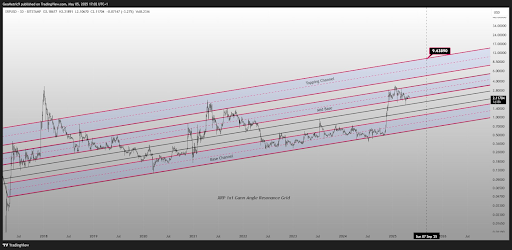
As it stands, the XRP price is in the mid-base zone, now at the cusp of entering the upper band called the topping channel. The technical structure of the rally resembles a stair-step progression, with each consolidation phase occurring near major grid lines.
Strong Support At $1.60, But $9 In September
Although the long-term outlook is a strong surge, there is also a need to consider the possibility of a short-term downside movement. If XRP fails to hold the mid-base level just above $2.00, the next structural support zone is around $1.60.
Related Reading
Notably, the grid-based projection places XRP reaching the $9 target sometime around September 7, 2025. However, even if a strong rally and stronger inflows were to push XRP to this point, this might not be done in a straight line but gradually through a series of breakouts and pullbacks. The greater the breakout, the greater the pullbacks.
At the time of writing, XRP is trading at $2.14, up by 2.14% in the past 24 hours with an intraday high of $2.17. Right now, all eyes are on whether it can break above the descending trendline that has capped its price movement into lower highs and lower lows in the past seven days.
Featured image from Getty Images, chart from Tradingview.com
The latest update from the world’s largest crypto exchange, Binance saw the platform introduce an exclusive service of spot grid trading. According to Binance’s community release, this new feature will be a table turner, automating the buying and selling of cryptocurrencies by keeping a round the clock track of market trends.
Binance spot grid trading feature is now live on its website and aims to eliminate “FOMO (Fear Of Missing Out) and make strategic, informed, and rational trading decisions” on behalf of the traders.
“Binance is excited to announce the launch of Spot Grid Trading, a strategic tool that automates the buying and selling of crypto at preset intervals around a preset price range to construct trading grids.”, the exchange platform noted in its community announcement.
Binance faces regulatory wrath despite regulator-friendly approach
Binance is rapidly climbing the ladder of success since it opted a regulator-friendly approach. However, despite Binance’s centralised focus, it continues to receive regulatory backlash from countries like China and Turkey. On the last day of 2021, the crypto exchange platform announced suspension of C2C trading services for mainland China users, while handing over the responsibilities to its verified partner, a C2C trading platform called Pexpay.
Along with Chinese authorities, the Turkish regulators also seemed discontent with Binance’s stay in its territory. During the same week as Binance shut down C2C trading in China, the Turkish subsidiary of Binance, BN Teknologi got in trouble worth 8 million lira, which amounts to approximately $751,314. The country’s Financial Crimes Investigation Board (MASAK) fined Binance’s local unit for several infringements of the new laws of Turkey that require crypto-exchanges to track user information for taxation purposes.
Binance global expansion continues amid minimal regulatory backlash
While it is evident that few countries’ regulators continue to stay displeased with Binance, yet the exchange has followed it path to growth across the world. From acquiring in-principle approval in Bahrain to establish itself as a crypto-asset service provider in the nation to announcing a new partnership with Dubai World Trade Center Authority (DWTCA) to build a crypto hub, Binance is knocking it out of the ball park.
Disclaimer
The presented content may include the personal opinion of the author and is subject to market condition. Do your market research before investing in cryptocurrencies. The author or the publication does not hold any responsibility for your personal financial loss.
About Author

After China’s Bitcoin (BTC) mining ban in May this year, the US became the biggest Bitcoin mining hub in the world. Most of the large Bitcoin mining farms in China either shut down completely or relocated to the US, Kazakhstan, and Russia to continue their mining operations. The US has seen the largest influx of Bitcoin miners especially in cities like Texas. However, what was seen as a great opportunity for the city now seems to be turning into a problem.
Texas is quite popular among crypto miners because of its business-centered regulations and cheap cost of electricity. The majority of the big crypto mining cooperations are opening up new subsidies and increasing their existing capacity with more mining rigs. This has put a severe concern among people whether the electric grid would be able to absorb the heavy load.
Texas Is Becoming A Mecca For Bitcoin Miners.#Bitcoin @Nasdaq @Bitcoin https://t.co/mNaSBG6EIT
— Greg Abbott (@GregAbbott_TX) May 5, 2021
Michelle Michot Foss, a fellow in the Center for Energy Studies at Rice University’s Baker Institute called Bitcoin miners “energy hogs.” He explained that even though the severe growth of crypto mining in the wake of the China ban was anticipated but nobody took note of the “sensitivity of the system to break downs.”
“They are energy hogs, absolutely. I don’t think that in Texas, we’ve actually done a bad job in terms of anticipating growth, I think where we’ve missed it is in understanding the sensitivity of the system to break downs.” Michot Foss said. “And when you’ve got much larger load building at the same time, then the chance for disruptions is there.”
Texas Electricity Council is Keeping a Tight Watch
The Electric Reliability Council of Texas (ERCOT) is monitoring the growing pace of crypto mining in the state and its potential impact on the power grid.
“ERCOT is monitoring cryptomining developments and evaluating the potential impacts on the grid,” an ERCOT spokesperson said. “It is fair to say that these crypto loads can have impacts just like any large load.”
The power grid issues won’t be a first of its kind, in fact, countries that have legalized crypto mining have also faced similar problems be it Iran or Kazakhstan. Iran had suspended crypto mining operations for five months in the Summer amid growing blackouts in the country. However, it’s mostly illegal crypto mining that takes the main toll on power consumption as they are unaccounted for.
Disclaimer
The presented content may include the personal opinion of the author and is subject to market condition. Do your market research before investing in cryptocurrencies. The author or the publication does not hold any responsibility for your personal financial loss.
About Author
