
A crypto wallet connected to the notorious $300 million Coinbase hack has reappeared with another suspicious move on the Ethereum blockchain.
Over the weekend, the address acquired 3,976 ETH worth approximately $18.9 million, according to on-chain data from Arkham Intelligence. The purchase was executed using 18.9 million DAI, a stablecoin, and split across multiple transactions before being consolidated into the buy.
The transaction came just as Ethereum broke above $4,700, marking its highest level in more than two weeks. Currently, ETH trades at $4,538, down 2.9% in the past 24 hours.
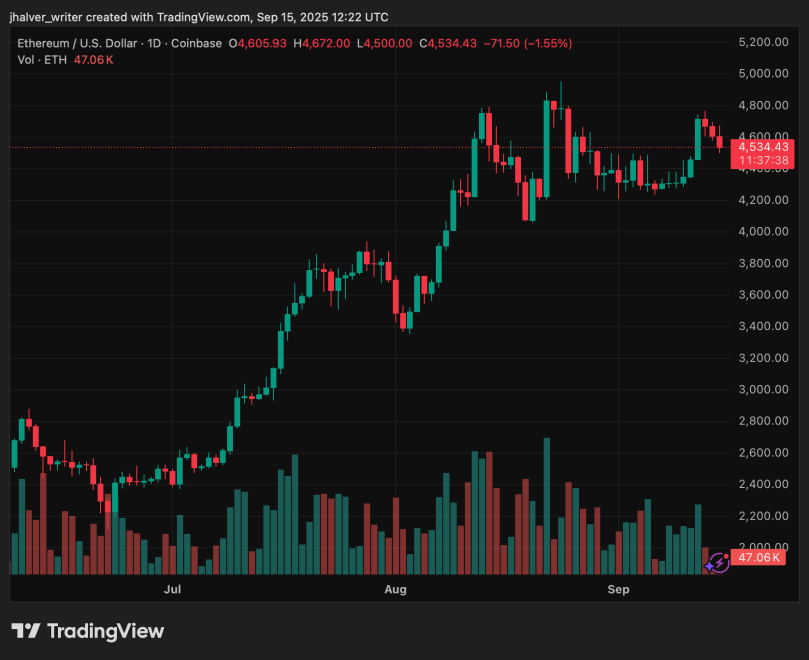
ETH's price trends to the upside on the daily chart. Source: ETHUSD on Tradingview
A Pattern of Bold Acquisitions
This is not the first time the wallet has made waves. In July, it bought 4,863 ETH for $12.6 million and later added 649 ETH at $3,562 per token. Just last month, the same wallet scooped up $8 million worth of Solana (SOL), though that position has since slipped below entry price.
Analysts say the strategy shows deliberate fund consolidation, often seen in money laundering tactics. Breaking transactions into smaller amounts and using privacy tools allows the hacker to mask movements, making tracking more difficult.
Blockchain investigator ZachXBT previously estimated that the Coinbase-related social engineering scam drained at least $330 million from victims, warning that the real figure may be significantly higher.
Growing Concerns Over Rising Crypto Hacks
The latest Ethereum purchase shows broader concerns in the crypto industry, where hack-related losses reached $163 million in August alone, according to security firm PeckShield.
With exploits shifting from smart contract bugs to social engineering and cross-chain bridge vulnerabilities, wallets like this continue to pose a major threat to investor confidence.
Despite Coinbase offering a $20 million reward for information on the perpetrators and tightening security, the hacker remains unidentified. The latest $19M ETH grab proves the resilience and boldness of cybercriminals operating in the space.
As crypto rallies and institutional inflows grow, the question remains: is the hacker simply riding bullish momentum, or is this part of a deeper strategy to launder stolen funds? Regulators and blockchain investigators are watching closely, but for now, the crypto world is left with more questions than answers.
Cover image from ChatGPT, ETHUSD chart from Tradingview
Editorial Process for bitcoinist is centered on delivering thoroughly researched, accurate, and unbiased content. We uphold strict sourcing standards, and each page undergoes diligent review by our team of top technology experts and seasoned editors. This process ensures the integrity, relevance, and value of our content for our readers.

- The largest theft was $91.4 million from anonymous Bitcoin addresses.
- Other victims included Odin.fun ($7 million), BetterBank.io ($5 million), and CrediX Finance ($4.5 million).
- Weak audits, human error, and fast platform launches are driving security risks.
The digital asset industry faced another blow in August as hackers stole $163 million across 16 separate incidents, according to blockchain security firm PeckShield.
This was a jump from July’s $142 million, showing how attacks are becoming more frequent and technically advanced.

The largest theft was $91.4 million from multiple anonymous Bitcoin addresses, underlining the vulnerability of individual investors as well as institutions.
Beyond the immediate financial loss, these incidents raise questions about the security of centralised platforms and the long-term impact on investor trust in the wider crypto market, which continues to expand globally.
$54 million BtcTurk hack highlights exchange weaknesses
One of the biggest cases in August was the breach of BtcTurk, Turkey’s leading crypto exchange, which lost $54 million.
This incident was particularly notable because the same platform had already been hit in June 2024 for another $54 million, bringing its total annual losses above $100 million.
BtcTurk confirmed that unauthorised access had been detected, affected wallets were frozen, and investigations with local authorities were underway.
The repeat nature of the attack highlights how centralised exchanges remain a high-value target, with security defences proving inadequate against persistent attackers.
Other platforms lost $17 million in separate cases
While BtcTurk dominated headlines, smaller but still damaging attacks hit other platforms. Odin.fun lost $7 million, BetterBank.io suffered $5 million in losses, and CrediX Finance was drained of $4.5 million.
These examples show how cybercriminals are not only targeting major exchanges but also smaller platforms, often exploiting weak security audits or untested systems.
The cumulative effect of these breaches demonstrates how no level of the crypto ecosystem is safe from exploitation, whether through technical loopholes or basic operational oversights.
Human error and lack of audits fuel rising attacks
PeckShield’s data shows that the crypto sector’s rapid growth is directly linked to the rising number of hacks. New platforms and protocols are often launched quickly without thorough security reviews, giving attackers multiple entry points.
Alongside structural weaknesses, human error continues to play a major role. Users failing to enable two-factor authentication, relying on weak passwords, or falling victim to phishing scams leave both exchanges and personal wallets open to compromise.
The combination of technical flaws and behavioural lapses is creating an environment where cybercrime thrives, forcing exchanges and investors to reconsider their defences.
Regulatory authorities in multiple jurisdictions have noted these trends, pointing to the need for stricter compliance checks.
Bitcoin dips as investor confidence weakens
The impact of these hacks has extended into the wider market. Bitcoin (BTC) slipped 0.29% in the past 24 hours to trade at $108,361.50, with a market capitalisation of $2.15 trillion.

Analysts warn that repeated breaches could slow mainstream adoption, as every incident erodes investor confidence and strengthens the case for stricter regulations to protect consumers and stabilise trading activity.
Shiba Inu Issues Crucial Security Alert to SHIB Holders Amid Surge in Hacks Live Bitcoin News
Source link ]]>
Shiba Inu Team Issues Critical Scam Alert Over New Wallet Hacks CoinCentral
Source link ]]>
PEPE Trader Hacks the System: Unveils the Altcoin Quietly Moving Above Shiba Inu in Crypto Top 20 The Merkle News
Source link ]]>
Cardano $ADA Claiming Hacks: Maximize Your Crypto Earnings Medium
Source link ]]>
A massive Bitcoin hack by a North Korean hacker group came to limelight with new data. This came following the news of Mixin Network, a decentralized exchange (DEX), was reported to have faced a $200 million worth of crypto hack.
Also Read: Ripple Proper Party, Gary Gensler Hearing: Key Crypto Events This Week
Lazarus Group Bitcoin Hack
It has been reported that Dune, a blockchain ecosystem analytics platform, has shown a $40 million holdings in possession with the Lazarus Group. However, it is not clear as to whether the BTC held is accounted for the Group’s previous hacks or a fresh attack. Earlier, CoinGape reported that Mixin Network, which offers support to 48 public blockchain networks, faced an attack with $200 million worth crypto assets compromised.
Hacking Spree
The same group of hackers was involved in the $100 million hack of the Horizon bridge in June 2023. Earlier, CoinGape reported that the Lazarus Group was closely associated with North Korea’s intelligence agency. In an incident as recent as September 15, 2023, the Lazarus Group targeted the Remitano cryptocurrency exchange which saw a hack of around $2.7 million. The group is turning out to be a major threat to the integrity of the crypto ecosystem, with it amassing around $240 million in the space of just 104 days.
Also Read: Long-term Bitcoin Hodlers Now Own Over Half the Circulating Supply: Report

The presented content may include the personal opinion of the author and is subject to market condition. Do your market research before investing in cryptocurrencies. The author or the publication does not hold any responsibility for your personal financial loss.
Ethereum is once again at the forefront of innovation within the rapidly expanding realm of decentralized finance (DeFi). A group of passionate Ethereum community members has recently put forth a groundbreaking proposal aimed at bolstering the security of DeFi protocols.
Introducing ERC 7265, a new standard that promises to revolutionize the way DeFi platforms handle potential hacks and safeguard user funds. The proposed ERC 7265 standard introduces a vital component, which serves as a fail-safe mechanism integrated into the smart contracts of DeFi protocols.
This “circuit breaker” would act as a safeguard, enabling developers to swiftly halt any token transfers before they leave the contracts in the event of a security breach or suspicious activity.
1/ Announcing ERC 7265: Circuit Breaker
We are fixing the biggest problem with DeFi Security – lack of response time to mitigate hacks.
Built by @Diyahir @tcb_00 @real_philogyhttps://t.co/4KQDYEK2H7
— Meir Bank (@MeirBank) July 3, 2023
ERC 7265 As ‘Circuit Breaker’ For Ethereum Network
In the wake of the recent Poly Network hack, a team of diligent researchers and developers has taken the initiative to address the security vulnerabilities plaguing the DeFi space.
Inspired by the exploit’s root cause, which was the lack of a prompt response mechanism, they have introduced ERC 7265 as a proposed standard aimed at fortifying DeFi protocols against such intrusions.
The developers behind this proposal, including Diyahir Campos and Meir Bank, have made their case on Github. They describe ERC 7265 as a “Circuit Breaker” solution capable of triggering a system-wide pause on outgoing transactions if certain predetermined thresholds are breached.
By implementing this protocol-wide halt on outflows, DeFi platforms can significantly minimize the potential impact of hacks and fraudulent activities, allowing for timely intervention and protection of user funds.
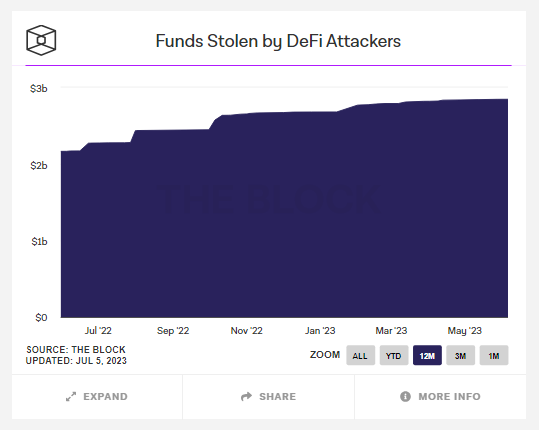
Chart: The Block Crypto Data
The release of ERC 7265 comes at a crucial time, as the DeFi ecosystem has witnessed a surge in hacking incidents. According to The Block’s Data Dashboard, attackers have managed to steal a staggering $3 billion from DeFi protocols thus far.
This alarming trend underscores the urgent need for robust security measures in the DeFi space, making the proposed ERC 7265 standard a timely and significant development in the pursuit of safeguarding users’ assets and fostering trust in decentralized finance.
Poly Network Attacker Gains $10 Million Profit
On July 2, Poly Network fell victim to a devastating hack, resulting in the attacker making off with an astonishing $10 million in ill-gotten gains. The breach exposed vulnerabilities within the platform, allowing the hacker to exploit weaknesses and collect substantial profits from the attack.
MistTrack Alert Update
We have discovered two new stolen transactions of over 3 million USDC and over 2.6 million USDT.
The attacker swapped $USDC to 1,557.36 $ETH and stayed at the address (0x2f6c…7b82), and swapped $USDT to 1,371.64 $ETH and stayed at the address… https://t.co/KdzTe2uhl1 pic.twitter.com/D1HW8Zh7D4
— MistTrack
(@MistTrack_io) July 3, 2023
As the situation unfolds, crypto security firm SlowMist has taken charge of monitoring the hacker’s movements closely. They are actively tracking the funds and providing updates through their tweet thread, shedding light on the ongoing developments in an effort to protect users and the wider cryptocurrency community.
ETHUSD trading at $1,935 on the daily chart: TradingView.com
Unfortunately, this is not the first time Poly Network has faced such a severe security breach. In August 2021, the platform endured a previous attack that resulted in hackers absconding with a staggering $600 million worth of various cryptocurrencies.
Featured image from Dollero Technology
Latest Crypto News: Ordinals Help Increase Transaction Volume On LTC, DOGE Networks, Crypto Hacks Fall In Q1 Outlook India
Source link ]]>
Bitcoin Price In 2035: Coinbase Exec Hacks ChatGPT For Prediction – Coinbase Glb (NASDAQ:COIN) Benzinga
Source link ]]>
✓ Share: