Bitcoin has returned to an extreme technical zone that has historically marked major cycle bottoms for the BTC price. According to crypto analyst @DurdenBTC, the Harmonic Oscillator has now printed its lowest possible reading, a level that previously preceded outsized one-year gains. The signal raises a direct question: Does history imply that Bitcoin is positioned to double from here?
Bitcoin Harmonic Oscillator Signals BTC Price Could More Than Double
A chart shared by the analyst highlights a striking signal for Bitcoin, showing the Harmonic Oscillator at -100, the lowest point on its long-term decaying price range, which spans from -100 to +100. This “Capitulation” zone marks periods when BTC trades far below its harmonic center and historical equilibrium, signaling extreme market pessimism.
Related Reading
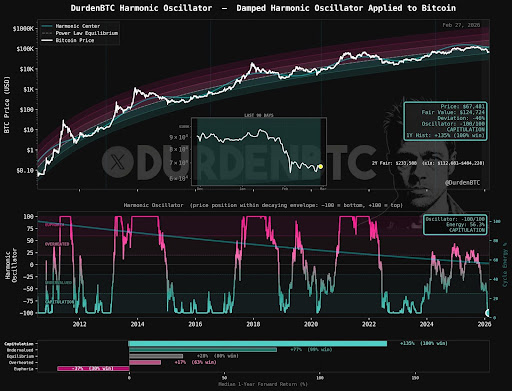
Historically, every time the oscillator has hit this level—late 2011, early 2015, late 2018, March 2020, and late 2022—Bitcoin reached major cycle lows before entering strong upward trends. The chart quantifies this pattern, showing a median one-year return of +135% from the capitulation zone, with a 100% success rate across all recorded signals.
For traders, this suggests that the BTC price could more than double over the next year if history repeats itself. The chart also contrasts other zones in the oscillator, illustrating the model’s cyclical reliability: the “Undervalued” zone historically produced +77% median returns, “Equilibrium” and “Overheated” zones delivered smaller gains, and the “Euphoria” band at the top often led to negative returns.
In essence, the chart emphasizes that Bitcoin’s current capitulation reading may mark a rare opportunity for a major rally. By connecting extreme market lows with historically consistent gains, the oscillator provides traders a clear framework for anticipating BTC’s next potential cycle.
Bearish Trend Model Meets A Generational Buy Signal
Although the oscillator has a strong historical record, @DurdenBTC notes that his broader trend system currently leans bearish. This creates a tension between momentum-based trend signals and the oscillator, which indicates extreme undervaluation. The oscillator works on a damped harmonic model, where price moves around a rising long-term center line while volatility gradually compresses.
Related Reading
The chart shows Bitcoin trading below its harmonic center and fair value, with a negative deviation reinforcing the capitulation signal. A 90-day inset highlights a sharp drop to this lower boundary. Meanwhile, the two-year fair value estimate remains well above the current price, showing a significant gap between current levels and the modeled equilibrium.
The oscillator also shows that cycle energy has reset to lower levels, similar to previous macro bottoms. Historically, these resets marked the shift from decline into accumulation phases.
This does not mean price will immediately reverse, but statistically, readings like this have marked generational buying opportunities. While the analyst maintains a cautious stance aligned with the bearish trend, the -100 oscillator reading represents one of the most asymmetric setups in Bitcoin’s cycle history.
Featured image created with Dall.E, chart from Tradingview.com
Top Harmonic Pattern Points to a Shiba Inu price Surge BanklessTimes
Source link ]]>
This week’s guest on the Cardano SPO Column is a stake pool operated by Michele who is working on a project called “plu-ts”, which will allow developers to build dApps using Typescript: Harmonic [ARMN].
Last week’s guest was a stake pool operated by Brian and Joe from the US who are involved in building software tools, including Pool Peek Mobile and GetPayda.
This initiative is a point of reference for everything Cardano and every week or two we will invite a Stake Pool Operator (SPO) to answer some questions and give us an update directly from within the Cardano community.
Considering that many of our readers are new to the crypto space, we will have a mix of simple and technical questions.
Cardano SPO Column, interview with Harmonic [ARMN]
![Cardano SPO [ARMN]](https://en.cryptonomist.ch/wp-content/uploads/2022/09/IMG_InternaSPO_077-1.jpg.webp)
Hi, awesome to have you here. Tell us something about yourself, where are you based and what is your background?
Hi, I’m happy to be here too!
I’m Michele, I’m 21 and I’m a very curious person.
I used to be a computer science student at the Politecnico di Milano.
I said “used to” because I chose to drop out so as not to limit my curiosity, preferring a more practical approach; to many it sounds like bad news, to me it is an unique opportunity!
What’s the path that led you to Cardano and to become a Stake Pool Operator (SPO)?
I started with Bitcoin, but not like everyone did. I discovered Bitcoin through an introductory book on cryptography.
Given my curious nature, I had to know more and so I started playing around with some cryptocurrencies.
When Cardano‘s turn came, the spark was struck. At the time I didn’t know about the extensive research being made in order to build such a protocol, but I could sense the complexity behind the ease of use of it.
That is the main reason that pushed me to set up a stake pool, to learn more about that complexity.
In all this process I had the occasion to learn the value of decentralization, and that is why the stake pool is still operative to date.
What are your thoughts about the programming language chosen for Cardano, Haskell? What are the pros and cons? Tell us about your solution that addresses the drawbacks.
Haskell is an awesome language, it does have its learning curve but I can guarantee you that it is totally worth it; once you understand the syntax, writing a Haskell program is almost like writing plain English.
In my opinion, Haskell is a great choice to build a decentralized protocol thanks to the features of the language, which makes it very difficult to mess up something, but a slightly worse choice if you need to write smart contracts with it, due to the previously mentioned learning curve.
That is why I’m coming out with an alternative.
Currently, I’m working on an open source project called “plu-ts”, taking inspiration from the name of the original smart contract programming language “Plutus”.
Plu-ts is not yet ready but is getting closer to a first release day by day.
Once a first version is released developers will be able to build entire decentralized applications using only Typescript, without sacrificing the security that Haskell can guarantee.
On top of that, Typescript automatically translates to Javascript, which is the language running behind almost every website and sometimes mobile apps.
This not only implies that all the developers currently focused on these types of products will be able to write smart contracts on Cardano, but also means that smart contracts could be generated client-side; allowing a dApp to build customized smart contracts for the user, without any centralized server.
For the curious ones, the source code of plu-ts is present on my Github.
The Vasil hard fork is upon us. How will it improve the Cardano blockchain and what projects are you most looking forward to that are waiting for this important upgrade?
Vasil brings massive scalability, in line with the goals of the Basho era that we can find in the roadmap of Cardano.
Among the features introduced, notably reference inputs and reference scripts are the ones that will make the difference in terms of throughput and developer experience.
Reference inputs will allow accessing data attached to some UTxO as read-only. This implies multiple transactions can access the same data in parallel, whereas until now one could have accessed that data only by spending the relative UTxO, and in this process nobody else had the right to read the data.
Until Vasil, in order to interact with a smart contract, the source code of the smart contract had to be included in the transaction itself; with referenced scripts this changes. As the name implies, now a transaction can reference a script already present on the blockchain, resulting in transactions of similar size to a plain transfer of ADA.
I’ve no particular project I’m waiting for; I believe the best ones are not even in our imagination yet, we are just getting started after all.
Thank you kindly for your time. Any closing remarks? Where can people follow you?
My pleasure.
If anyone wants to stay updated on what I’m doing I’m mostly active on Twitter.
I do also have a YouTube channel and even if I’ve not been very active lately.
I plan to upload tutorials on how to write smart contracts and dApps in general using plu-ts once it’s ready; Here’s the Youtube channel.
Disclaimer: The opinions and views of the SPOs are their own and do not necessarily reflect those of the Cardano Foundation or IOG.